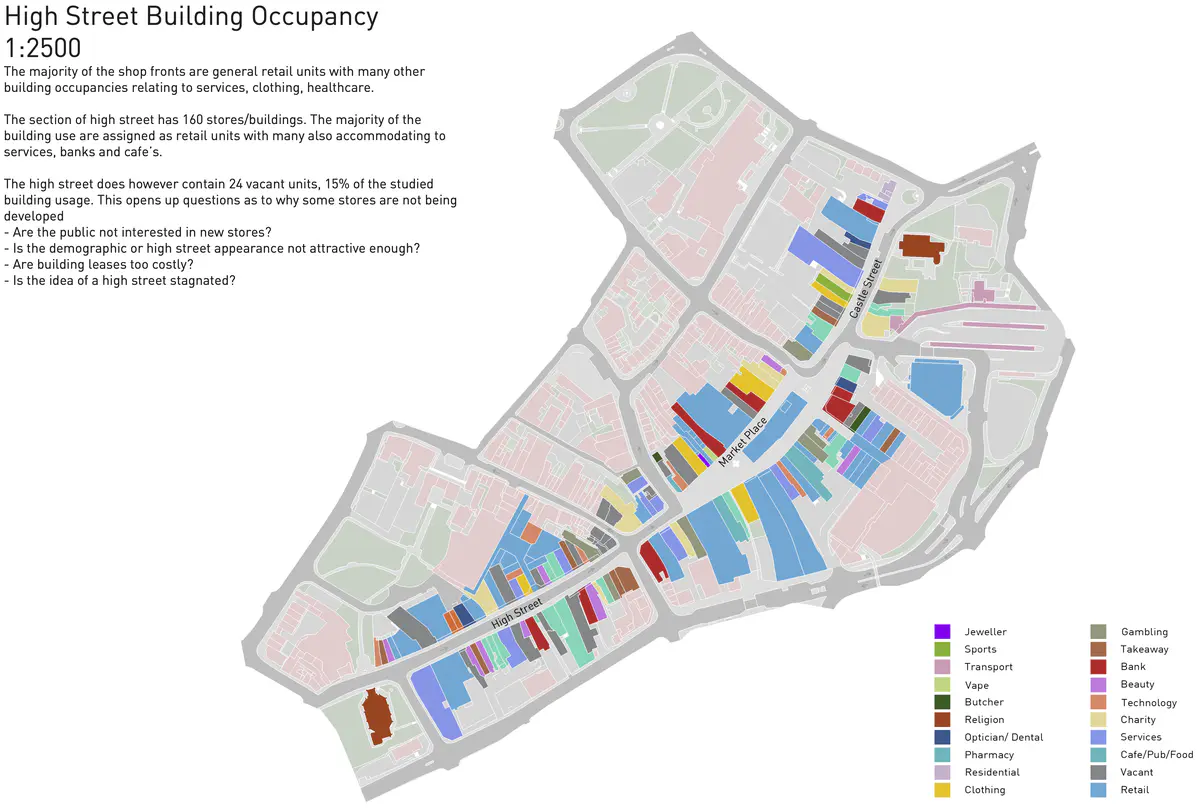
High Street Building Occupancy
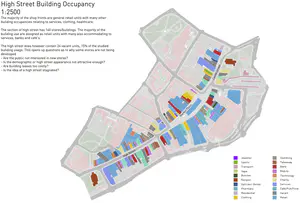
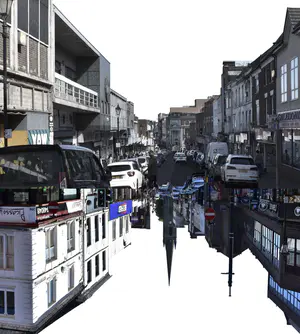
The majority of the shop fronts are general retail units with many other building occupancies relating to services, clothing, healthcare.
The section of high street has 160 stores/buildings. The majority of the building use are assigned as retail units with many also accommodating to services, banks and cafe’s.
The high street does however contain 24 vacant units, 15% of the studied building usage.
We feel that our local High Streets should be the focal point for our local community. They should be seen as places of interest and a place where you can go for both essential items and leisure. Therefore, we feel making the High Street pedestrianised would mean that there is a larger space to work with on the High Street and that it will not only allow locals to shop but also congregate and relax with family and friends.
"The new market in Dudley market place in 1983 had a little more aisle space between the stalls, making shopping easier for customers. The market had just reopened after three months spent in Stone Street while it was refurbished. Traditionalists had bitterly attacked the replacing of wooden stalls with metal and the removal of the old-fashioned cobbles. This was taken on May 15, 1983."
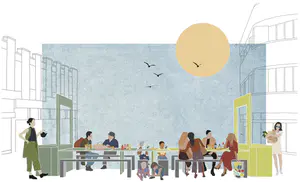
It is 5pm in the evening and the shops are still full with customers. David has had a long and busy working day at the shop and can now finally take a break, and so he ventured out onto the street to get fresh air. David randomly bumped into an old customer, they both instantly recognised each other, and decided to share some conversations on a nearby bench. The old customer could not stop pointing out many of positive changes on the High Street since he last visited. He noticed the fresh air from more vegetation and less pollution, outdoor seating and a thriving enjoyable space.
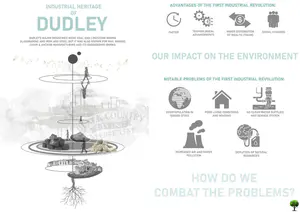
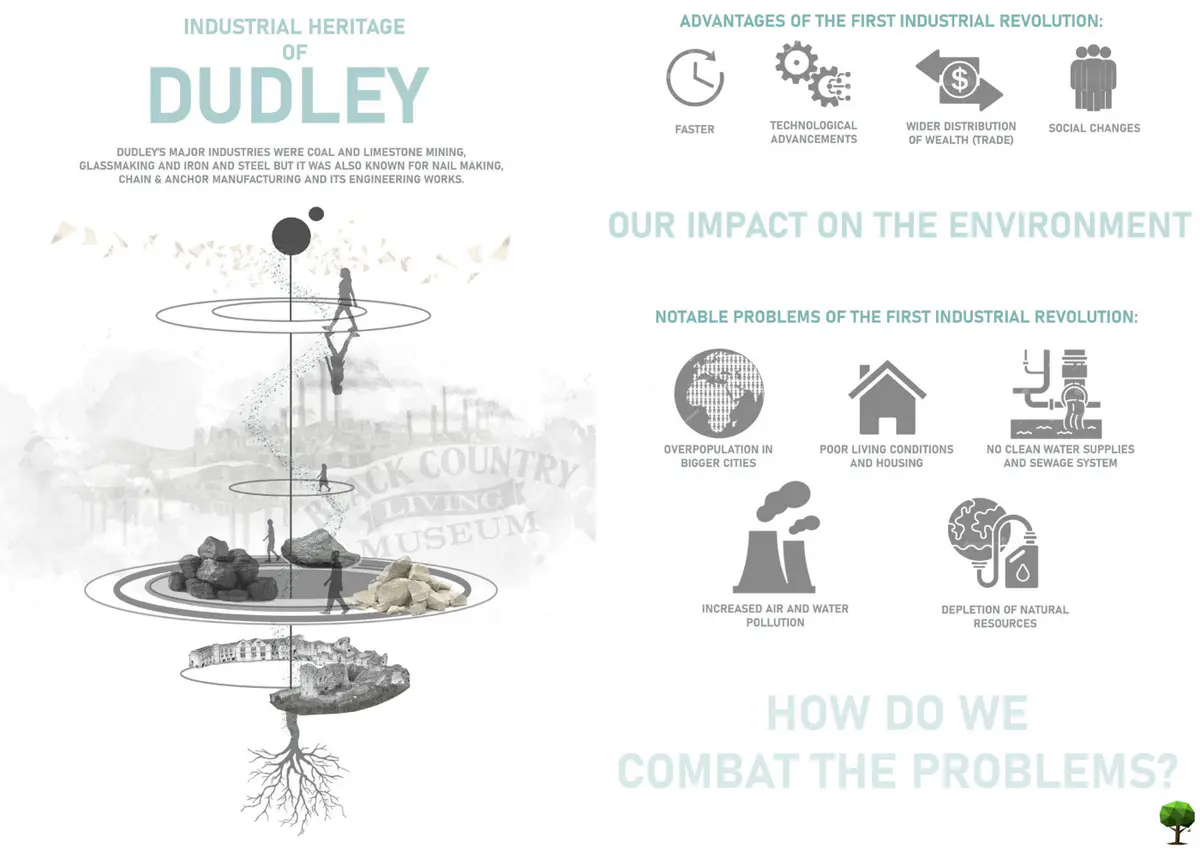
Dudley was pretty much at the centre of the Industrial Revolution. It had many advantages like making things faster, leading to technological advancements, a wider distribution of wealth and the social changes that came with this. However, it also had its own set of problems that are still relevant today which we need to acknowledge and address to successfully move forward, mainly: overpopulation, housing, water, air pollution and depletion of natural resources.
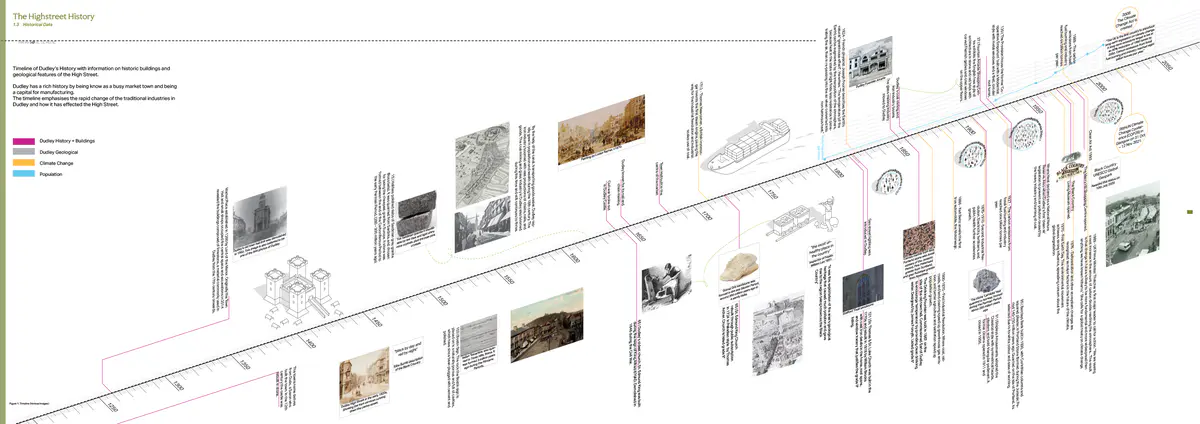
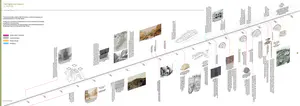
Timeline of Dudley’s History with information on historic buildings and geological features of the High Street.
Dudley has a rich history by being know as a busy market town and being a capital for manufacturing.
The timeline emphasises the rapid change of the traditional industries in Dudley and how it has effected the High Street.
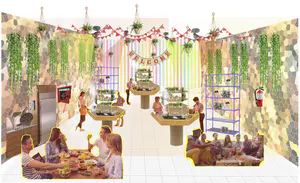
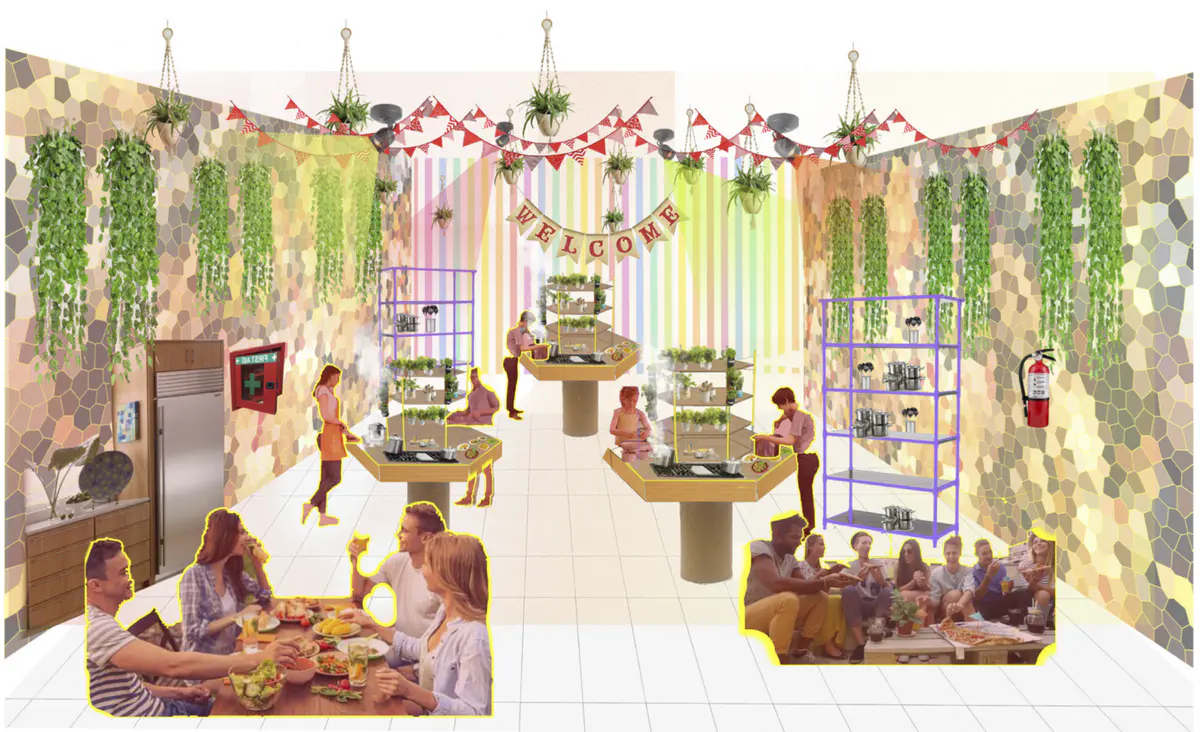
The interior of the community kitchen would be inviting and colourful to create a positive atmosphere. The colours were abstracted from one of our group collages of food. The kitchen counters are not considered as a back of house element; they have been combined with seating as we are trying to embrace the cooking process. The kitchen desk is designed in a way so multiple people can work together from all sides, with central storage for herbs.
The facade of the kitchen contains a small window so food can be sold outside. We have also created a vertical herb garden so it can be used in the community kitchen. We wanted to keep these below eye-line so people outdoors have a clear view into what’s going on inside.
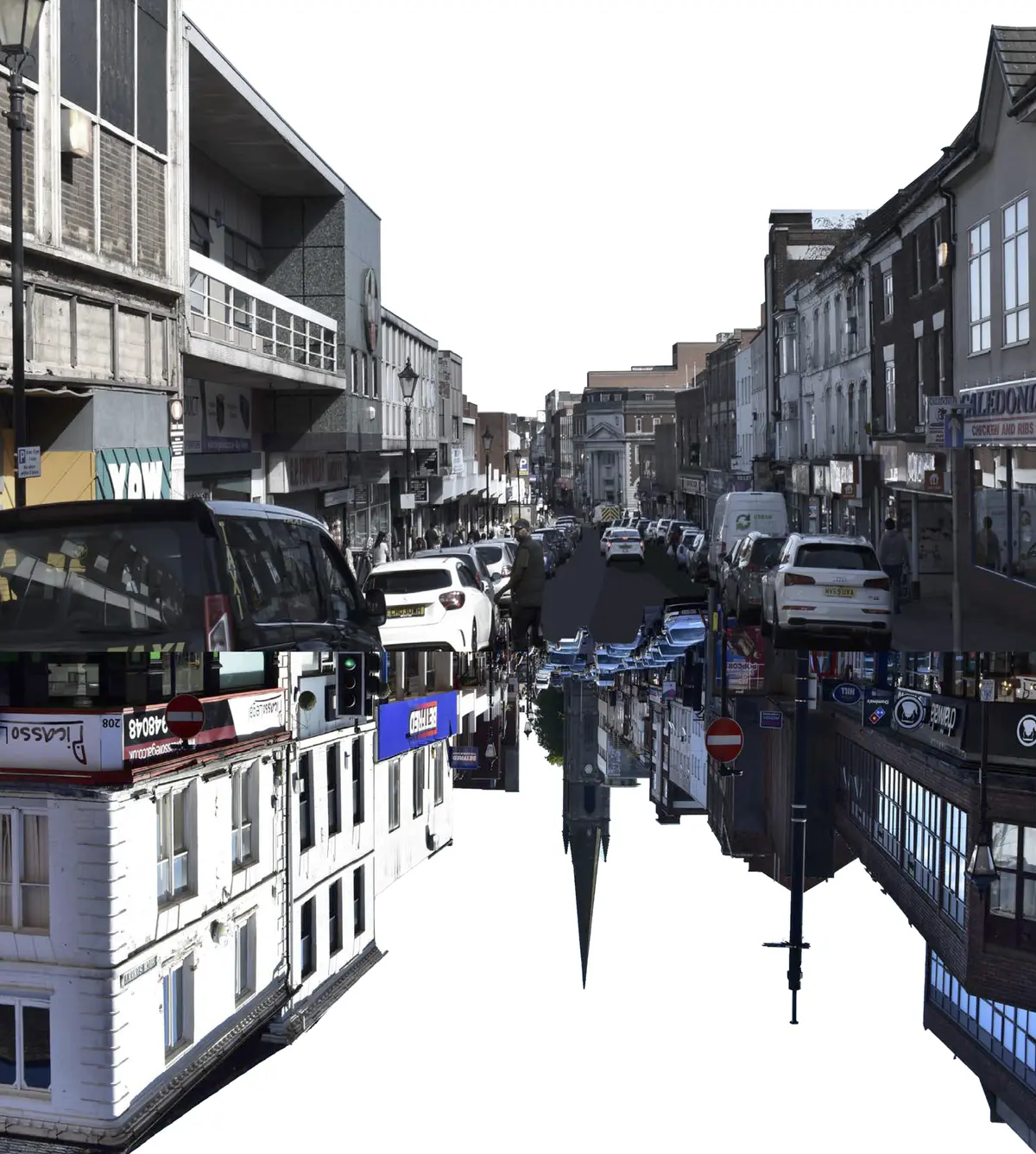
This street section shows activity from the back of the community kitchen to the other end of the street and how all these elements are working coherently. The street is filled more with people rather than cars. We believe that the outdoor seating, more trees, canopies and street lights can attract people to connect with the High Street.
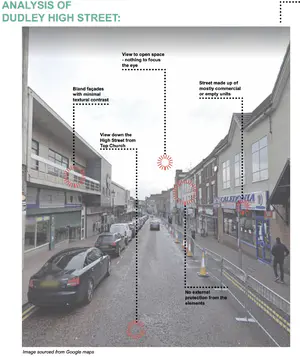
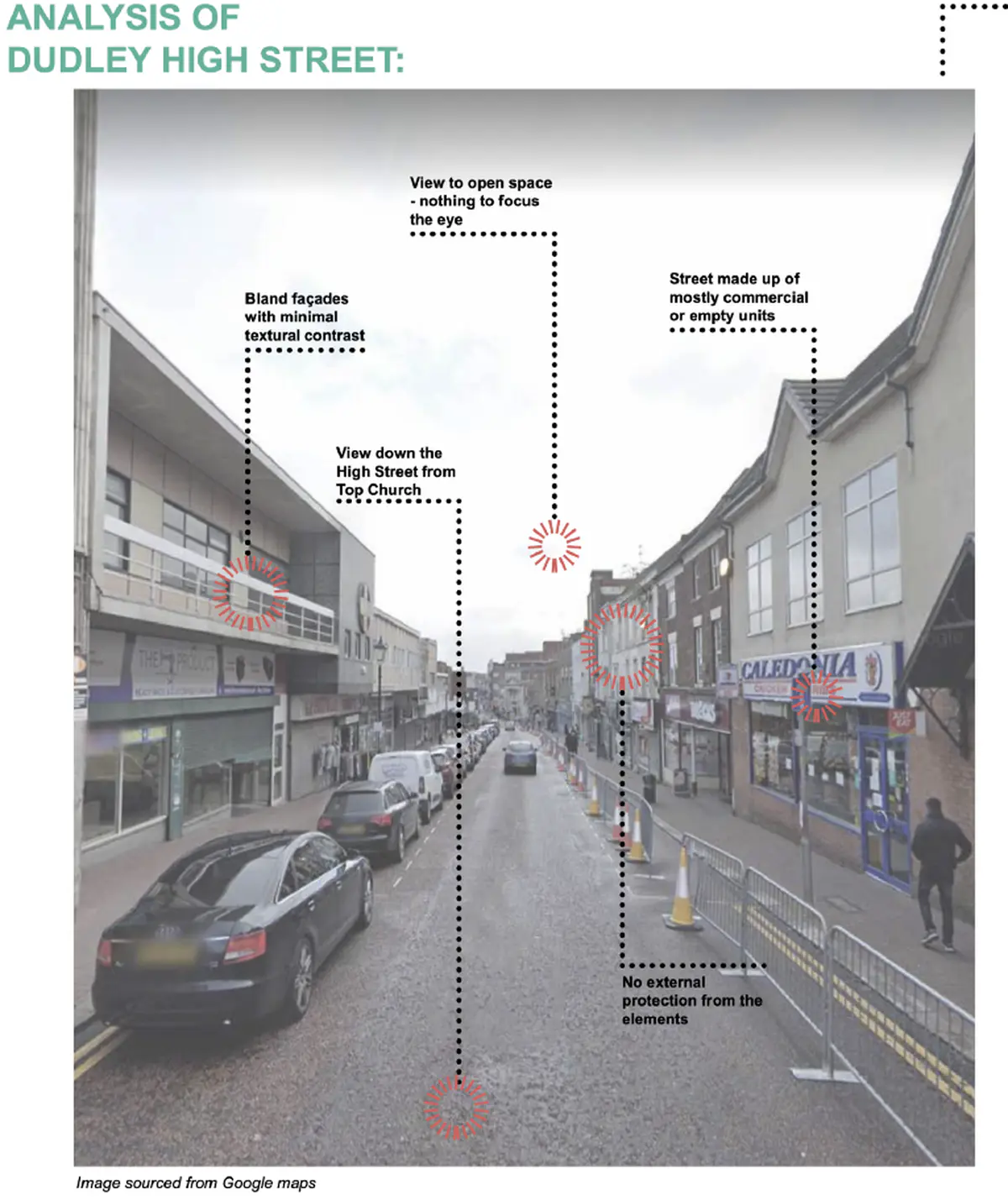
Seen as the heart of the town, Dudley High Street stretch- es from the Dudley ASDA, all the way up to the St. Edmund King & Martyr Church. Although, the street has seen better days.
Along the High Street itself, there are 28 abandoned shop fronts, accounting for 1/5 shops being neglected. It is also home to a few of Dudley’s landmarks:
The Drinking Fountain, a Grade II listed fountain, which had a portion of a £4.6 million funding from the HLF European 2015 funding go towards to its restoration (Richards, 2017).
The Market Place is a fixed centre of trading and selling at the heart of the market square. It too benefited from the funding, allowing for permanent fixings.
The Top Church, St. Thomas and St. Luke, overlooking the entire street, and most of the surrounding town itself.
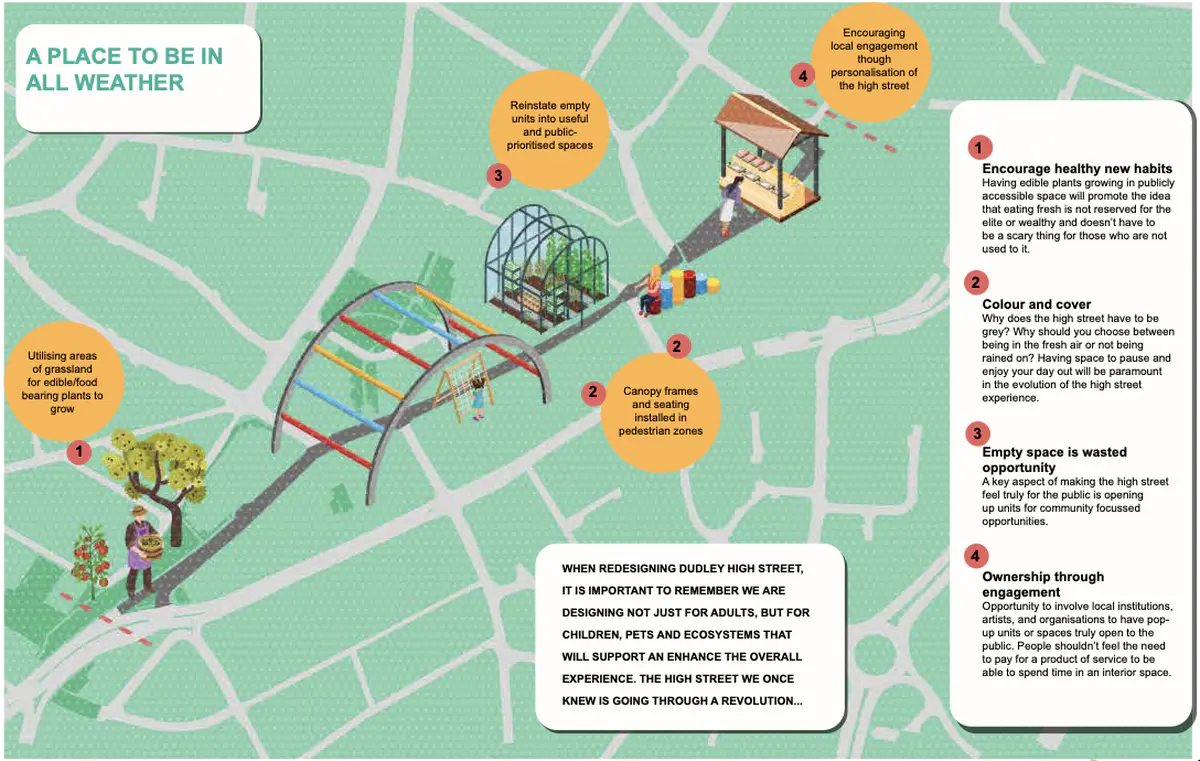
Stepping Stone 4 adds layers to the High Street. Like the other visions, we wanted to use CoLab Dudley’s principles ‘use nature as a guidebook’ and ‘create conditions for curiosity and experimentation’. The main way we proposed to do this was adding a green canopy to provide shelter, create a hybrid indoor outdoor space welcoming to families and a more communal open space, and support ecosystems.
Bianca and her friends went clothes shopping. As they could smell the delicious food making in the community kitchen, they curiously went inside for the first time. Bianca and her friends were offered freshly made, delicious soup.
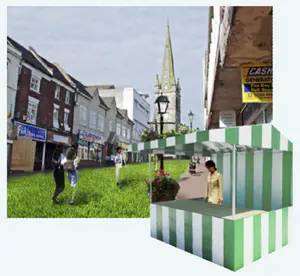
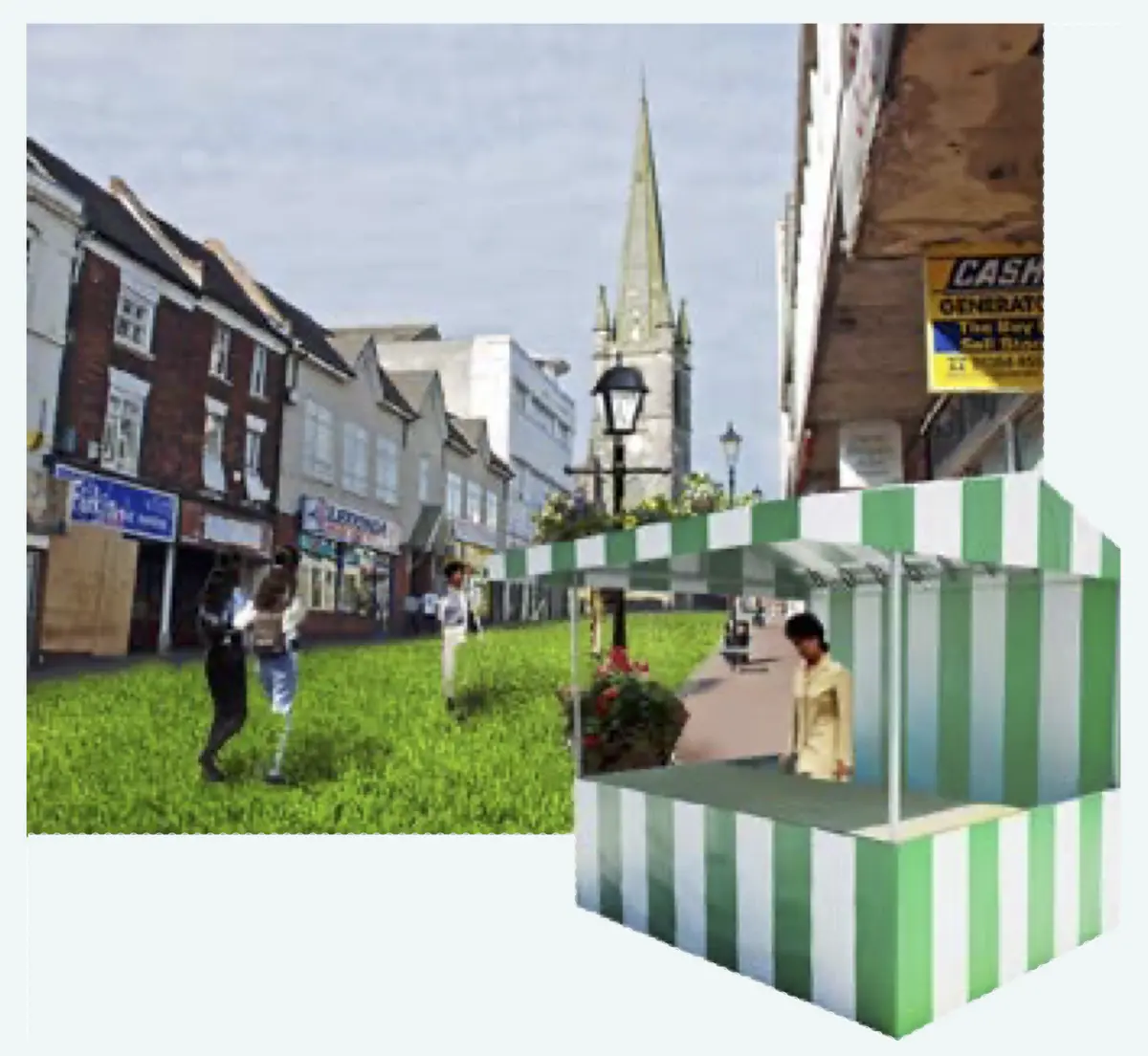
The first Stepping Stone project looks into designing multifunctional furniture for Dudley High Street to provide opportunities for a regenerative community, focusing on how the high street can be occupied with resilience. Initially, the stalls act as market stalls to provide opportunities for enterprises and small businesses to begin thriving and encouraging the High Street to become a place of inclusivity.
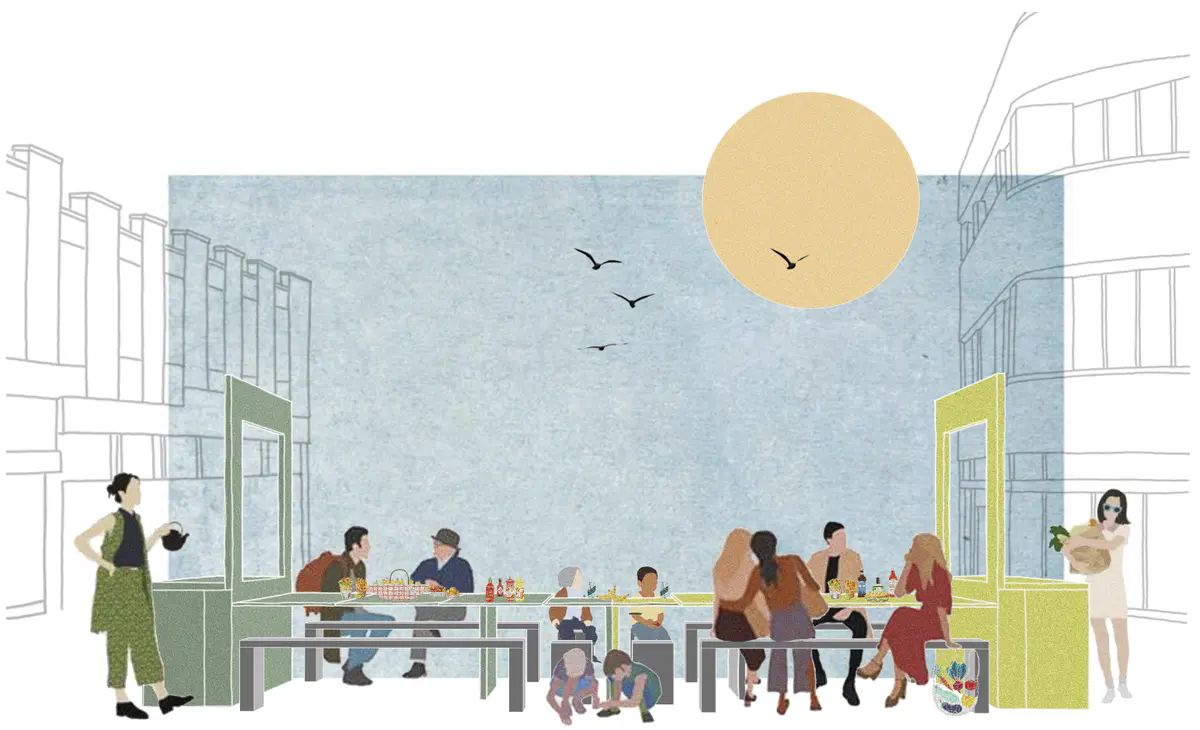
However, the stalls can extend out into outdoor seating arrangements, which can become an extension of the community kitchen and during events can become a part of the whole atmosphere.
By extending the furniture, they can connect together and become a large spread where people can sit together and enjoy company. It creates a lowered centre space so children can sit together, or paint on the surfaces. We decided to focus on furniture because we felt the importance of it can go unrecognised. We felt through the design of this market stall, many memories can be created and attached to these items, and become valuable assets within the community.