Dudley Time Portal

Items tagged: Map
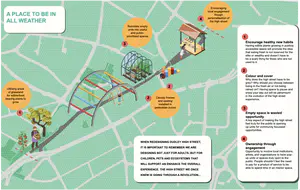
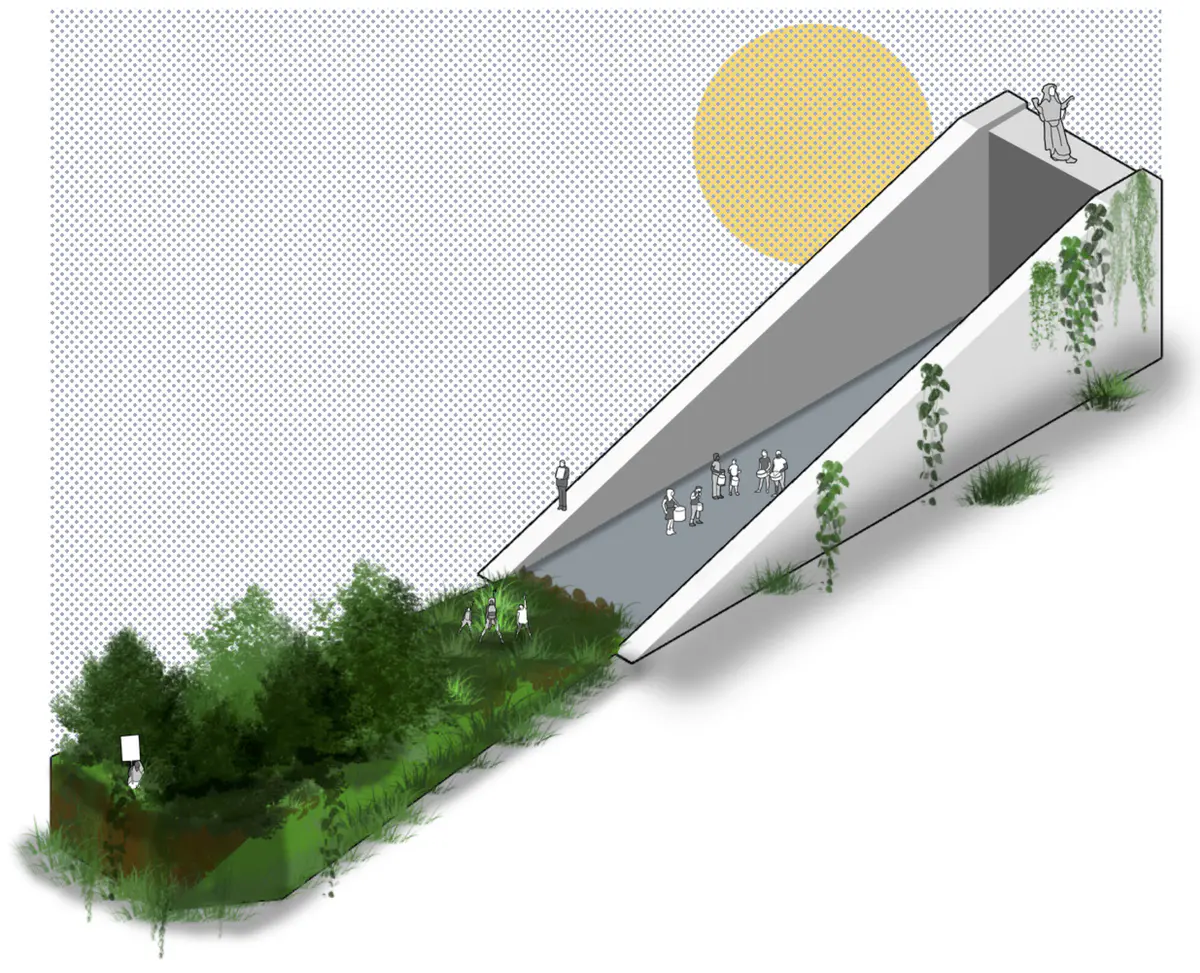
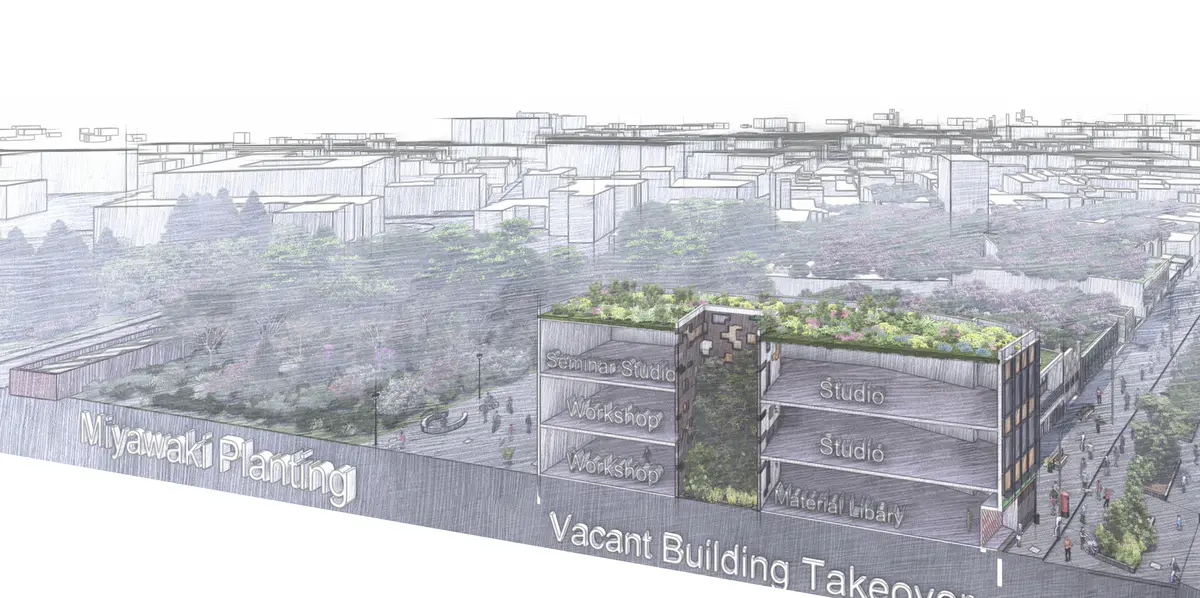
The whole High Street would be dug out to make way for this new kind of “street”. The idea, as stated, is to alter the way that people use this street, so that they can learn about the legacy of Dudley. This would mean that there would be a canopy that sits on top of the cut, that would also act as a means to shelter everything underneath, but would also be made in Dudley to promote local craftsmans. This canopy can then hold something like Theatre Curtains with the history of Dudley presented on them. As you walk through the cut, you go through all the different parts of Dudley’s Legacy - Saxon, Middle Ages, Industrial Revolution, Modern, and you would end the walk on the “Future”. You would start at one end, up by the top church, and as you walk through towards the market place, you would walk through the eras in chronological order. Then, once you exit the tunnel, you would leave the Modern era, and come out into the reclaimed green space, which would represent the future of Dudley’s Legacy. This would be a Miyawaki Forest that would be expanded out through the streets, taking over the spots where cars used to drive, to now benefit Dudley, it’s people, and the world as a whole.

Dudley’s High Street is about 240 metres long, about 9 metres wide, and rises about 8 metres. This would provided a very prominent feature for the High Street if it was dug out and recommissioned.

An added aspect to the dug out street would be that of the canopy that would reside above it. While thinking of the design, two ideas stood out - one that would stand raised, at about the same level as the end of the street, which would create this arcade styled archway that would reside high above the street. The second was having the canopy be flush with the pavement all the way up, except at the end that would then provide a small increase around the steps.

Both ideas serve the same purpose, but provide drastically different means of doing so. - Oscar Law Parti Diagram.png
The whole High Street would be dug out to make way for this new kind of “street”. The idea, as stated, is to alter the way that people use this street, so that they can learn about the legacy of Dudley. This would mean that there would be a canopy that sits on top of the cut, that would also act as a means to shelter everything underneath, but would also be made in Dudley to promote local craftsmans. This canopy can then hold something like Theatre Curtains with the history of Dudley presented on them. As you walk through the cut, you go through all the different parts of Dudley’s Legacy - Saxon, Middle Ages, Industrial Revolution, Modern, and you would end the walk on the “Future”. You would start at one end, up by the top church, and as you walk through towards the market place, you would walk through the eras in chronological order. Then, once you exit the tunnel, you would leave the Modern era, and come out into the reclaimed green space, which would represent the future of Dudley’s Legacy. This would be a Miyawaki Forest that would be expanded out through the streets, taking over the spots where cars used to drive, to now benefit Dudley, it’s people, and the world as a whole. Dudley’s High Street is about 240 metres long, about 9 metres wide, and rises about 8 metres. This would provided a very prominent feature for the High Street if it was dug out and recommissioned. An added aspect to the dug out street would be that of the canopy that would reside above it. While thinking of the design, two ideas stood out - one that would stand raised, at about the same level as the end of the street, which would create this arcade styled archway that would reside high above the street. The second was having the canopy be flush with the pavement all the way up, except at the end that would then provide a small increase around the steps. Both ideas serve the same purpose, but provide drastically different means of doing so.
Imagining Map Drawing Collage Change Craft Past Future Potential Imagination Identity Industry Memory Learning Shelter Nature Plantlife Growing Architecture
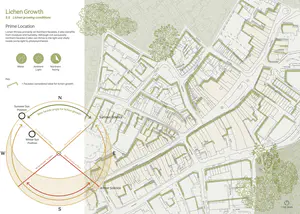
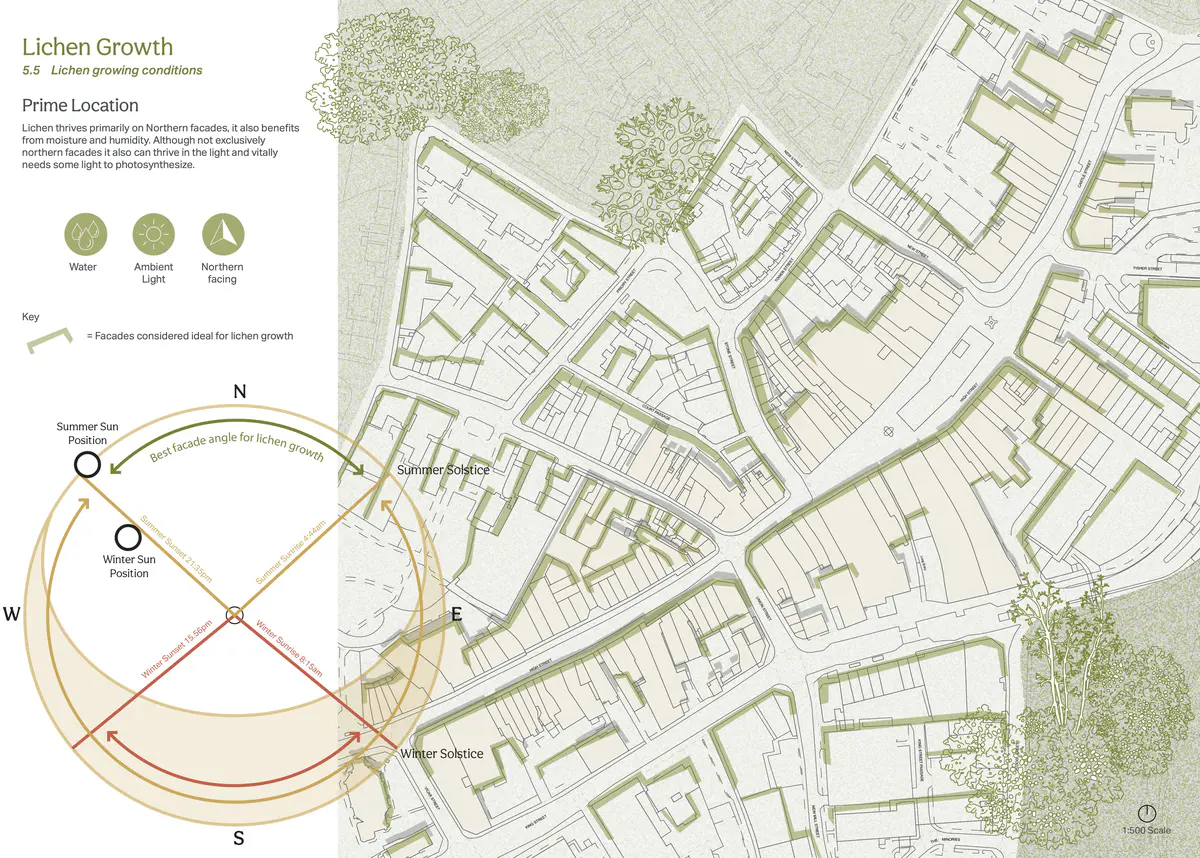
Lichen Growth

Lichen thrives primarily on Northern facades, it also benefits from moisture and humidity. Although not exclusively northern facades it also can thrive in the light and vitally needs some light to photosynthesize. - Michelle Gartside Lichen Growth.png
Lichen Growth Lichen thrives primarily on Northern facades, it also benefits from moisture and humidity. Although not exclusively northern facades it also can thrive in the light and vitally needs some light to photosynthesize.
Map Architecture Nature Plantlife Growing Imagination Life Air Light Water
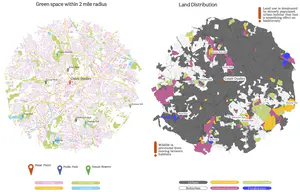
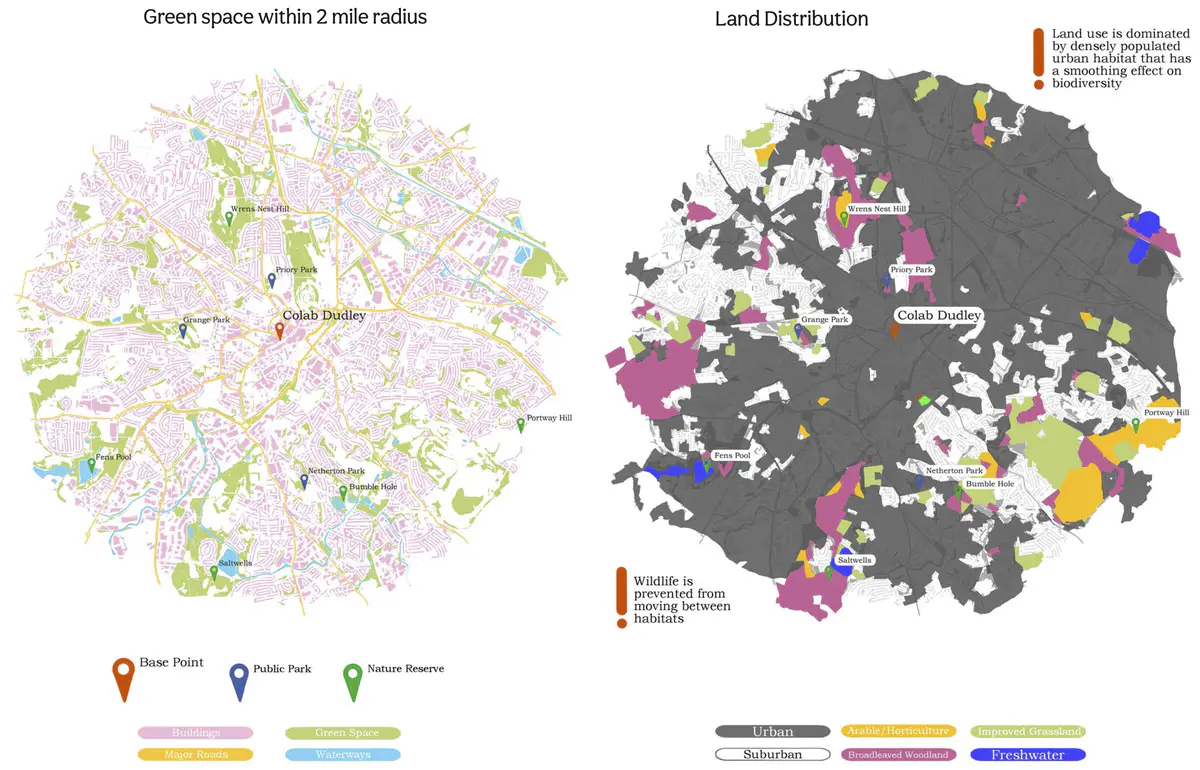
Green space / land distribution - Annabel Linch Land Distribution.png
Green space / land distribution
Map Architecture Boundaries Water Nature Plantlife Growing
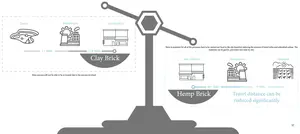
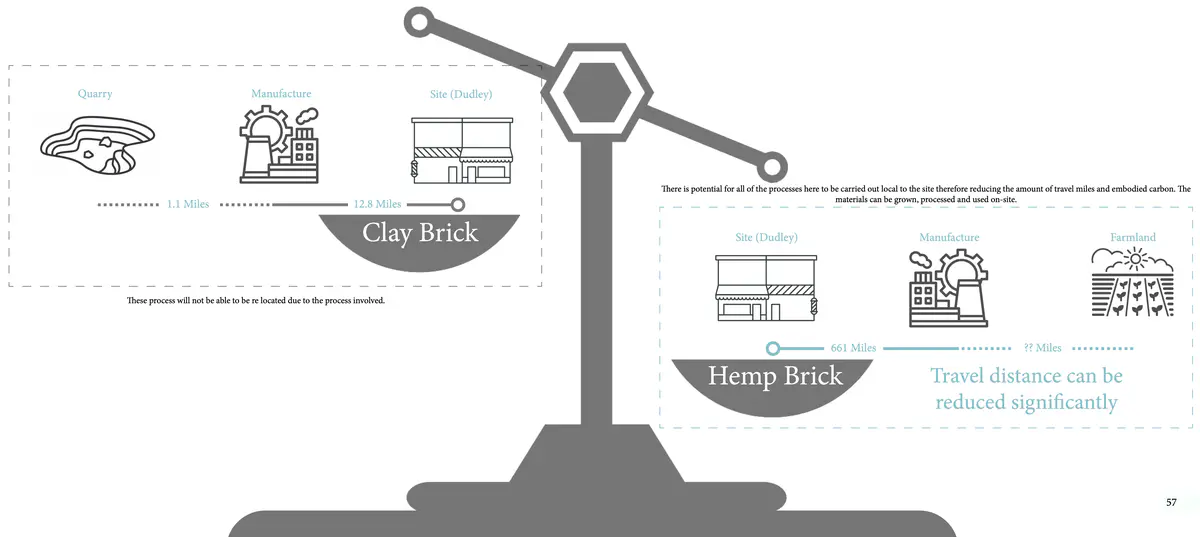
Material Accessibility is The Problem
The accessibility to brick products outweigh that of the hemp equivalent. But why? - Ryan Cooksey Material accessibility 2.png
Material Accessibility is The Problem The accessibility to brick products outweigh that of the hemp equivalent. But why?
Map Diagram Material Transport Climate Change Potential Opportunity System
Water Collection
With this information I can begin to map out 1038m2 of miyawaki forests.
It is crucial that the forests do not use more water than stored as then the project isn’t zero carbon as it would require fresh water. It is important that the water collected is sufficient for this project to work. This data also provides the information to how much storage is required on the site. - Ryan Cooksey Water 1.png
Water Collection With this information I can begin to map out 1038m2 of miyawaki forests. It is crucial that the forests do not use more water than stored as then the project isn’t zero carbon as it would require fresh water. It is important that the water collected is sufficient for this project to work. This data also provides the information to how much storage is required on the site.
Map Diagram Text Count Water High Nature Growing Plantlife Sustainable Regenerative Potential Opportunity Material Waste System
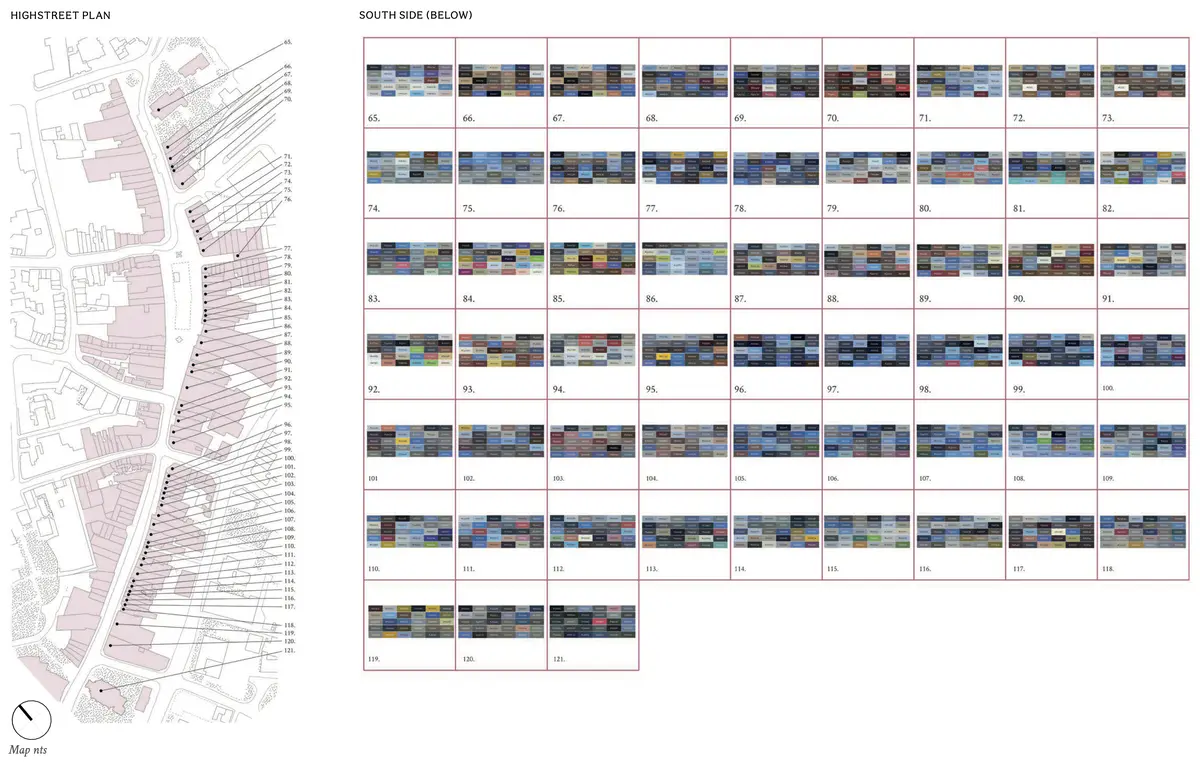
High street facade colour palette - High street facade colour palette south.png
High street facade colour palette
Map Photo Diagram Architecture Colour
'Walking fast & hurriedly' - 230720 Bill.JPG
'Walking fast & hurriedly'
Map 18C Cloudy Slight breeze Speeds Actions
Explore The History Of Site Voids - This will provide an opportunity to reimplement these to allow vertical green corridors to occur.

Explore Vacant Buildings - To avoid damaging an already deteriorating high street, I aim only to take over vacant plots.

Investigate the opportunity for Miyawaki planting - understand the conditions required to grow a sustainable material source on-site, including ground, water, and space conditions.

It takes over a building that leads directly to an open space where a community hub is the centre of the thesis, offering education, community engagement and material celebration. - Ryan Cooksey Material Celebration Hub 1.png
Explore The History Of Site Voids - This will provide an opportunity to reimplement these to allow vertical green corridors to occur. Explore Vacant Buildings - To avoid damaging an already deteriorating high street, I aim only to take over vacant plots. Investigate the opportunity for Miyawaki planting - understand the conditions required to grow a sustainable material source on-site, including ground, water, and space conditions. It takes over a building that leads directly to an open space where a community hub is the centre of the thesis, offering education, community engagement and material celebration.
Collage Diagram Drawing Imagining Map Text Photo Sustainable Regenerative Potential Opportunity Architecture Change Energy Decay Unused Nature Growing Plantlife Water Community Past Archaeology Learning Health Aesthetic Biodiversity Imagination Climate
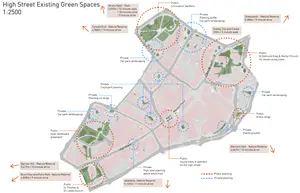
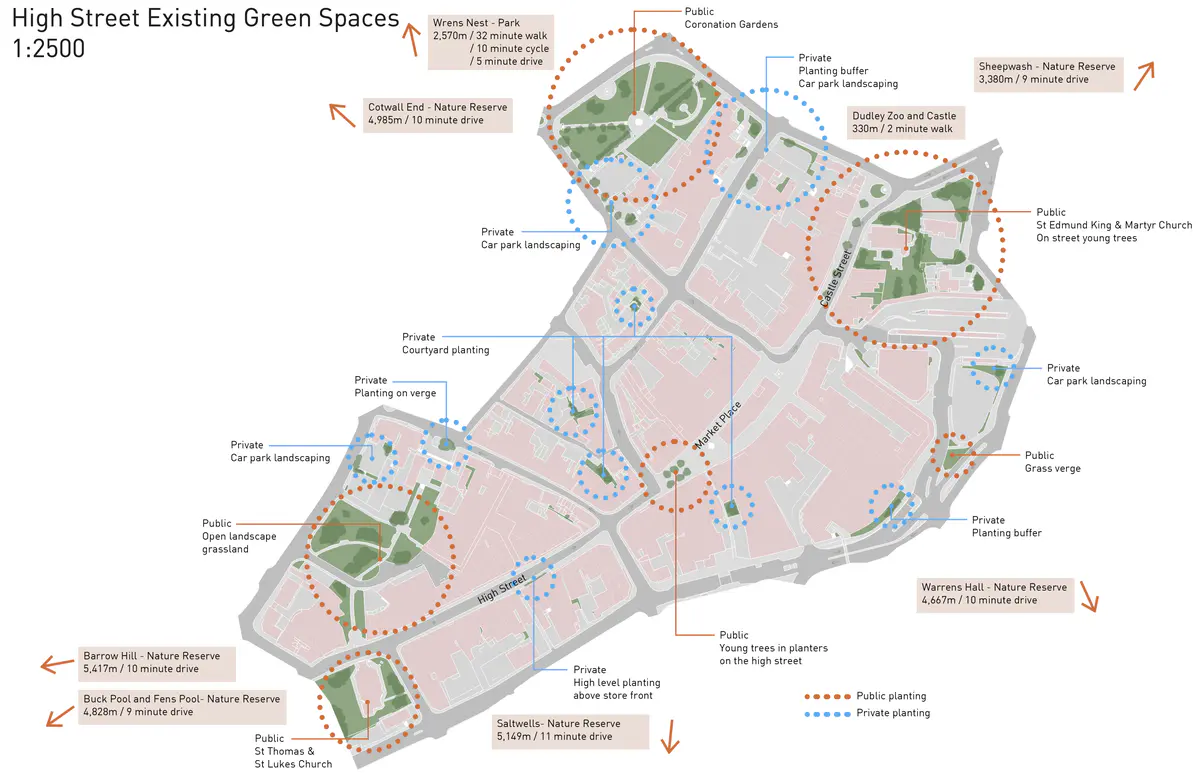
High Street existing green spaces - Matthew Hewitt Existing Green Spaces.png
High Street existing green spaces
Map Diagram Nature Plantlife Growing
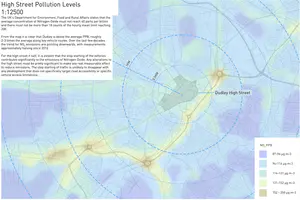
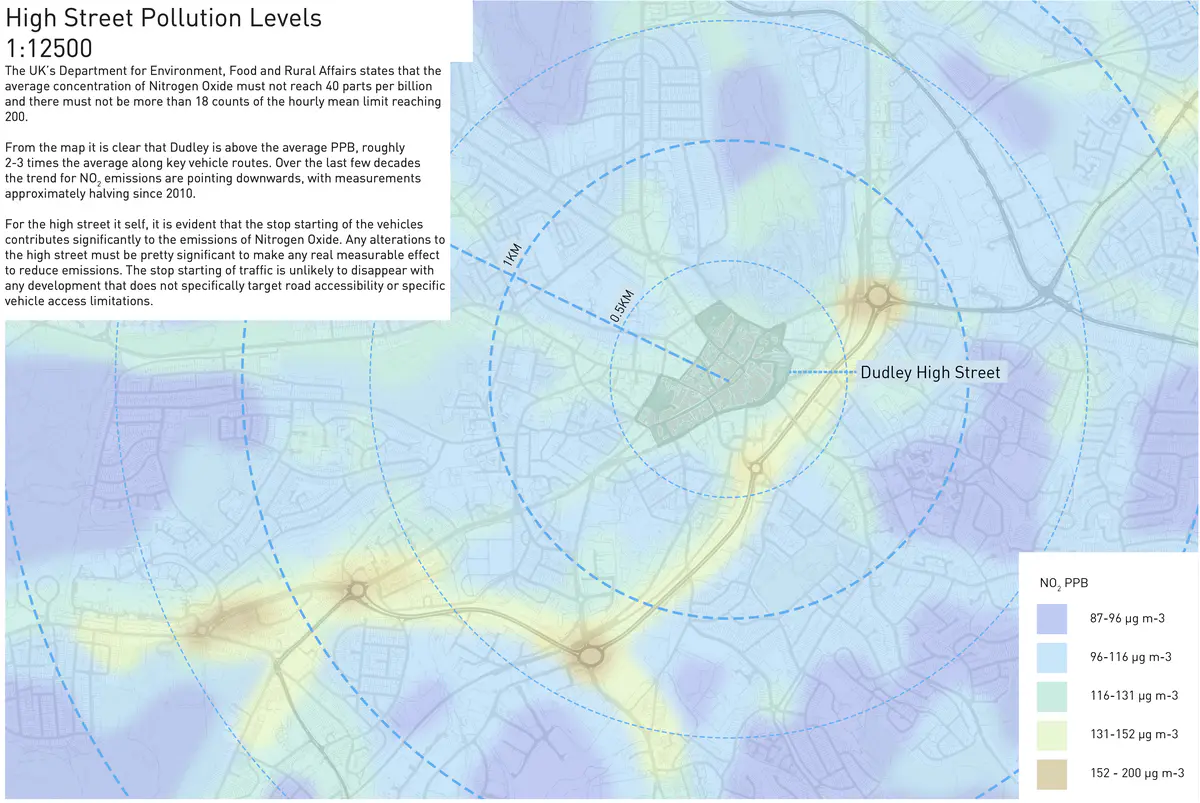
High Street Pollution Levels 

The UK’s Department for Environment, Food and Rural Affairs states that the average concentration of Nitrogen Oxide must not reach 40 parts per billion and there must not be more than 18 counts of the hourly mean limit reaching 200.

From the map it is clear that Dudley is above the average PPB, roughly 2-3 times the average along key vehicle routes. Over the last few decades the trend for NO2 emissions are pointing downwards, with measurements approximately halving since 2010.

For the high street it self, it is evident that the stop starting of the vehicles contributes significantly to the emissions of Nitrogen Oxide. Any alterations to the high street must be pretty significant to make any real measurable effect to reduce emissions. The stop starting of traffic is unlikely to disappear with any development that does not specifically target road accessibility or specific vehicle access limitations. - Matthew Hewitt Pollution Levels.png
High Street Pollution Levels The UK’s Department for Environment, Food and Rural Affairs states that the average concentration of Nitrogen Oxide must not reach 40 parts per billion and there must not be more than 18 counts of the hourly mean limit reaching 200. From the map it is clear that Dudley is above the average PPB, roughly 2-3 times the average along key vehicle routes. Over the last few decades the trend for NO2 emissions are pointing downwards, with measurements approximately halving since 2010. For the high street it self, it is evident that the stop starting of the vehicles contributes significantly to the emissions of Nitrogen Oxide. Any alterations to the high street must be pretty significant to make any real measurable effect to reduce emissions. The stop starting of traffic is unlikely to disappear with any development that does not specifically target road accessibility or specific vehicle access limitations.
Map Diagram Pollution Traffic Vehicle
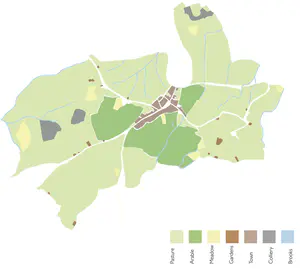
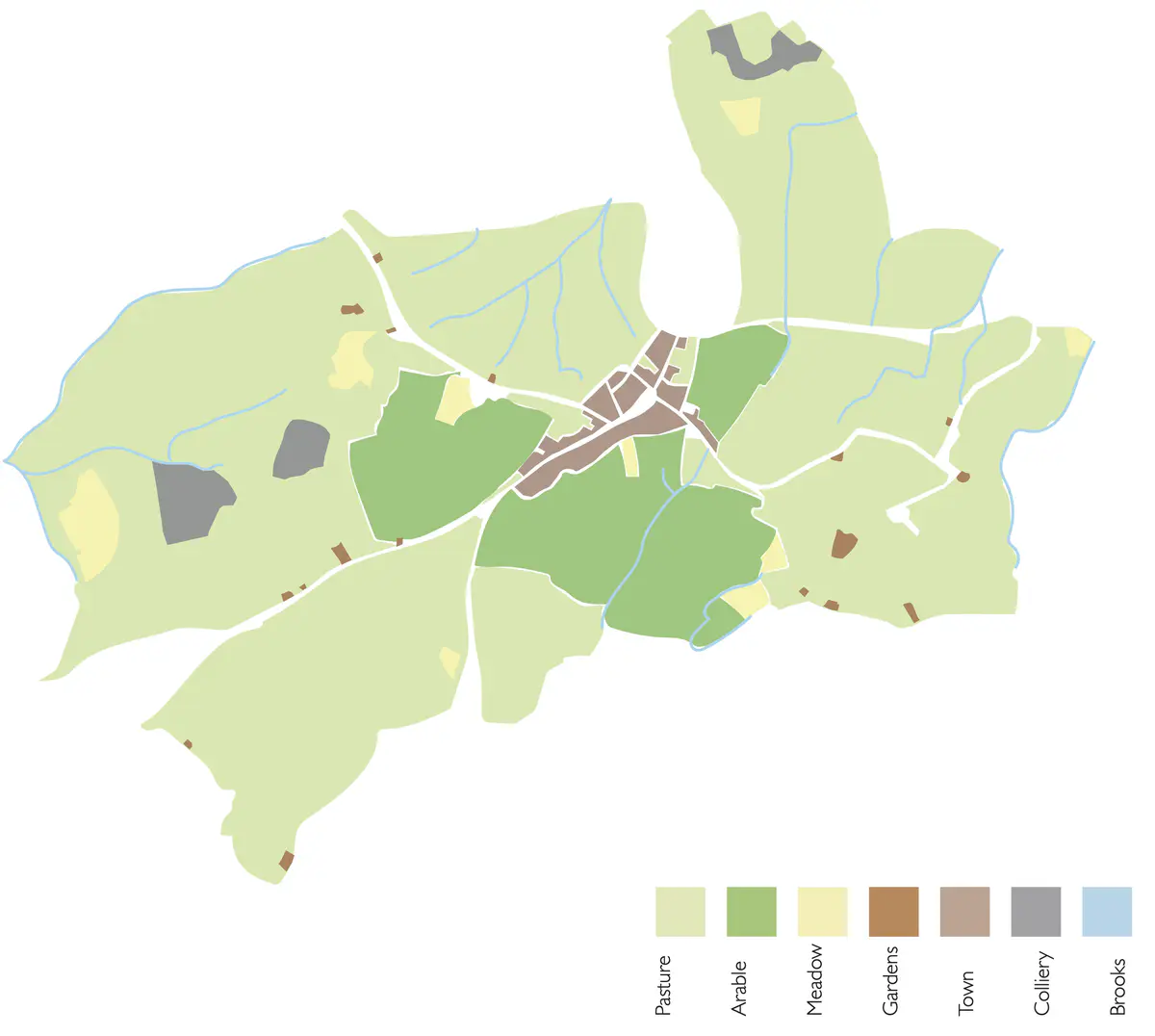
Township of Dudley 1750 - Sita Patel Township 1.png
Township of Dudley 1750
Map Past Growing
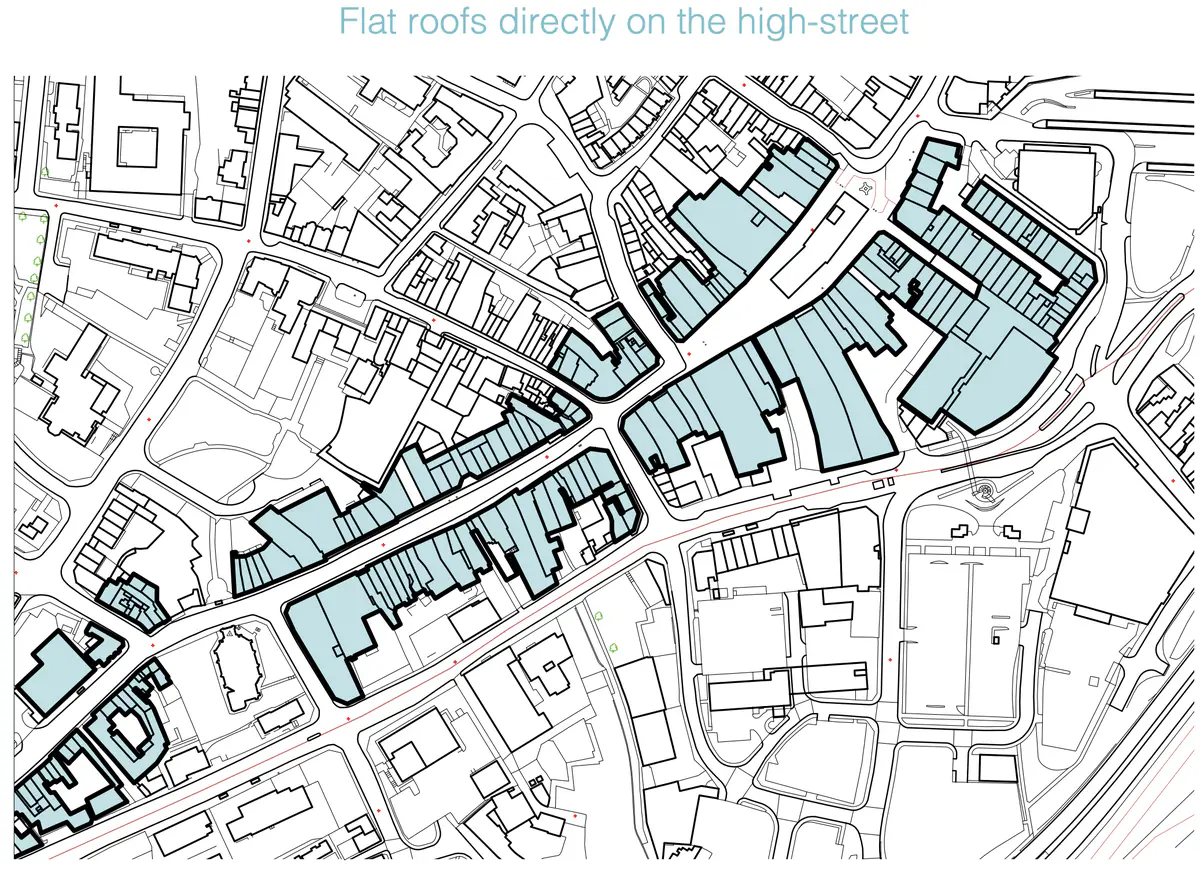
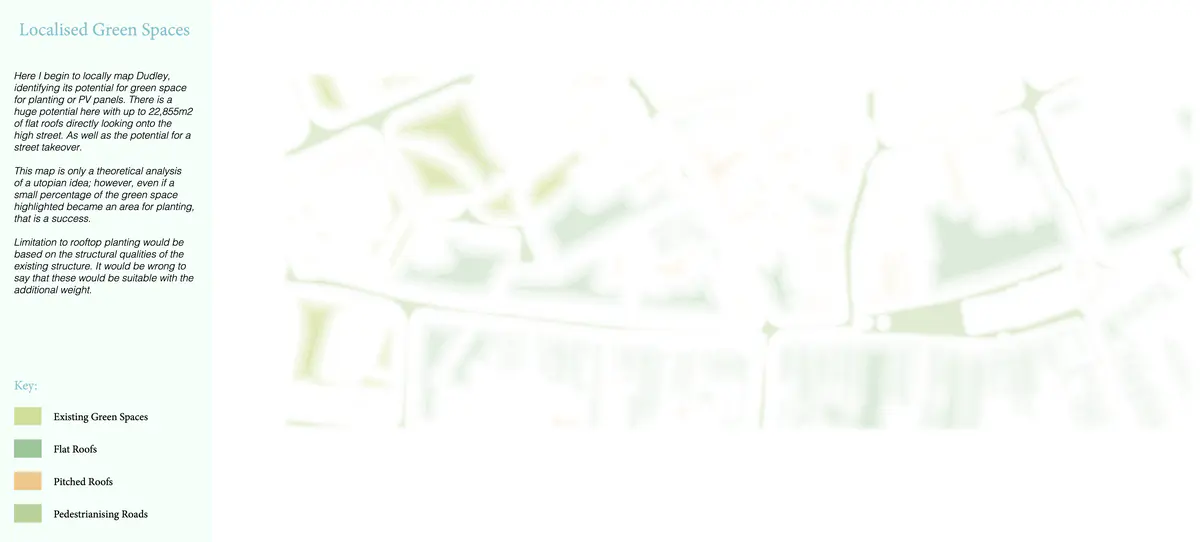
Localised Green Spaces

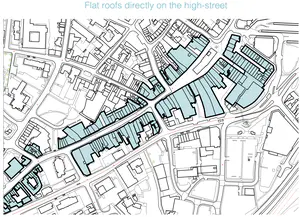
Here I begin to locally map Dudley, identifying its potential for green space for planting or PV panels. There is a huge potential here with up to 22,855m2 of flat roofs directly looking onto the high street. As well as the potential for a street takeover.

This map is only a theoretical analysis of a utopian idea; however, even if a small percentage of the green space highlighted became an area for planting, that is a success.

Limitation to rooftop planting would be based on the structural qualities of the existing structure. It would be wrong to say that these would be suitable with the additional weight. - Ryan Cooksey Green roofs.png
Localised Green Spaces Here I begin to locally map Dudley, identifying its potential for green space for planting or PV panels. There is a huge potential here with up to 22,855m2 of flat roofs directly looking onto the high street. As well as the potential for a street takeover. This map is only a theoretical analysis of a utopian idea; however, even if a small percentage of the green space highlighted became an area for planting, that is a success. Limitation to rooftop planting would be based on the structural qualities of the existing structure. It would be wrong to say that these would be suitable with the additional weight.
Map Diagram High Nature Growing Plantlife Sustainable Regenerative Potential Opportunity
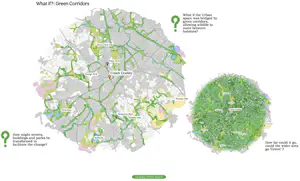
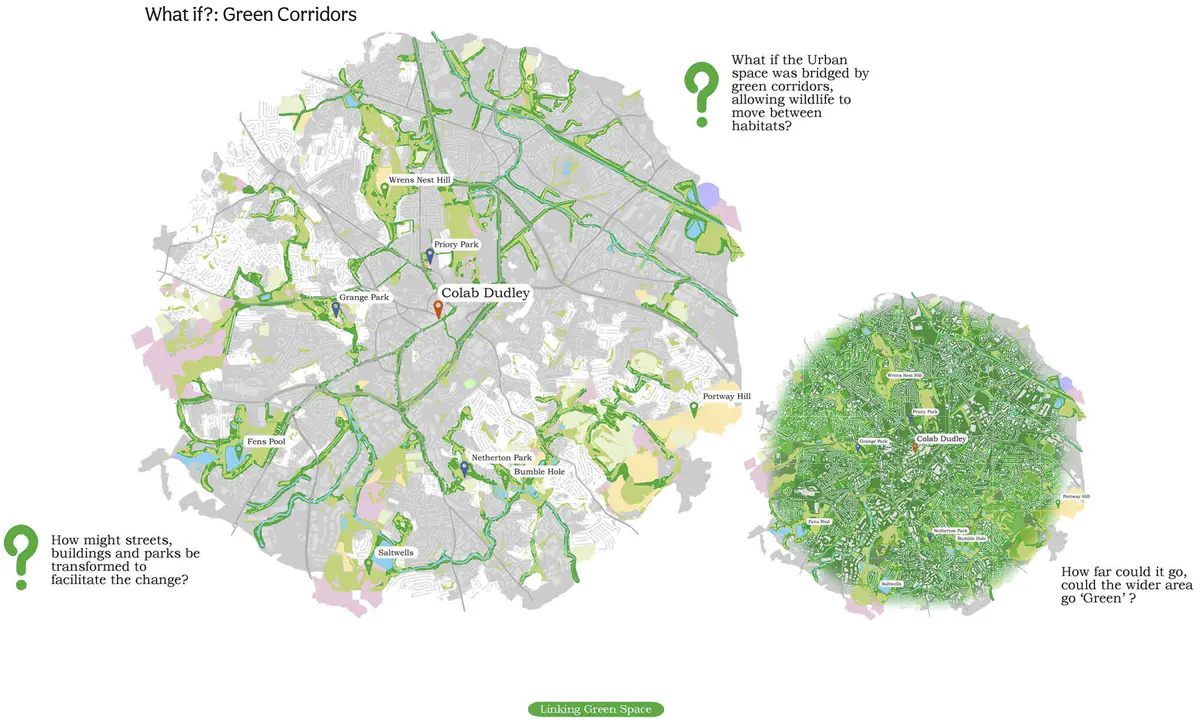
What if? Green corridors - Annabel Linch Green Corridors.png
What if? Green corridors
Map Boundaries Water Nature Plantlife Growing
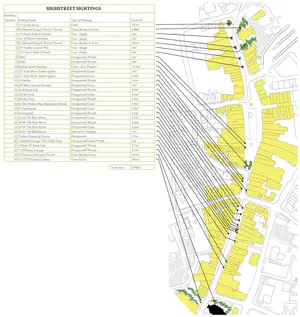
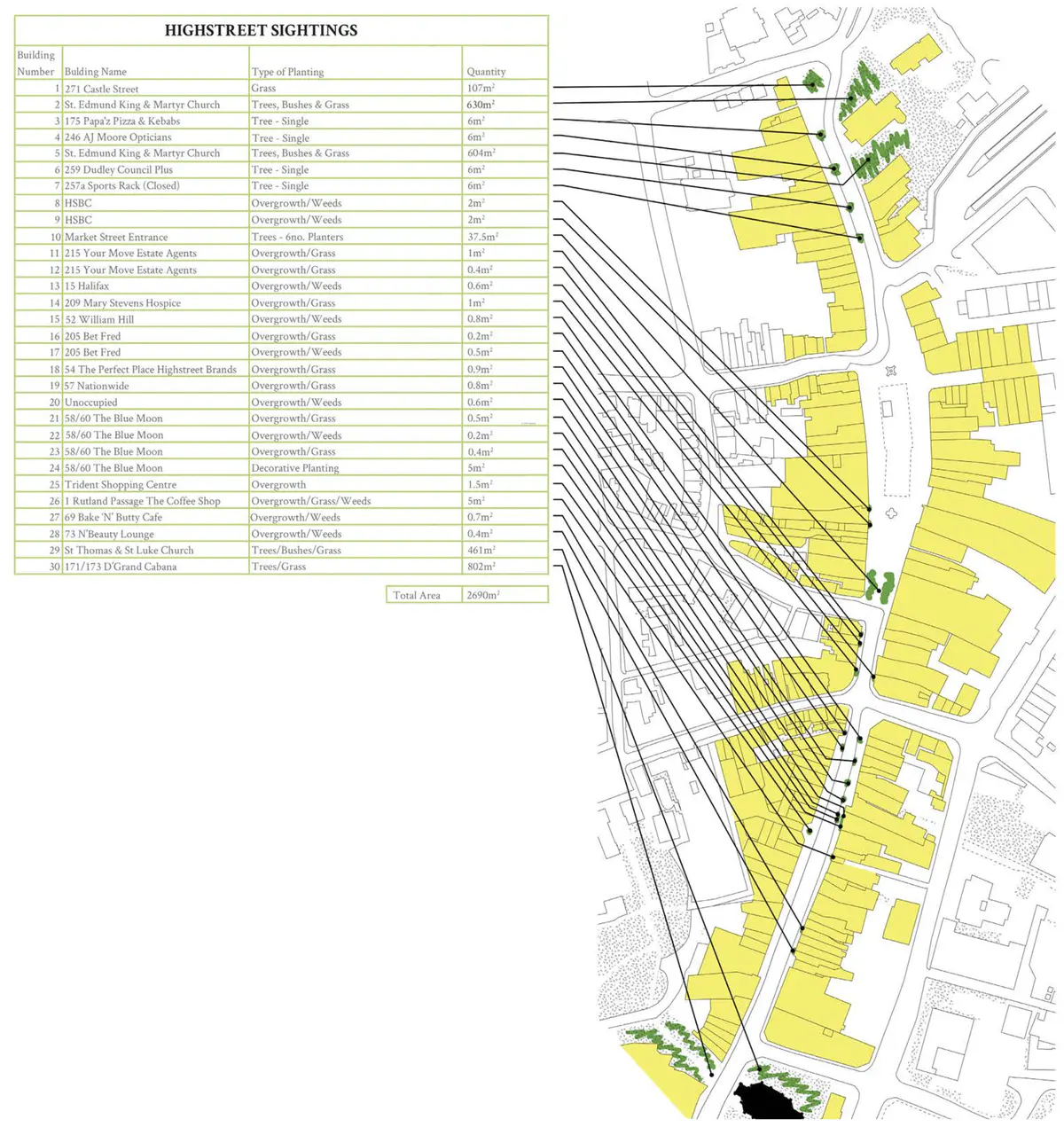
Street plant sightings

The charted planting is a selection of the current extent of the high street. As discovered, the area has little to no variance, with the exception of the more developed properties at either end of the high street. These properties generally have more trees and mature planting around them, making them more appreciative of the biodiversity.

Facing the high street, there is approximately 2690m2 of greenery, the majority of which is situated at either end, on the property of the two churches. Ignoring these numbers, the area of greenery drops significantly due to the limited overgrowth around lampposts, bins and along the store fronts.

For the wider biodiversity of the high street the select amount greenery provides very little benefit for nesting wildlife. Within the developed properties more thought and appreciation can be given to accommodate a more diverse spread of wildlife and planting. Along the high street there is little consideration for interactions with the wider biodiversity, a few trees (provided by the council) and strip of high level planting along a store front.

As for the rest of the ‘greenery’ along the high street, this could be seen more as neglect from the cleaning and maintenance of the street. The remaining biodiversity identified comes from areas that have retained water from lack of drainage and moisture retention. Seen around the street furniture, grass, weeds and moss can be seen growing along the gaps between paviers and along gutters. Despite being ‘greenery’ these areas provide no benefit to the biodiversity and are more of a sign that the council have no intention to improve the state of the area.

Within the developed quarters, the majority of the biodiversity is grassland, which too only has a limited positive environmental impact. The two churches provide an excellent coverage of their respective sights and can provide a good quality of air and absorption of CO2 due to the large number of trees and bushes . Whilst the grasslands are a welcoming sight, they play a very little roll in absorbing CO2 and to provide other positive environmental impacts that the larger greenery does. - Matthew Hewitt Street Plant Sightings.png
Street plant sightings The charted planting is a selection of the current extent of the high street. As discovered, the area has little to no variance, with the exception of the more developed properties at either end of the high street. These properties generally have more trees and mature planting around them, making them more appreciative of the biodiversity. Facing the high street, there is approximately 2690m2 of greenery, the majority of which is situated at either end, on the property of the two churches. Ignoring these numbers, the area of greenery drops significantly due to the limited overgrowth around lampposts, bins and along the store fronts. For the wider biodiversity of the high street the select amount greenery provides very little benefit for nesting wildlife. Within the developed properties more thought and appreciation can be given to accommodate a more diverse spread of wildlife and planting. Along the high street there is little consideration for interactions with the wider biodiversity, a few trees (provided by the council) and strip of high level planting along a store front. As for the rest of the ‘greenery’ along the high street, this could be seen more as neglect from the cleaning and maintenance of the street. The remaining biodiversity identified comes from areas that have retained water from lack of drainage and moisture retention. Seen around the street furniture, grass, weeds and moss can be seen growing along the gaps between paviers and along gutters. Despite being ‘greenery’ these areas provide no benefit to the biodiversity and are more of a sign that the council have no intention to improve the state of the area. Within the developed quarters, the majority of the biodiversity is grassland, which too only has a limited positive environmental impact. The two churches provide an excellent coverage of their respective sights and can provide a good quality of air and absorption of CO2 due to the large number of trees and bushes . Whilst the grasslands are a welcoming sight, they play a very little roll in absorbing CO2 and to provide other positive environmental impacts that the larger greenery does.
Map Photo Plantlife Nature Growing Pollution Care
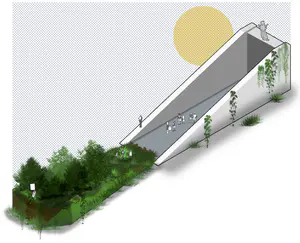
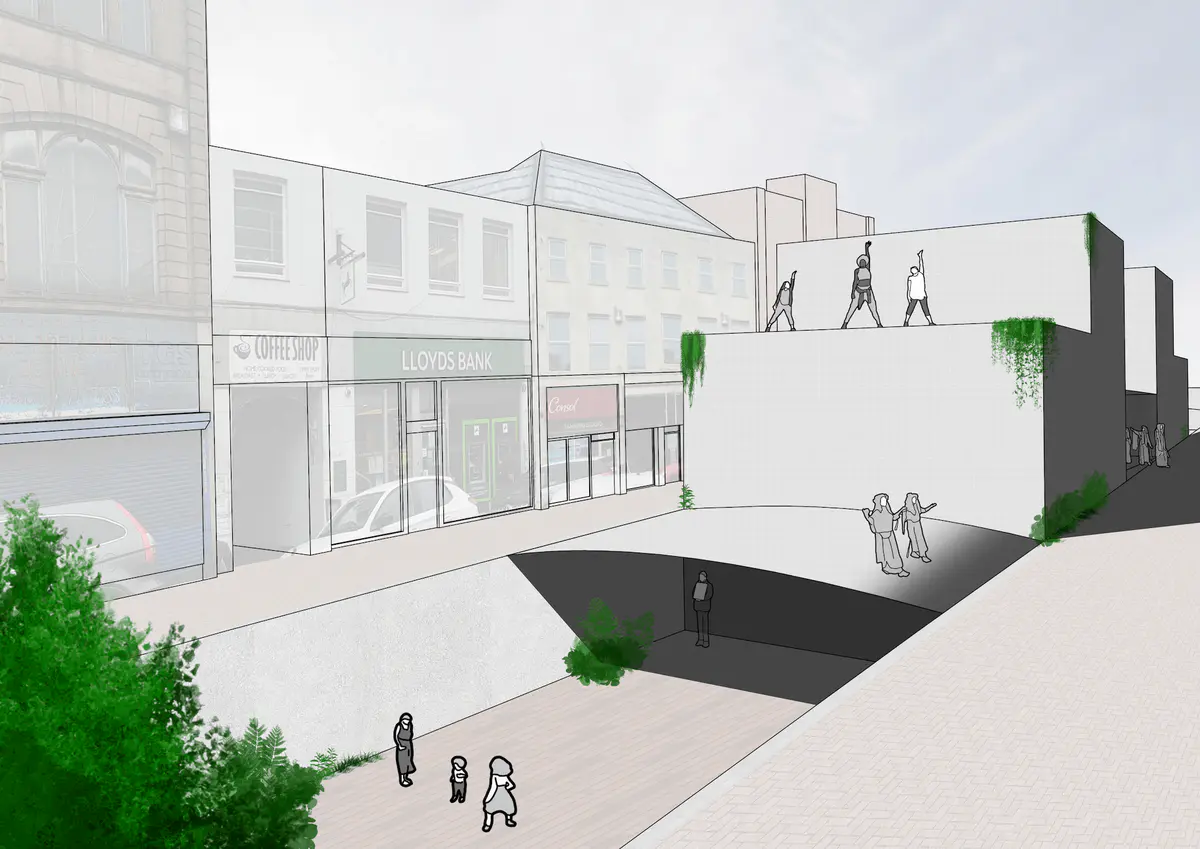
The main structure would have various spaces such as the Museum space, possibly a place that people can pin up local activities, and maybe rooms for either changing or for performance practice. As the street is 11m wide on average, there is plenty of space to have the building
fill the space. As the sunlight comes from mainly the south, the south side buildings often shadow the street entirely, which would mean that something being built (especially as it will be dug down a bit) would not shadow out the other buildings. The biggest hurdle to tackle is
that the space shouldn’t not feel overwhelming to the other shops or those who walk down the pavement. Because of this, most of the building’s structure would be in the underneath area, and only parts of it would pop out over the pavement. As the design would be flush
with the pavement, there are also opportunities to have crossing bridges that are both useful by the public, but also incorporated with the design of the new street.

The back of the street would create a unique space for social activities. The space is wide enough and long enough for a performance theatre space to be erected there, but it also has the possibility of having some kind of altered shape to the area, like a raised platform that could house
seating and other social activities. However, the space can also perfectly fit a fully regulated tennis court, badminton court, and volley ball court. People have mentioned that there is also a lack of sport engagement in the area, so this could be used to provide that kind of space. - Oscar Law Proposed design.png
The main structure would have various spaces such as the Museum space, possibly a place that people can pin up local activities, and maybe rooms for either changing or for performance practice. As the street is 11m wide on average, there is plenty of space to have the building fill the space. As the sunlight comes from mainly the south, the south side buildings often shadow the street entirely, which would mean that something being built (especially as it will be dug down a bit) would not shadow out the other buildings. The biggest hurdle to tackle is that the space shouldn’t not feel overwhelming to the other shops or those who walk down the pavement. Because of this, most of the building’s structure would be in the underneath area, and only parts of it would pop out over the pavement. As the design would be flush with the pavement, there are also opportunities to have crossing bridges that are both useful by the public, but also incorporated with the design of the new street. The back of the street would create a unique space for social activities. The space is wide enough and long enough for a performance theatre space to be erected there, but it also has the possibility of having some kind of altered shape to the area, like a raised platform that could house seating and other social activities. However, the space can also perfectly fit a fully regulated tennis court, badminton court, and volley ball court. People have mentioned that there is also a lack of sport engagement in the area, so this could be used to provide that kind of space.
Imagining Map Drawing Collage Change Craft Past Future Potential Imagination Identity Industry Memory Learning Shelter Nature Plantlife Growing Architecture
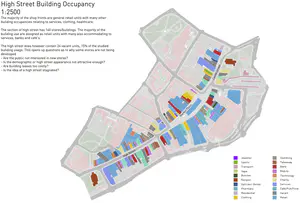
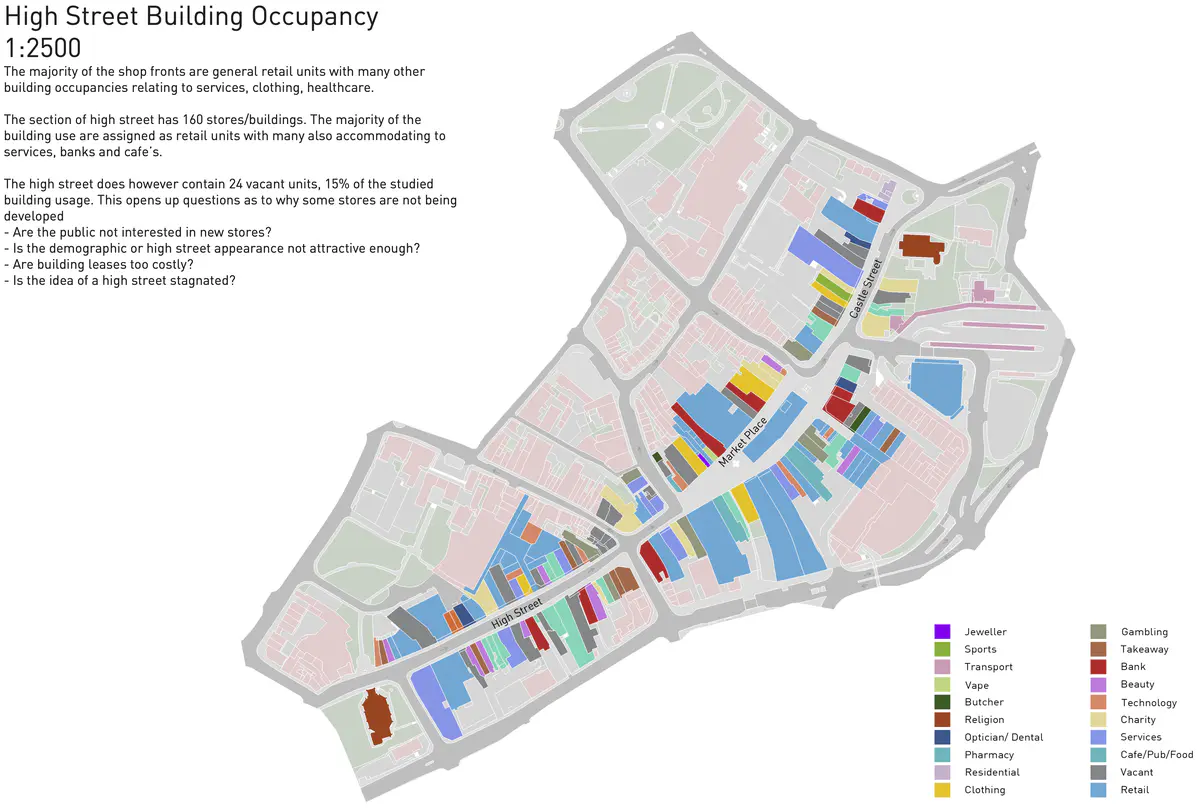
High Street Building Occupancy 
The majority of the shop fronts are general retail units with many other building occupancies relating to services, clothing, healthcare.
The section of high street has 160 stores/buildings. The majority of the building use are assigned as retail units with many also accommodating to services, banks and cafe’s.

The high street does however contain 24 vacant units, 15% of the studied building usage.  - Matthew Hewitt 1.png
High Street Building Occupancy The majority of the shop fronts are general retail units with many other building occupancies relating to services, clothing, healthcare. The section of high street has 160 stores/buildings. The majority of the building use are assigned as retail units with many also accommodating to services, banks and cafe’s. The high street does however contain 24 vacant units, 15% of the studied building usage.
Map Diagram Consumption Commerce Unused
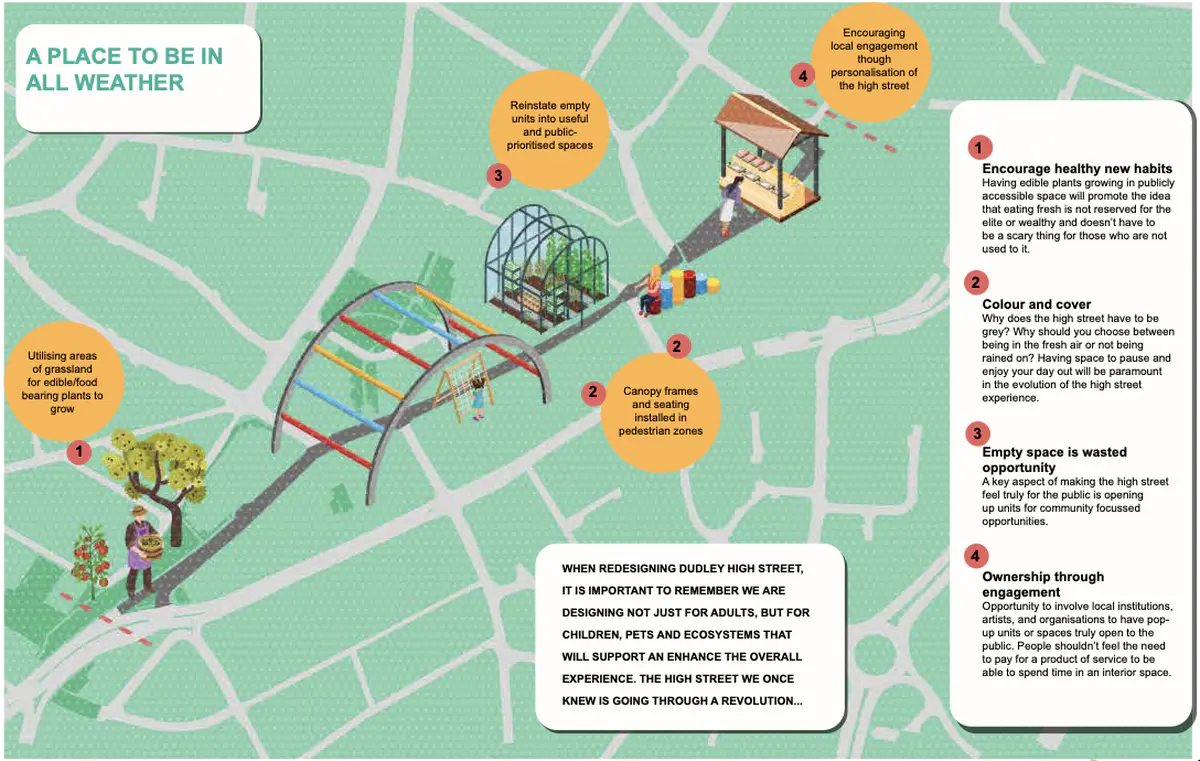
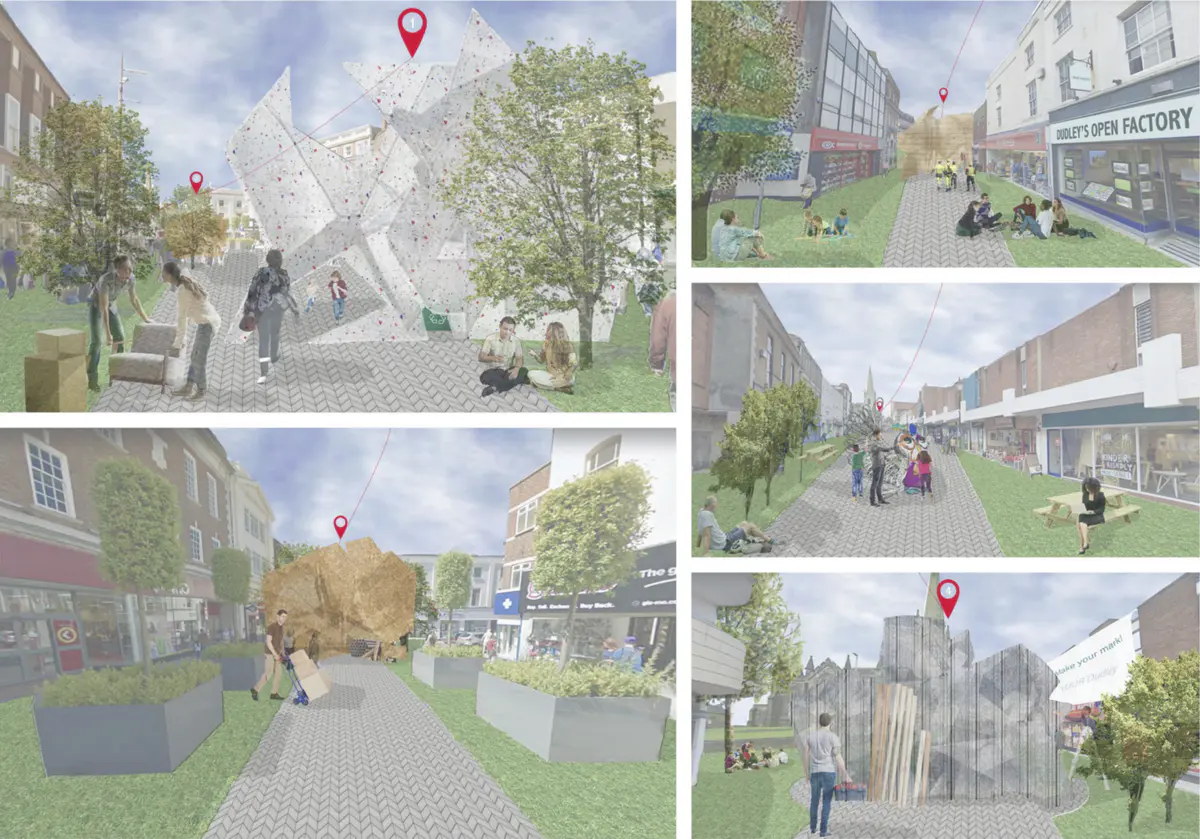
Our collective vision for Dudley is to support a creative community that is connected through our internet of things; creating spaces that allow for the collection and redistribution of materials that locals can use to construct products with. Community engagement is central to this design network with local businesses encouraged to get involved in manufacturing. 

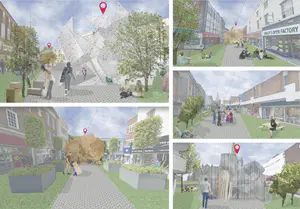
We decided to bring alive this vision through a series of pavilions positioned through the High Street, following a process through recycling, storing constructing and manufacturing. To take this idea further, we allocated several empty units along the High Street to become spaces involved in the open factory, from workshops, educational centres and co-working hubs. Since we wanted to show the journey people would be able to take, we decided to create a storyboard for our final visual.

These visuals show how the pavilions could sit in the High Street, starting at the market place, past CoLab Dudley’s base, and ending up at Top Church. We wanted to show how people would be able to interact with these different spaces and navigate between them. - 1_VMp1Jai-Vr7tZ4pe8U752Q.png
Our collective vision for Dudley is to support a creative community that is connected through our internet of things; creating spaces that allow for the collection and redistribution of materials that locals can use to construct products with. Community engagement is central to this design network with local businesses encouraged to get involved in manufacturing. We decided to bring alive this vision through a series of pavilions positioned through the High Street, following a process through recycling, storing constructing and manufacturing. To take this idea further, we allocated several empty units along the High Street to become spaces involved in the open factory, from workshops, educational centres and co-working hubs. Since we wanted to show the journey people would be able to take, we decided to create a storyboard for our final visual. These visuals show how the pavilions could sit in the High Street, starting at the market place, past CoLab Dudley’s base, and ending up at Top Church. We wanted to show how people would be able to interact with these different spaces and navigate between them.
Collage Map Drawing Imagining Community Creativity Technology Doughnut Regenerative Material Making Connection Economics Unused Ownership Learning Agency Abundance Actions Change Future Imagination Industry Interacting Invitations Opportunity People Potential Shelter Architecture Difference
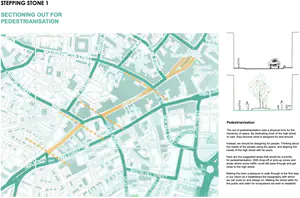
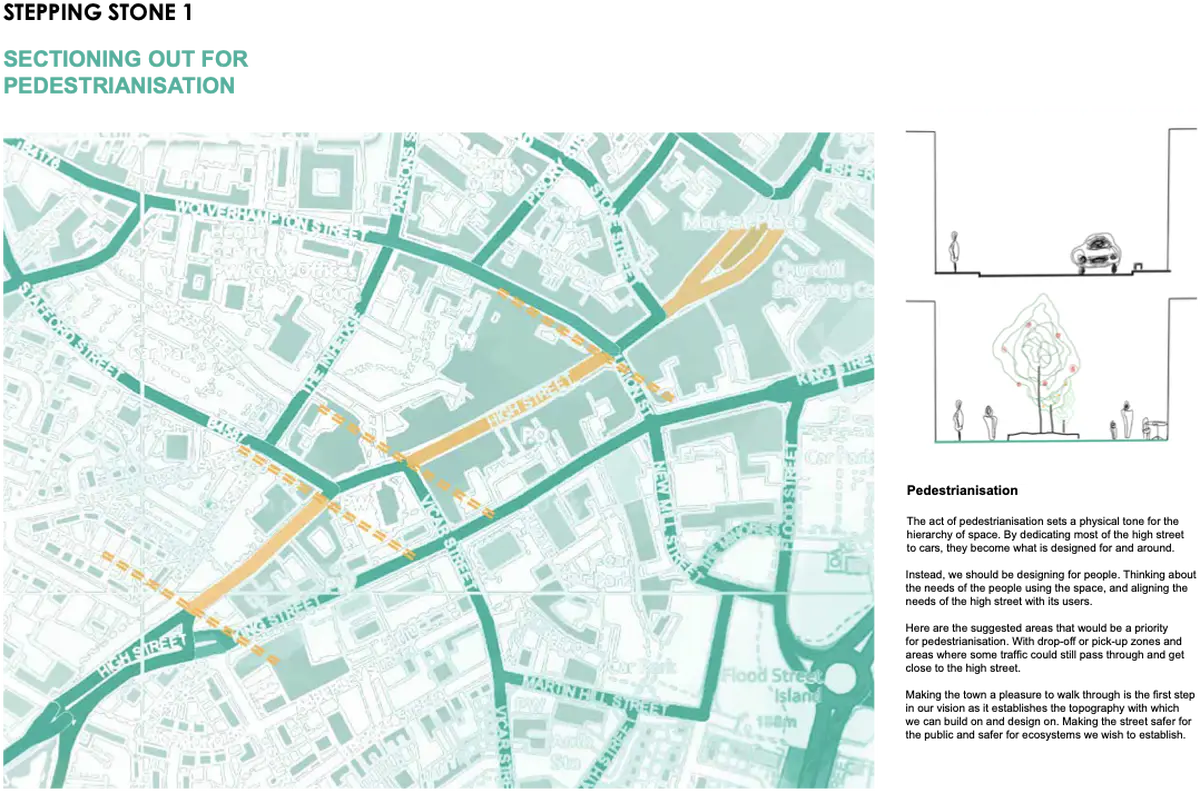
The first step is sectioning out for pedestrianisation. It was important that we did this so we can move down the intervention scale to the next stepping stone; laying the foundation for social and ecological benefits. The hierarchy of space is very much dedicated to cars right now. If you design for cars, you’re going to get more cars. If you design for people, you’re going to get more people. According to Just Economics, the footfall can increase by about 40% following pedestrianisation, and retail follows suit with about 30% increase in sales. - 1_u90NvmZWEYJpy_l7kZT3ww.png
The first step is sectioning out for pedestrianisation. It was important that we did this so we can move down the intervention scale to the next stepping stone; laying the foundation for social and ecological benefits. The hierarchy of space is very much dedicated to cars right now. If you design for cars, you’re going to get more cars. If you design for people, you’re going to get more people. According to Just Economics, the footfall can increase by about 40% following pedestrianisation, and retail follows suit with about 30% increase in sales.
Map Drawing Imagining Change Access Future Imagination Moving Opportunity People Potential Safety Traffic Transport Vehicle
Creating a stronger connecting between the current food spaces by:
- Pedestrianising the road with a grassland
- Utilising abandoned building for education centres and community farming.

Linked to the Food Hub is an education centre sharing information on edible insects and Dudley’s biodiversity. Also offers insect cooking lessons to the local community and schools.

Immersed within the grassland is areas where existing buildings can extend out onto the street to create a stronger bond with new sustainable environment.

Redesigning the Market Place with more levels of outdoor seating to create a new experience and environment of eating food on the High Street.

Gardening and insect farming spaces integrated within the buildings. By bringing all the food production onto the High Street will help reduce food waste and also offer fresh produce to the locals. - Sita Patel Food Hub 0.png
Creating a stronger connecting between the current food spaces by: - Pedestrianising the road with a grassland - Utilising abandoned building for education centres and community farming. Linked to the Food Hub is an education centre sharing information on edible insects and Dudley’s biodiversity. Also offers insect cooking lessons to the local community and schools. Immersed within the grassland is areas where existing buildings can extend out onto the street to create a stronger bond with new sustainable environment. Redesigning the Market Place with more levels of outdoor seating to create a new experience and environment of eating food on the High Street. Gardening and insect farming spaces integrated within the buildings. By bringing all the food production onto the High Street will help reduce food waste and also offer fresh produce to the locals.
Diagram Drawing Photo Map Food System Growing Regenerative Sustainable Creatures Nature Plantlife Learning Community Health Waste Unused Architecture Biodiversity
'Fast motorbike / loud & fast' - 230720 Bill.JPG
'Fast motorbike / loud & fast'
Map 18C Cloudy Slight breeze Speeds Vehicle Sounds
Nurturing AgroEcology in Urban Life
A strategy for living alongside food production

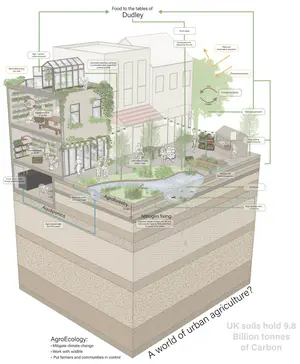
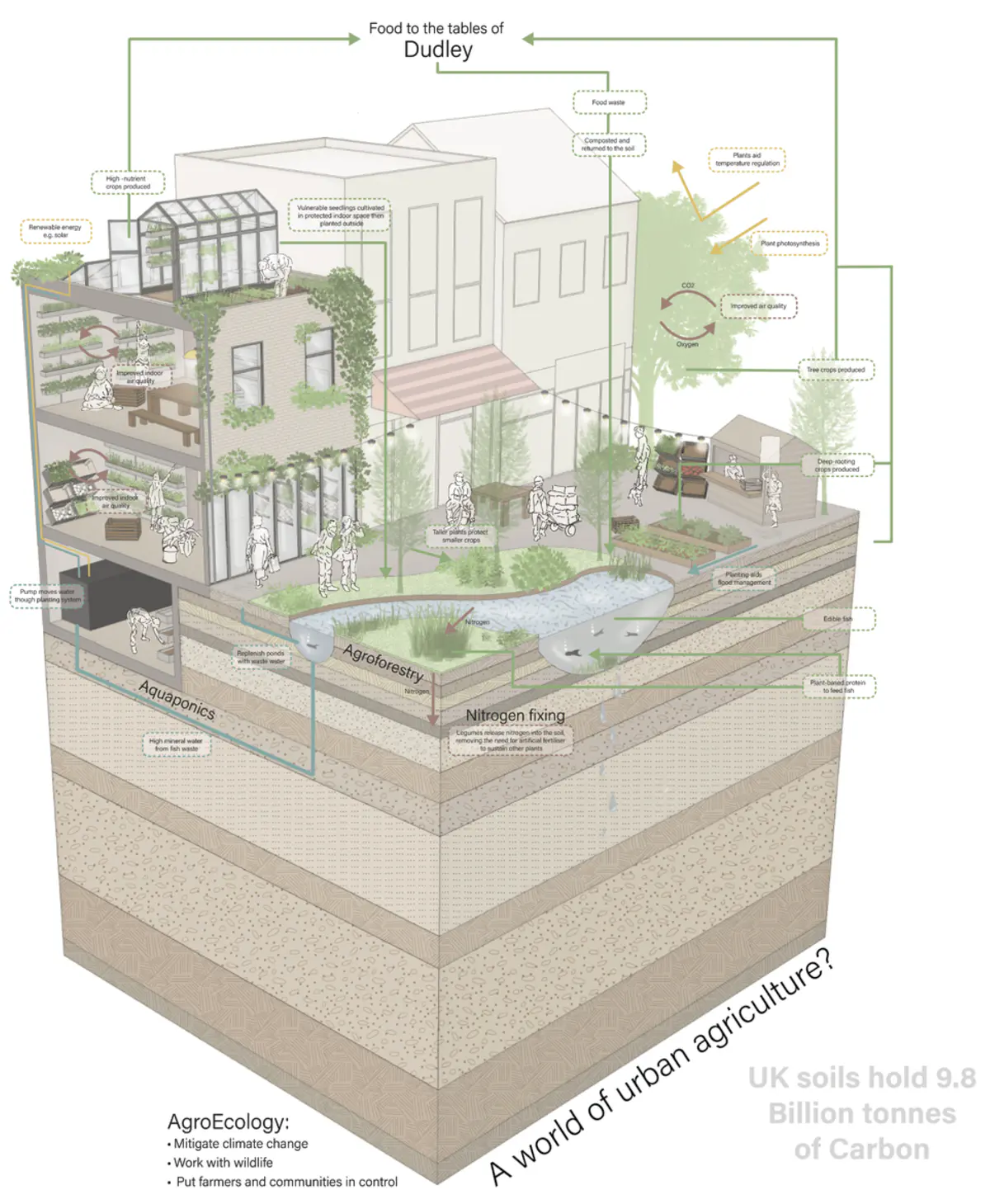
A critical part of the climate crisis is the degradation of soil, leading to scientists predicting the UK has approximately 100 harvests left of stable crop production. As an attempt to address the problem this project will explore the possibility of integrating sustainable agriculture into an urban setting, reducing the strain on agricultural land, reducing food miles and widening city biodiversity. Taking guidance from the farming movement, ‘Agroecology,’ a climate conscious, wildlife supporting and community engaged closed loop system will be developed, combining traditional growing with technology driven techniques that will support each other to produce a diverse plate.

Dudley High Street will be the focal point, reinvented as a destination not just for the purchase and consumption of food but also its creation, driven by the needs and engagement of local people. Connecting the community to the food they eat.  - Annabel Linch 4.png
Nurturing AgroEcology in Urban Life A strategy for living alongside food production A critical part of the climate crisis is the degradation of soil, leading to scientists predicting the UK has approximately 100 harvests left of stable crop production. As an attempt to address the problem this project will explore the possibility of integrating sustainable agriculture into an urban setting, reducing the strain on agricultural land, reducing food miles and widening city biodiversity. Taking guidance from the farming movement, ‘Agroecology,’ a climate conscious, wildlife supporting and community engaged closed loop system will be developed, combining traditional growing with technology driven techniques that will support each other to produce a diverse plate. Dudley High Street will be the focal point, reinvented as a destination not just for the purchase and consumption of food but also its creation, driven by the needs and engagement of local people. Connecting the community to the food they eat.
Drawing Map Imagining Nature Life Plantlife Growing Climate Soil Sustainable Food Biodiversity Creatures Community System Technology Consumption Creativity People Connection Architecture Pollution Regenerative Potential Opportunity Imagination Craft Making Material
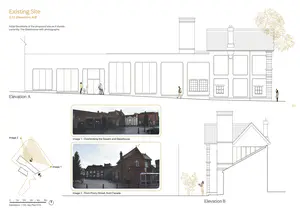
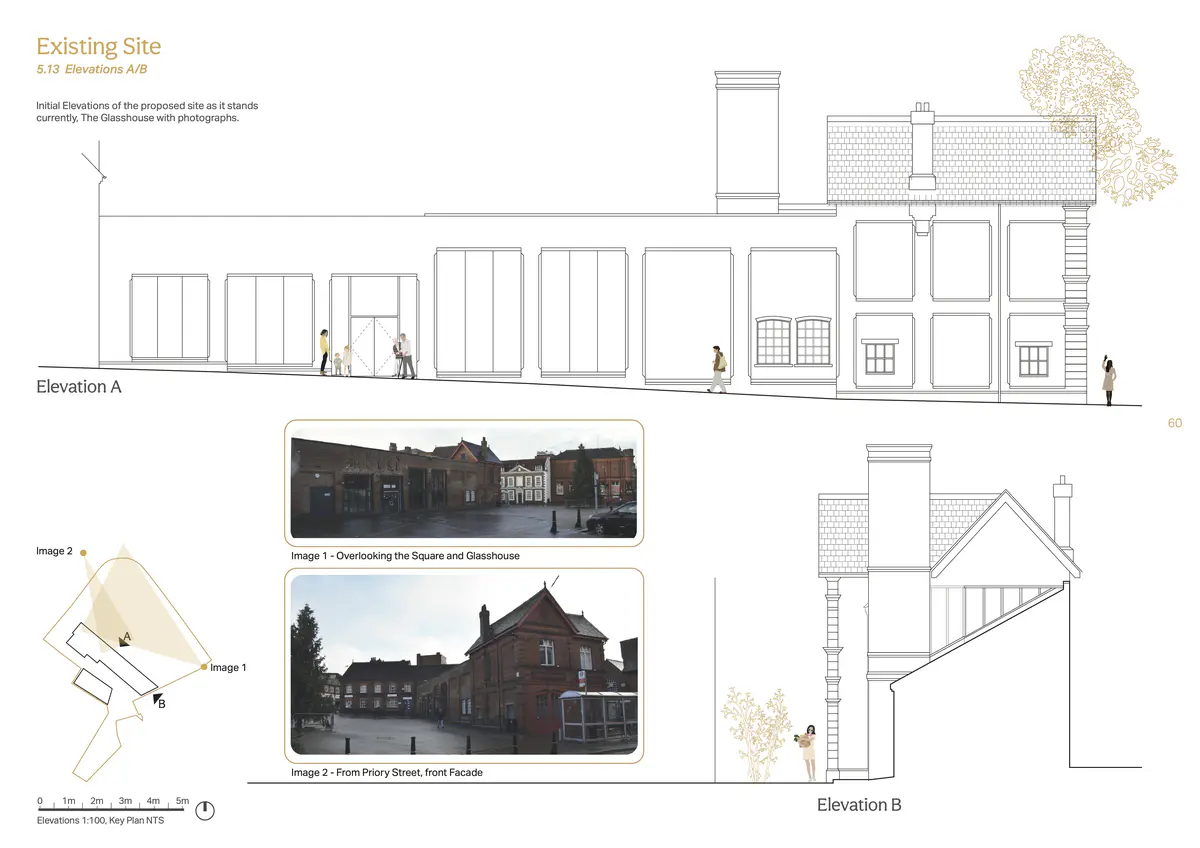
Glasshouse existing elevations - Michelle Gartside Existing site 1.png
Glasshouse existing elevations
Drawing Photo Map Architecture
Nurturing AgroEcology in Urban Life
A strategy for living alongside food production

A critical part of the climate crisis is the degradation of soil, leading to scientists predicting the UK has approximately 100 harvests left of stable crop production. As an attempt to address the problem this project will explore the possibility of integrating sustainable agriculture into an urban setting, reducing the strain on agricultural land, reducing food miles and widening city biodiversity. Taking guidance from the farming movement, ‘Agroecology,’ a climate conscious, wildlife supporting and community engaged closed loop system will be developed, combining traditional growing with technology driven techniques that will support each other to produce a diverse plate.

Dudley High Street will be the focal point, reinvented as a destination not just for the purchase and consumption of food but also its creation, driven by the needs and engagement of local people. Connecting the community to the food they eat. - Annabel Linch 1.png
Nurturing AgroEcology in Urban Life A strategy for living alongside food production A critical part of the climate crisis is the degradation of soil, leading to scientists predicting the UK has approximately 100 harvests left of stable crop production. As an attempt to address the problem this project will explore the possibility of integrating sustainable agriculture into an urban setting, reducing the strain on agricultural land, reducing food miles and widening city biodiversity. Taking guidance from the farming movement, ‘Agroecology,’ a climate conscious, wildlife supporting and community engaged closed loop system will be developed, combining traditional growing with technology driven techniques that will support each other to produce a diverse plate. Dudley High Street will be the focal point, reinvented as a destination not just for the purchase and consumption of food but also its creation, driven by the needs and engagement of local people. Connecting the community to the food they eat.
Drawing Map Imagining Nature Life Plantlife Growing Climate Soil Sustainable Food Biodiversity Creatures Community System Technology Consumption Creativity People Connection Architecture Pollution Regenerative Potential Opportunity Imagination Craft Making Material
Materials analysis 2.pdf
Material analysis
Map Photo Diagram Architecture Material
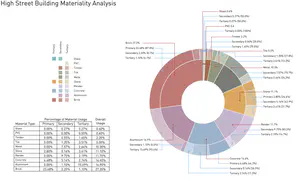
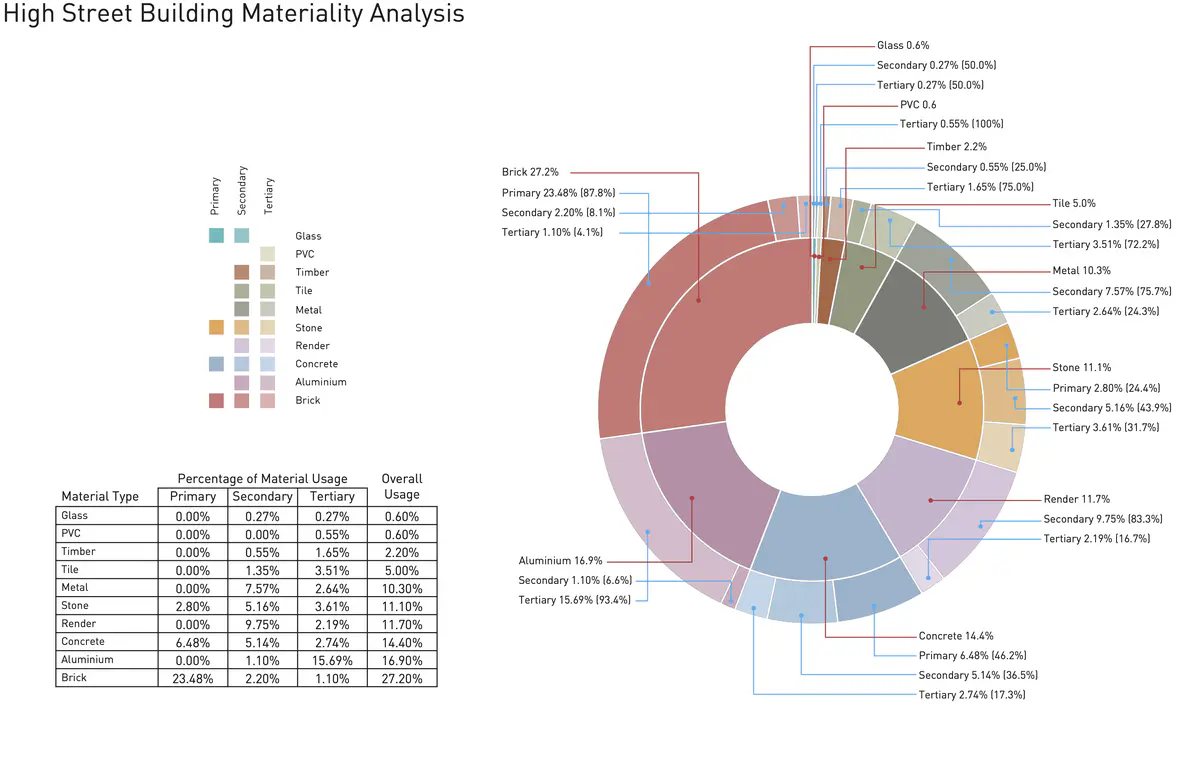
High Street building materiality analysis - Matthew Hewitt Building Materiality 3.png
High Street building materiality analysis
Map Diagram Architecture Material Colour
It’s difficult to see green from plants although then noticed the weeds in the pavement and buildings - 230720 Erica.JPG
It’s difficult to see green from plants although then noticed the weeds in the pavement and buildings
Map 18C Cloudy Slight breeze Colour Surprise Hiding Plantlife Nature Growing
Stepping Stone 4 adds layers to the High Street. Like the other visions, we wanted to use CoLab Dudley’s principles ‘use nature as a guidebook’ and ‘create conditions for curiosity and experimentation’. The main way we proposed to do this was adding a green canopy to provide shelter, create a hybrid indoor outdoor space welcoming to families and a more communal open space, and support ecosystems. - 1_LproE6m65nkUvUNOhgvtwg.png
Stepping Stone 4 adds layers to the High Street. Like the other visions, we wanted to use CoLab Dudley’s principles ‘use nature as a guidebook’ and ‘create conditions for curiosity and experimentation’. The main way we proposed to do this was adding a green canopy to provide shelter, create a hybrid indoor outdoor space welcoming to families and a more communal open space, and support ecosystems.
Drawing Map Food Nature Growing Plantlife Unused Ownership Access Agency Stillness Shelter Lingering Invitations Imagination Interacting Actions Change Health Colour Curiosity Consumption Commerce Community Care Economics Fairness Future Layer Life People Potential Opportunity Emotion
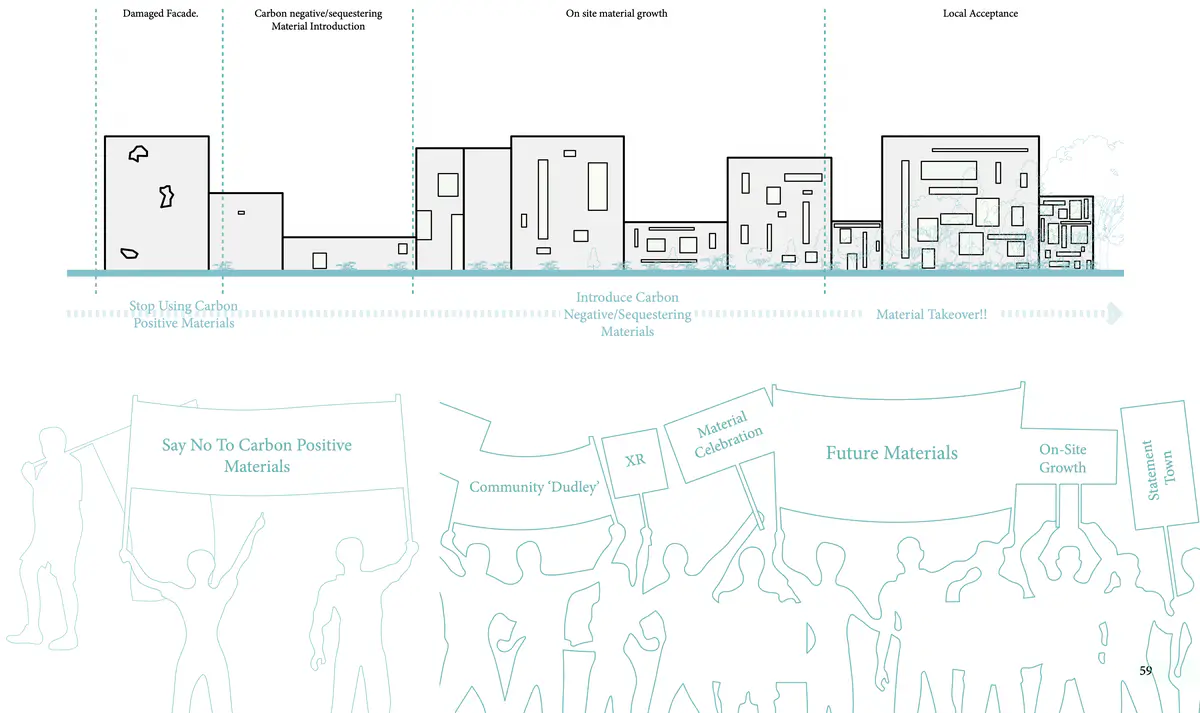
Localising Material Accessibility
During my initial walk through the High Street of Dudley, I noticed an inevitable decline in the area. There were vacant shops, but those open had apparent facade damage. For the area to thrive, there needs to be an aesthetical uplift. Here I began to question how to make the repairs. On the one hand, one could complete a like for like repair with a deep clean to provide a new lease of life to achieve an aesthetical value. Alternatively, the repairs could be a status of where the street aims to be in the future. To achieve a statement, the implementation of repair work needs to stand out. It needs to be futuristic, a bold contrast to the existing.

At this point, I decided that after being informed of the damage the built environment has on the climate crisis, only carbon zero/ carbon sequestering materials would be present during repairs. This does not aim to destroy existing buildings but instead carefully implement repairs creating a patchwork effect across the street. This would then grow over time as more repair work is required.

Over time, the high street would transform into a zero-carbon environment. The manufacturing and growth of these materials need to be local, so consideration is vital. This provides an opportunity for the site to be a material producer itself. - Ryan Cooksey Ban Materials.png
Localising Material Accessibility During my initial walk through the High Street of Dudley, I noticed an inevitable decline in the area. There were vacant shops, but those open had apparent facade damage. For the area to thrive, there needs to be an aesthetical uplift. Here I began to question how to make the repairs. On the one hand, one could complete a like for like repair with a deep clean to provide a new lease of life to achieve an aesthetical value. Alternatively, the repairs could be a status of where the street aims to be in the future. To achieve a statement, the implementation of repair work needs to stand out. It needs to be futuristic, a bold contrast to the existing. At this point, I decided that after being informed of the damage the built environment has on the climate crisis, only carbon zero/ carbon sequestering materials would be present during repairs. This does not aim to destroy existing buildings but instead carefully implement repairs creating a patchwork effect across the street. This would then grow over time as more repair work is required. Over time, the high street would transform into a zero-carbon environment. The manufacturing and growth of these materials need to be local, so consideration is vital. This provides an opportunity for the site to be a material producer itself.
Map Diagram Material Transport Climate Change Potential Opportunity System Decay Aesthetic Future Imagination Regenerative Growing Community Identity Pollution Industry Sustainable Connection Nature Biodiversity Creatures Doughnut Architecture
Bin - can hardly see the Dudley coat of arms (didn’t notice it before) - dripping ice-cream down the side. - 230720 Bin.jpg
Bin - can hardly see the Dudley coat of arms (didn’t notice it before) - dripping ice-cream down the side.
Drawing Map 18C Cloudy Slight breeze Colour Waste Identity
'Quick eating pigeon' - 230720 Bill.JPG
'Quick eating pigeon'
Map 18C Cloudy Slight breeze Speeds Food Creatures Nature Actions
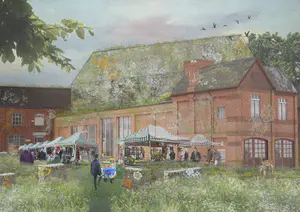
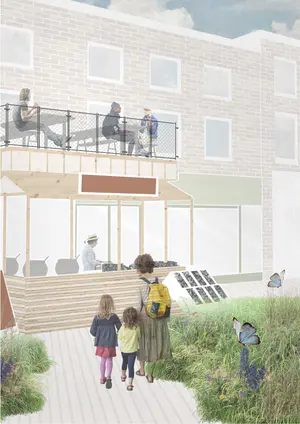
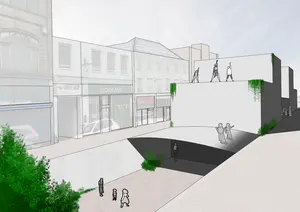
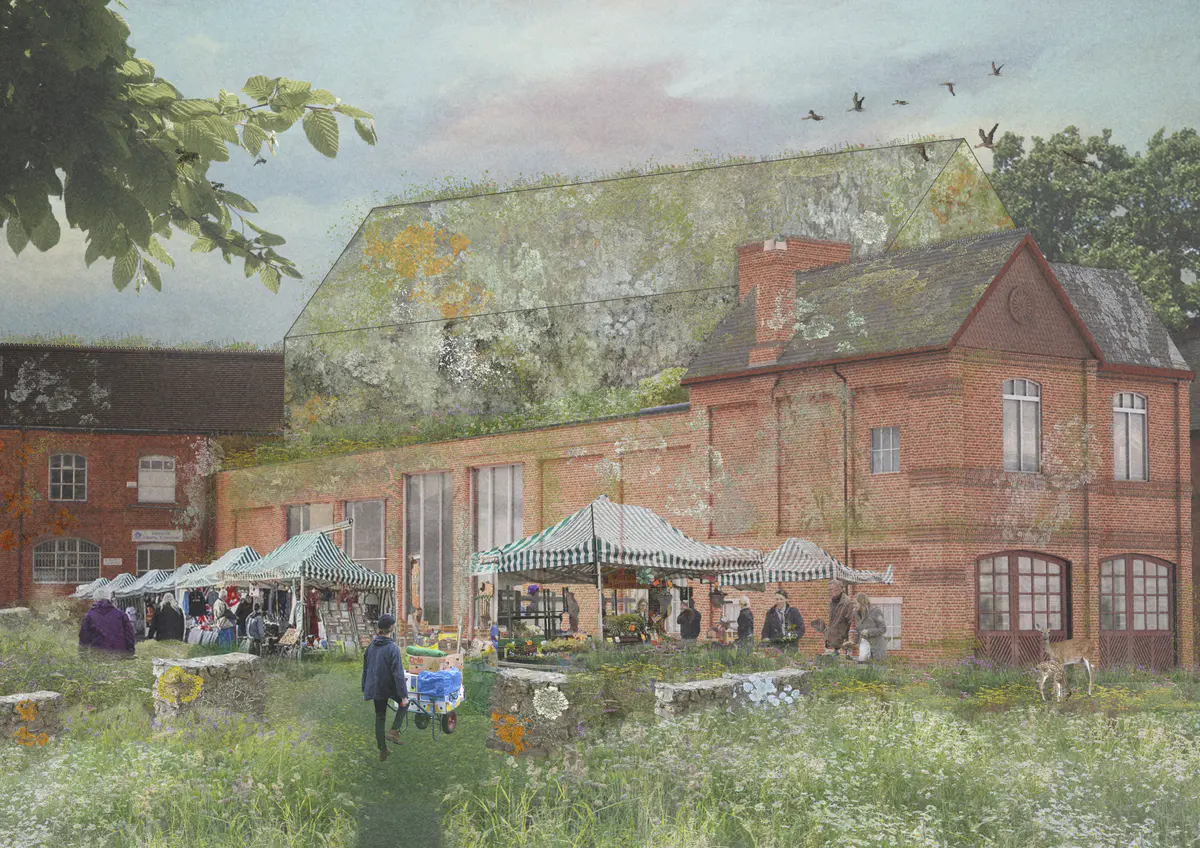
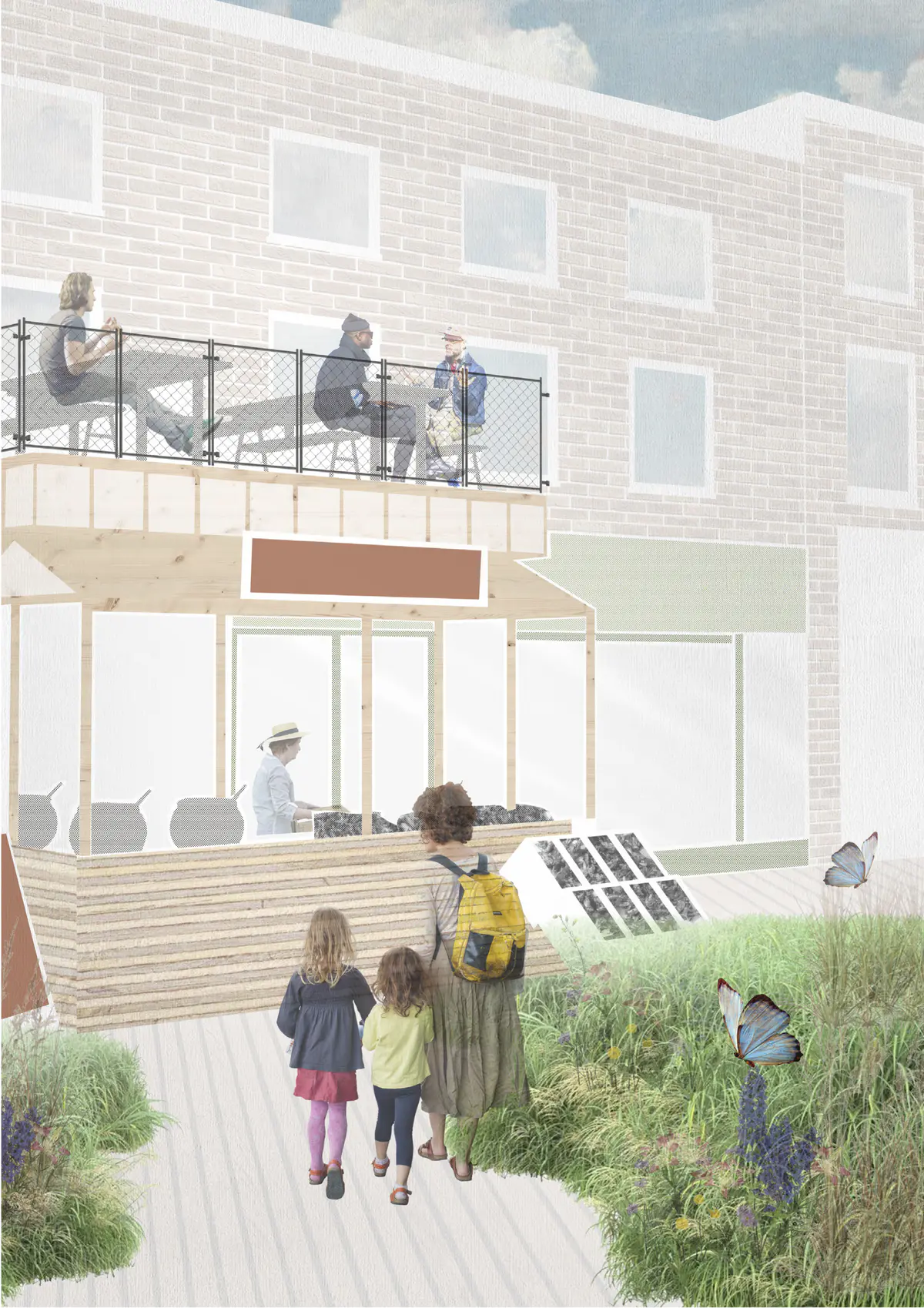
This visual represents the vision for the thesis, buildings covered in lichens, air purifying plants and community activities held on the Highstreet. This visual focuses in on the proposed site for the building and shows expression of a raised new build component on site as well as a full and wild landscaping plan. - Michelle Gartside Visualisation.png
This visual represents the vision for the thesis, buildings covered in lichens, air purifying plants and community activities held on the Highstreet. This visual focuses in on the proposed site for the building and shows expression of a raised new build component on site as well as a full and wild landscaping plan.
Map Collage Drawing Diagram Imagining Architecture Nature Plantlife Growing Imagination Life Air Light Water Potential Opportunity Creatures Community
Shop fronts are mostly reds and blues - 230720 Erica.JPG
Shop fronts are mostly reds and blues
Map 18C Cloudy Slight breeze Colour Identity Commerce
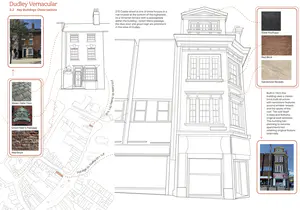
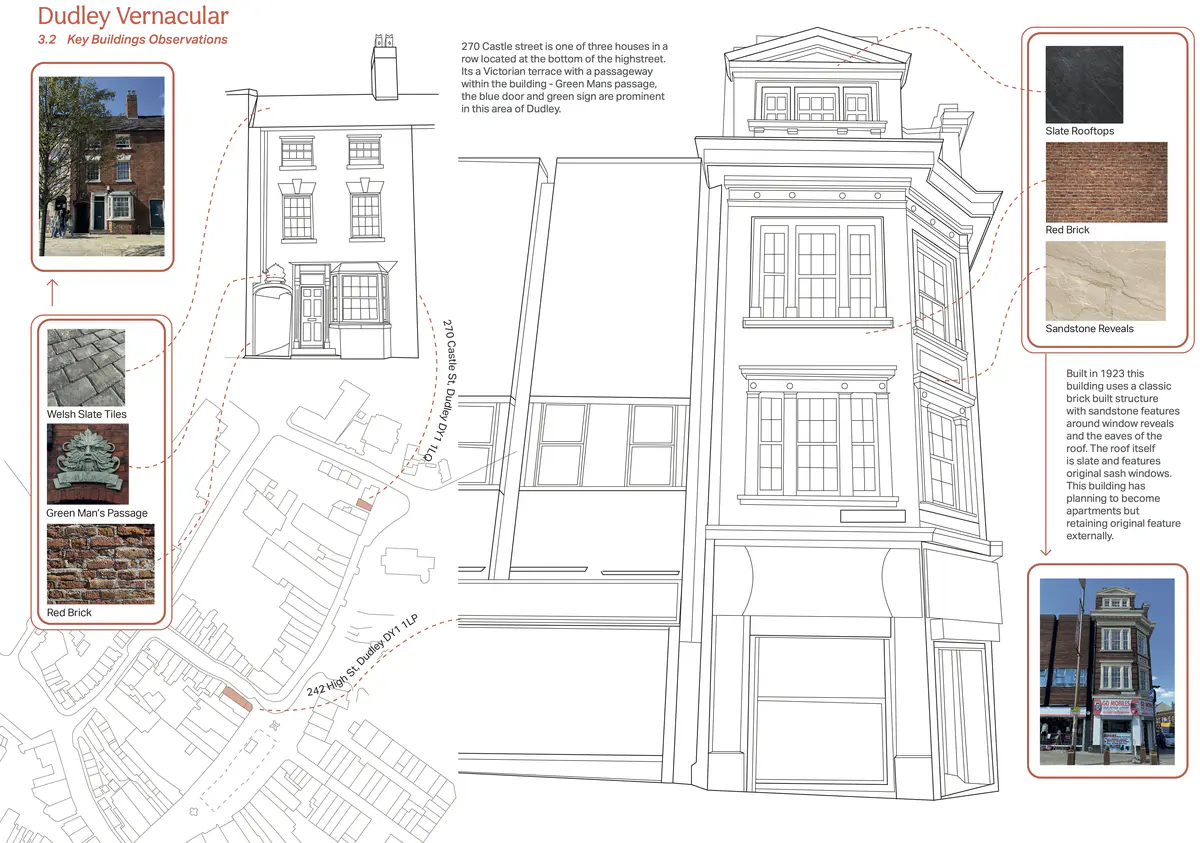
Dudley Vernacular - Michelle Gartside Dudley Vernacular 2.png
Dudley Vernacular
Photo Drawing Map Architecture Material