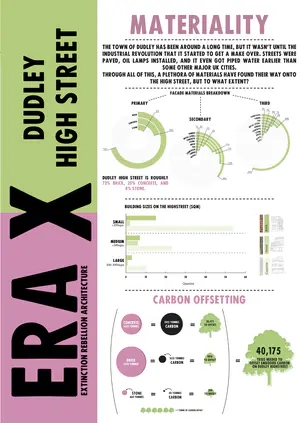
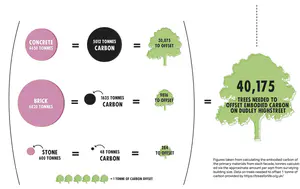
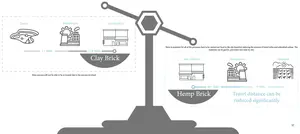
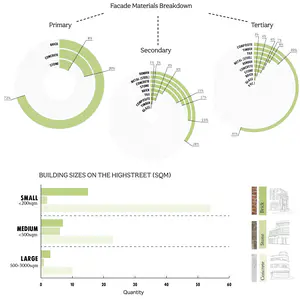
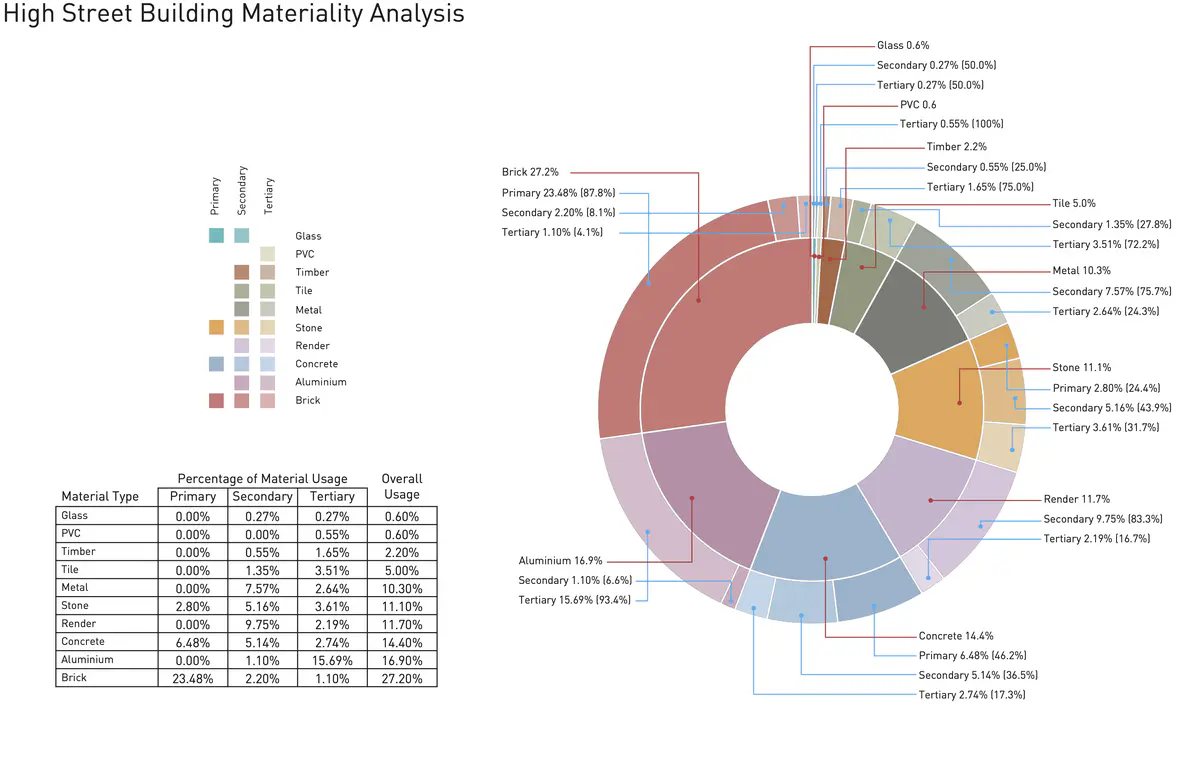
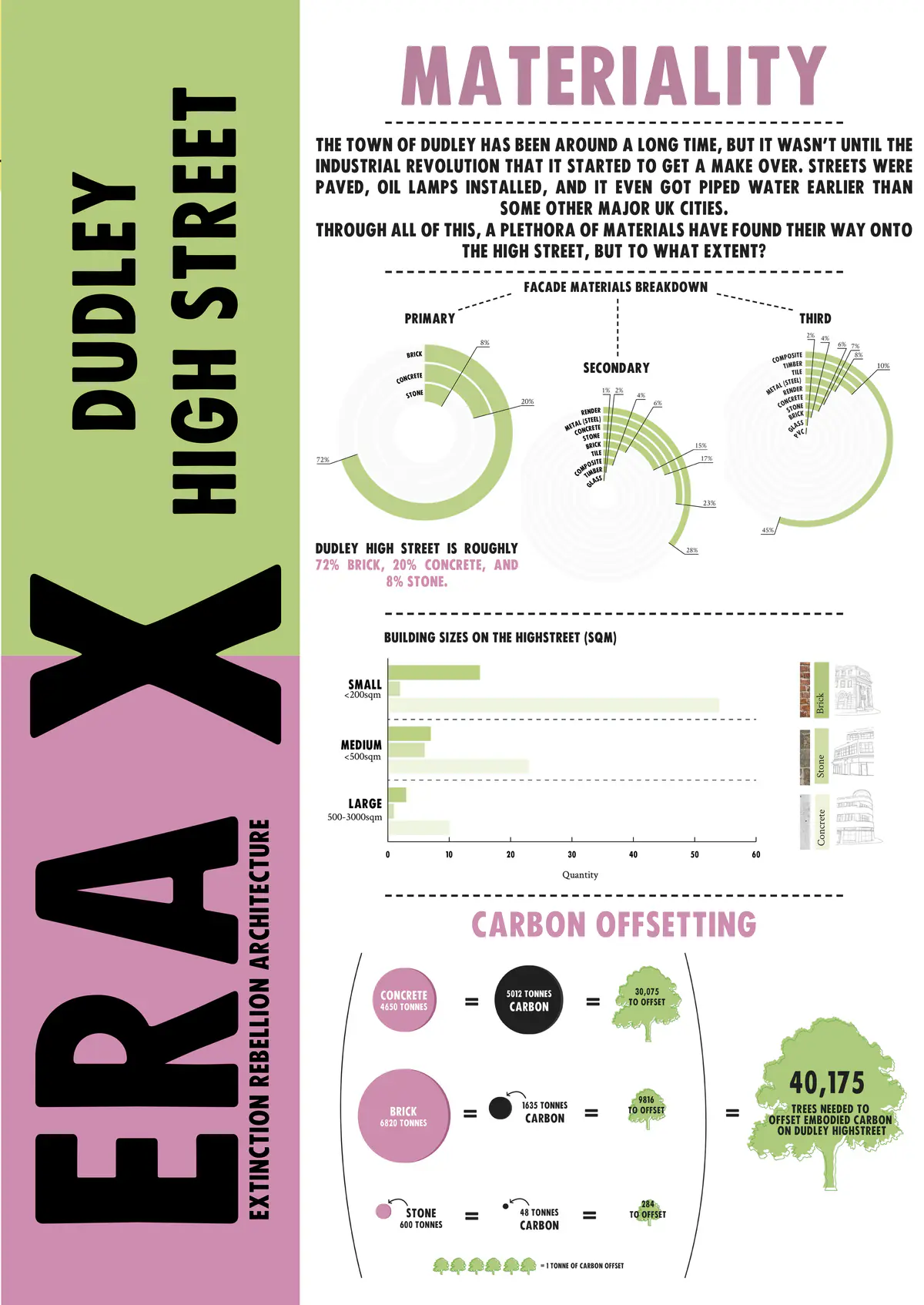
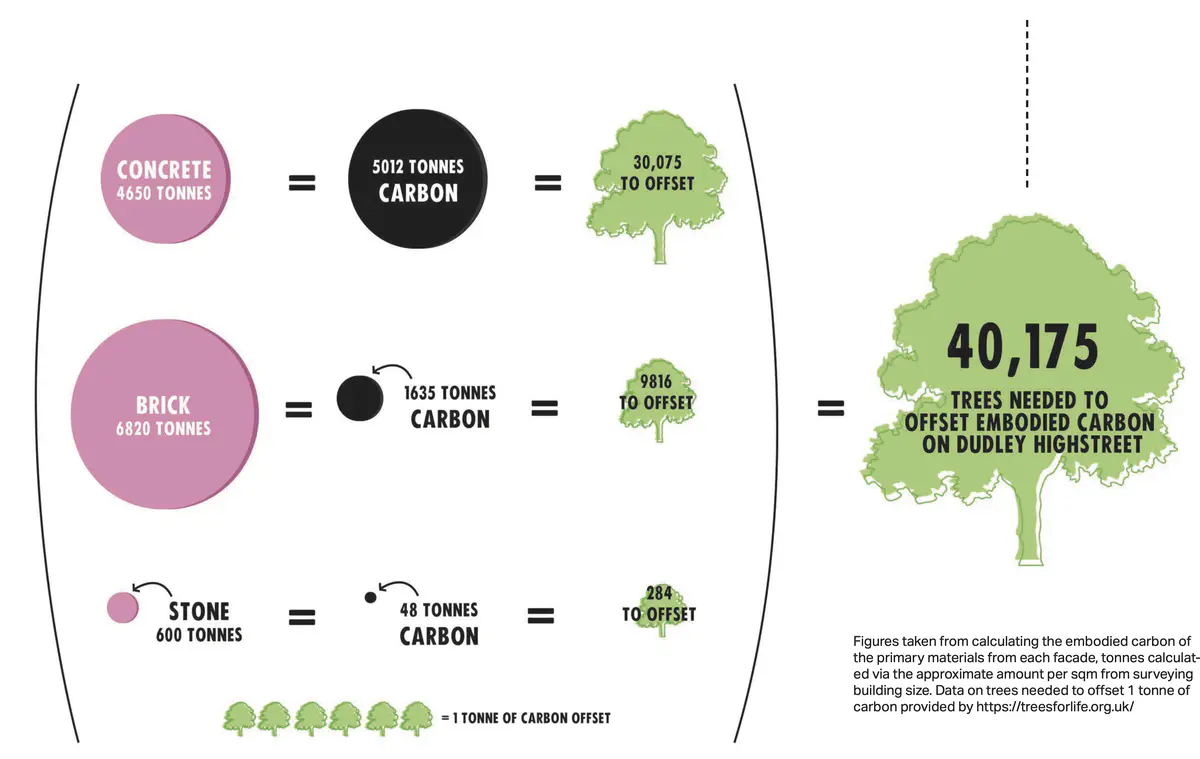
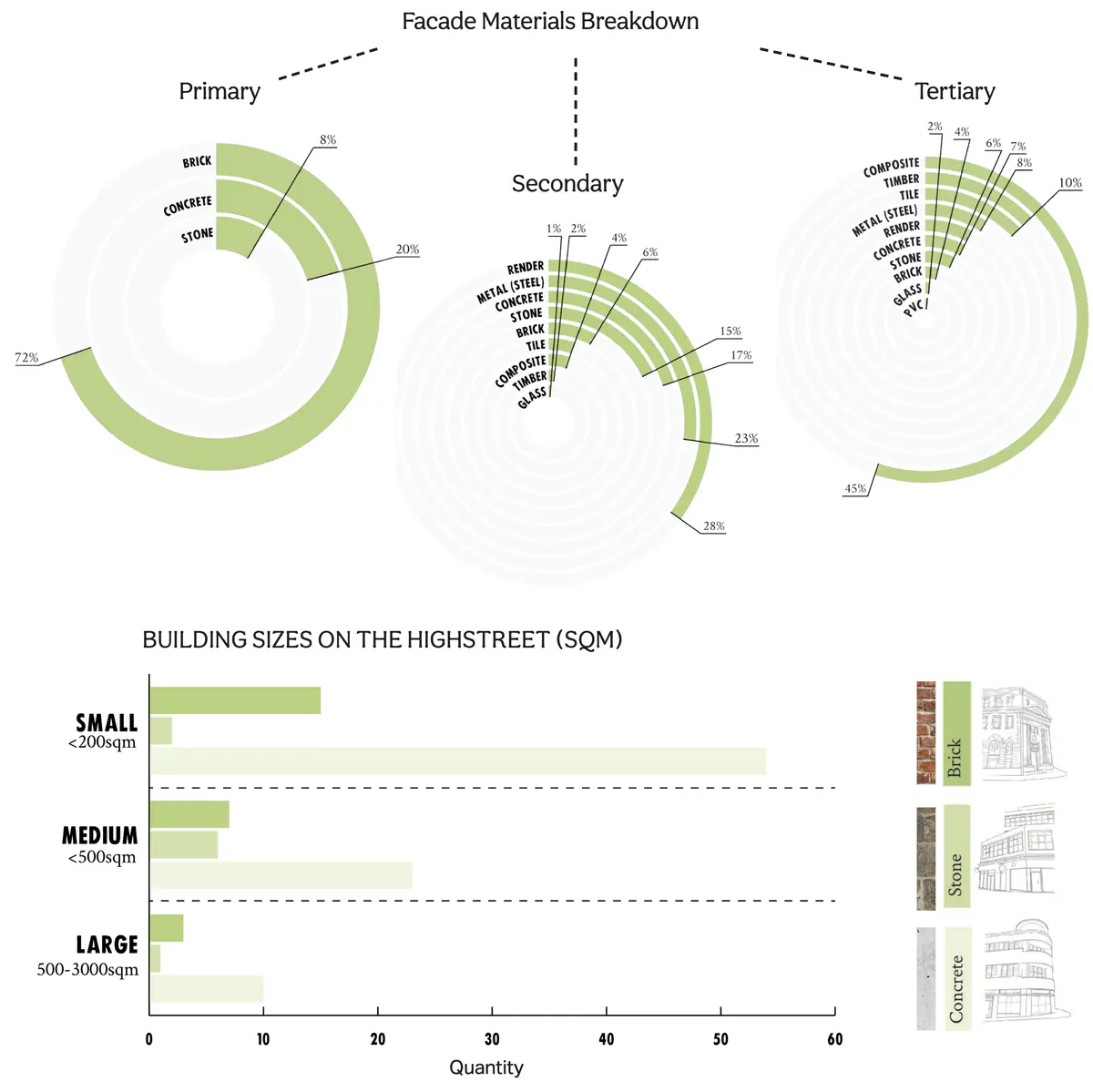
Figures taken from calculating the embodied carbon of the primary materials from each facade, tonnes calculated via the approximate amount per sqm from surveying building size. Data on trees needed to offset 1 tonne of carbon provided by https://treesforlife.org.uk/
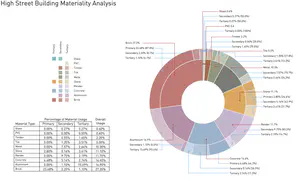
Charts break down the percentage of each Material featured on the façades, materials were surveyed in a hierarchy of appearance. Table looks at the variation of building size on the High Street.
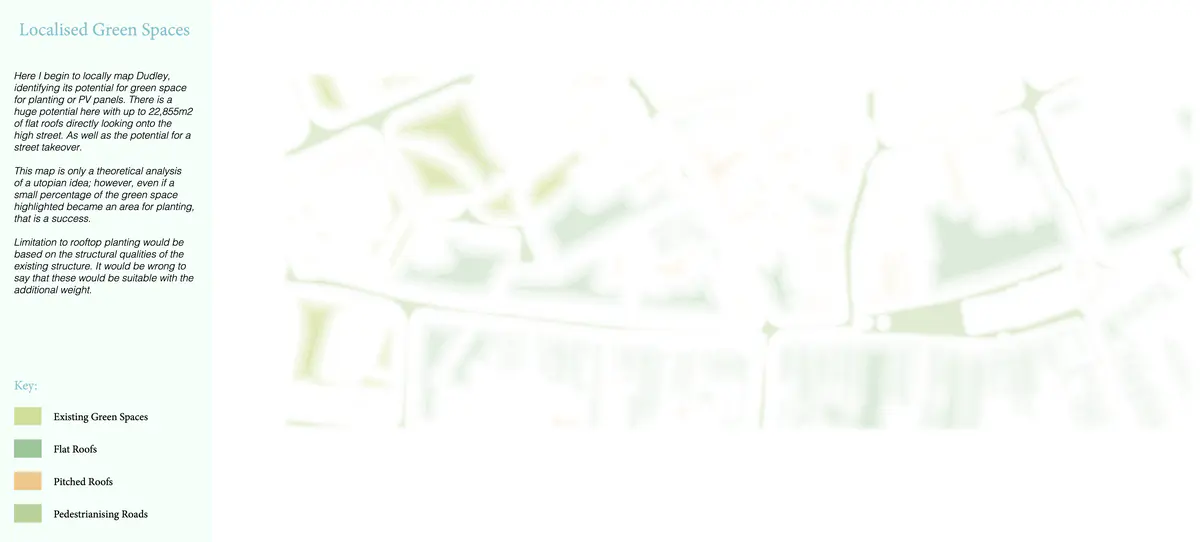
Localised Green Spaces
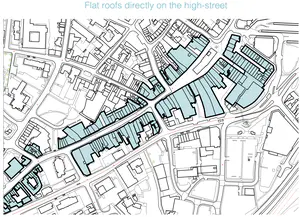
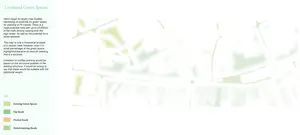
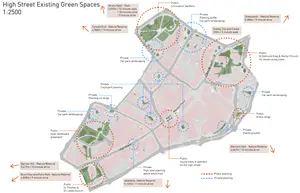
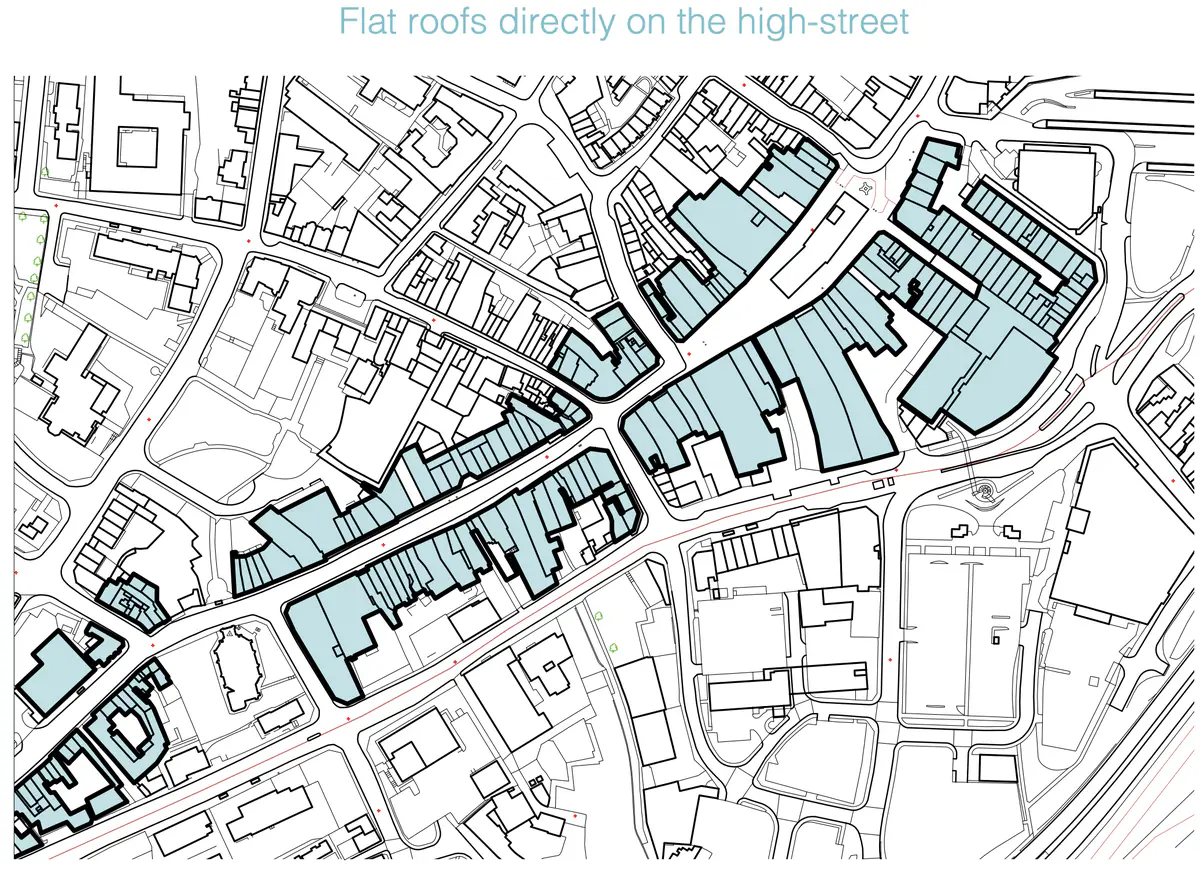
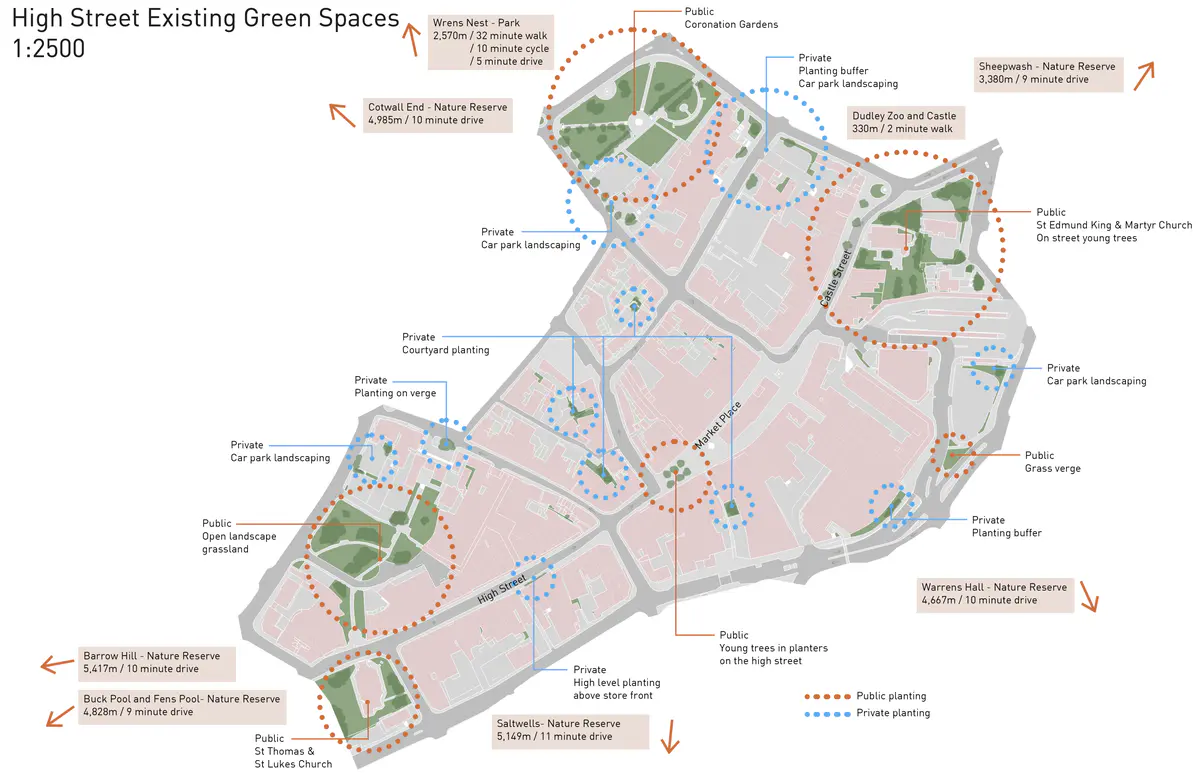
Here I begin to locally map Dudley, identifying its potential for green space for planting or PV panels. There is a huge potential here with up to 22,855m2 of flat roofs directly looking onto the high street. As well as the potential for a street takeover.
This map is only a theoretical analysis of a utopian idea; however, even if a small percentage of the green space highlighted became an area for planting, that is a success.
Limitation to rooftop planting would be based on the structural qualities of the existing structure. It would be wrong to say that these would be suitable with the additional weight.
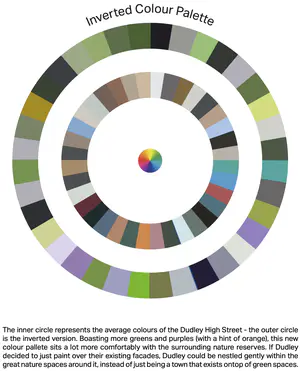
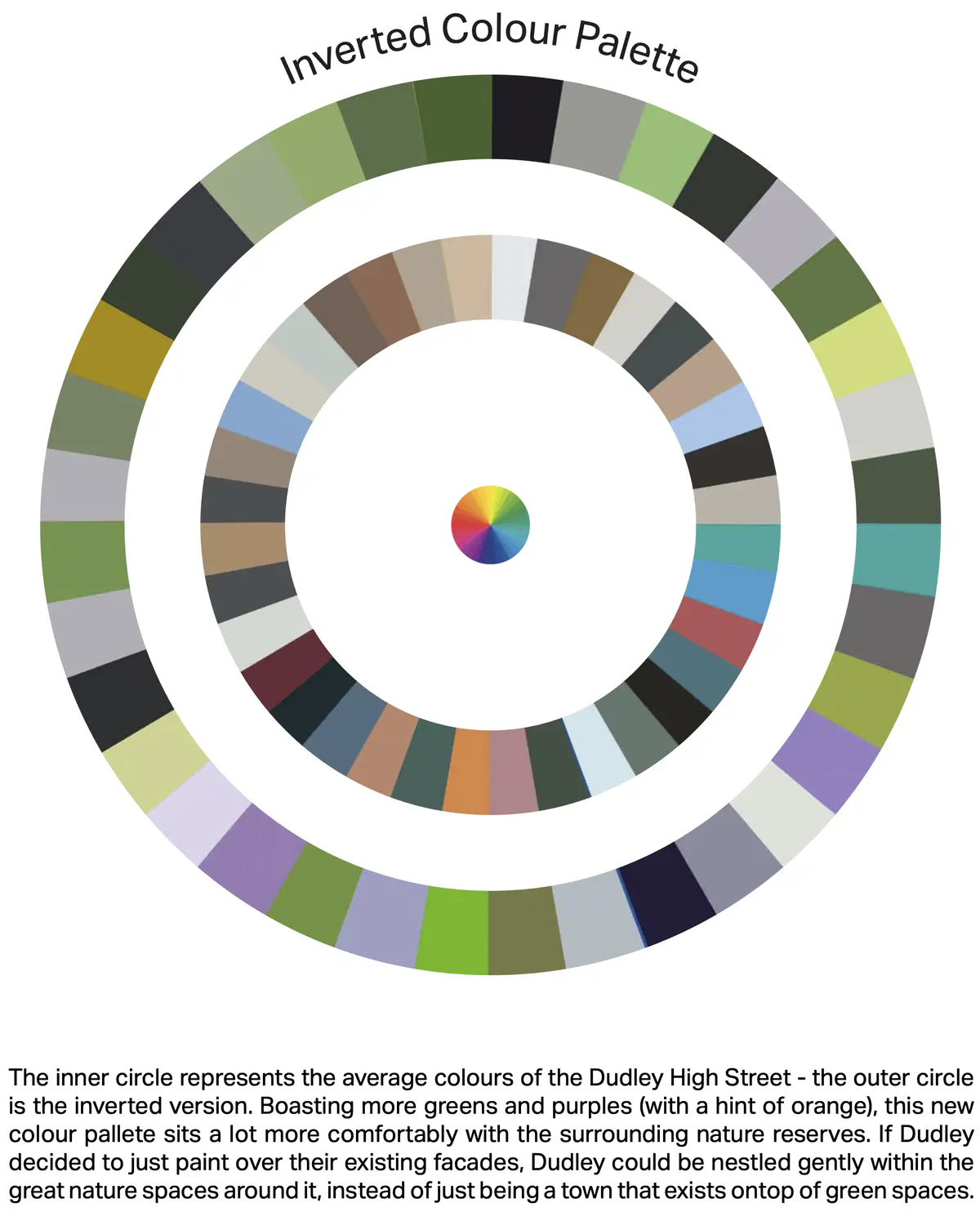
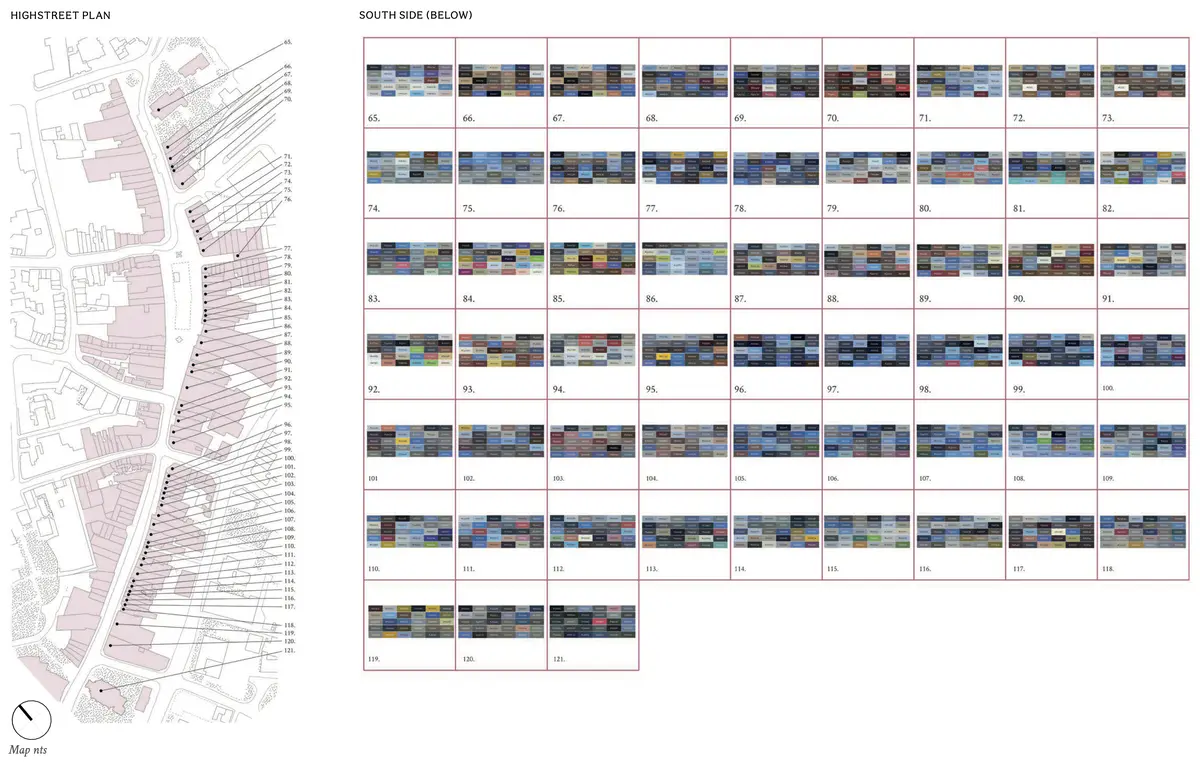
The inner circle represents the average colours of the Dudley High Street - the outer circle is the inverted version. Boasting more greens and purples (with a hint of orange), this new colour pallete sits a lot more comfortably with the surrounding nature reserves. If Dudley decided to just paint over their existing facades, Dudley could be nestled gently within the great nature spaces around it, instead of just being a town that exists ontop of green spaces.
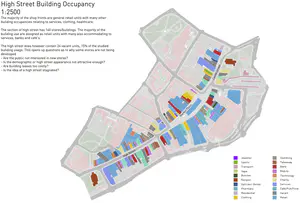
High Street Building Occupancy
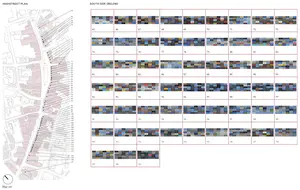
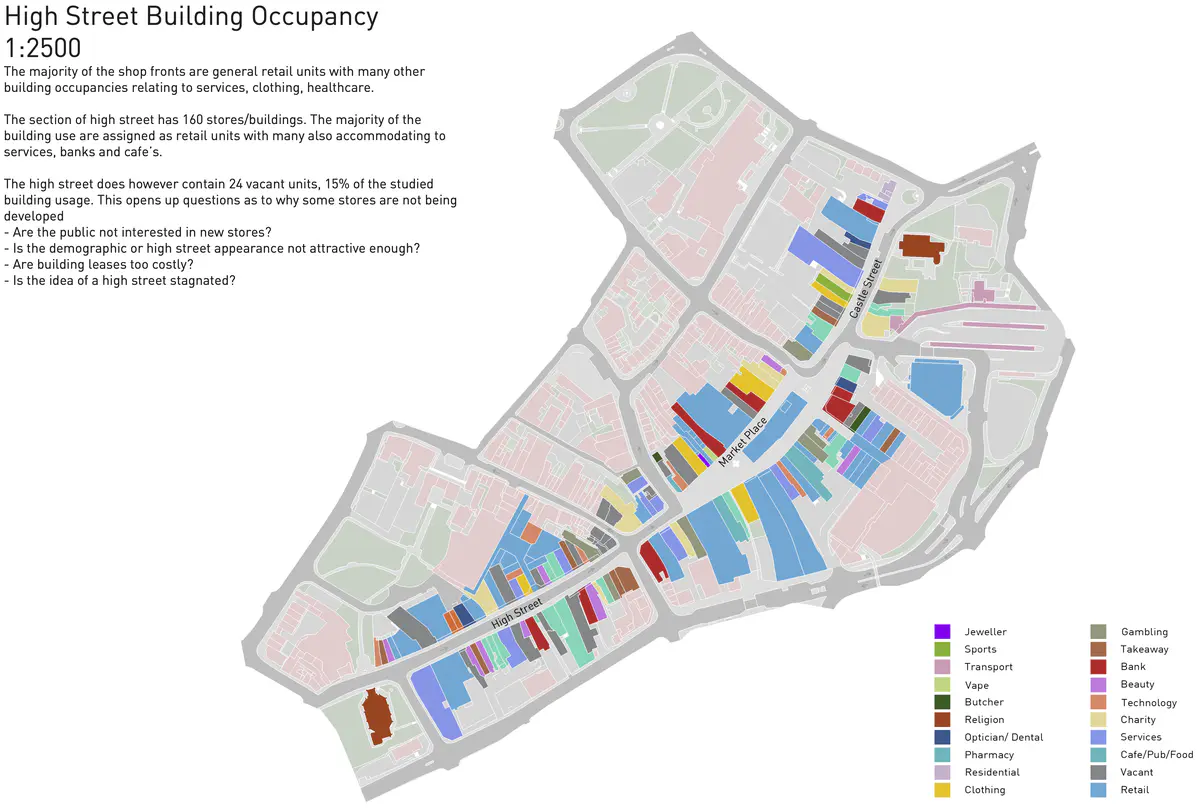
The majority of the shop fronts are general retail units with many other building occupancies relating to services, clothing, healthcare.
The section of high street has 160 stores/buildings. The majority of the building use are assigned as retail units with many also accommodating to services, banks and cafe’s.
The high street does however contain 24 vacant units, 15% of the studied building usage.
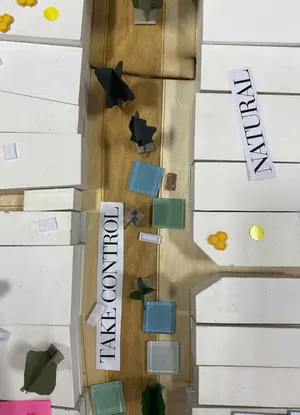
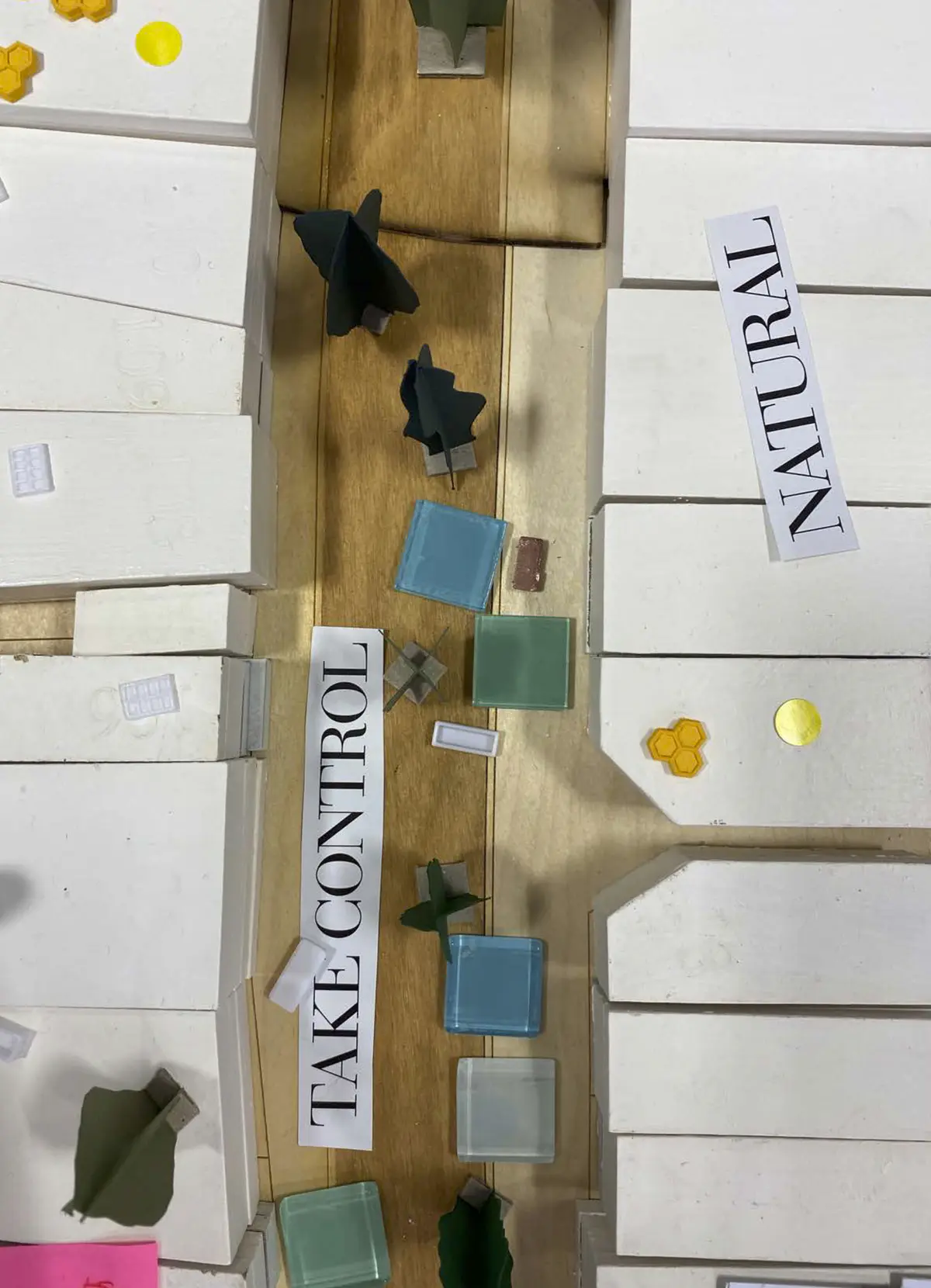
Looking to be the centrepiece of our exhibition, we proposed to create a site model of Dudley Highstreet at 1:200 scale with buildings modelled in a simple form. Local residents and visitors to the exhibition are then invited to decorate a chosen building to how they would envision it sat within the context of a greener Highstreet. We want to tie in our themes of biodiversity and materials by proposing that buildings can, and do, have the potential to be a lot healthier, sustainable, and interactive on the street. This site model also helps gain vital public opinions on the Highstreet and prompts discussion of areas most in need of attention.
To ensure that the model is utilising the MDF to the most efficient standard possible. First, the centres of the massing blocks have been hollowed out. This allows a reduction in materials used as other buildings can be cut in the centres of the model. Then the top is finished with a solid piece.
The waste material is placed into the recycling rack where other students can reuse it; otherwise, if the material left cannot be used for another project, it is recycled correctly by the university.
The model spanned just over 3.4m long and over 50cm wide. With the majority being cut from scrap woods that would fit the jigsaw of the shape, we were able to drastically cut down on waste. We also got some small benches and bee hives printed from recycled plastics, and used dried flowers as trees to represent the green spaces. Ultimately, the model seemed like a huge success, and really helped portray our ideas about Dudley High Street to those who came by. Everyone from Dudley who saw the model knew that it was the High Street, and interacted well with it. The size did make it difficult to move, especially to carry to the site, but it sat nicely in the centre of the the room and really drew people in to interact with it.
The model brought people in from outside to play with, write on, interact with. It became a spectacle for the public to come in and see what was happening and offer their ideas about what could be done.
The event was a success. Many people from the public (those who heard about the event, and those who just happened across it on the day) came in to interact with the model, which sat as the centre piece in the room. Kids liked to play with the pieces while the adults talked about things that could come from actions to help the High Street, not just leave it as is.
SOME OF THE KEY IDEAS WERE:
- The Shops need to be inviting for everyone. It’s no good having these places to go if people would rather take a bus to the next town.
- Just putting up boards across the windows is awful. Paint, Posters, Graffiti: Anything that actually makes the High Street look still alive is better than just wooden boards.
- More Green is needed. While it is obvious that there is a lack of Trees, many people wanted to push for these small bushes or planting spaces that could easily be implemented across the street.
- Spaces for public events or for people to at least gather at. While there is the Market and Fountain, it is not enough for the people of Dudley.
- Something needs to be done about the cars on the High Street. Some were Pro-Removal of all Cars, while some just wanted to limit when they could access the High Street.
Following the exhibition we created a series of drawings with our own interpretation of Sarah Wigglesworth ‘The Dining Table’ drawing. The drawings are a perfect representation of the our interactive model at the ERA Environmental Exhibition and Event. Showing the interaction the public had with the model, as well as the conversations that were held around the model.
Explore The History Of Site Voids - This will provide an opportunity to reimplement these to allow vertical green corridors to occur.
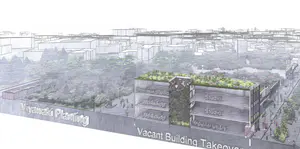
Explore Vacant Buildings - To avoid damaging an already deteriorating high street, I aim only to take over vacant plots.
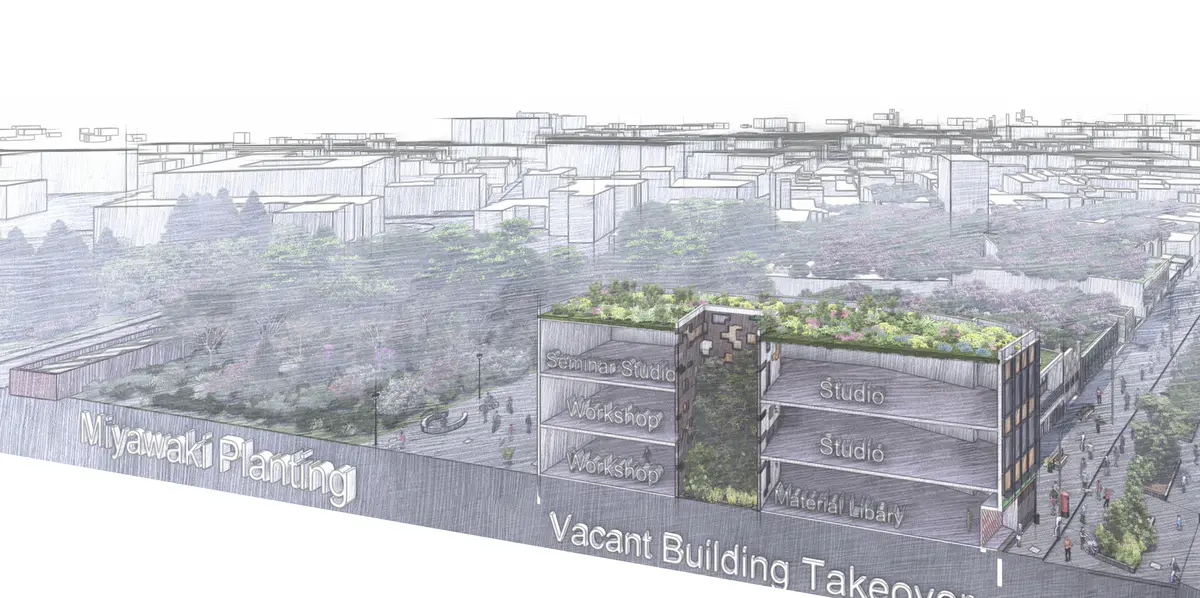
Investigate the opportunity for Miyawaki planting - understand the conditions required to grow a sustainable material source on-site, including ground, water, and space conditions.
It takes over a building that leads directly to an open space where a community hub is the centre of the thesis, offering education, community engagement and material celebration.
Localising Material Accessibility
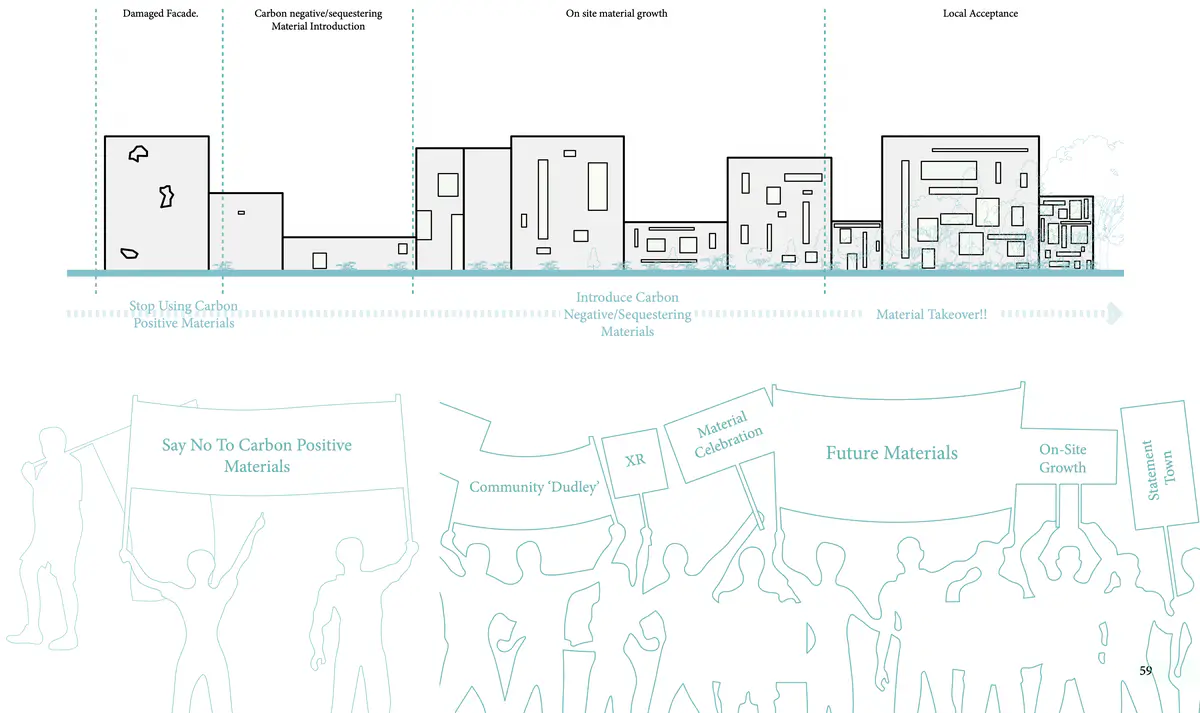
During my initial walk through the High Street of Dudley, I noticed an inevitable decline in the area. There were vacant shops, but those open had apparent facade damage. For the area to thrive, there needs to be an aesthetical uplift. Here I began to question how to make the repairs. On the one hand, one could complete a like for like repair with a deep clean to provide a new lease of life to achieve an aesthetical value. Alternatively, the repairs could be a status of where the street aims to be in the future. To achieve a statement, the implementation of repair work needs to stand out. It needs to be futuristic, a bold contrast to the existing.
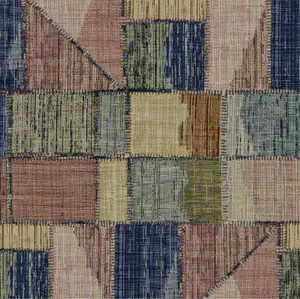
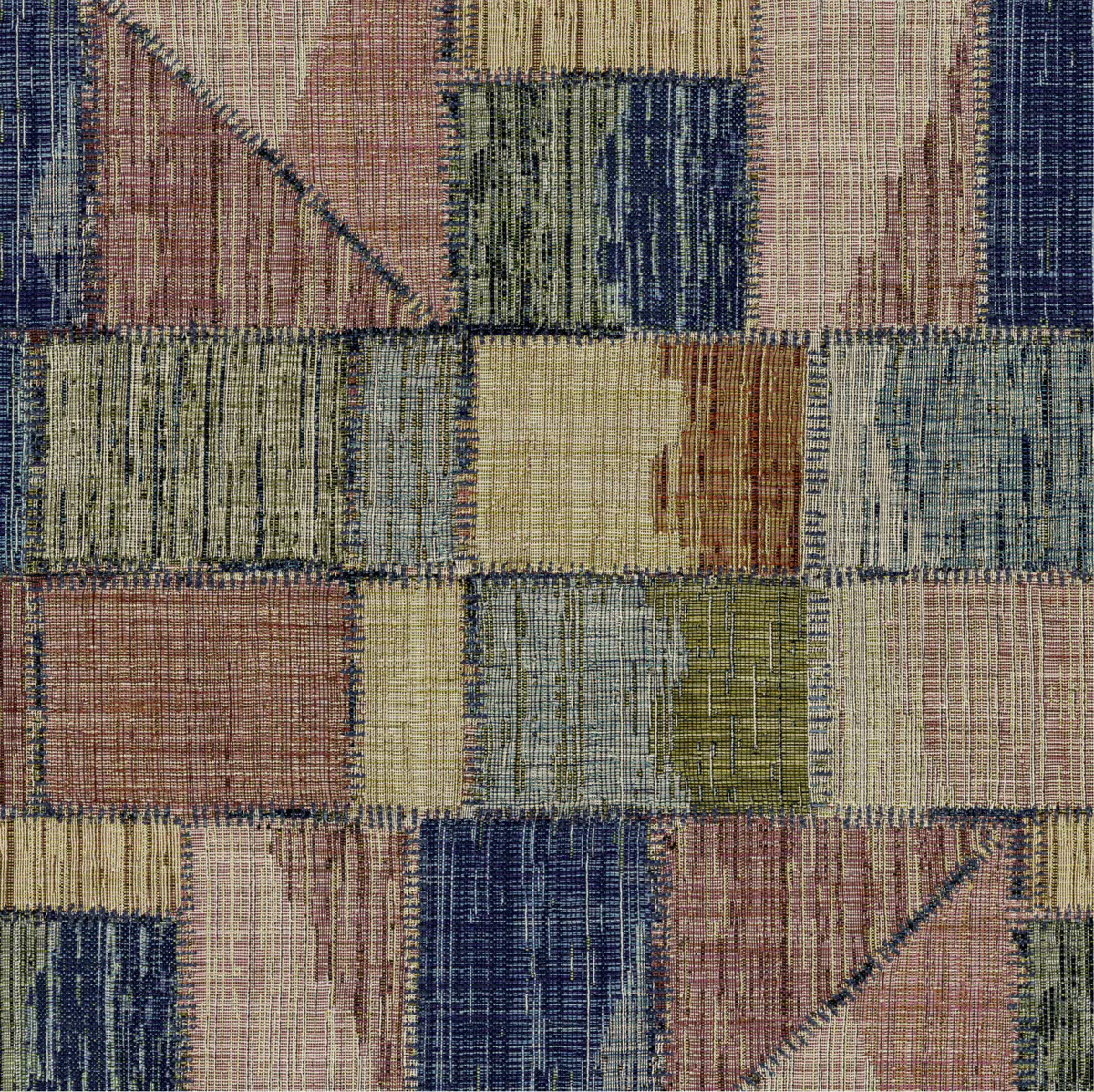
At this point, I decided that after being informed of the damage the built environment has on the climate crisis, only carbon zero/ carbon sequestering materials would be present during repairs. This does not aim to destroy existing buildings but instead carefully implement repairs creating a patchwork effect across the street. This would then grow over time as more repair work is required.
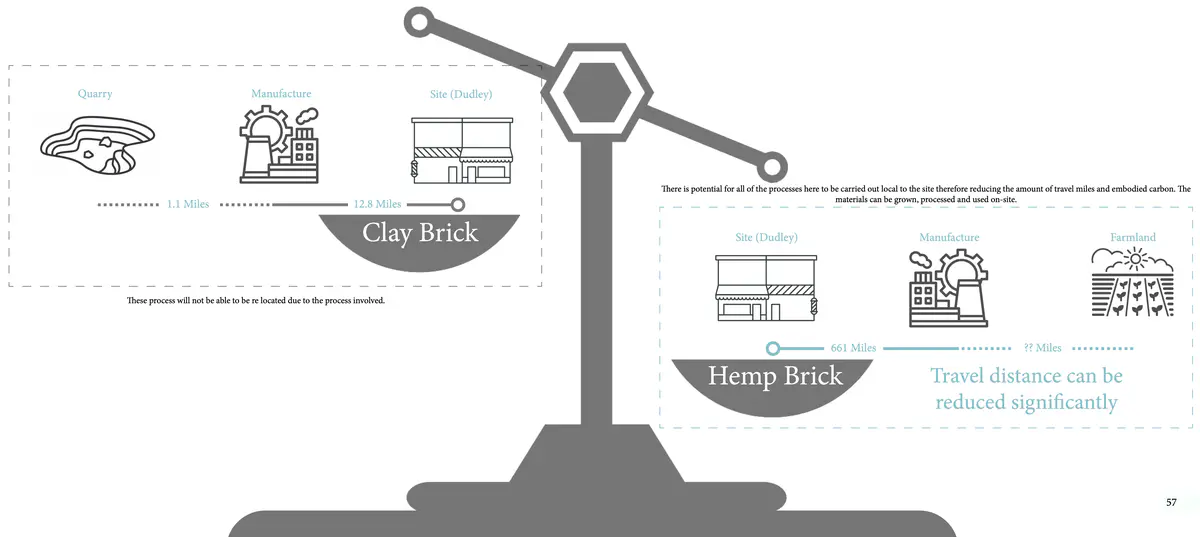
Over time, the high street would transform into a zero-carbon environment. The manufacturing and growth of these materials need to be local, so consideration is vital. This provides an opportunity for the site to be a material producer itself.
Street scale patchwork
Investigating Facade Damage will highlight where the repair needs to be undertaken.
It is creating an irregular pattern of repair that evolves.
Only intervene when necessary; this proposal will not ‘repair what does not need fixing’ as it appreciates there could be a negative effect on an already declining high street.
Repairs will be constructed with the materials grown on the street as part of the Macro-scale intervention.
The population of Dudley in 2021 is circ. 80,000 and including the wider borough totals 313,000.
For one person on the average diet, roughly 2.6 Hectares of farm land is required. A family of four, just over 10 Hectares. A population of 313,000 required 813,800 Hectares, the equivalent of 1,162 football fields or 707,652,174 car parking bays.
FEEDING DUDLEY REQUIRES 1,162 FOOTBALL FIELDS OF FARM LAND
Thesis Concept Image - The Farm House
Taking a fun and more literal approach for providing local food production onto the high street, I looked at layering a farm growing different fruits, vegetables and meat products into the same structure to view the absurdity of growing, processing and packaging within a single structure. Ultimately the project would be as close to being a closed system as possible, where food grown could be fed to the animals and the waste from the animals will be used as fertiliser from the food. Air flow and lighting would not only be critical for the animals, but it also allows the fruit and vegetables to grow faster and more efficiently.
The processes within the Farm House would be very energy intense due to the amount of heating, water and lighting that will be required to house the animals and grow the crops. The project utilises conventional farming methods, ploughing, seeding etc., but without the harmful pesticides that would be usually applied. The farming problem of space efficiency is partially targeted in this proposal. Per m2 in plan does contain a greater yield due to the floor layering, however per m2 of gross internal floor area the yield efficiency remains. To ultimately increase overall yield per m2 aeroponics should be applied to massively increase yield and decrease water consumption.
THESIS PROPOSAL
The redevelopment of the high street is a re-envisaged perception of what the high street is and what it will become. A future look at what the high street will become, with mixed use residential and food growth structure to create dense living accommodation and localised food growth which prevents the need to contribute to deforestation and loss of biodiversity from urbanisation.
As part of the schemes wider aims, the high street and surrounding roads will become part of a network of green corridors, where pedestrian footfall/cycling can increase and the use of polluting vehicles will be greatly reduced. The idea of greatly increasing the density of vegetation along roads and reducing lanes will not only improve the rate of absorbing carbon dioxide, but also reduce noise and reduce temperature spots. The Miyawaki planted method would be used where ever possible to create dense areas of trees and shrubs, as well as quickly create new living conditions for new biodiversity.
The primary focus for the building will be the localised food growth in the vertical farms, several floors of food growth will create a new economy centred around the high street, removing the need to import fresh food from farms from across the country or on the other side of the world. The environment within the farms will be climate controlled, allowing the farms to adjust their climate to the optimum for the specific food. The density at which food can be grown in is almost 400 times greater than conventional farming, which greatly reduces the need to create new farms.
The residential aspects pairs with the farm, in bringing a new generation of people to live above the high street. The new vision of the high street would become an attraction point for people to not only visit but to live in as well. Access to land converted from roads and paving to nature will create value and attraction to the area once again. Eventually the low income stores will transition to stores that cater to the new environment.
This project targets all the XR themes directly or indirectly.
Air & Biodiversity - Creating new and preventing the loss of woodland and habitats.
Food - Growing food local and a much greater yield.
Water - Greatly reducing the resource requirement during farming.
Materiality - Managing sustainable usage of the deconstructed buildings and sourcing of the proposed.
Community - Creating new environments for communities to interact with each other.
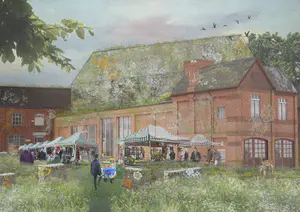
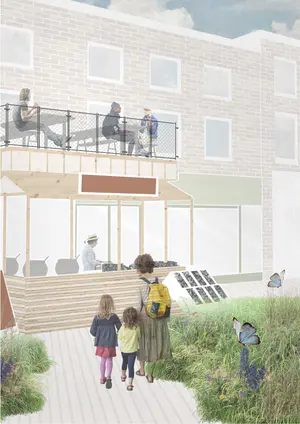
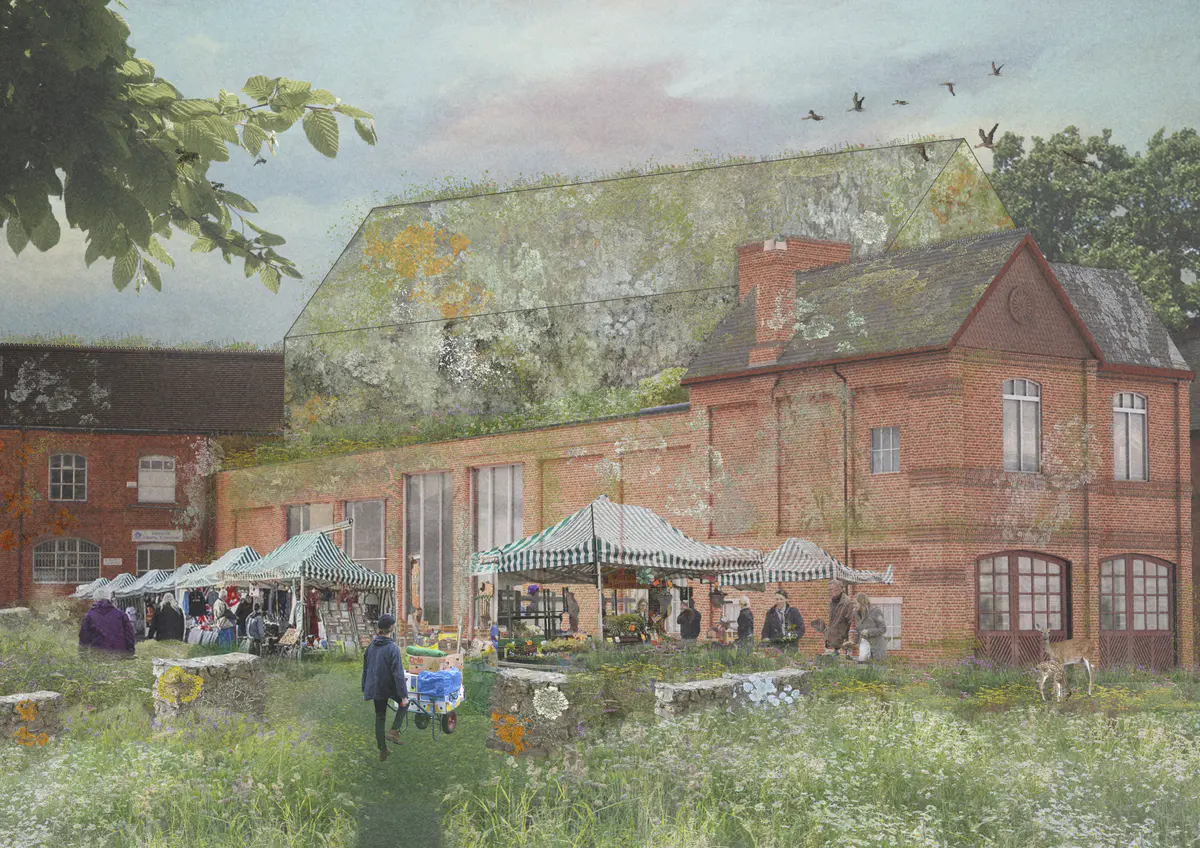
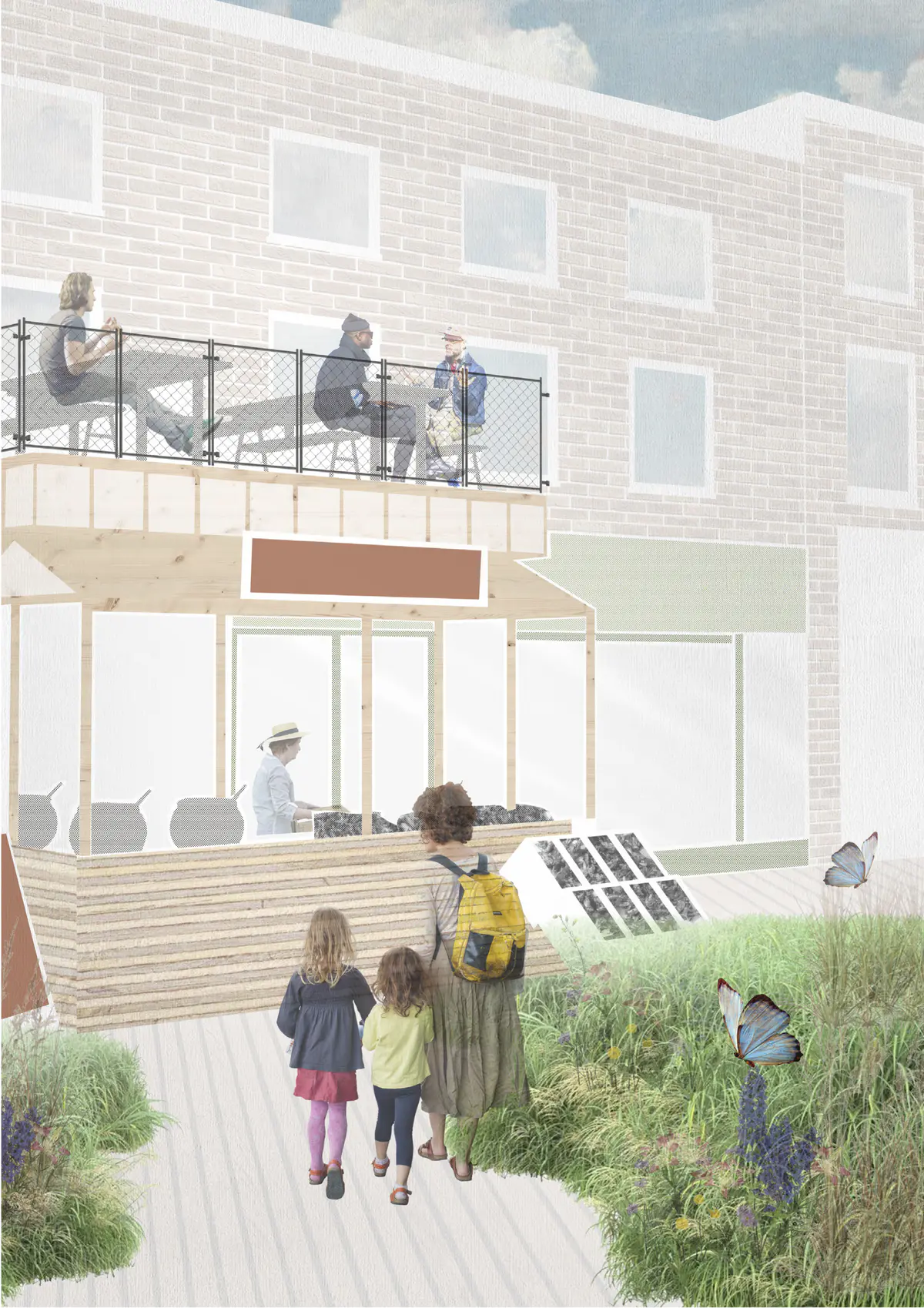
This visual represents the vision for the thesis, buildings covered in lichens, air purifying plants and community activities held on the Highstreet. This visual focuses in on the proposed site for the building and shows expression of a raised new build component on site as well as a full and wild landscaping plan.
Water Collection
With this information I can begin to map out 1038m2 of miyawaki forests.
It is crucial that the forests do not use more water than stored as then the project isn’t zero carbon as it would require fresh water. It is important that the water collected is sufficient for this project to work. This data also provides the information to how much storage is required on the site.
Creating a stronger connecting between the current food spaces by:
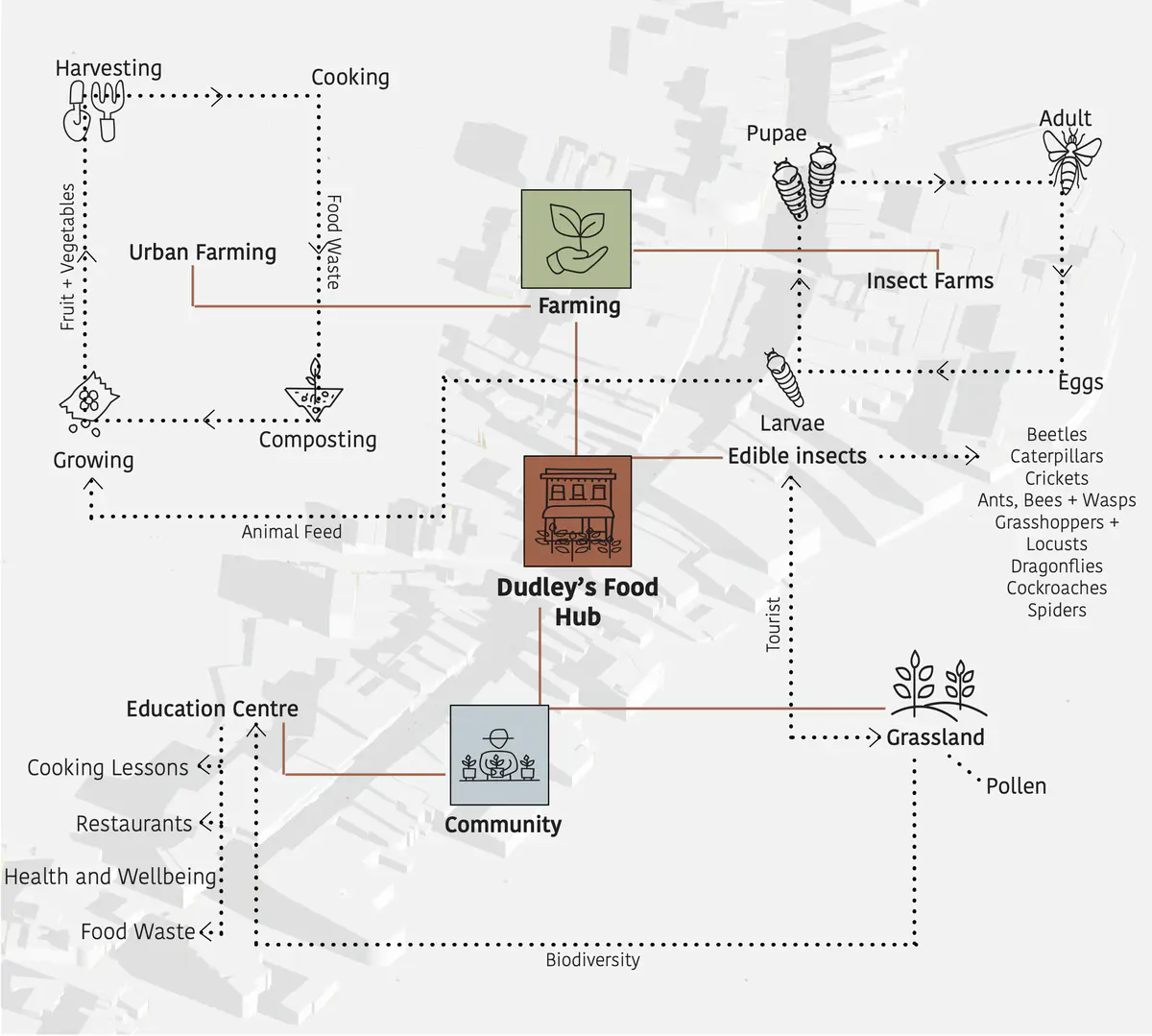
- Pedestrianising the road with a grassland
- Utilising abandoned building for education centres and community farming.
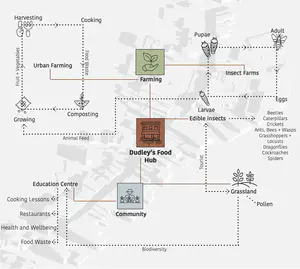
Linked to the Food Hub is an education centre sharing information on edible insects and Dudley’s biodiversity. Also offers insect cooking lessons to the local community and schools.
Immersed within the grassland is areas where existing buildings can extend out onto the street to create a stronger bond with new sustainable environment.
Redesigning the Market Place with more levels of outdoor seating to create a new experience and environment of eating food on the High Street.
Gardening and insect farming spaces integrated within the buildings. By bringing all the food production onto the High Street will help reduce food waste and also offer fresh produce to the locals.
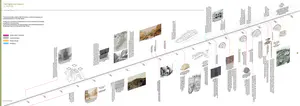
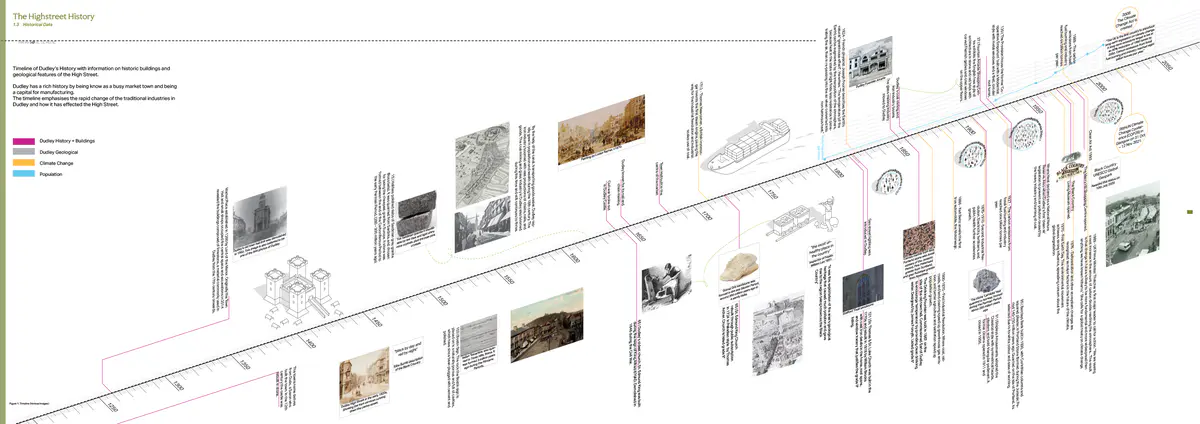
Timeline of Dudley’s History with information on historic buildings and geological features of the High Street.
Dudley has a rich history by being know as a busy market town and being a capital for manufacturing.
The timeline emphasises the rapid change of the traditional industries in Dudley and how it has effected the High Street.
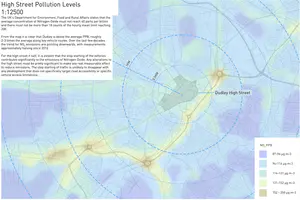
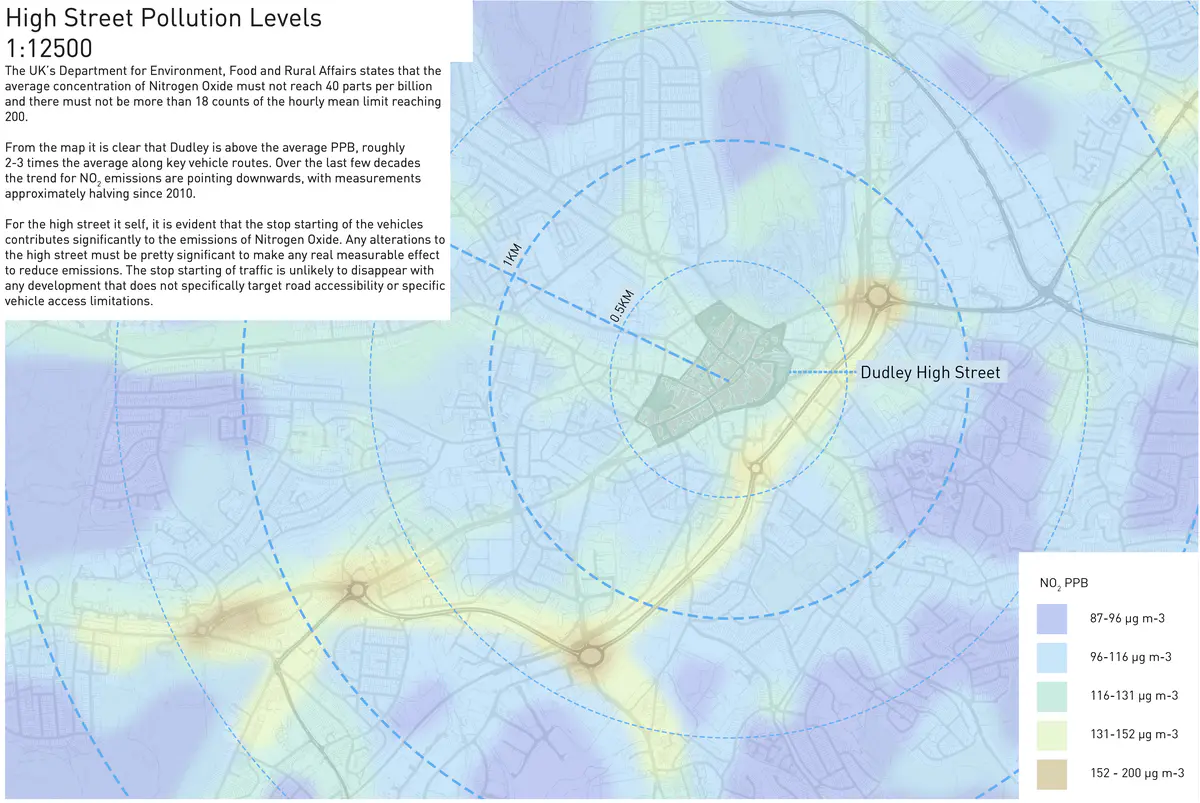
High Street Pollution Levels
The UK’s Department for Environment, Food and Rural Affairs states that the average concentration of Nitrogen Oxide must not reach 40 parts per billion and there must not be more than 18 counts of the hourly mean limit reaching 200.
From the map it is clear that Dudley is above the average PPB, roughly 2-3 times the average along key vehicle routes. Over the last few decades the trend for NO2 emissions are pointing downwards, with measurements approximately halving since 2010.
For the high street it self, it is evident that the stop starting of the vehicles contributes significantly to the emissions of Nitrogen Oxide. Any alterations to the high street must be pretty significant to make any real measurable effect to reduce emissions. The stop starting of traffic is unlikely to disappear with any development that does not specifically target road accessibility or specific vehicle access limitations.