Dudley Time Portal

Items tagged: Pollution
Localising Material Accessibility
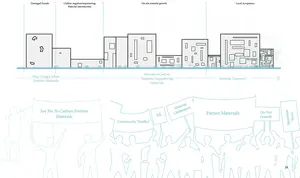
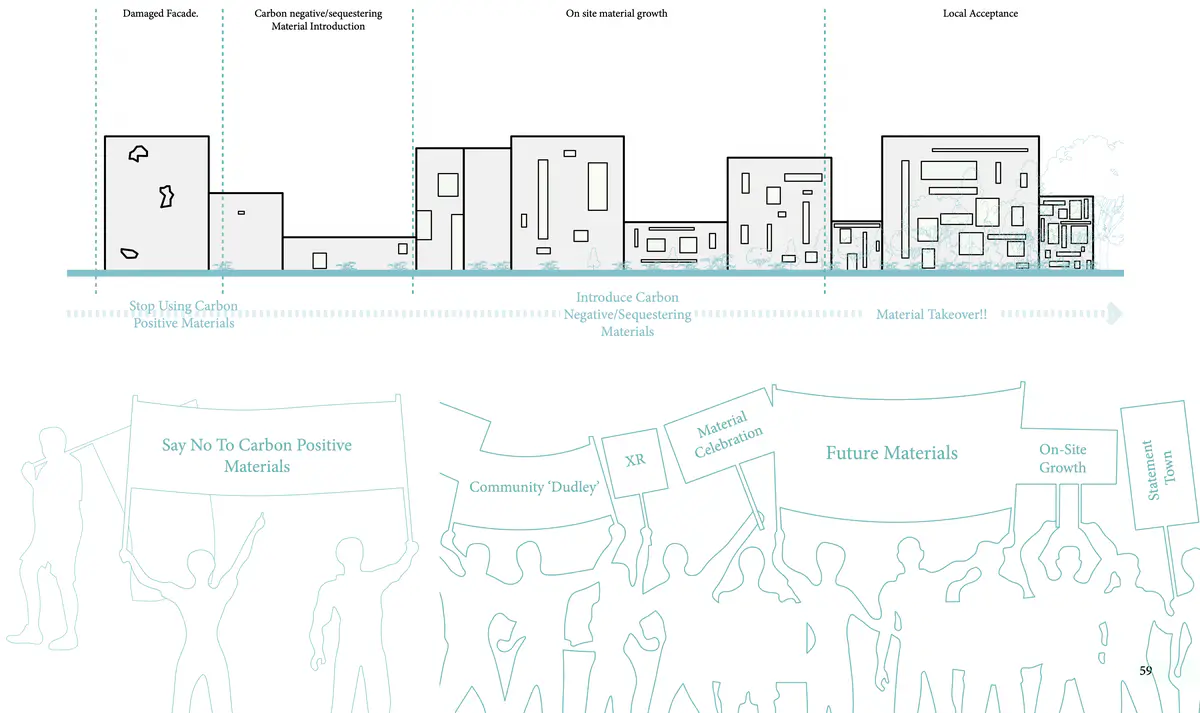
During my initial walk through the High Street of Dudley, I noticed an inevitable decline in the area. There were vacant shops, but those open had apparent facade damage. For the area to thrive, there needs to be an aesthetical uplift. Here I began to question how to make the repairs. On the one hand, one could complete a like for like repair with a deep clean to provide a new lease of life to achieve an aesthetical value. Alternatively, the repairs could be a status of where the street aims to be in the future. To achieve a statement, the implementation of repair work needs to stand out. It needs to be futuristic, a bold contrast to the existing.

At this point, I decided that after being informed of the damage the built environment has on the climate crisis, only carbon zero/ carbon sequestering materials would be present during repairs. This does not aim to destroy existing buildings but instead carefully implement repairs creating a patchwork effect across the street. This would then grow over time as more repair work is required.

Over time, the high street would transform into a zero-carbon environment. The manufacturing and growth of these materials need to be local, so consideration is vital. This provides an opportunity for the site to be a material producer itself. - Ryan Cooksey Ban Materials.png
Localising Material Accessibility During my initial walk through the High Street of Dudley, I noticed an inevitable decline in the area. There were vacant shops, but those open had apparent facade damage. For the area to thrive, there needs to be an aesthetical uplift. Here I began to question how to make the repairs. On the one hand, one could complete a like for like repair with a deep clean to provide a new lease of life to achieve an aesthetical value. Alternatively, the repairs could be a status of where the street aims to be in the future. To achieve a statement, the implementation of repair work needs to stand out. It needs to be futuristic, a bold contrast to the existing. At this point, I decided that after being informed of the damage the built environment has on the climate crisis, only carbon zero/ carbon sequestering materials would be present during repairs. This does not aim to destroy existing buildings but instead carefully implement repairs creating a patchwork effect across the street. This would then grow over time as more repair work is required. Over time, the high street would transform into a zero-carbon environment. The manufacturing and growth of these materials need to be local, so consideration is vital. This provides an opportunity for the site to be a material producer itself.
Map Diagram Material Transport Climate Change Potential Opportunity System Decay Aesthetic Future Imagination Regenerative Growing Community Identity Pollution Industry Sustainable Connection Nature Biodiversity Creatures Doughnut Architecture
View story
It is 5pm in the evening and the shops are still full with customers. David has had a long and busy working day at the shop and can now finally take a break, and so he ventured out onto the street to get fresh air. David randomly bumped into an old customer, they both instantly recognised each other, and decided to share some conversations on a nearby bench. The old customer could not stop pointing out many of positive changes on the High Street since he last visited. He noticed the fresh air from more vegetation and less pollution, outdoor seating and a thriving enjoyable space.
Creative writing Imagining Commerce Interacting Conversation Imagination Future Lingering Relaxing Friendliness Change Pollution Plantlife Nature Happiness Joy Thriving People
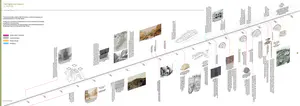
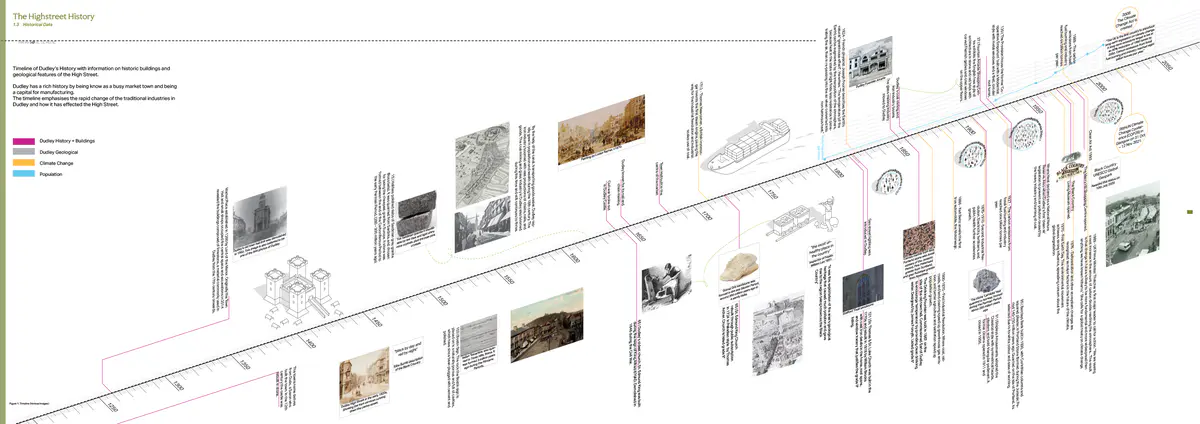
Timeline of Dudley’s History with information on historic buildings and geological features of the High Street.

Dudley has a rich history by being know as a busy market town and being a capital for manufacturing.

The timeline emphasises the rapid change of the traditional industries in Dudley and how it has effected the High Street. - Sita Patel Group Timeline.png
Timeline of Dudley’s History with information on historic buildings and geological features of the High Street. Dudley has a rich history by being know as a busy market town and being a capital for manufacturing. The timeline emphasises the rapid change of the traditional industries in Dudley and how it has effected the High Street.
Drawing Text Diagram Past Hiding Material Commerce Economics Architecture Words Water Transport Making Industry Vehicle Colour Pollution Fairness Light Growing Nature
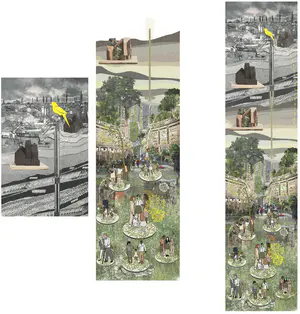
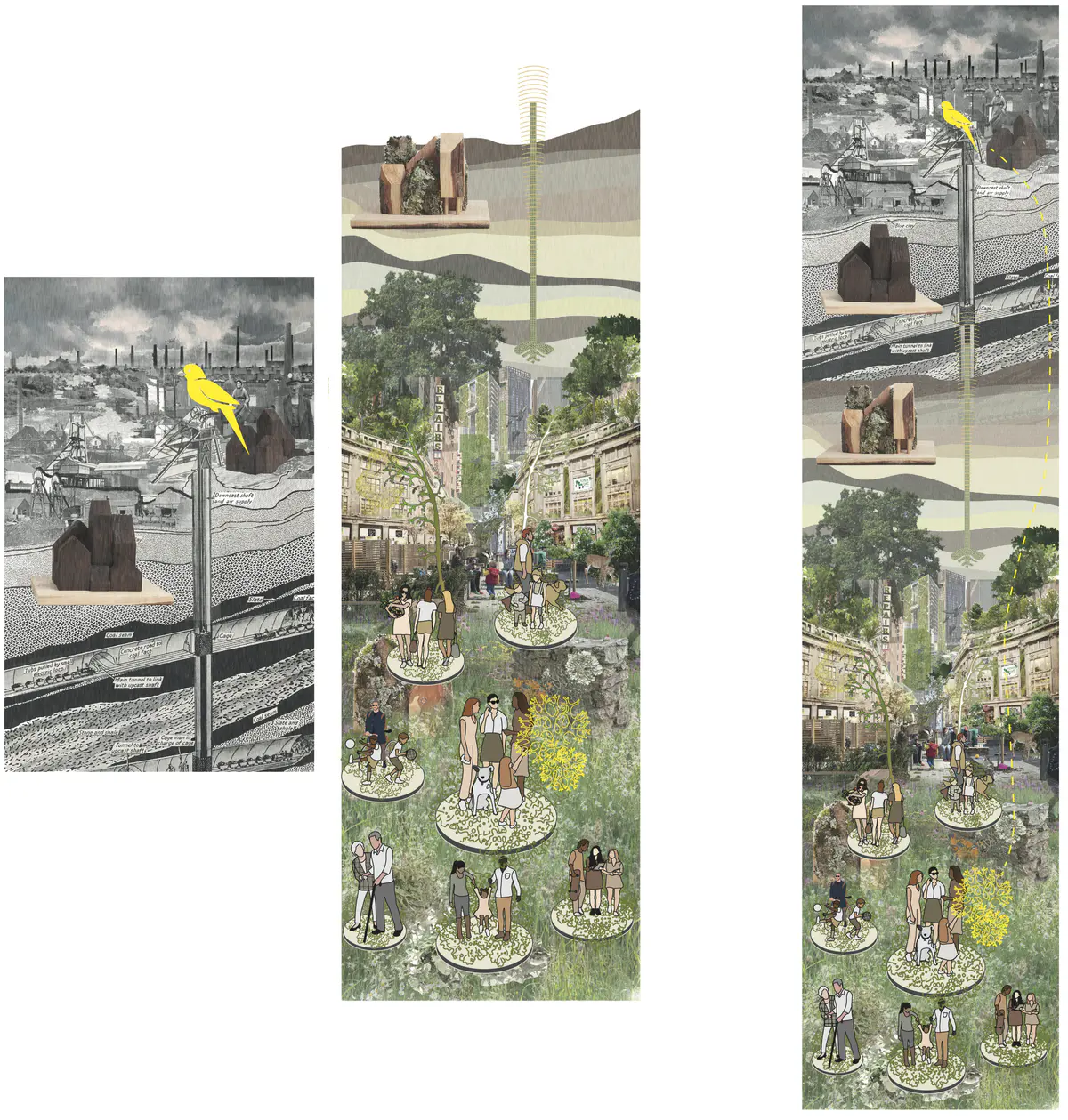
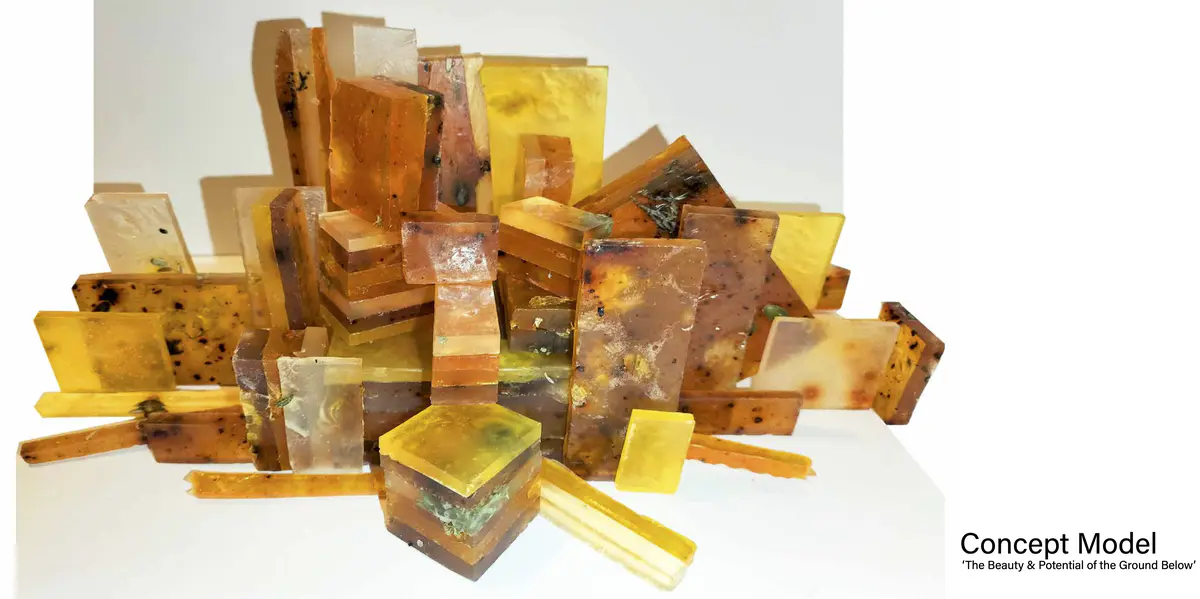
The yellow canary of the mines, a symbol of protection for miners spending time in highly polluted areas. The yellow lichen becomes the new symbol for Dudley, protecting inhabitants through carbon sequestration & clean air. - Michelle Gartside Concept Collage.png
The yellow canary of the mines, a symbol of protection for miners spending time in highly polluted areas. The yellow lichen becomes the new symbol for Dudley, protecting inhabitants through carbon sequestration & clean air.
Collage Drawing Imagining Model Architecture Nature Plantlife Growing Imagination Life Air Light Water Potential Opportunity Creatures Community Safety Industry Pollution
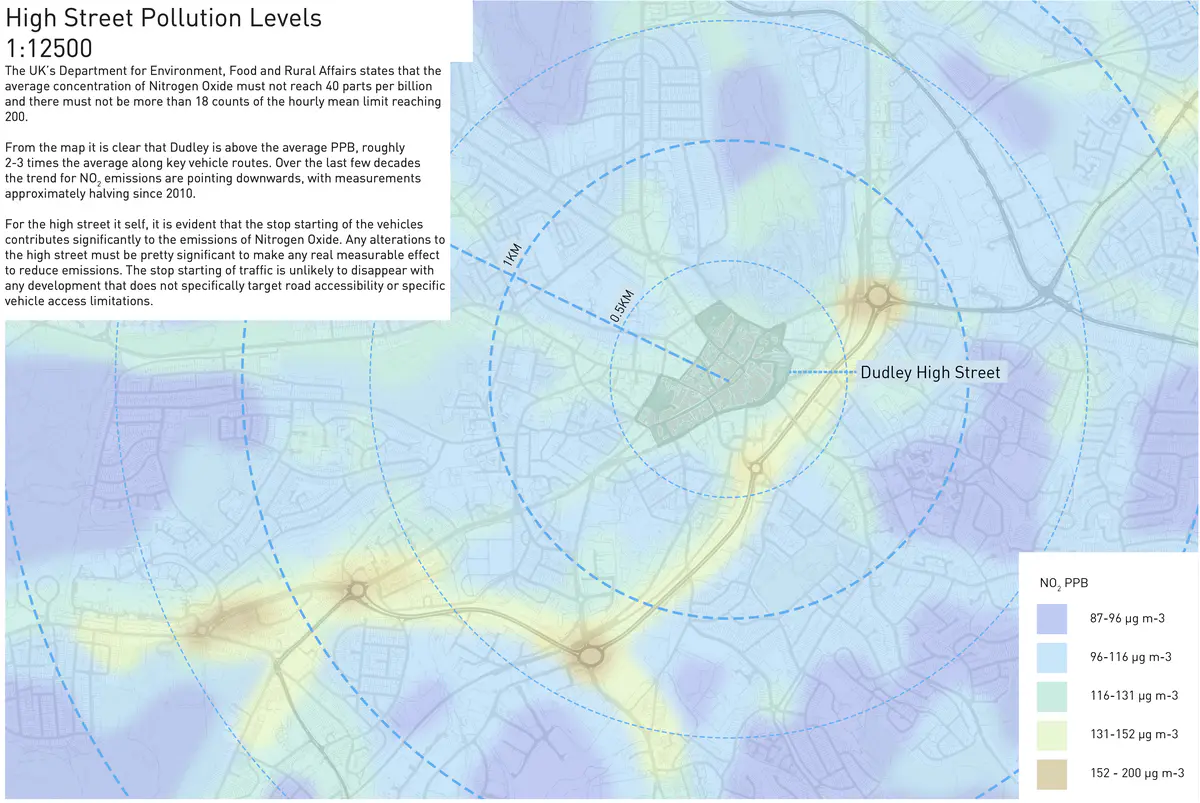
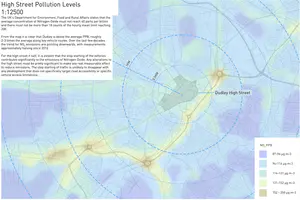
High Street Pollution Levels 

The UK’s Department for Environment, Food and Rural Affairs states that the average concentration of Nitrogen Oxide must not reach 40 parts per billion and there must not be more than 18 counts of the hourly mean limit reaching 200.

From the map it is clear that Dudley is above the average PPB, roughly 2-3 times the average along key vehicle routes. Over the last few decades the trend for NO2 emissions are pointing downwards, with measurements approximately halving since 2010.

For the high street it self, it is evident that the stop starting of the vehicles contributes significantly to the emissions of Nitrogen Oxide. Any alterations to the high street must be pretty significant to make any real measurable effect to reduce emissions. The stop starting of traffic is unlikely to disappear with any development that does not specifically target road accessibility or specific vehicle access limitations. - Matthew Hewitt Pollution Levels.png
High Street Pollution Levels The UK’s Department for Environment, Food and Rural Affairs states that the average concentration of Nitrogen Oxide must not reach 40 parts per billion and there must not be more than 18 counts of the hourly mean limit reaching 200. From the map it is clear that Dudley is above the average PPB, roughly 2-3 times the average along key vehicle routes. Over the last few decades the trend for NO2 emissions are pointing downwards, with measurements approximately halving since 2010. For the high street it self, it is evident that the stop starting of the vehicles contributes significantly to the emissions of Nitrogen Oxide. Any alterations to the high street must be pretty significant to make any real measurable effect to reduce emissions. The stop starting of traffic is unlikely to disappear with any development that does not specifically target road accessibility or specific vehicle access limitations.
Map Diagram Pollution Traffic Vehicle
The population of Dudley in 2021 is circ. 80,000 and including the wider borough totals 313,000.

For one person on the average diet, roughly 2.6 Hectares of farm land is required. A family of four, just over 10 Hectares. A population of 313,000 required 813,800 Hectares, the equivalent of 1,162 football fields or 707,652,174 car parking bays.

FEEDING DUDLEY REQUIRES 1,162 FOOTBALL FIELDS OF FARM LAND

Thesis Concept Image - The Farm House

Taking a fun and more literal approach for providing local food production onto the high street, I looked at layering a farm growing different fruits, vegetables and meat products into the same structure to view the absurdity of growing, processing and packaging within a single structure. Ultimately the project would be as close to being a closed system as possible, where food grown could be fed to the animals and the waste from the animals will be used as fertiliser from the food. Air flow and lighting would not only be critical for the animals, but it also allows the fruit and vegetables to grow faster and more efficiently.

The processes within the Farm House would be very energy intense due to the amount of heating, water and lighting that will be required to house the animals and grow the crops. The project utilises conventional farming methods, ploughing, seeding etc., but without the harmful pesticides that would be usually applied. The farming problem of space efficiency is partially targeted in this proposal. Per m2 in plan does contain a greater yield due to the floor layering, however per m2 of gross internal floor area the yield efficiency remains. To ultimately increase overall yield per m2 aeroponics should be applied to massively increase yield and decrease water consumption.

THESIS PROPOSAL

The redevelopment of the high street is a re-envisaged perception of what the high street is and what it will become. A future look at what the high street will become, with mixed use residential and food growth structure to create dense living accommodation and localised food growth which prevents the need to contribute to deforestation and loss of biodiversity from urbanisation.

As part of the schemes wider aims, the high street and surrounding roads will become part of a network of green corridors, where pedestrian footfall/cycling can increase and the use of polluting vehicles will be greatly reduced. The idea of greatly increasing the density of vegetation along roads and reducing lanes will not only improve the rate of absorbing carbon dioxide, but also reduce noise and reduce temperature spots. The Miyawaki planted method would be used where ever possible to create dense areas of trees and shrubs, as well as quickly create new living conditions for new biodiversity.

The primary focus for the building will be the localised food growth in the vertical farms, several floors of food growth will create a new economy centred around the high street, removing the need to import fresh food from farms from across the country or on the other side of the world. The environment within the farms will be climate controlled, allowing the farms to adjust their climate to the optimum for the specific food. The density at which food can be grown in is almost 400 times greater than conventional farming, which greatly reduces the need to create new farms.

The residential aspects pairs with the farm, in bringing a new generation of people to live above the high street. The new vision of the high street would become an attraction point for people to not only visit but to live in as well. Access to land converted from roads and paving to nature will create value and attraction to the area once again. Eventually the low income stores will transition to stores that cater to the new environment.

This project targets all the XR themes directly or indirectly.
Air & Biodiversity - Creating new and preventing the loss of woodland and habitats.
Food - Growing food local and a much greater yield.
Water - Greatly reducing the resource requirement during farming.
Materiality - Managing sustainable usage of the deconstructed buildings and sourcing of the proposed. 
Community - Creating new environments for communities to interact with each other. - Matthew Hewitt Thesis Concept.png
The population of Dudley in 2021 is circ. 80,000 and including the wider borough totals 313,000. For one person on the average diet, roughly 2.6 Hectares of farm land is required. A family of four, just over 10 Hectares. A population of 313,000 required 813,800 Hectares, the equivalent of 1,162 football fields or 707,652,174 car parking bays. FEEDING DUDLEY REQUIRES 1,162 FOOTBALL FIELDS OF FARM LAND Thesis Concept Image - The Farm House Taking a fun and more literal approach for providing local food production onto the high street, I looked at layering a farm growing different fruits, vegetables and meat products into the same structure to view the absurdity of growing, processing and packaging within a single structure. Ultimately the project would be as close to being a closed system as possible, where food grown could be fed to the animals and the waste from the animals will be used as fertiliser from the food. Air flow and lighting would not only be critical for the animals, but it also allows the fruit and vegetables to grow faster and more efficiently. The processes within the Farm House would be very energy intense due to the amount of heating, water and lighting that will be required to house the animals and grow the crops. The project utilises conventional farming methods, ploughing, seeding etc., but without the harmful pesticides that would be usually applied. The farming problem of space efficiency is partially targeted in this proposal. Per m2 in plan does contain a greater yield due to the floor layering, however per m2 of gross internal floor area the yield efficiency remains. To ultimately increase overall yield per m2 aeroponics should be applied to massively increase yield and decrease water consumption. THESIS PROPOSAL The redevelopment of the high street is a re-envisaged perception of what the high street is and what it will become. A future look at what the high street will become, with mixed use residential and food growth structure to create dense living accommodation and localised food growth which prevents the need to contribute to deforestation and loss of biodiversity from urbanisation. As part of the schemes wider aims, the high street and surrounding roads will become part of a network of green corridors, where pedestrian footfall/cycling can increase and the use of polluting vehicles will be greatly reduced. The idea of greatly increasing the density of vegetation along roads and reducing lanes will not only improve the rate of absorbing carbon dioxide, but also reduce noise and reduce temperature spots. The Miyawaki planted method would be used where ever possible to create dense areas of trees and shrubs, as well as quickly create new living conditions for new biodiversity. The primary focus for the building will be the localised food growth in the vertical farms, several floors of food growth will create a new economy centred around the high street, removing the need to import fresh food from farms from across the country or on the other side of the world. The environment within the farms will be climate controlled, allowing the farms to adjust their climate to the optimum for the specific food. The density at which food can be grown in is almost 400 times greater than conventional farming, which greatly reduces the need to create new farms. The residential aspects pairs with the farm, in bringing a new generation of people to live above the high street. The new vision of the high street would become an attraction point for people to not only visit but to live in as well. Access to land converted from roads and paving to nature will create value and attraction to the area once again. Eventually the low income stores will transition to stores that cater to the new environment. This project targets all the XR themes directly or indirectly. Air & Biodiversity - Creating new and preventing the loss of woodland and habitats. Food - Growing food local and a much greater yield. Water - Greatly reducing the resource requirement during farming. Materiality - Managing sustainable usage of the deconstructed buildings and sourcing of the proposed. Community - Creating new environments for communities to interact with each other.
Drawing Imagining Diagram Architecture Funny Food Layer Growing System Air Light Creatures Energy Water Consumption Imagination Nature Transport Moving Pollution Biodiversity Material Community
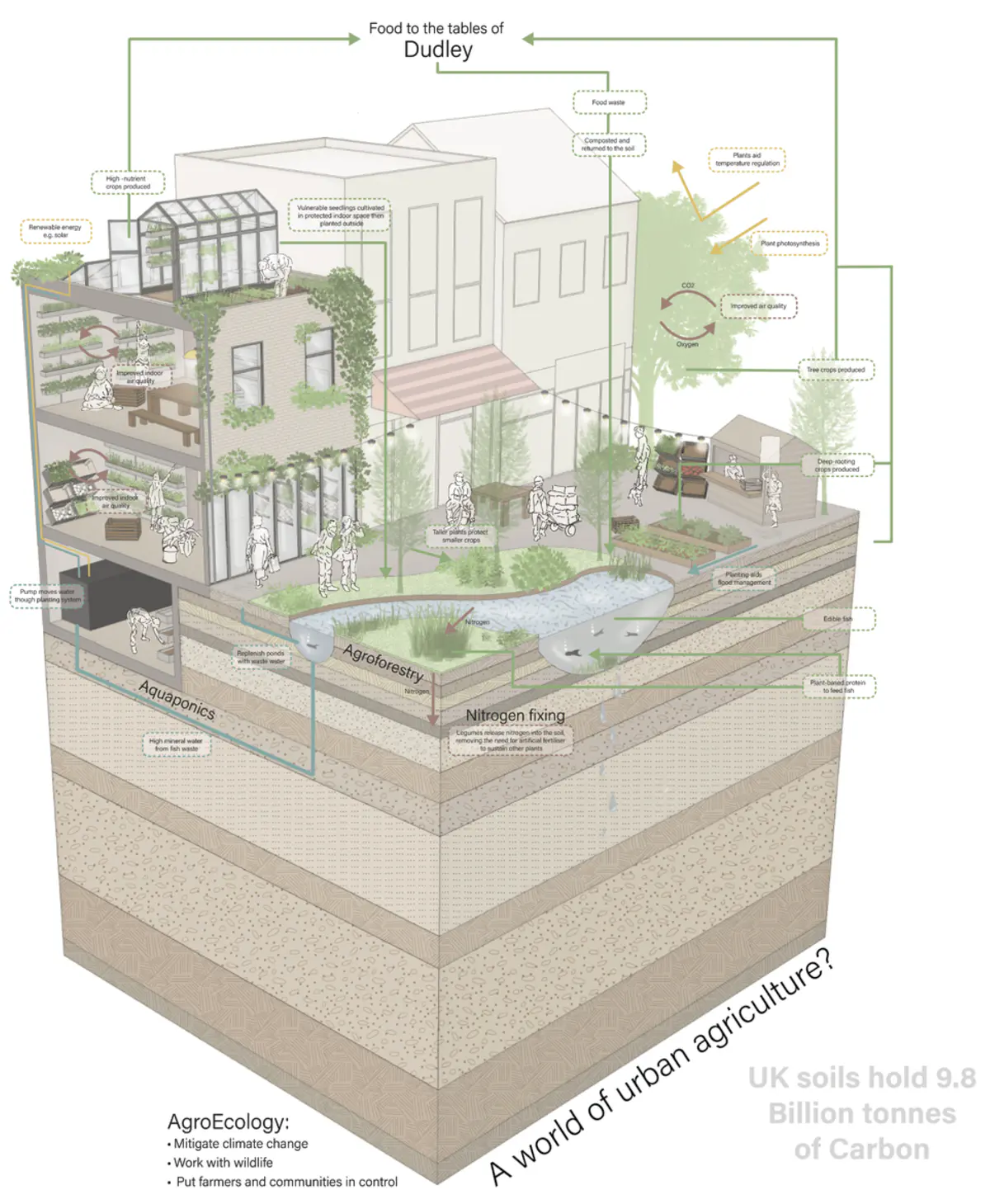
Nurturing AgroEcology in Urban Life
A strategy for living alongside food production

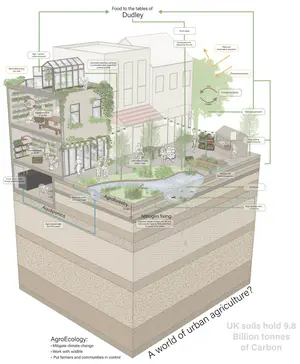
A critical part of the climate crisis is the degradation of soil, leading to scientists predicting the UK has approximately 100 harvests left of stable crop production. As an attempt to address the problem this project will explore the possibility of integrating sustainable agriculture into an urban setting, reducing the strain on agricultural land, reducing food miles and widening city biodiversity. Taking guidance from the farming movement, ‘Agroecology,’ a climate conscious, wildlife supporting and community engaged closed loop system will be developed, combining traditional growing with technology driven techniques that will support each other to produce a diverse plate.

Dudley High Street will be the focal point, reinvented as a destination not just for the purchase and consumption of food but also its creation, driven by the needs and engagement of local people. Connecting the community to the food they eat.  - Annabel Linch 4.png
Nurturing AgroEcology in Urban Life A strategy for living alongside food production A critical part of the climate crisis is the degradation of soil, leading to scientists predicting the UK has approximately 100 harvests left of stable crop production. As an attempt to address the problem this project will explore the possibility of integrating sustainable agriculture into an urban setting, reducing the strain on agricultural land, reducing food miles and widening city biodiversity. Taking guidance from the farming movement, ‘Agroecology,’ a climate conscious, wildlife supporting and community engaged closed loop system will be developed, combining traditional growing with technology driven techniques that will support each other to produce a diverse plate. Dudley High Street will be the focal point, reinvented as a destination not just for the purchase and consumption of food but also its creation, driven by the needs and engagement of local people. Connecting the community to the food they eat.
Drawing Map Imagining Nature Life Plantlife Growing Climate Soil Sustainable Food Biodiversity Creatures Community System Technology Consumption Creativity People Connection Architecture Pollution Regenerative Potential Opportunity Imagination Craft Making Material
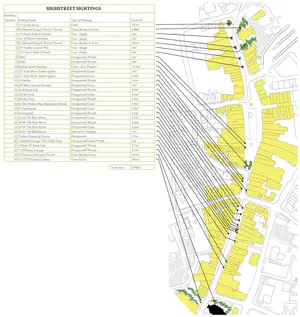
Street plant sightings

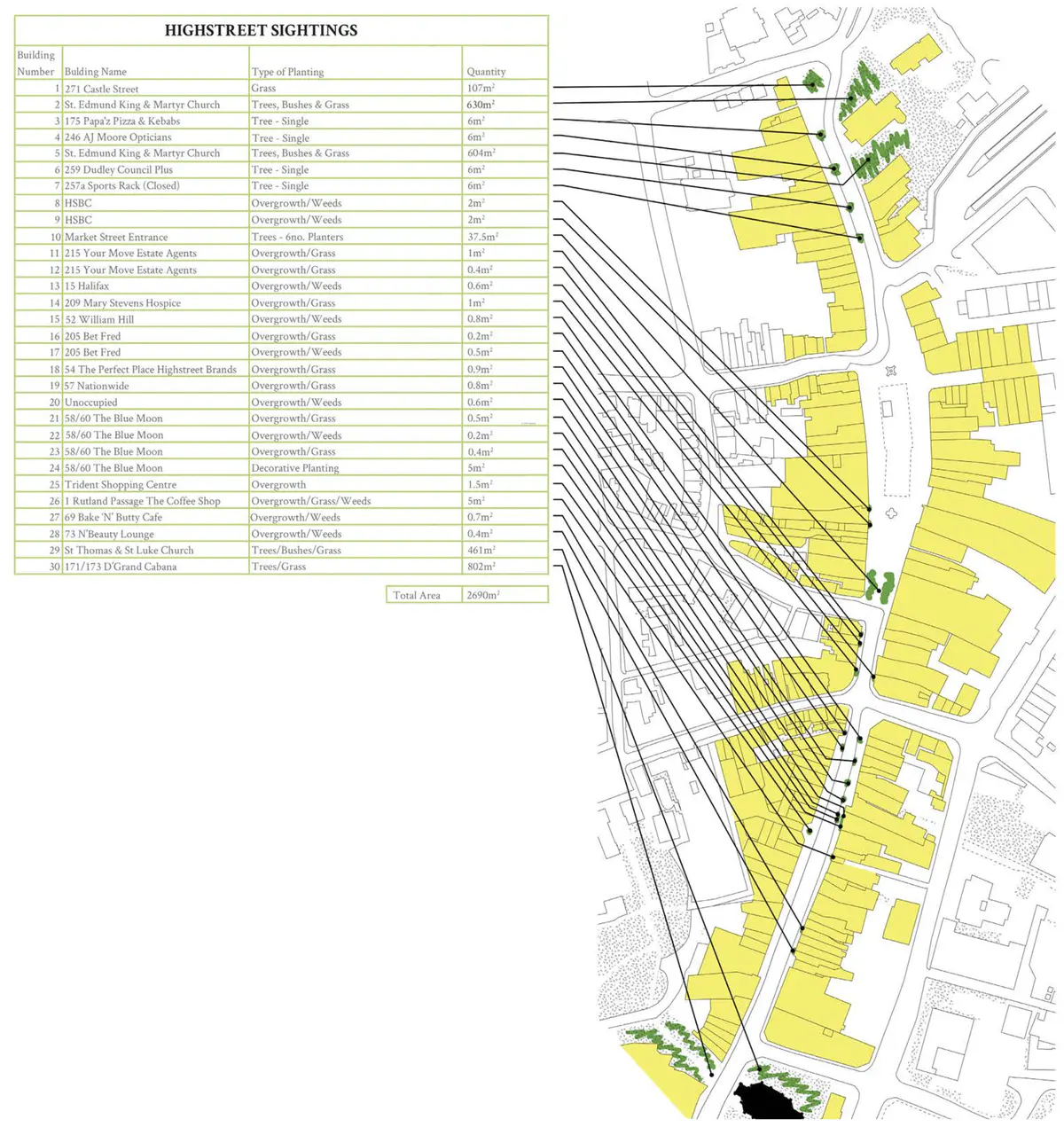
The charted planting is a selection of the current extent of the high street. As discovered, the area has little to no variance, with the exception of the more developed properties at either end of the high street. These properties generally have more trees and mature planting around them, making them more appreciative of the biodiversity.

Facing the high street, there is approximately 2690m2 of greenery, the majority of which is situated at either end, on the property of the two churches. Ignoring these numbers, the area of greenery drops significantly due to the limited overgrowth around lampposts, bins and along the store fronts.

For the wider biodiversity of the high street the select amount greenery provides very little benefit for nesting wildlife. Within the developed properties more thought and appreciation can be given to accommodate a more diverse spread of wildlife and planting. Along the high street there is little consideration for interactions with the wider biodiversity, a few trees (provided by the council) and strip of high level planting along a store front.

As for the rest of the ‘greenery’ along the high street, this could be seen more as neglect from the cleaning and maintenance of the street. The remaining biodiversity identified comes from areas that have retained water from lack of drainage and moisture retention. Seen around the street furniture, grass, weeds and moss can be seen growing along the gaps between paviers and along gutters. Despite being ‘greenery’ these areas provide no benefit to the biodiversity and are more of a sign that the council have no intention to improve the state of the area.

Within the developed quarters, the majority of the biodiversity is grassland, which too only has a limited positive environmental impact. The two churches provide an excellent coverage of their respective sights and can provide a good quality of air and absorption of CO2 due to the large number of trees and bushes . Whilst the grasslands are a welcoming sight, they play a very little roll in absorbing CO2 and to provide other positive environmental impacts that the larger greenery does. - Matthew Hewitt Street Plant Sightings.png
Street plant sightings The charted planting is a selection of the current extent of the high street. As discovered, the area has little to no variance, with the exception of the more developed properties at either end of the high street. These properties generally have more trees and mature planting around them, making them more appreciative of the biodiversity. Facing the high street, there is approximately 2690m2 of greenery, the majority of which is situated at either end, on the property of the two churches. Ignoring these numbers, the area of greenery drops significantly due to the limited overgrowth around lampposts, bins and along the store fronts. For the wider biodiversity of the high street the select amount greenery provides very little benefit for nesting wildlife. Within the developed properties more thought and appreciation can be given to accommodate a more diverse spread of wildlife and planting. Along the high street there is little consideration for interactions with the wider biodiversity, a few trees (provided by the council) and strip of high level planting along a store front. As for the rest of the ‘greenery’ along the high street, this could be seen more as neglect from the cleaning and maintenance of the street. The remaining biodiversity identified comes from areas that have retained water from lack of drainage and moisture retention. Seen around the street furniture, grass, weeds and moss can be seen growing along the gaps between paviers and along gutters. Despite being ‘greenery’ these areas provide no benefit to the biodiversity and are more of a sign that the council have no intention to improve the state of the area. Within the developed quarters, the majority of the biodiversity is grassland, which too only has a limited positive environmental impact. The two churches provide an excellent coverage of their respective sights and can provide a good quality of air and absorption of CO2 due to the large number of trees and bushes . Whilst the grasslands are a welcoming sight, they play a very little roll in absorbing CO2 and to provide other positive environmental impacts that the larger greenery does.
Map Photo Plantlife Nature Growing Pollution Care
Nurturing AgroEcology in Urban Life
A strategy for living alongside food production

A critical part of the climate crisis is the degradation of soil, leading to scientists predicting the UK has approximately 100 harvests left of stable crop production. As an attempt to address the problem this project will explore the possibility of integrating sustainable agriculture into an urban setting, reducing the strain on agricultural land, reducing food miles and widening city biodiversity. Taking guidance from the farming movement, ‘Agroecology,’ a climate conscious, wildlife supporting and community engaged closed loop system will be developed, combining traditional growing with technology driven techniques that will support each other to produce a diverse plate.

Dudley High Street will be the focal point, reinvented as a destination not just for the purchase and consumption of food but also its creation, driven by the needs and engagement of local people. Connecting the community to the food they eat. - Annabel Linch 1.png
Nurturing AgroEcology in Urban Life A strategy for living alongside food production A critical part of the climate crisis is the degradation of soil, leading to scientists predicting the UK has approximately 100 harvests left of stable crop production. As an attempt to address the problem this project will explore the possibility of integrating sustainable agriculture into an urban setting, reducing the strain on agricultural land, reducing food miles and widening city biodiversity. Taking guidance from the farming movement, ‘Agroecology,’ a climate conscious, wildlife supporting and community engaged closed loop system will be developed, combining traditional growing with technology driven techniques that will support each other to produce a diverse plate. Dudley High Street will be the focal point, reinvented as a destination not just for the purchase and consumption of food but also its creation, driven by the needs and engagement of local people. Connecting the community to the food they eat.
Drawing Map Imagining Nature Life Plantlife Growing Climate Soil Sustainable Food Biodiversity Creatures Community System Technology Consumption Creativity People Connection Architecture Pollution Regenerative Potential Opportunity Imagination Craft Making Material
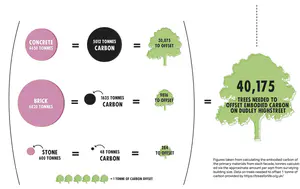
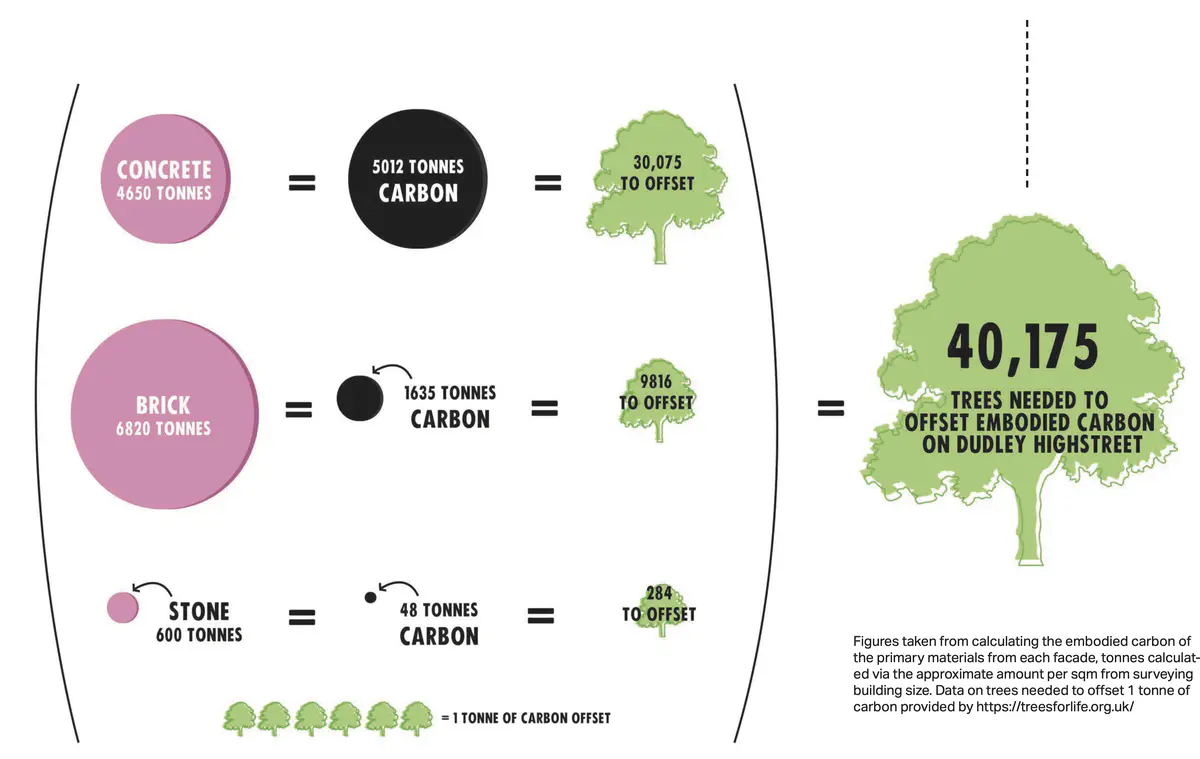
 Figures taken from calculating the embodied carbon of the primary materials from each facade, tonnes calculated via the approximate amount per sqm from surveying building size. Data on trees needed to offset 1 tonne of carbon provided by https://treesforlife.org.uk/ - Michelle Gartside Embodied carbon.png
Figures taken from calculating the embodied carbon of the primary materials from each facade, tonnes calculated via the approximate amount per sqm from surveying building size. Data on trees needed to offset 1 tonne of carbon provided by https://treesforlife.org.uk/
Diagram Architecture Material System Nature Pollution