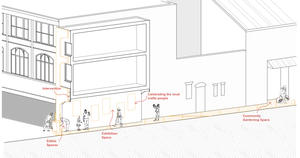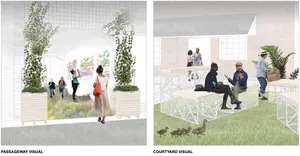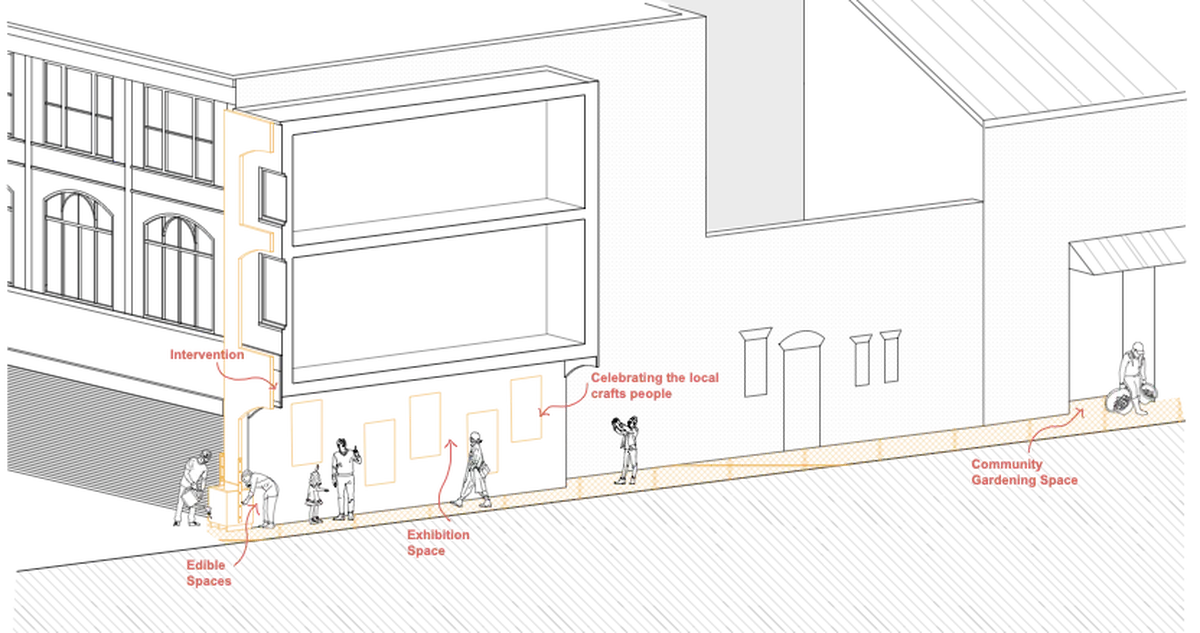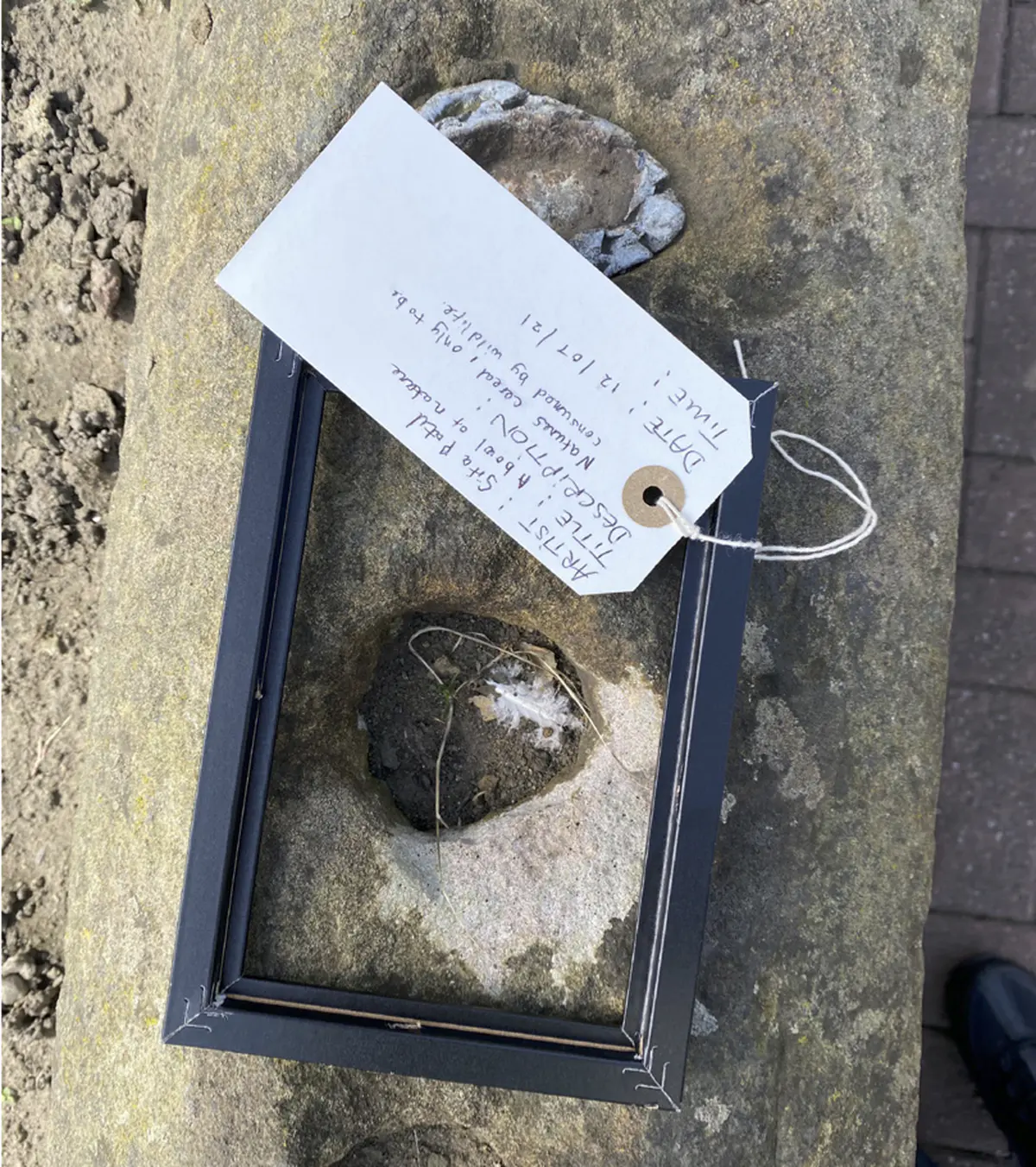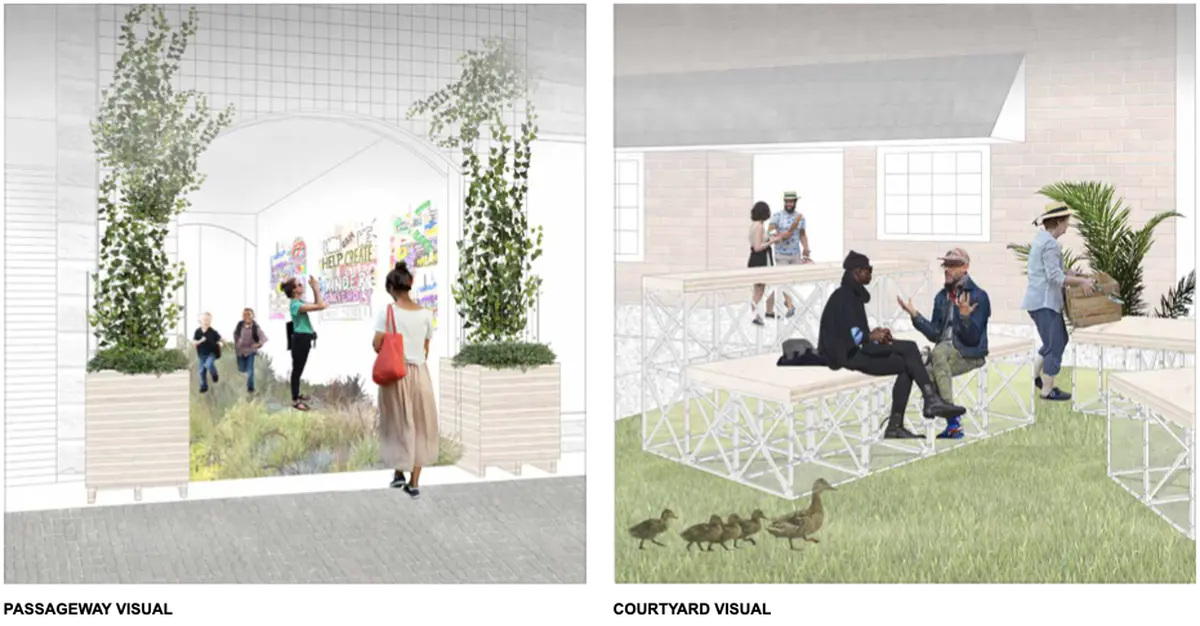
By utilising the passageway to display exhibition work from local institutions it would not only encourage them to create their crafts, it will celebrate their work and the range of crafts that Dudley has.
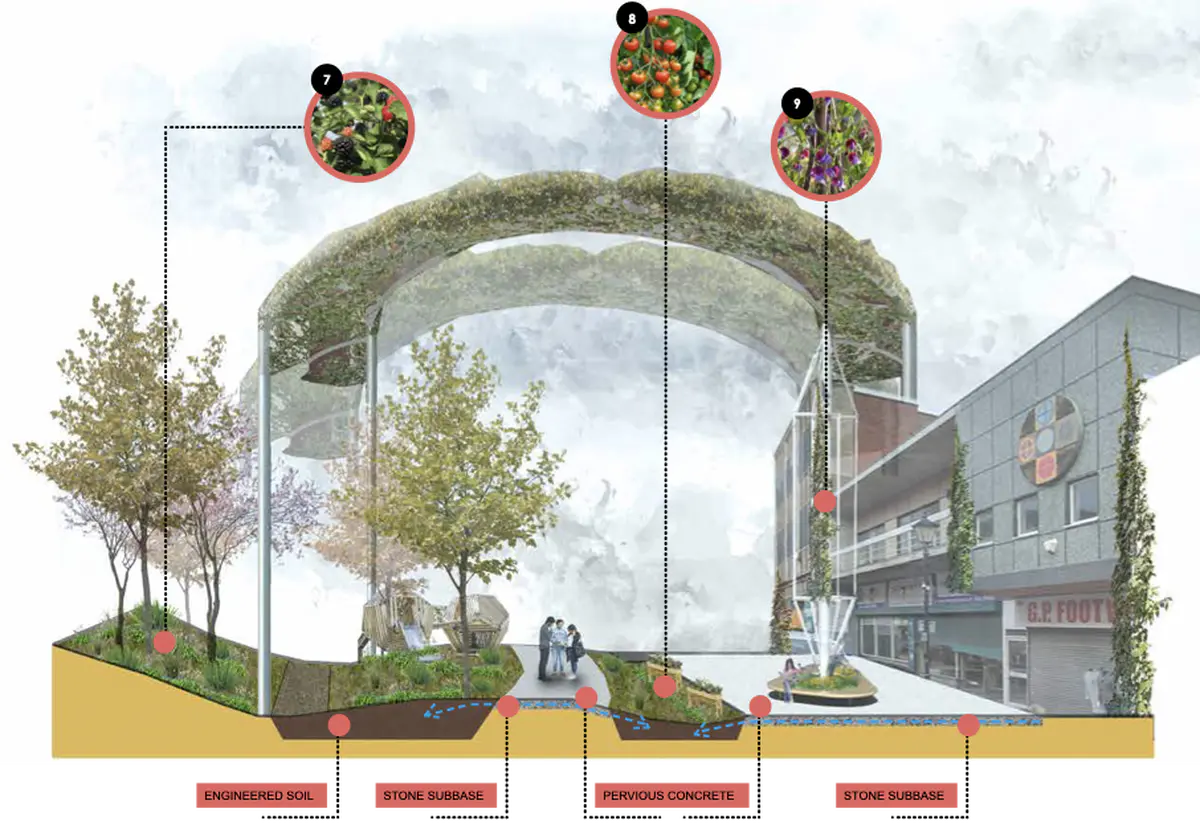
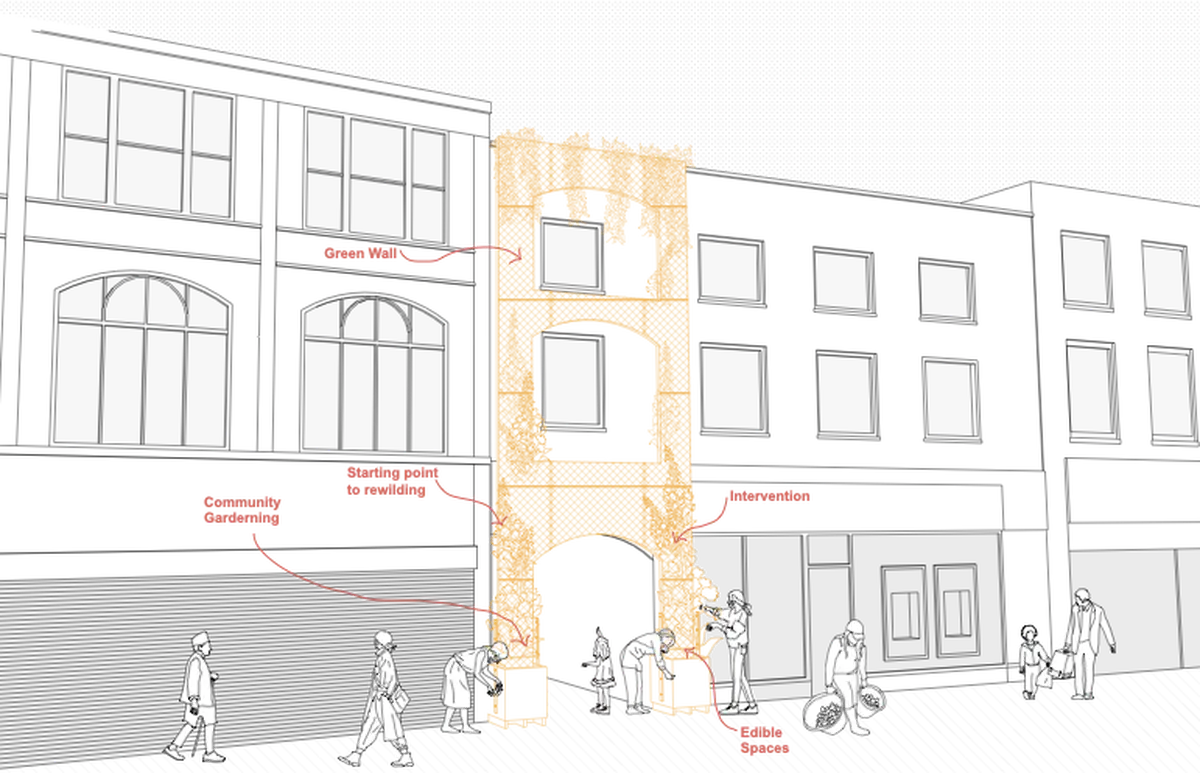
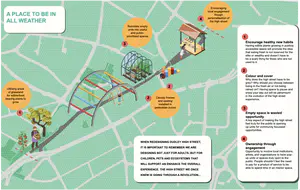
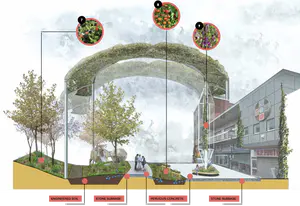
This visual represents Dudley High Street re-imagined; a new vision of a re-wilded, food-centric town centre. The green canopy will begin as a frame that will encourage the growth of plants. Smaller scale units will be integrated at the start and build towards the final vision.
The third Stepping Stone project attempted to design the community kitchen in one of the empty shops on Dudley High Street. We all know that food is an essential factor in our life and eating and cooking the food is not an abstract activity we do, it is part of our everyday routine. In our initial research, we found that many people live alone in compact housing on the High Street. We thought the kitchen connect the residents with society. We decided to make the process of preparing food more enjoyable. As our aim was to grow food on the street wherever possible, we can use these vegetables for the community kitchen. This will encourage residents to come down onto the street and engage with it. This could also be a new experience for the visitors of the High Street.
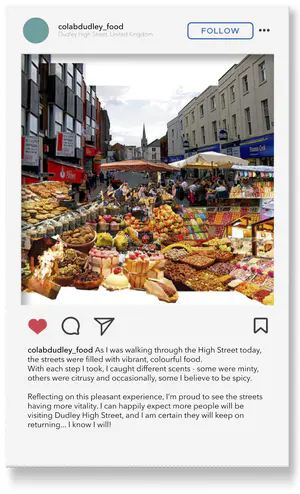
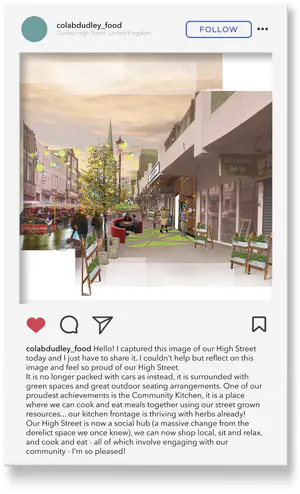
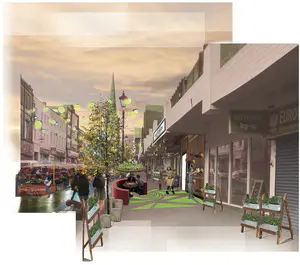
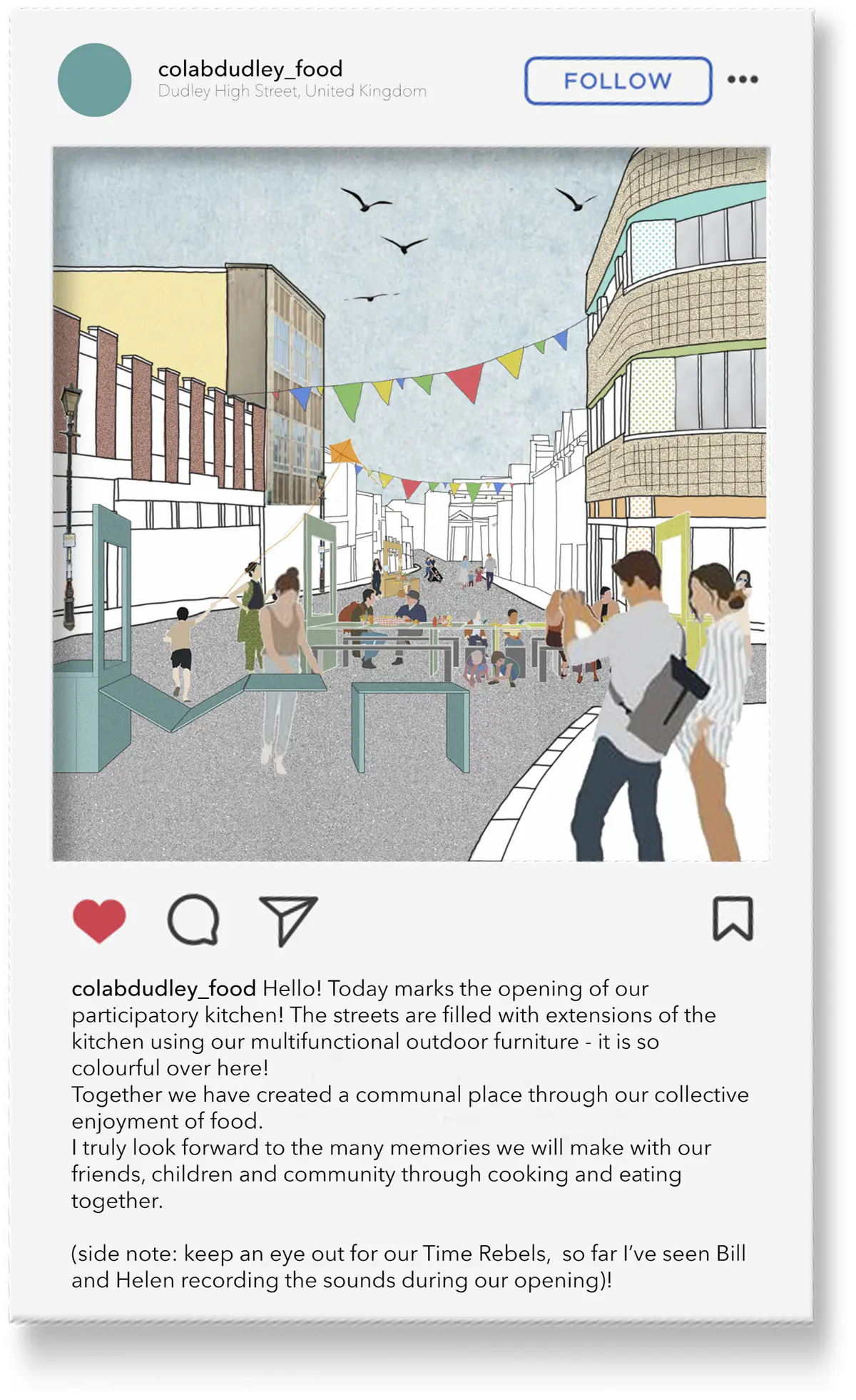
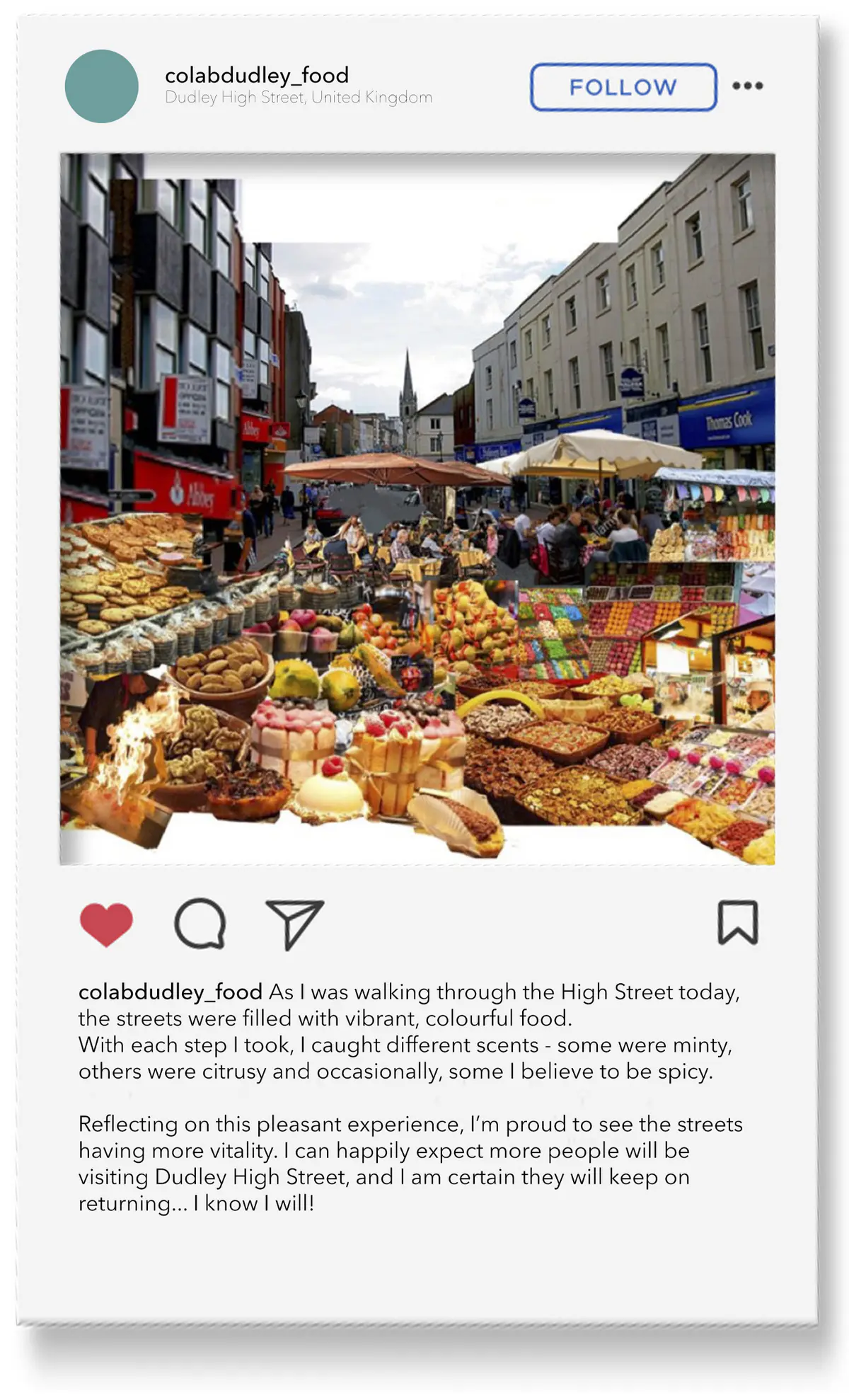
In this post, we captured the street’s atmosphere filled with colour, activity, and pedestrianised streets.
(We decided to present our narrative through social media and instagram posts as we wanted to showcase what individual experiences might be like when experiencing the future High Street. Each of our posts captures a different element of experience on the High Street to form a collective scenario.)
Bake ‘n’ Butty
Fairy lights all year round
Three clocks working triple time
More seating at the rear and
Above the sound of something frying in a pan
Laughter
The scrape of cutlery on finished plates
Stacked and cleared
Two cappuccinos
Two toasted teacakes
Footsteps on the lino floor
The hum of radio from somewhere
The clash of a saucepan lid
Tea, milk, two sugars
The tapping of a spoon on a plastic bowl
Fishfinger sandwich to take away
Do you need a receipt?
It won’t be long, alright?
Chips sizzling in the deep fat
Steam escaping the coffee machine
There’s your knife and fork
Musical buttons singing from the till
No sugar, I’m sweet enough
A message left on the answering machine
Phone rings
How can I help you?
Mobile notification
Chatter
Printing
There’s your change
I’ll bring your coffee over
Sausage, egg and chips
Large breakfast, no beans
Two lattes
Milk delivery
Grated cheese in a bag
Butter balanced in the crock of an arm
Is there enough money in the till?
Bacon and egg sandwich to go
Cappuccino
Cheers love
It was lovely, thank you
All this is seen and heard as
I am joined at my table
To talk through
Covid
Cars
Past lives
Old homes
Acceptance
Cooking
Gender
Pubs
Health and
Putting the world back together
My tea is done
I pop my mug back on the counter
All this for the prices of a cuppa I think
Stepping out past the flashing fairy lights
The population of Dudley in 2021 is circ. 80,000 and including the wider borough totals 313,000.
For one person on the average diet, roughly 2.6 Hectares of farm land is required. A family of four, just over 10 Hectares. A population of 313,000 required 813,800 Hectares, the equivalent of 1,162 football fields or 707,652,174 car parking bays.
FEEDING DUDLEY REQUIRES 1,162 FOOTBALL FIELDS OF FARM LAND
Thesis Concept Image - The Farm House
Taking a fun and more literal approach for providing local food production onto the high street, I looked at layering a farm growing different fruits, vegetables and meat products into the same structure to view the absurdity of growing, processing and packaging within a single structure. Ultimately the project would be as close to being a closed system as possible, where food grown could be fed to the animals and the waste from the animals will be used as fertiliser from the food. Air flow and lighting would not only be critical for the animals, but it also allows the fruit and vegetables to grow faster and more efficiently.
The processes within the Farm House would be very energy intense due to the amount of heating, water and lighting that will be required to house the animals and grow the crops. The project utilises conventional farming methods, ploughing, seeding etc., but without the harmful pesticides that would be usually applied. The farming problem of space efficiency is partially targeted in this proposal. Per m2 in plan does contain a greater yield due to the floor layering, however per m2 of gross internal floor area the yield efficiency remains. To ultimately increase overall yield per m2 aeroponics should be applied to massively increase yield and decrease water consumption.
THESIS PROPOSAL
The redevelopment of the high street is a re-envisaged perception of what the high street is and what it will become. A future look at what the high street will become, with mixed use residential and food growth structure to create dense living accommodation and localised food growth which prevents the need to contribute to deforestation and loss of biodiversity from urbanisation.
As part of the schemes wider aims, the high street and surrounding roads will become part of a network of green corridors, where pedestrian footfall/cycling can increase and the use of polluting vehicles will be greatly reduced. The idea of greatly increasing the density of vegetation along roads and reducing lanes will not only improve the rate of absorbing carbon dioxide, but also reduce noise and reduce temperature spots. The Miyawaki planted method would be used where ever possible to create dense areas of trees and shrubs, as well as quickly create new living conditions for new biodiversity.
The primary focus for the building will be the localised food growth in the vertical farms, several floors of food growth will create a new economy centred around the high street, removing the need to import fresh food from farms from across the country or on the other side of the world. The environment within the farms will be climate controlled, allowing the farms to adjust their climate to the optimum for the specific food. The density at which food can be grown in is almost 400 times greater than conventional farming, which greatly reduces the need to create new farms.
The residential aspects pairs with the farm, in bringing a new generation of people to live above the high street. The new vision of the high street would become an attraction point for people to not only visit but to live in as well. Access to land converted from roads and paving to nature will create value and attraction to the area once again. Eventually the low income stores will transition to stores that cater to the new environment.
This project targets all the XR themes directly or indirectly.
Air & Biodiversity - Creating new and preventing the loss of woodland and habitats.
Food - Growing food local and a much greater yield.
Water - Greatly reducing the resource requirement during farming.
Materiality - Managing sustainable usage of the deconstructed buildings and sourcing of the proposed.
Community - Creating new environments for communities to interact with each other.
Subway
Here, it’s all about the brand.
Green and yellow
Flashes of black
As staff move quickly to
Make subs
6 inch
Foot long
In the lunchtime rush
It’s all go, go, go.
Here, it’s all about the image.
New York subways
Map the walls
Alongside
Legends
Heroes
Iconics
Classics
Not names I would associate
With sandwiches
But to be fair I am not the target here
Too old by a country mile.
Here, it’s all about immediacy
Driven by technology
Attractive to young minds
Thumbs scroll over phones
To place orders
To make payments
To text their mate, who’s
Sat right next to them
Phones, phones, phones
As the Deliveroo driver
Double parks across the street
To pick up a meal deal
As ovens ping and
Cookies slide off trays and
A student picks and goes
No desire to sit in or
Wait a while.
Here, it’s all about speed and
It is busy.
A boy in a boiler suit
Made for a man
Jokes with his mate
He can’t decide what to order
There’s too much choice
He doesn’t know what he wants
He needs inspiration and
The counter guy offers him help
Bread style
Filling
Extra cheese
Drink and a cookie.
His mate ribs him
For getting double Jalapenos
But he doesn’t care.
Here, it’s all about the future
Contactless
A space in which a new generation move
Transactional
The model of a brave new world
Phone app ordering
Because this is what some people want
Safe
Easy
Quick
Convenient
Just because it’s not for me
Doesn’t make it wrong and
Judging by the queue at the door
They’re obviously doing something right.
I leave as another delivery
Heads out the door.
Boilersuit boy is making his way down the High Street
Back to college.
I’m sure he’ll be back tomorrow
Grateful for the help with his order.
Caribbean One Stop
The sign above the door
Shows a tropical island
But in Dudley Town
There’s a chill in the air
As Earl runs nine miles
Before jam and toast and
A cup of tea with nine sugars
To recharge batteries.
He’s not getting any younger but
Age is just a mindset.
When you’ve worked forty years
On the wholesale markets
Grafting and providing
Your perspective shifts
To what is really important.
We talk family
Community
Among plantain and yams
We talk heritage
Education
Among chopped hake and Jamaican pears.
Gloria can’t find any mangos
Because Earl has stashed them
Behind the counter
Too soft and sweet for handling.
When he gets a ripe breadfruit
Earl thinks of Gloria
“Know your customers”
He tells me
“Know a little bit about everything”.
I ask Gloria about
Triple Blue Cross
She tells me about white shirts
Bed linen
Drying under a Jamaican sun
This shop is an education
If you just ask the right questions.
Earl’s father came in 1954
Bloodlines stretched
Across continents
Across boundaries
Nigeria
Scotland
Jamaica
Germany
A mix Earl’s grown into
Via Handsworth
Birmingham
England.
He knows a Bristol accent
When he hears one
They talk about Montpelier
Meat markets in Newport
Veg markets in St Pauls
She comes from Tipton each month
To get the things she needs
It’s personal
She likes personal.
The freezer is full of
Chicken feet
Ox tail
Turkey neck
Cow foot
Flavour is the thing
Even water gets spiced
For mash Earl tells me
As he trims Ghanian yam
With a very sharp knife
To just the right size.
There is barely anything
I recognise in this shop
But I’m drawn to the colours
The stories
The journey
The difference
Halfway around the world or
Baked up the road
For customers who bang on the window and wave
Who stand in the doorway
Giving back the banter
Who leave with the Caribbean
In a blue plastic bag.
I leave with a bag of Zoomers
Earl tells me
“That once I taste Jamaica
I’ll be back”
I stand in the High Street
Cheesy snacks in hand
Reminding myself
To buy two packets next time.
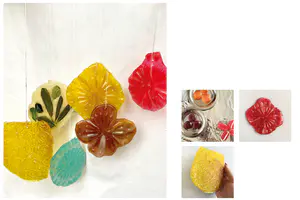
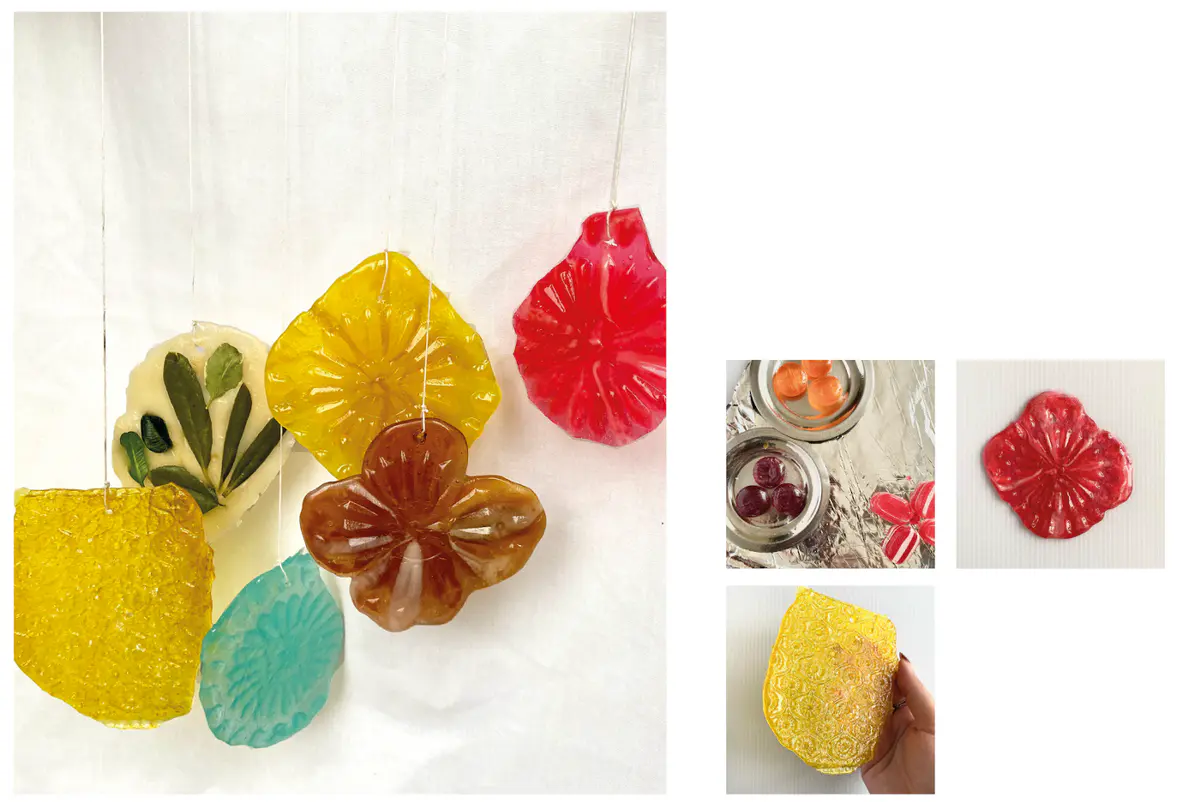
This gift was created to highlight different points in the social spaces on the high street. Aspects that we can improve on and celebrate. One point found was to incorporate more green spaces to improve health and wellbeing. The other to celebrate the textures and embossings in Dudley’s early ironworking. These ornaments were created by melting sweets and printing patterns onto them.
Provision
I invite you to stand in my shoes
In the space between dark and light
To imagine a room laid bare
Where you sleep in the bath
In the clothes you wear every day
Because you don’t have a bed or
Even a mattress on the floor
To rest your tired frame.
You are in crisis
Slipped through the cracks It doesn’t matter how or why Just that you are here
Needing help
Needing compassion
Practical support
To get back on your feet
To feel cared for
Provided for
Prayers answered.
I sit here listening to Blur
On the CD player I have just bought from Provision House
A beacon-topped Aladdin’s cave of treasures
That occupies a space right opposite
It’s higher calling
Old Co-op
Old shoe shop
New lease of life
For this art-deco giant
Three floors of stepping back in time
Down history rich stairs
Through formica inlaid doors
Its belly stuffed with
Furniture and bedding
Tables and lamps
Wardrobes and kitchenware
The things that we take for granted
Destined for those that have nothing
Absolutely nothing
A lifeline.
In the shop I can still buy a pair of shoes
Anything an old department store may well have stocked
Ironic I feel.
They save the sleeping bags
To hand to homeless folk
Health-packs and new socks
Whatever helps.
The Food Club caters for those
That need to feed themselves
Their families
On budgets stretched to breaking
They mind the gap that governments should fill
By remembering that everybody counts Black Country rules.
Kim chats to a woman
Buying sticker-books for her granddaughter
Laughter slips through this conversation
Two books for a pound and you know
The girl will have a fun filled afternoon.
I ask about the future
Plans for expansion
Rooms to hire
Office space
Training programmes on their way
Perhaps a life for the room upstairs and I see progress
New from old
Right from wrong.
So, step through this door and lend a hand
To those that need it more than
You and I will ever understand.
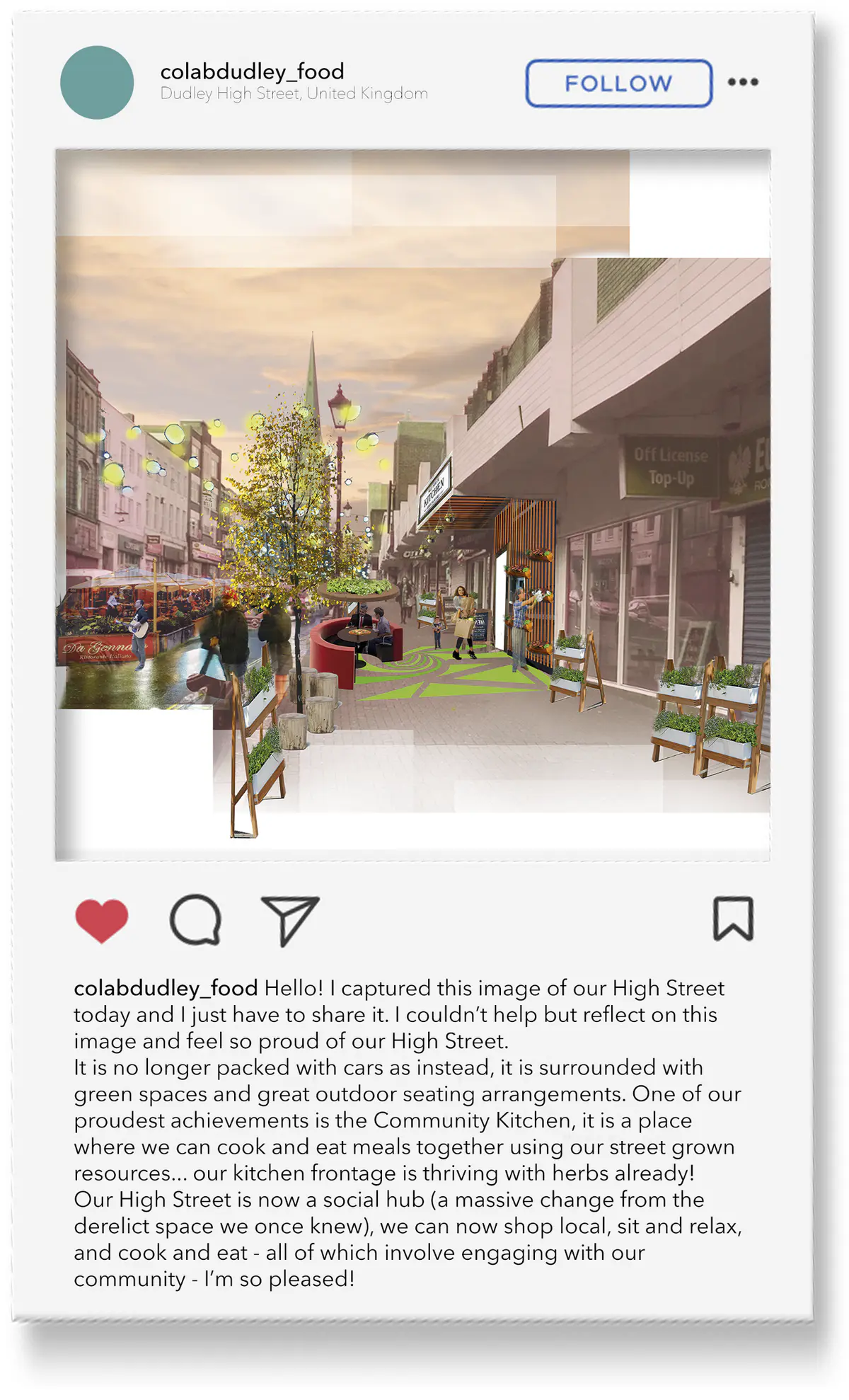
This post develops what the community kitchen has to offer with street grown resources and community engagement.
(We decided to present our narrative through social media and instagram posts as we wanted to showcase what individual experiences might be like when experiencing the future High Street. Each of our posts captures a different element of experience on the High Street to form a collective scenario.)
By placing a community garden in this space space you can learn how to plant food and it will lead to more edible spaces on the High Street that will then lead to the re-wilding of Dudley.
Caffe Min
Breakfast
Lunch
Meal deal
Everything you would expect
Fresh from the takeaway menu
Ham baguette
With a little bit of mayonnaise
Jacket potato
Hot cup of coffee
Bacon sarnie
Brown sauce
Not red
Tikka mint mayo panini
Something you might not expect
Sunglasses!
I sit on a long bench
Listening to Tainted Love
Over the radio
Reading one of the many signs
About coffee and good vibes
Jayne and Mustafa
Serve the steady flow of regulars
Some sit outside most of the day
Watching
Chatting
Taking it all in
There’s always a spot for them
As others come and go
Mustafa hopes that more regulars
Will return
From offices
When they can
The future seems uncertain
Until normality returns
Since West Brom
27 years ago
Jayne and Mustafa
Have been working together
She says she “has a thick skin to have put up with him for so long”
He says “she’s the second woman in his life”
Cheerful banter
From a lifetime of serving
Cooking
Cleaning
Managing
This is their third café in Dudley
23 years and still going
Opposite the Full Moon
Tables and chairs on the pavement
Watching the comings and goings
I end up chatting to Kath
Over a cup of tea
As she gets a sausage baguette
For the lady she volunteers with
Kath comes every Friday
For breakfast with her friends and
I see how this all takes shape
Regular
Reliable
Dependable
I say goodbye
Head back up the town
As Magic FM fades in the distance
I think I’ll probably pop in again
For a cup of tea
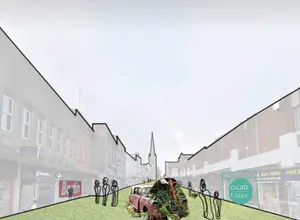
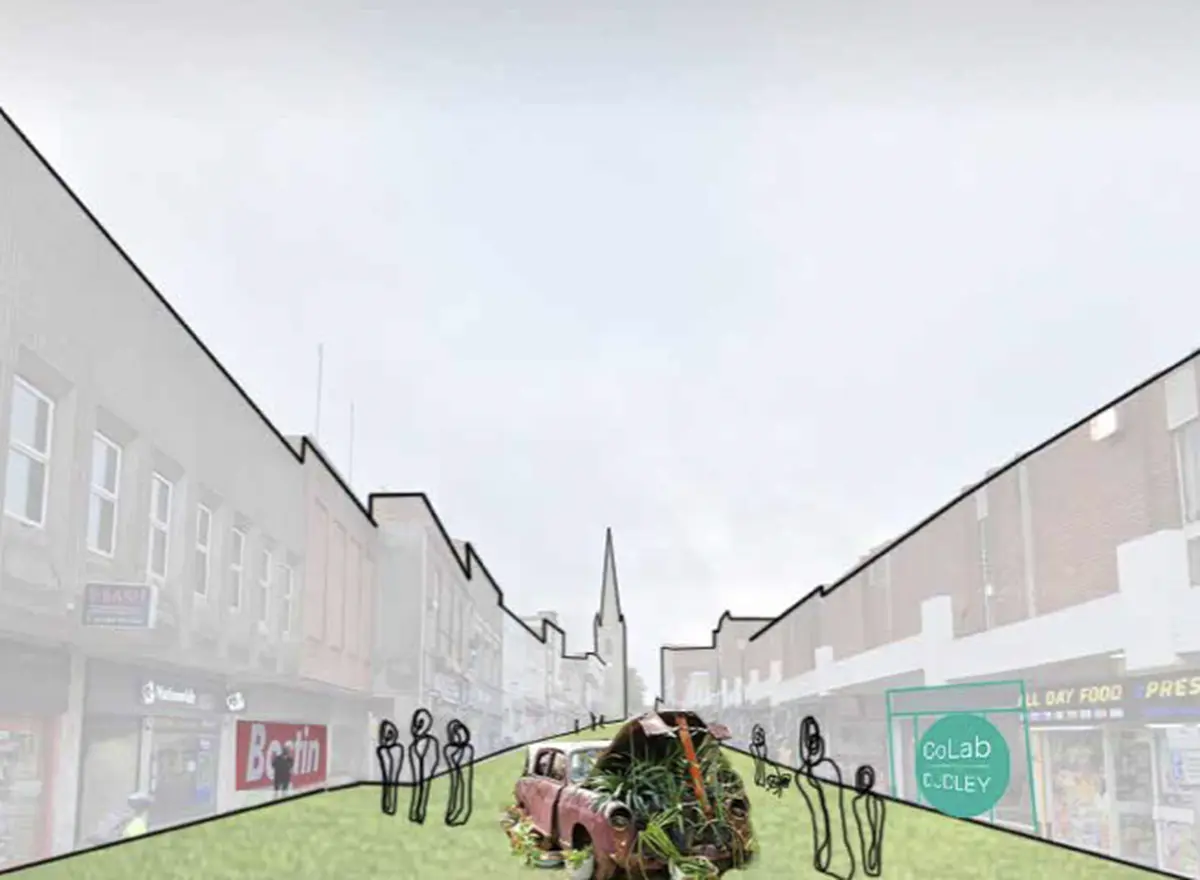
New use for cars — As part of pedestrianisation we would like to suggest a memorial of sorts to cars. The feature would sit in the middle of the High Street and would consist of an old out-of-use car, being used as a planter and being filled with plants. This gesture symbolises the movement of the High Street’s priorities shifting from the automobile to plants, people and food.
Bianca and her friends went clothes shopping. As they could smell the delicious food making in the community kitchen, they curiously went inside for the first time. Bianca and her friends were offered freshly made, delicious soup.
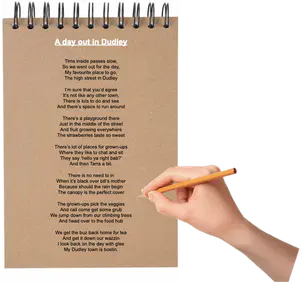
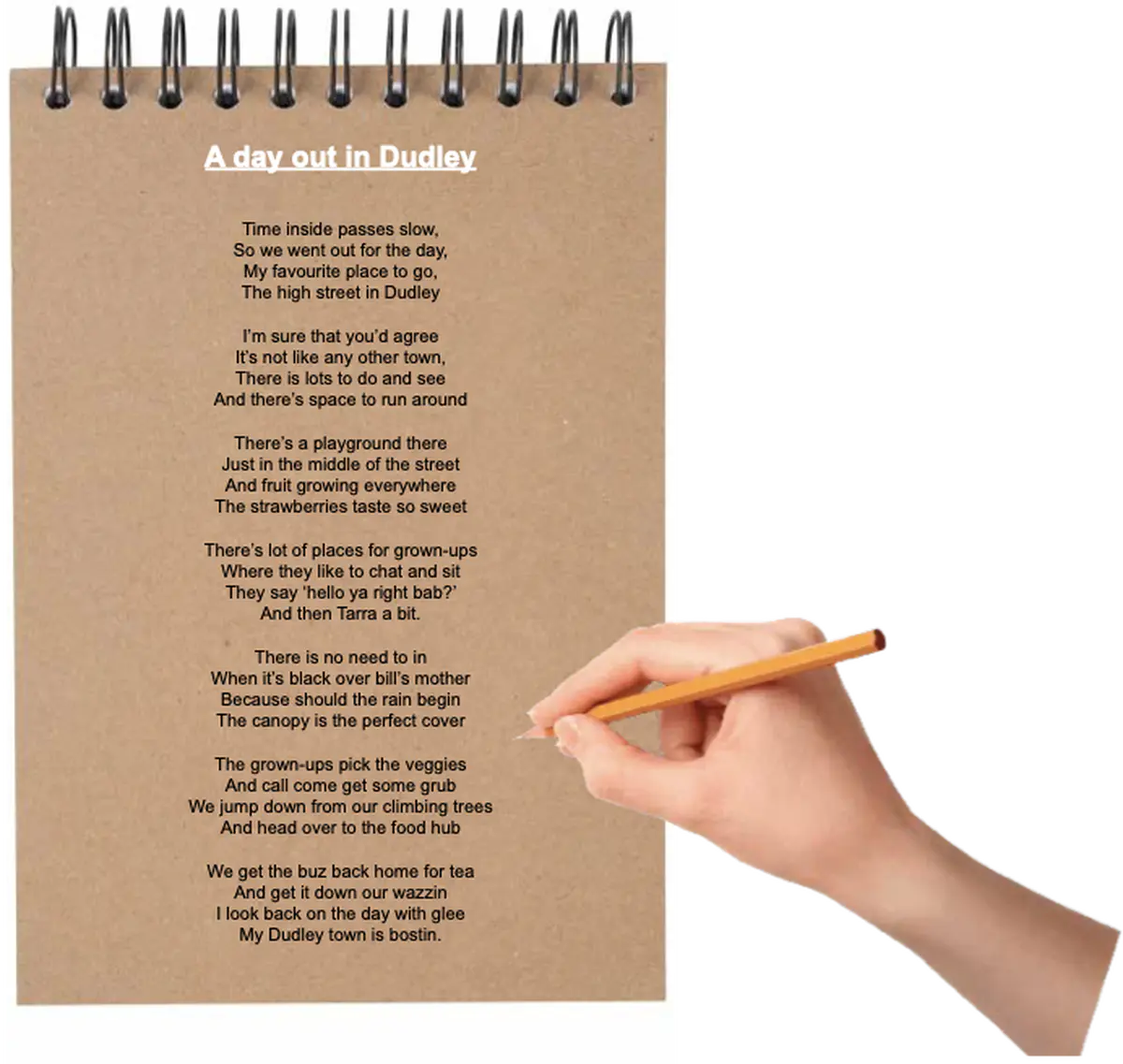
A day out in Dudley
Time inside passes slow,
So we went out for the day,
My favourite place to go,
The high street in Dudley
I'm sure that you'd agree
It's not like any other town,
There is lots to do and see
And there's space to run around
There's a playground there
Just in the middle of the street
And fruit growing everywhere
The strawberries taste so sweet
There's lots of places for grown-ups
Where they like to chat and sit
They say 'hello ya right bab?'
And then Tarra a bit.
There is no need to in
When it's black over bill's mother
Because should the rain begin
The canopy is the perfect cover
The grown-ups pick the veggies
And call come get some grub
We jump down from our climbing trees
And head over to the food hub
We get the buz back home for tea
And get it down our wazzin
I look back on the day with glee
My Dudley town is bostin.
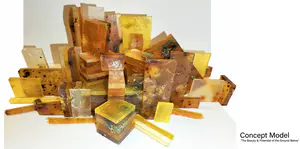
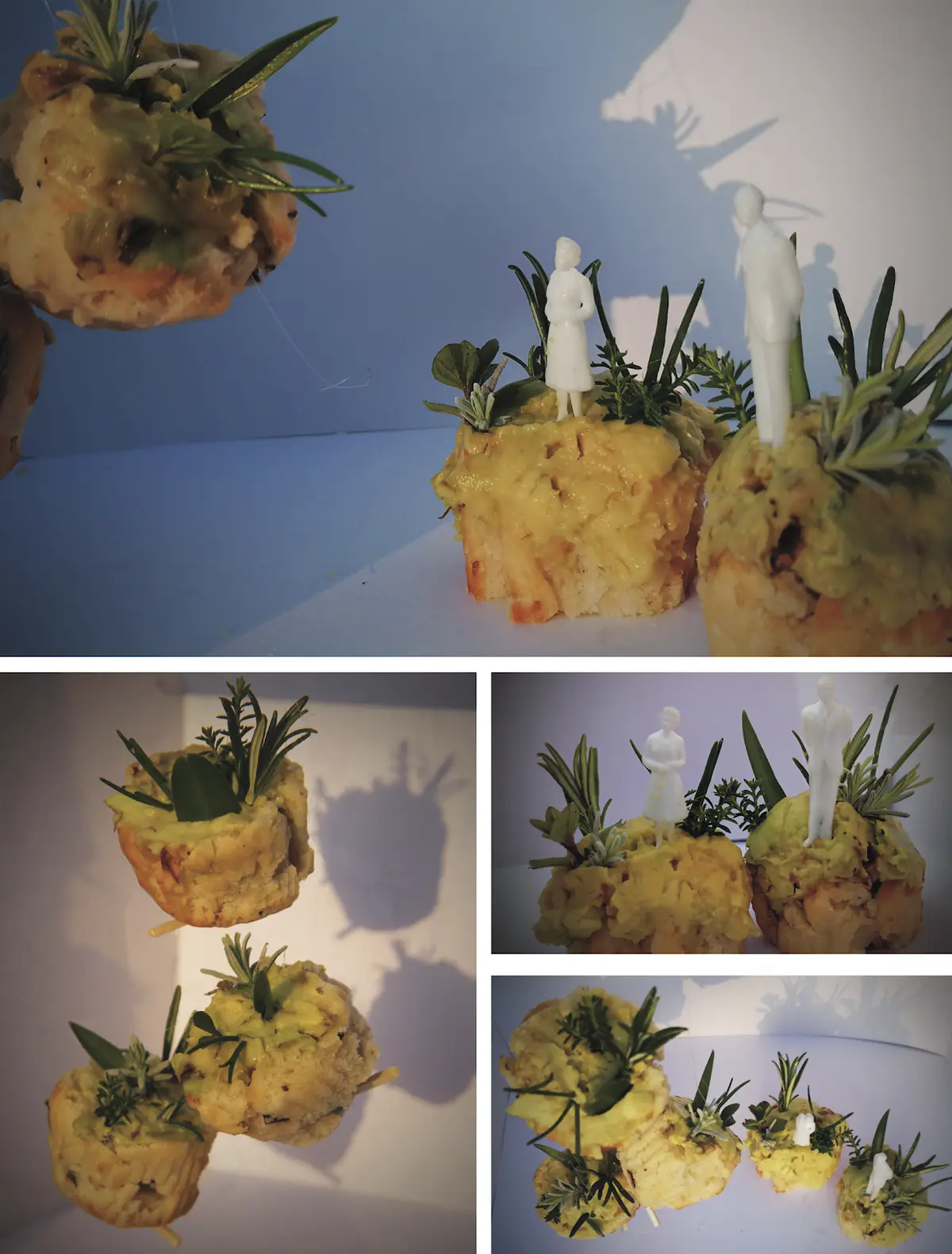
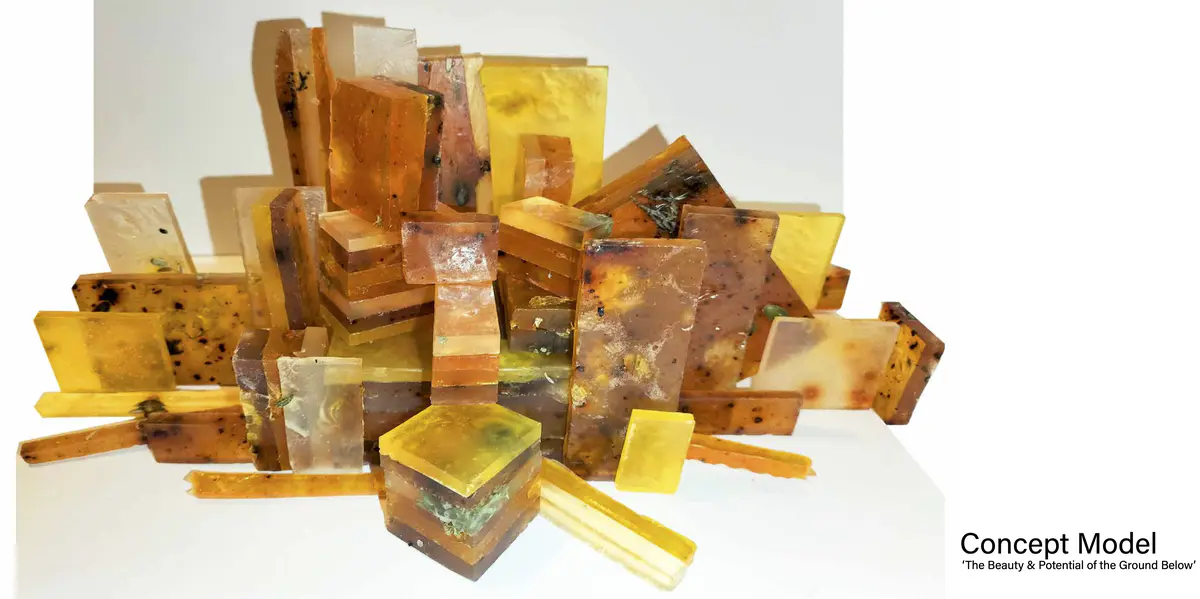
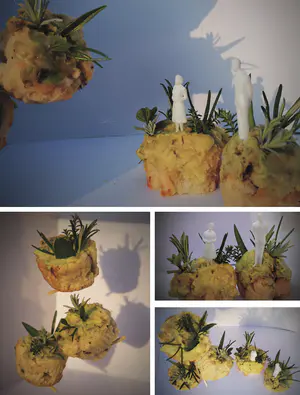
For Colab Dudley, I baked a model that ties into the final proposal. Food is a huge part of history and culture and part of Dudley’s history and culture is using what food there is available. Bread is cheap and easy to make, so is found in many traditional black country dishes. I foraged for edible plants in my garden and neighbourhood and built hanging baskets and islands to show in an abstract way how public space could be more productive and beautiful. They were a tasty treat and a sustainable model!
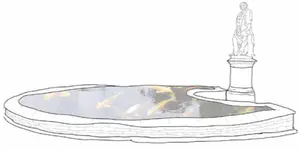
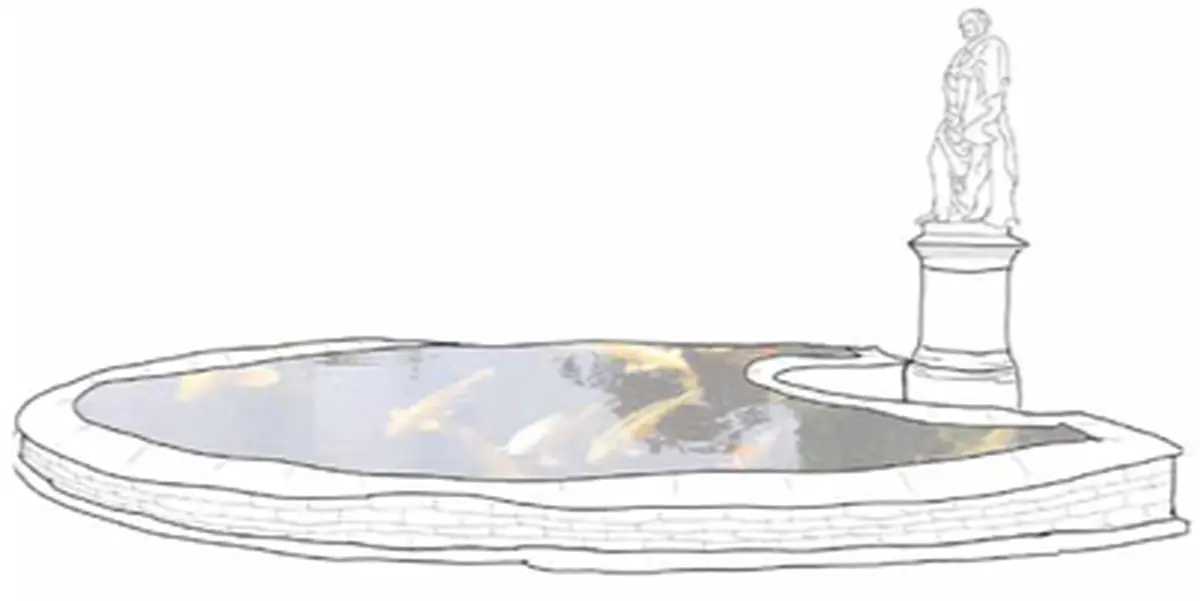
Pond — At the northern reaches of the High Street lies a raised bed with nothing but a sterile patch of grass. We suggest as a miniature stepping stone, we replace the grass with a pond. The sounds of water can soften the noise of the traffic and it will invite pedestrians onto the high street by having this point of interest. It also works with the plans for re-wilding and growing food along the High Street as it aids pollination.
Nurturing AgroEcology in Urban Life
A strategy for living alongside food production
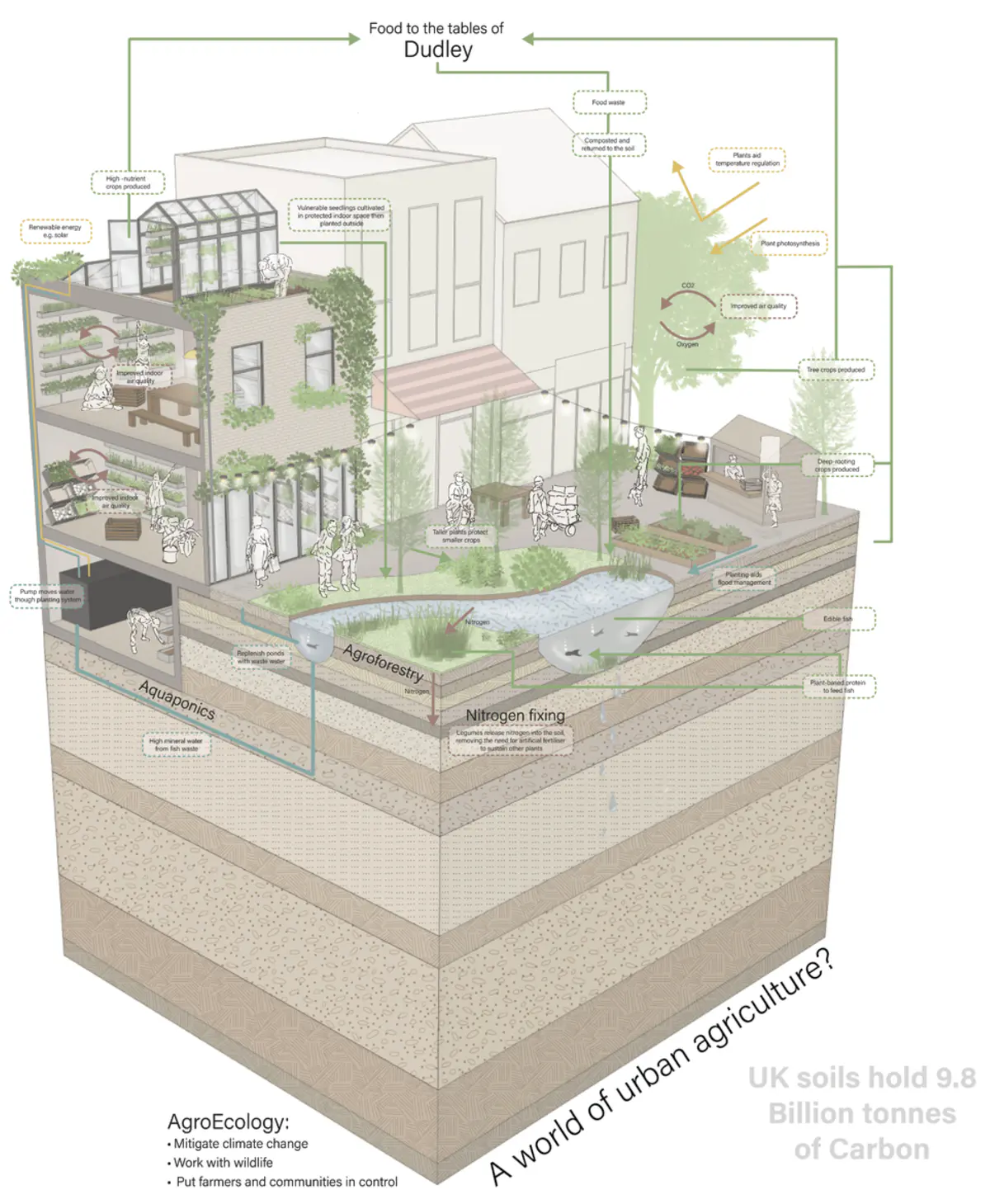
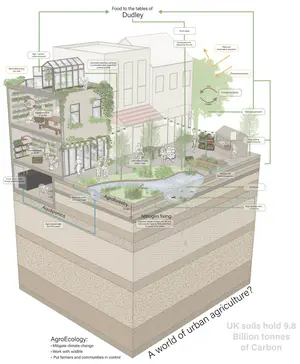
A critical part of the climate crisis is the degradation of soil, leading to scientists predicting the UK has approximately 100 harvests left of stable crop production. As an attempt to address the problem this project will explore the possibility of integrating sustainable agriculture into an urban setting, reducing the strain on agricultural land, reducing food miles and widening city biodiversity. Taking guidance from the farming movement, ‘Agroecology,’ a climate conscious, wildlife supporting and community engaged closed loop system will be developed, combining traditional growing with technology driven techniques that will support each other to produce a diverse plate.
Dudley High Street will be the focal point, reinvented as a destination not just for the purchase and consumption of food but also its creation, driven by the needs and engagement of local people. Connecting the community to the food they eat.
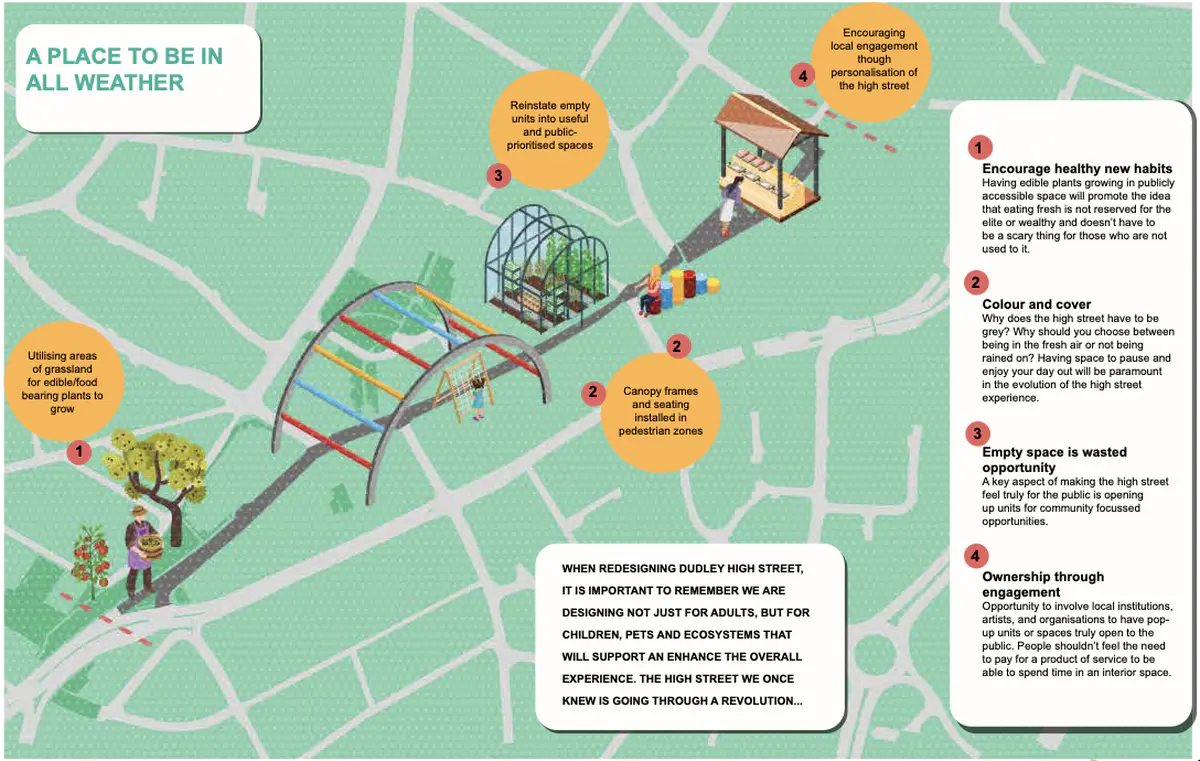
Stepping Stone 4 adds layers to the High Street. Like the other visions, we wanted to use CoLab Dudley’s principles ‘use nature as a guidebook’ and ‘create conditions for curiosity and experimentation’. The main way we proposed to do this was adding a green canopy to provide shelter, create a hybrid indoor outdoor space welcoming to families and a more communal open space, and support ecosystems.
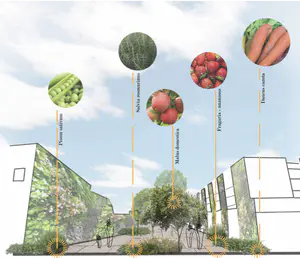
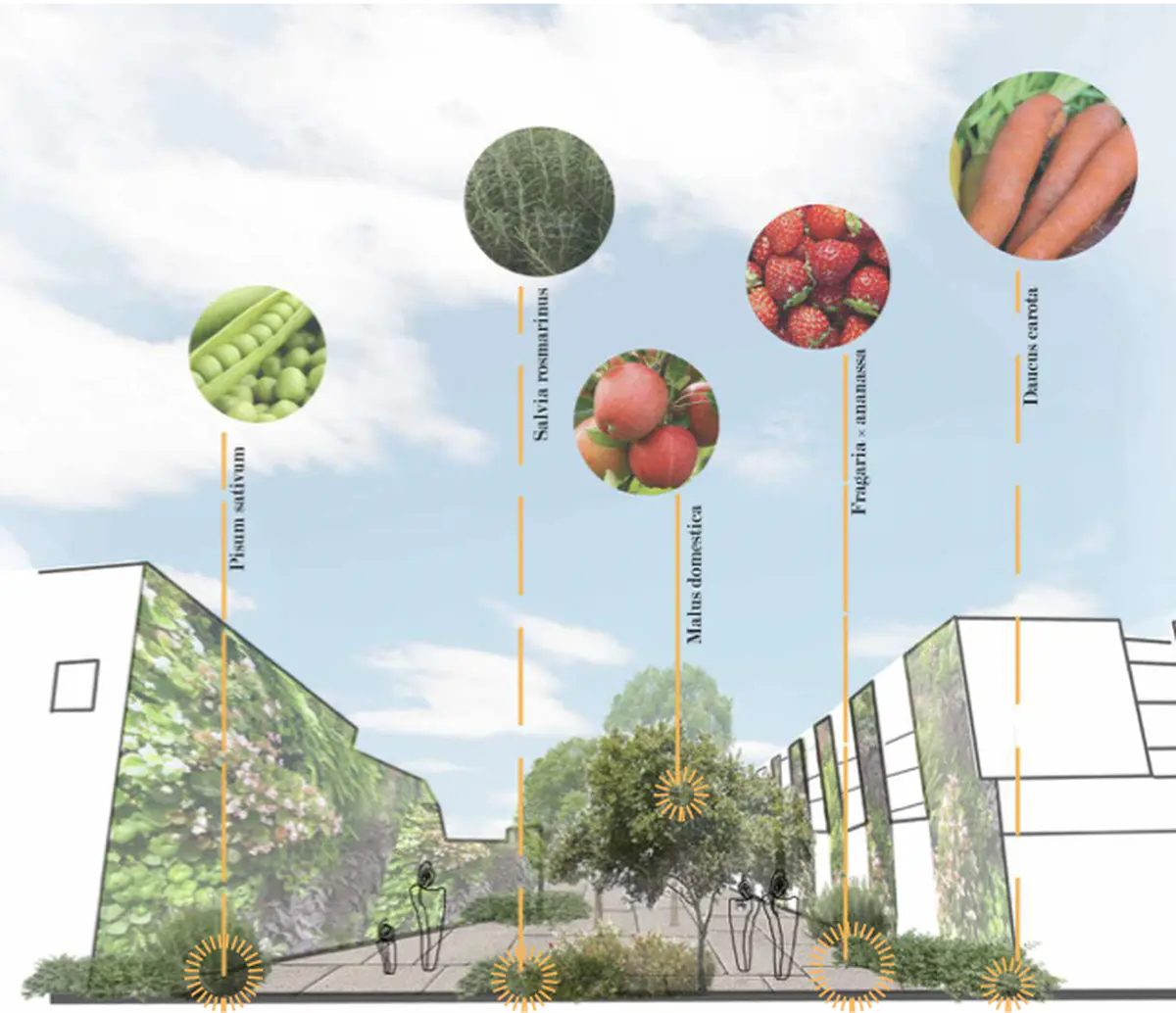
The image shows what this space could look like as a productive landscape. Where all the space is used. Vertical growing space can be utilised for pollinators for heights out of human range and for fruit and herbs in the lower regions that lie within our grasp. Trees can provide shelter, pollen and fruit, as can shrubs.
Creating a stronger connecting between the current food spaces by:
- Pedestrianising the road with a grassland
- Utilising abandoned building for education centres and community farming.
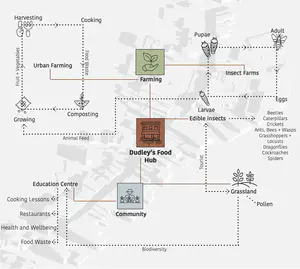
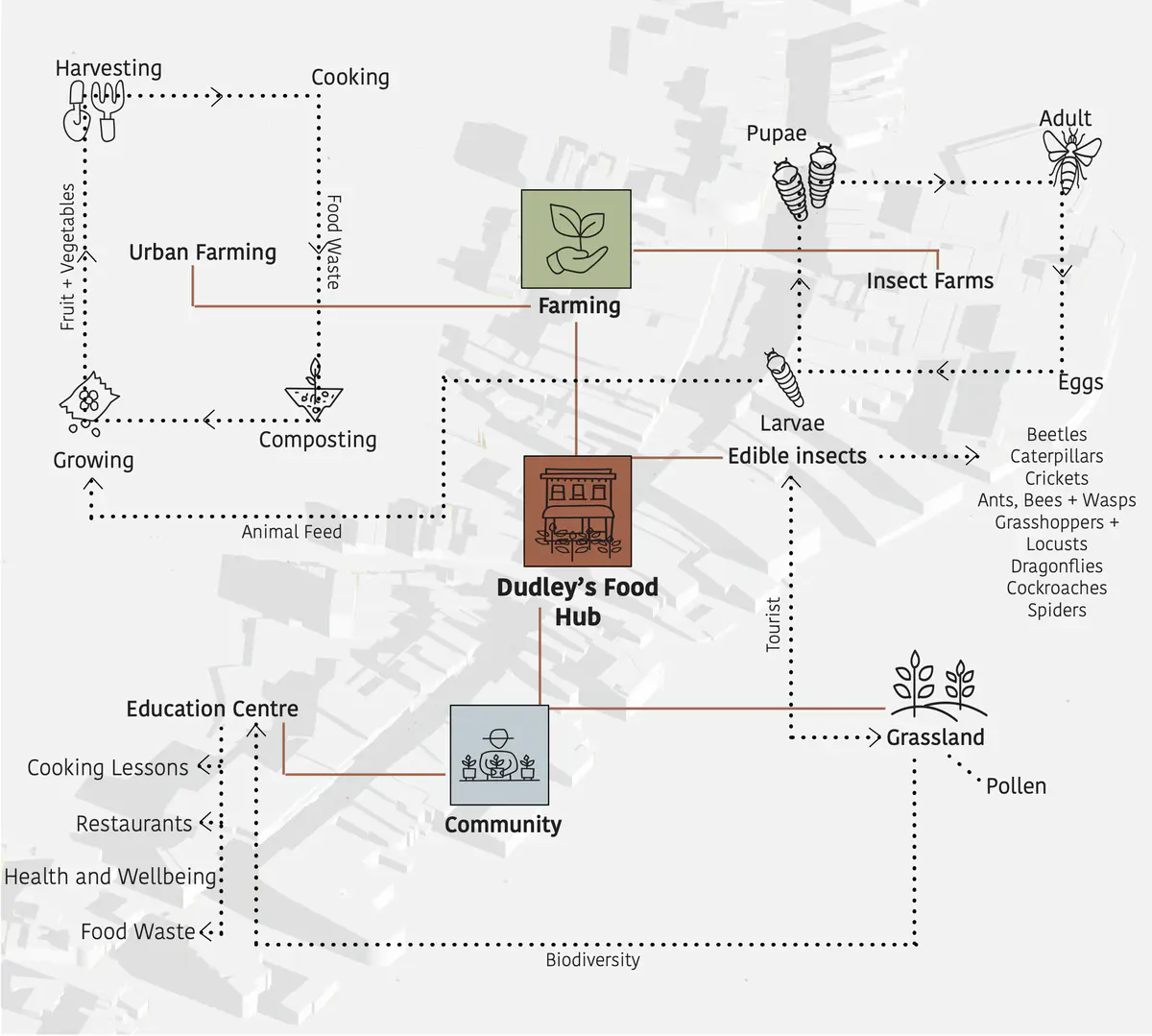
Linked to the Food Hub is an education centre sharing information on edible insects and Dudley’s biodiversity. Also offers insect cooking lessons to the local community and schools.
Immersed within the grassland is areas where existing buildings can extend out onto the street to create a stronger bond with new sustainable environment.
Redesigning the Market Place with more levels of outdoor seating to create a new experience and environment of eating food on the High Street.
Gardening and insect farming spaces integrated within the buildings. By bringing all the food production onto the High Street will help reduce food waste and also offer fresh produce to the locals.
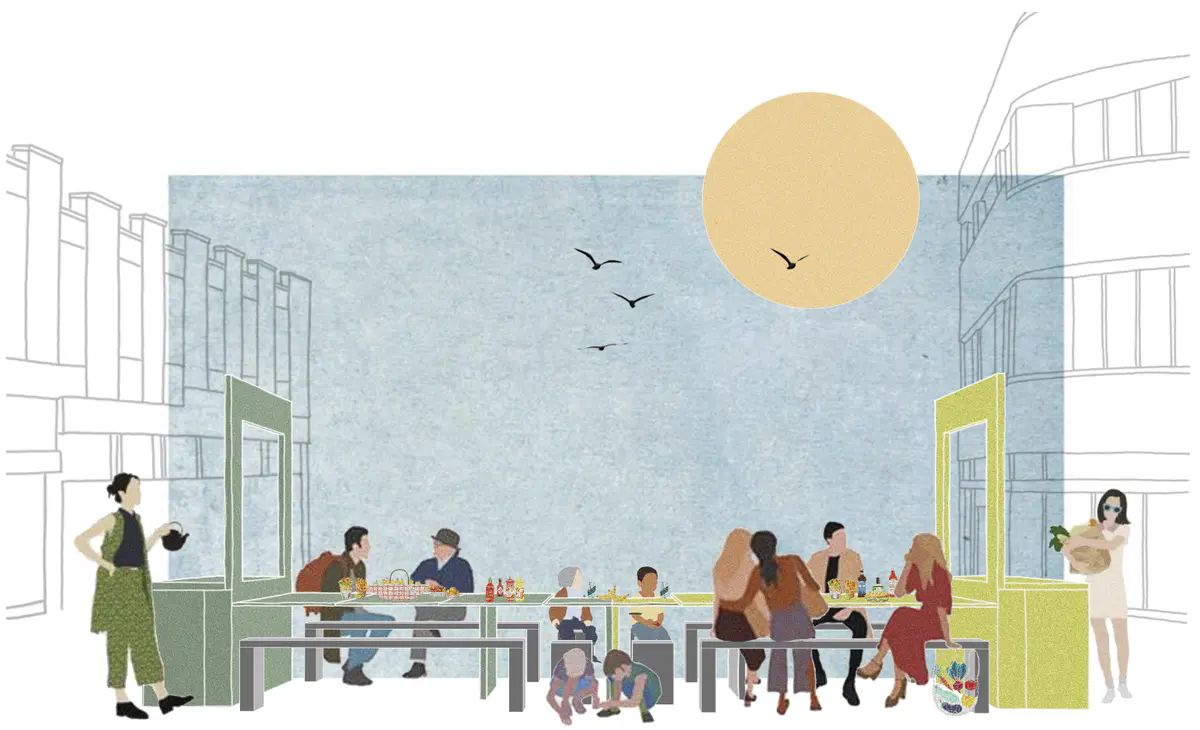
The first Stepping Stone project looks into designing multifunctional furniture for Dudley High Street to provide opportunities for a regenerative community, focusing on how the high street can be occupied with resilience. Initially, the stalls act as market stalls to provide opportunities for enterprises and small businesses to begin thriving and encouraging the High Street to become a place of inclusivity.
However, the stalls can extend out into outdoor seating arrangements, which can become an extension of the community kitchen and during events can become a part of the whole atmosphere.
By extending the furniture, they can connect together and become a large spread where people can sit together and enjoy company. It creates a lowered centre space so children can sit together, or paint on the surfaces. We decided to focus on furniture because we felt the importance of it can go unrecognised. We felt through the design of this market stall, many memories can be created and attached to these items, and become valuable assets within the community.
This post captures the street qualities where the visitors experience the colour and aromas of the food.
(We decided to present our narrative through social media and instagram posts as we wanted to showcase what individual experiences might be like when experiencing the future High Street. Each of our posts captures a different element of experience on the High Street to form a collective scenario.)
Jack and his friends visited the High Street with their school teacher during a study trip. He learned a lot of things about sustainability, and how to grow food. He was so inspired. Atifa gave him some seeds from fruits on the street garden, and later he planted them in a small unused bucket. After a few months he came back to street to gift the kitchen some of the fruit from his tiny garden at home. Atifa felt so proud of the young generation of Dudley.
Nurturing AgroEcology in Urban Life
A strategy for living alongside food production
A critical part of the climate crisis is the degradation of soil, leading to scientists predicting the UK has approximately 100 harvests left of stable crop production. As an attempt to address the problem this project will explore the possibility of integrating sustainable agriculture into an urban setting, reducing the strain on agricultural land, reducing food miles and widening city biodiversity. Taking guidance from the farming movement, ‘Agroecology,’ a climate conscious, wildlife supporting and community engaged closed loop system will be developed, combining traditional growing with technology driven techniques that will support each other to produce a diverse plate.
Dudley High Street will be the focal point, reinvented as a destination not just for the purchase and consumption of food but also its creation, driven by the needs and engagement of local people. Connecting the community to the food they eat.
Atifa lives nearby. During her free time, Atifa takes part in social work and welcomes the visitors of the High Street. Her main responsibility involves managing the food produced on street garden. A group of out of town visitors seemed lost on the street as they were wondering about what to do after shopping. Atifa suggested to participate in a workshop in the community kitchen. They plucked some berries and veggies from street and made a quick salad with a locally developed recipe that they had never tried. They thanked Atifa for the new recipe.
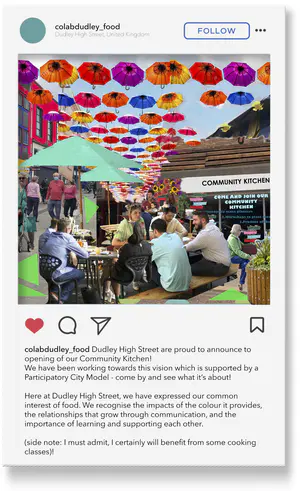
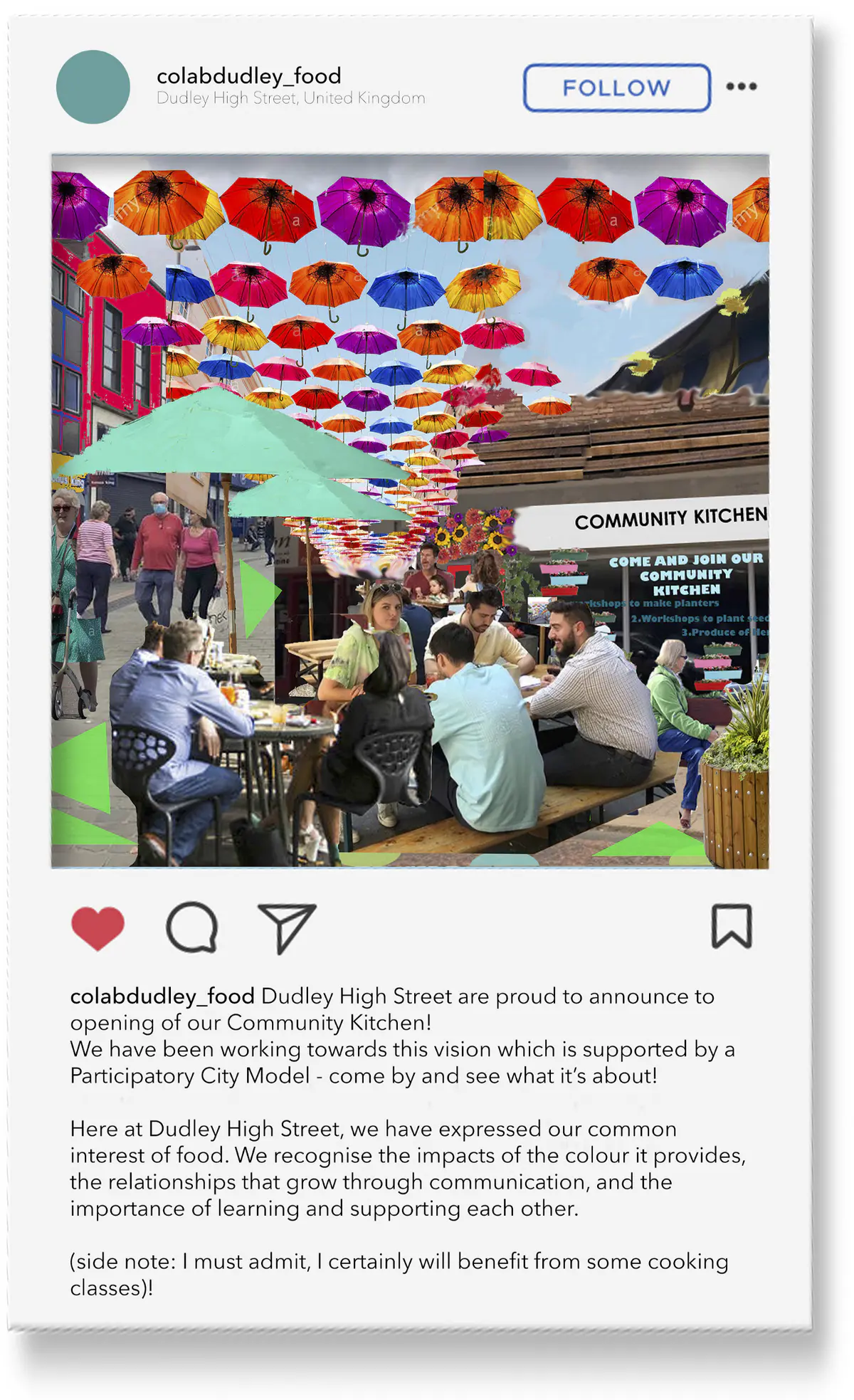
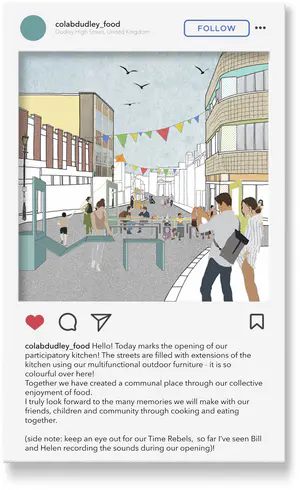
This post promotes the opening of a community kitchen, supported by the Participatory City model.
(We decided to present our narrative through social media and instagram posts as we wanted to showcase what individual experiences might be like when experiencing the future High Street. Each of our posts captures a different element of experience on the High Street to form a collective scenario.)
In this picture from 1914 in Dudley, you can just make out my grandfather. He's the small boy with the cap running across Wolverhampton Street in the days when the trams were still running. Years later we worked out that this day was probably a defining moment in his life, the day he chose never to have a second thought or to be bullied by others. You can see him running. This is because he had stolen the ham you can see him carrying under his arm. This one action started a chain of events for my grandfather that would go on to dominate his formative years. Petty larceny, theft, criminal activity that would shape him, turn him into one of the most notorious villains in the Black Country.
When he died in 1972, this photograph turned up amongst his possessions, in a locked drawer of his bureau. We agreed amongst us that no one in the family had ever seen this photo before, curious as to its importance to him. On the back of the photo he had written the date and time, together with a brief note - "Me stealing ham from W.Smiths, butcher". He would have been 10 years old and this was perhaps his first, or at least one of his first criminal acts.
We have no idea who took the photograph or how he had come to have the original print in his possession, but it appears that it held some significance for him as he kept it all of his life locked away in his bureau drawer.
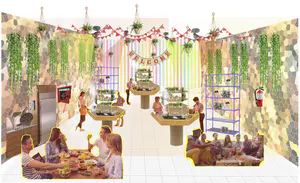
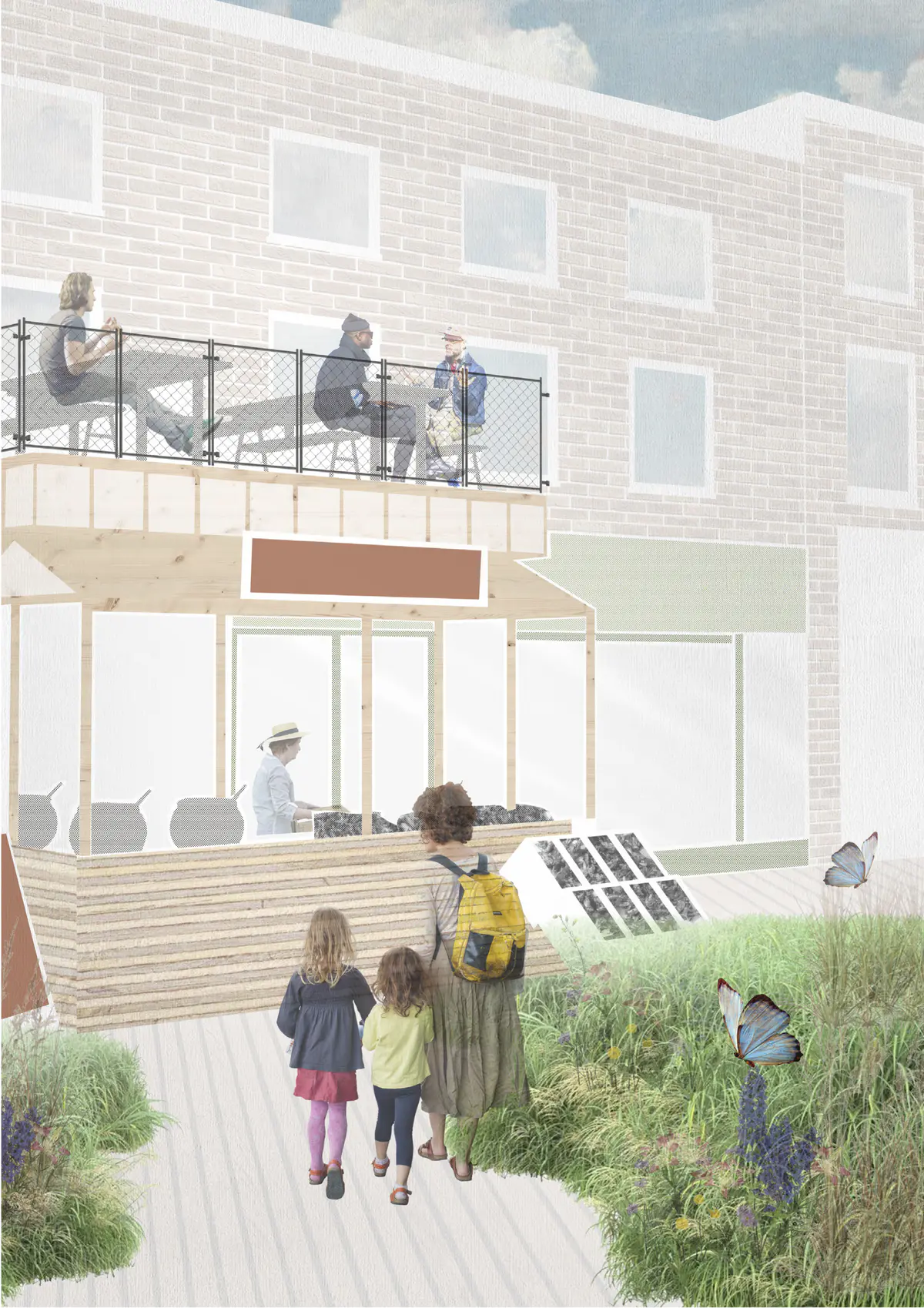
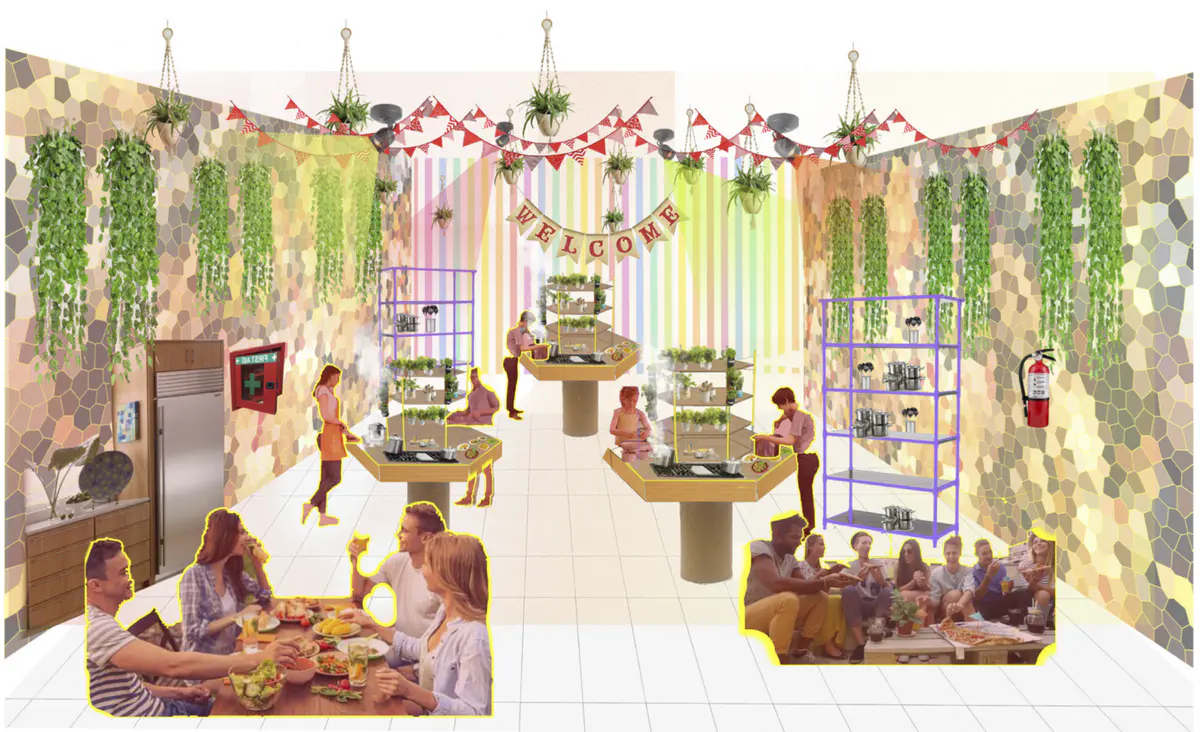
The interior of the community kitchen would be inviting and colourful to create a positive atmosphere. The colours were abstracted from one of our group collages of food. The kitchen counters are not considered as a back of house element; they have been combined with seating as we are trying to embrace the cooking process. The kitchen desk is designed in a way so multiple people can work together from all sides, with central storage for herbs.
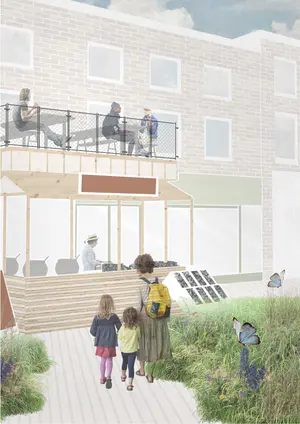
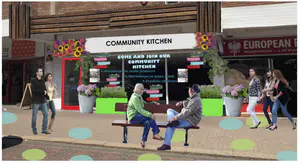
The facade of the kitchen contains a small window so food can be sold outside. We have also created a vertical herb garden so it can be used in the community kitchen. We wanted to keep these below eye-line so people outdoors have a clear view into what’s going on inside.
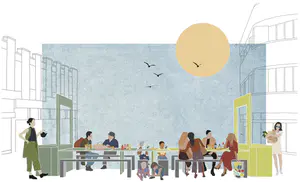
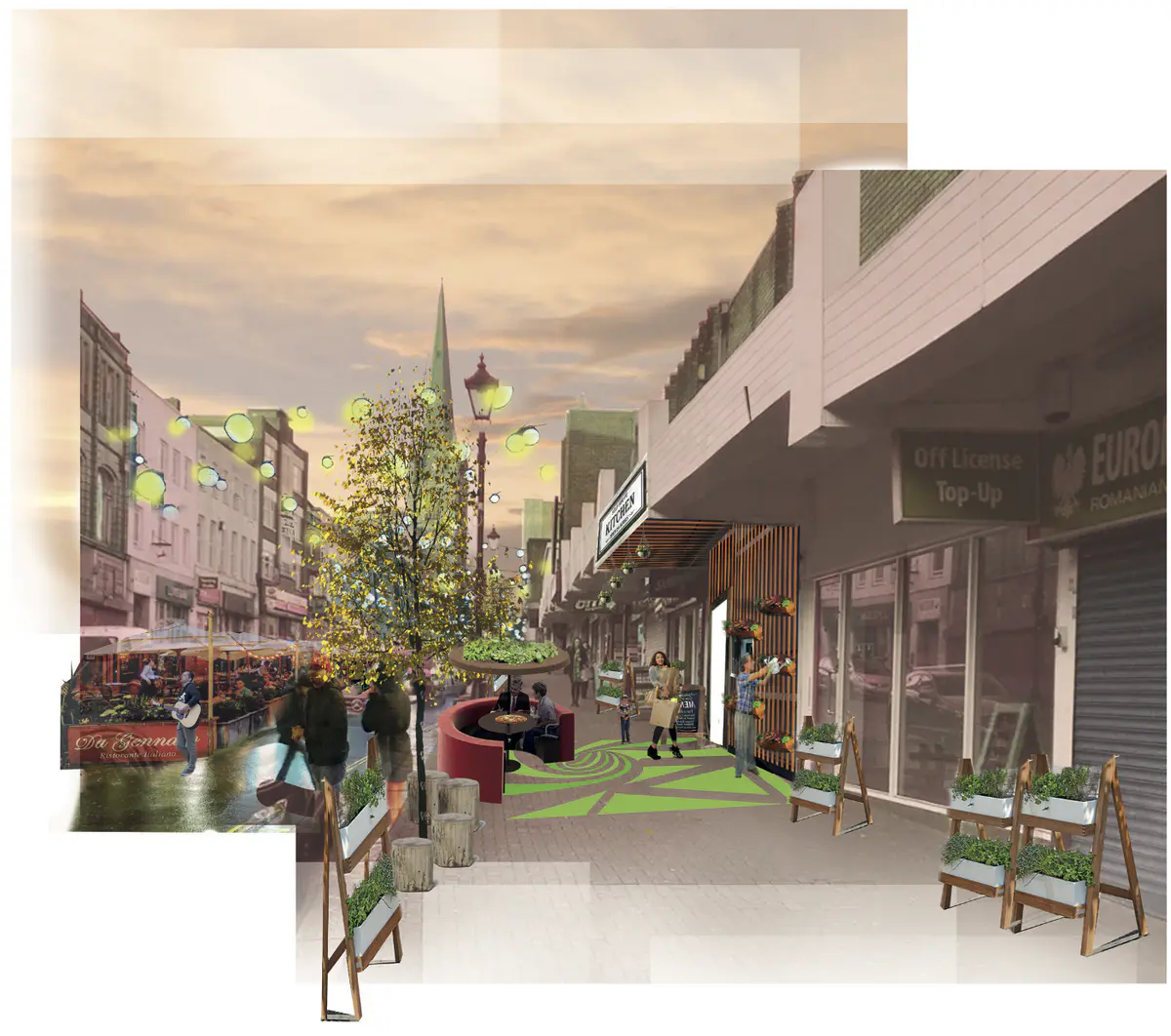
This street section shows activity from the back of the community kitchen to the other end of the street and how all these elements are working coherently. The street is filled more with people rather than cars. We believe that the outdoor seating, more trees, canopies and street lights can attract people to connect with the High Street.
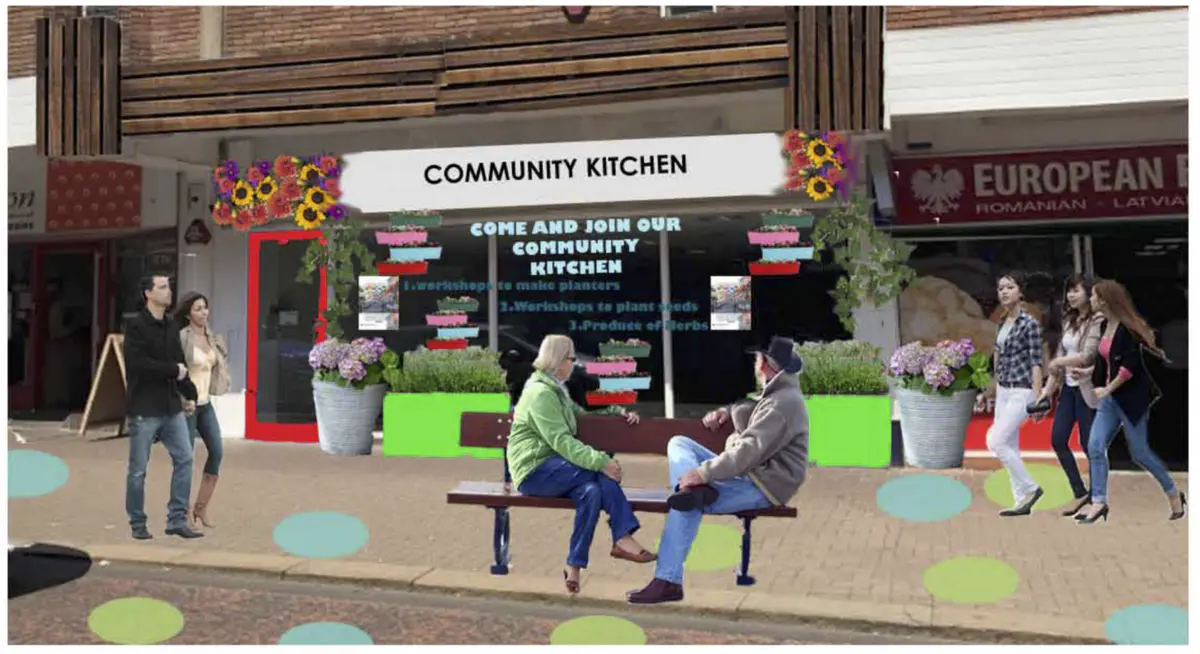
The second Stepping Stone project focused on the representation of colour and revitalising frontages. During our group discussions, we recognised the negligence of existing colour on Dudley High Street. Colour is a key element we believe can bring a sense of brightness into the High Street, and an element that should be of focus when revitalising the frontages.
In this example, we have approached the frontage for the community kitchen we envision. The visual showcases a Community Kitchen in which different herbs and spices can be grown. These can then be used to cook the many dishes respective to the different cultures existing on the High Street. Each frontage can respond to the different uses of the buildings to promote individuality across the street.