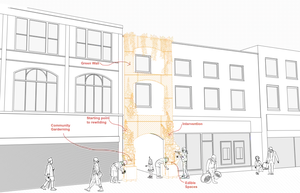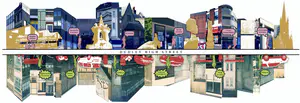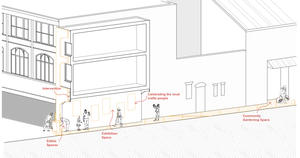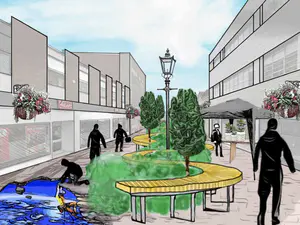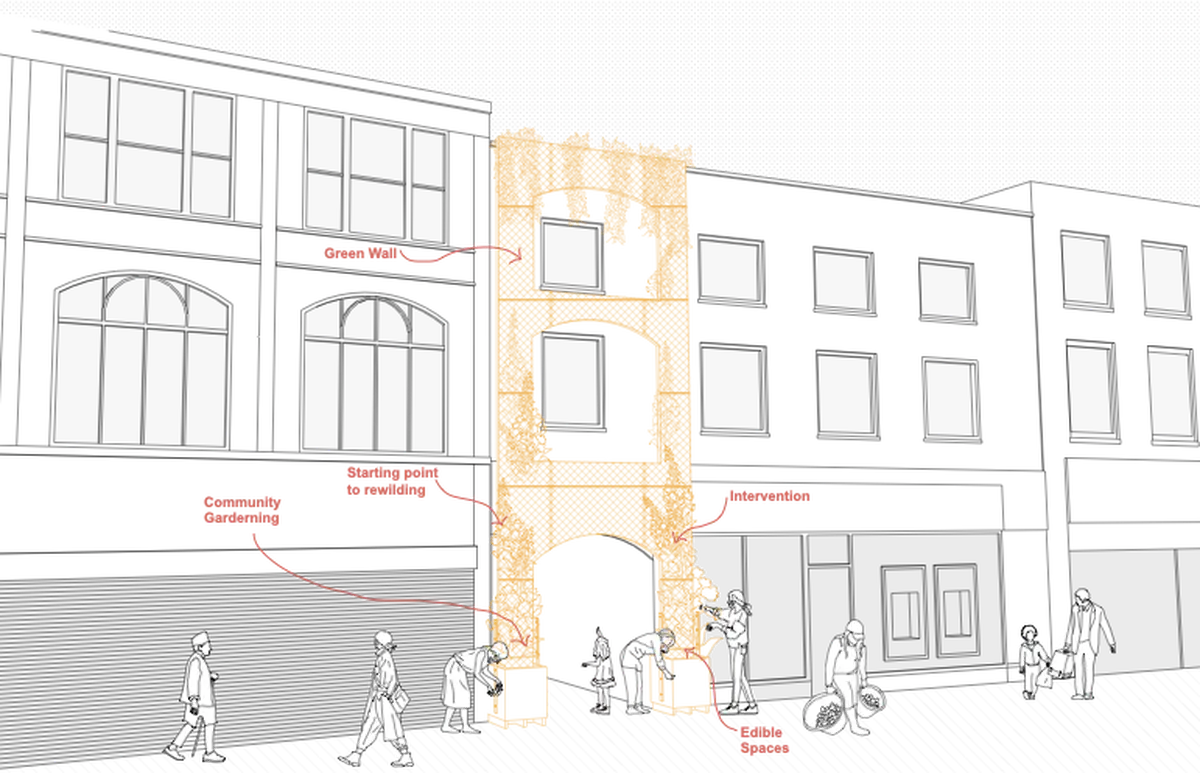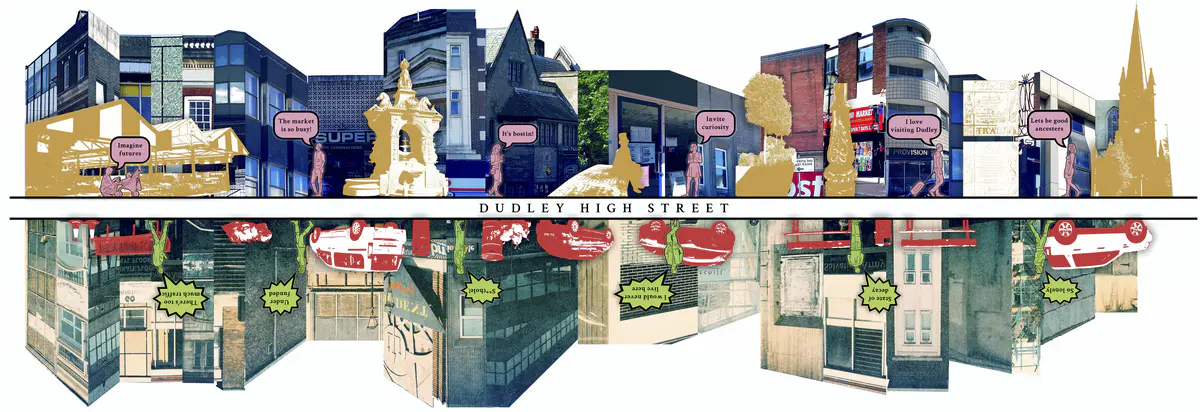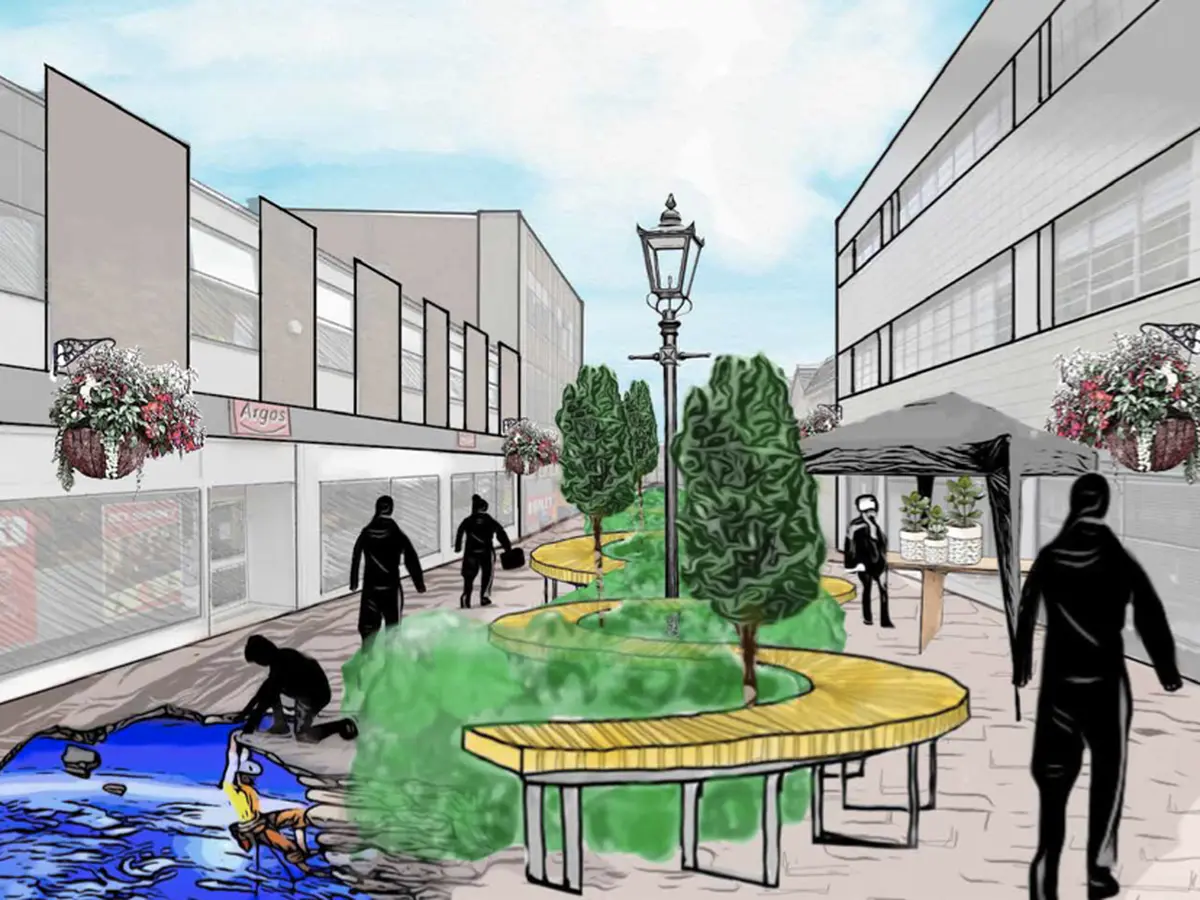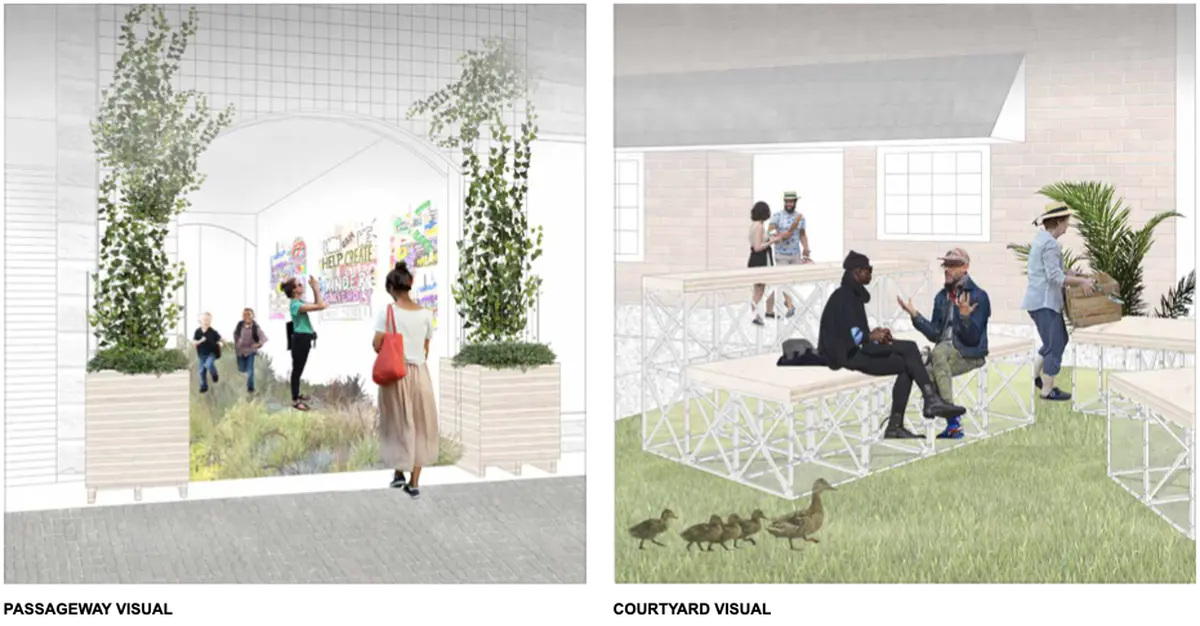
A sketch showing workshops utilising the empty spaces, street furniture, canopies on the side, and street art to brighten and liven the current High Street.
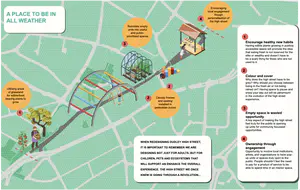
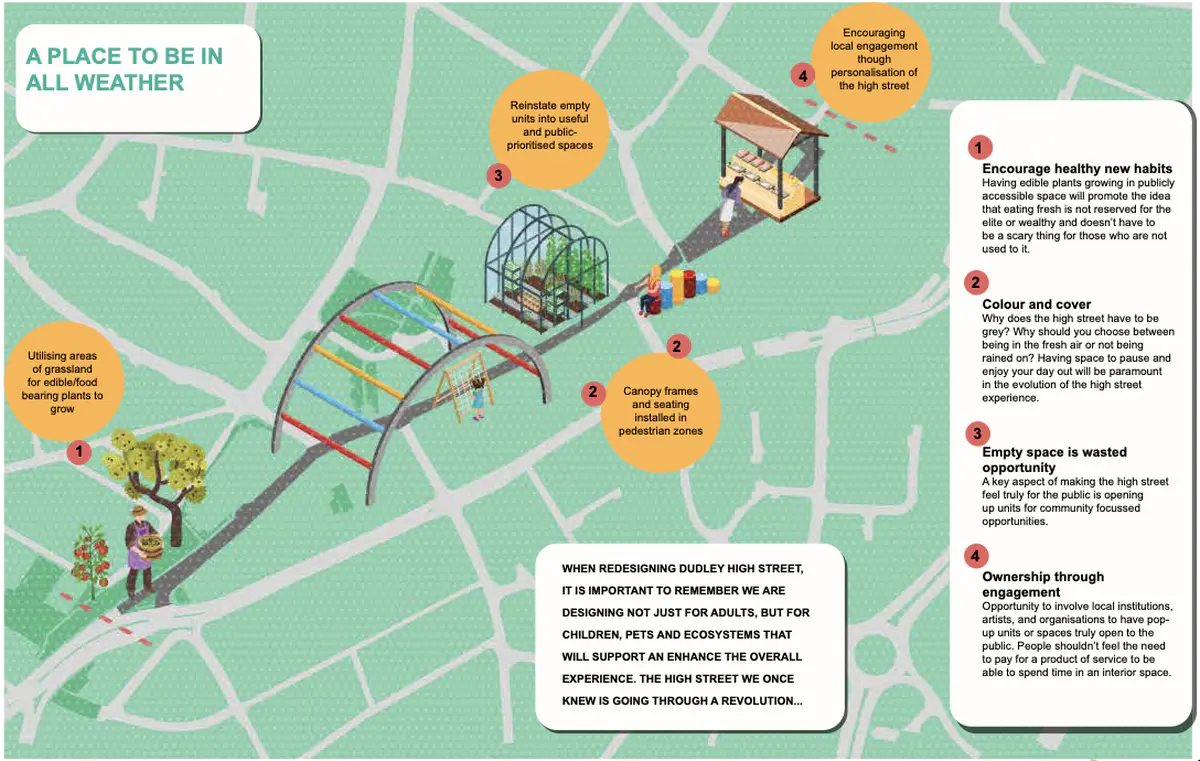
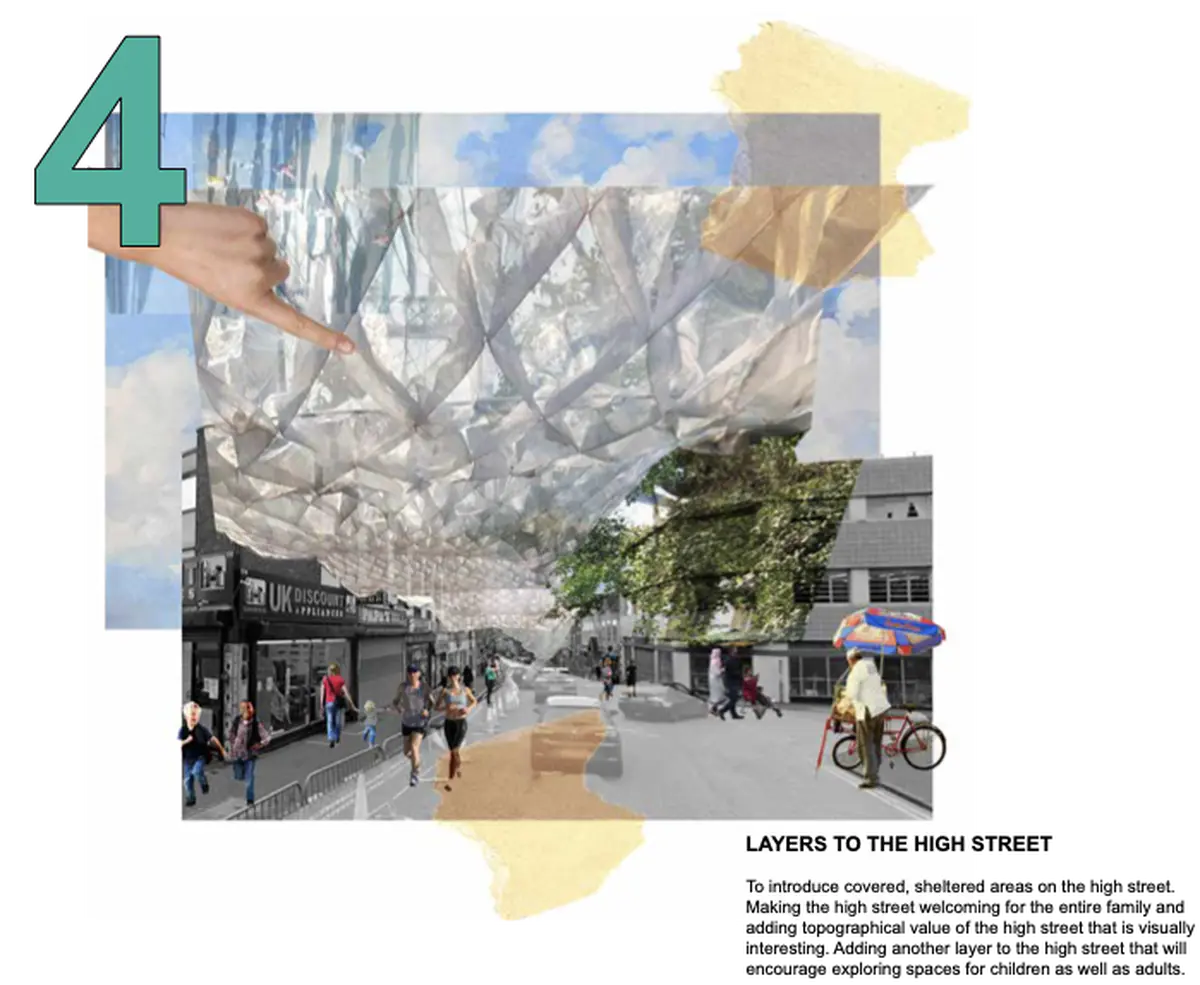
LAYERS TO THE HIGH STREET - To introduce covered, sheltered areas on the high street. Making the high street welcoming for the entire family and adding topographical value to the high street that is visually interesting. Adding another layer to the high street that will encourage exploring spaces for children as well as adults.
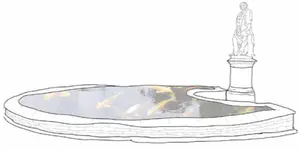
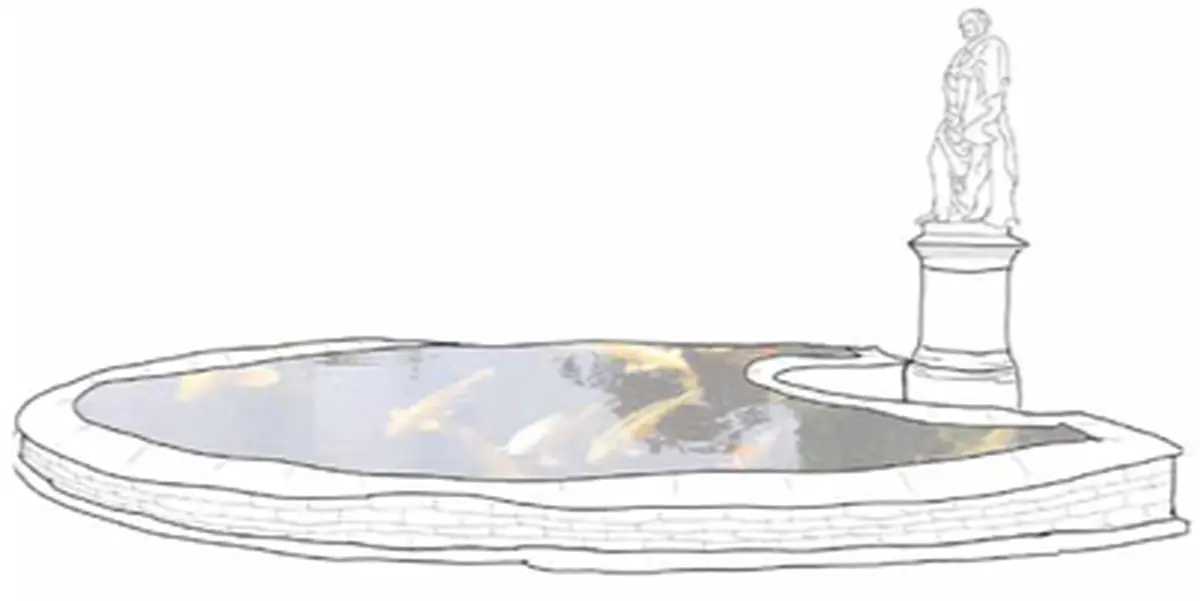
Pond — At the northern reaches of the High Street lies a raised bed with nothing but a sterile patch of grass. We suggest as a miniature stepping stone, we replace the grass with a pond. The sounds of water can soften the noise of the traffic and it will invite pedestrians onto the high street by having this point of interest. It also works with the plans for re-wilding and growing food along the High Street as it aids pollination.
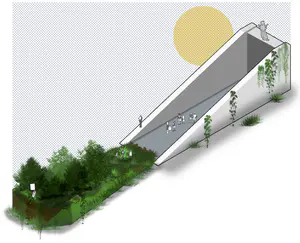
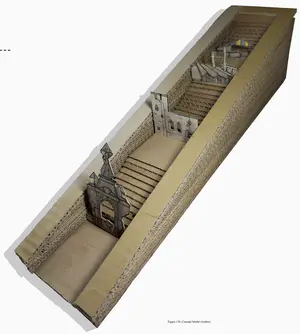
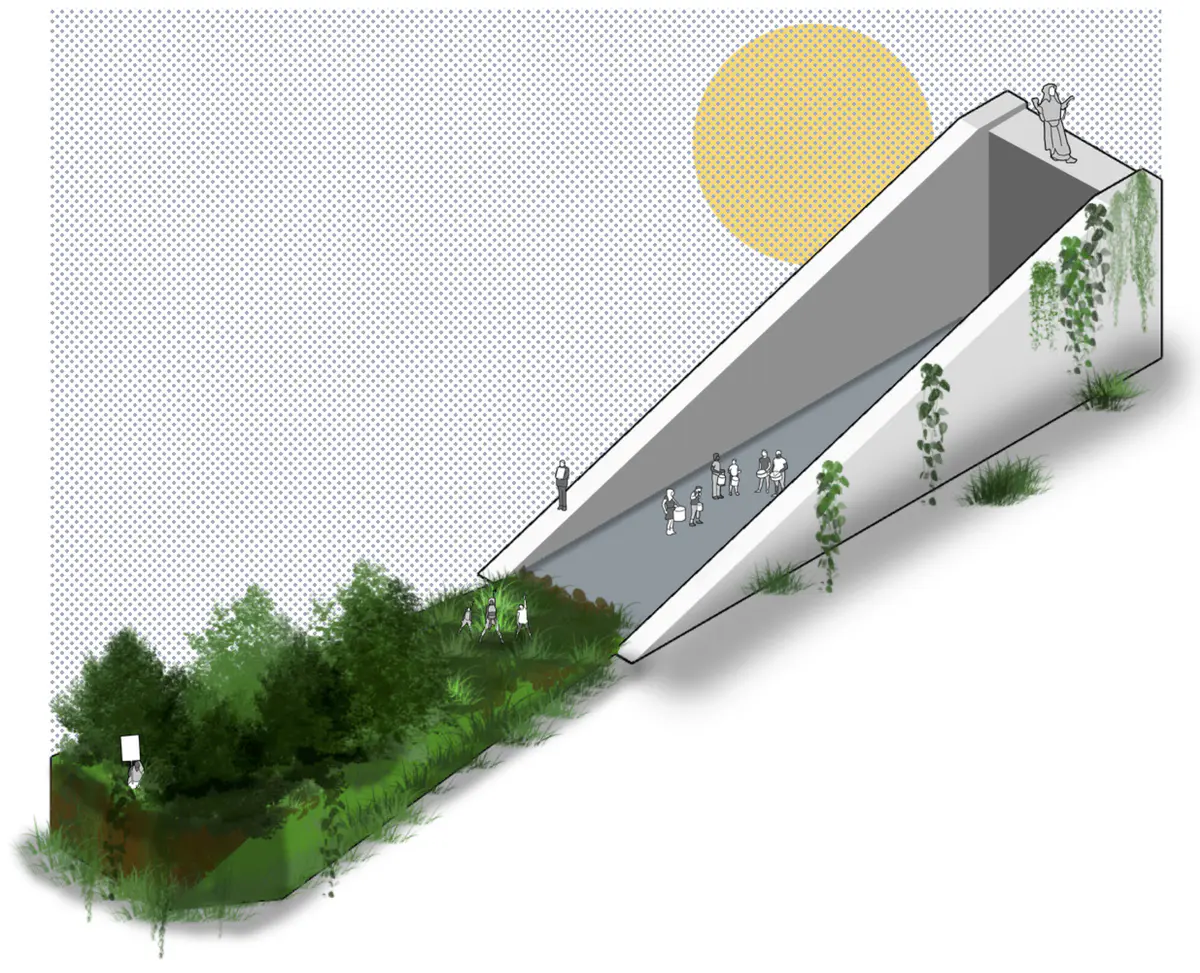
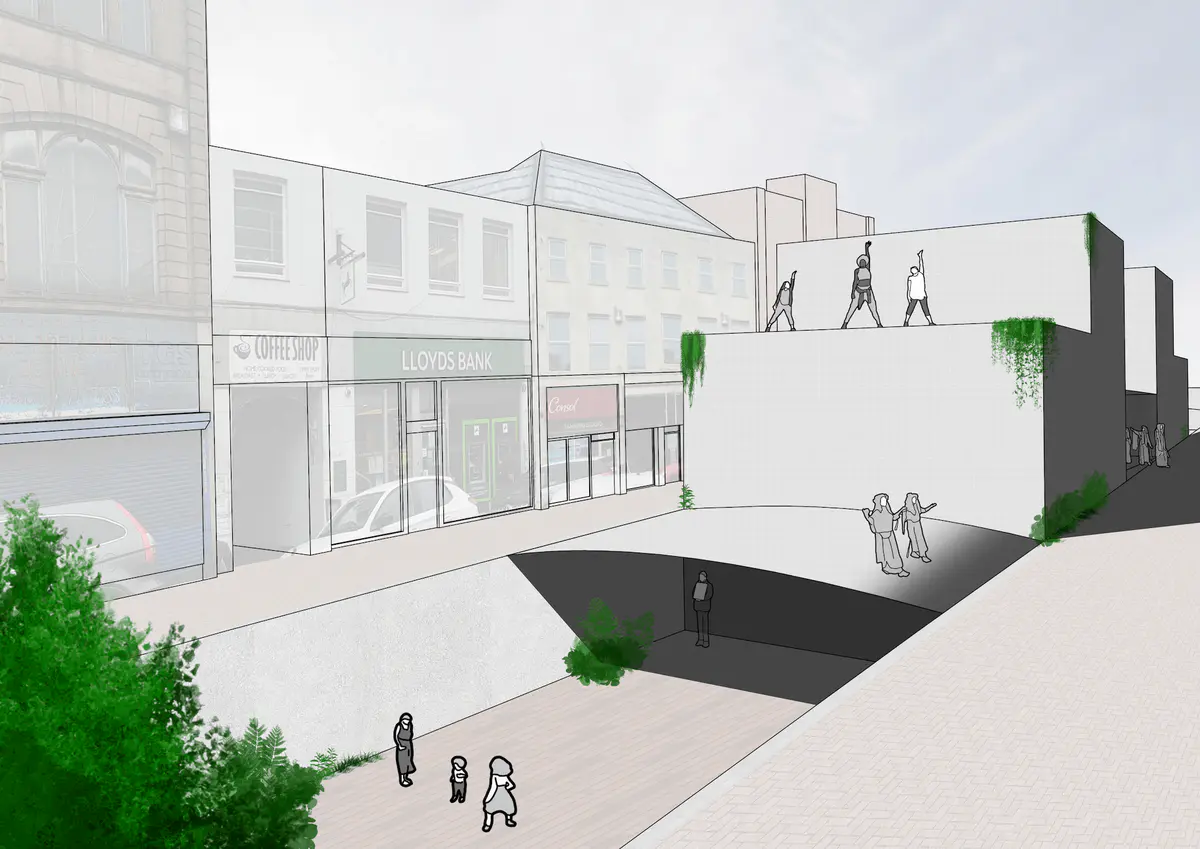
The whole High Street would be dug out to make way for this new kind of “street”. The idea, as stated, is to alter the way that people use this street, so that they can learn about the legacy of Dudley. This would mean that there would be a canopy that sits on top of the cut, that would also act as a means to shelter everything underneath, but would also be made in Dudley to promote local craftsmans. This canopy can then hold something like Theatre Curtains with the history of Dudley presented on them. As you walk through the cut, you go through all the different parts of Dudley’s Legacy - Saxon, Middle Ages, Industrial Revolution, Modern, and you would end the walk on the “Future”. You would start at one end, up by the top church, and as you walk through towards the market place, you would walk through the eras in chronological order. Then, once you exit the tunnel, you would leave the Modern era, and come out into the reclaimed green space, which would represent the future of Dudley’s Legacy. This would be a Miyawaki Forest that would be expanded out through the streets, taking over the spots where cars used to drive, to now benefit Dudley, it’s people, and the world as a whole.
Dudley’s High Street is about 240 metres long, about 9 metres wide, and rises about 8 metres. This would provided a very prominent feature for the High Street if it was dug out and recommissioned.
An added aspect to the dug out street would be that of the canopy that would reside above it. While thinking of the design, two ideas stood out - one that would stand raised, at about the same level as the end of the street, which would create this arcade styled archway that would reside high above the street. The second was having the canopy be flush with the pavement all the way up, except at the end that would then provide a small increase around the steps.
Both ideas serve the same purpose, but provide drastically different means of doing so.
Provision
I invite you to stand in my shoes
In the space between dark and light
To imagine a room laid bare
Where you sleep in the bath
In the clothes you wear every day
Because you don’t have a bed or
Even a mattress on the floor
To rest your tired frame.
You are in crisis
Slipped through the cracks It doesn’t matter how or why Just that you are here
Needing help
Needing compassion
Practical support
To get back on your feet
To feel cared for
Provided for
Prayers answered.
I sit here listening to Blur
On the CD player I have just bought from Provision House
A beacon-topped Aladdin’s cave of treasures
That occupies a space right opposite
It’s higher calling
Old Co-op
Old shoe shop
New lease of life
For this art-deco giant
Three floors of stepping back in time
Down history rich stairs
Through formica inlaid doors
Its belly stuffed with
Furniture and bedding
Tables and lamps
Wardrobes and kitchenware
The things that we take for granted
Destined for those that have nothing
Absolutely nothing
A lifeline.
In the shop I can still buy a pair of shoes
Anything an old department store may well have stocked
Ironic I feel.
They save the sleeping bags
To hand to homeless folk
Health-packs and new socks
Whatever helps.
The Food Club caters for those
That need to feed themselves
Their families
On budgets stretched to breaking
They mind the gap that governments should fill
By remembering that everybody counts Black Country rules.
Kim chats to a woman
Buying sticker-books for her granddaughter
Laughter slips through this conversation
Two books for a pound and you know
The girl will have a fun filled afternoon.
I ask about the future
Plans for expansion
Rooms to hire
Office space
Training programmes on their way
Perhaps a life for the room upstairs and I see progress
New from old
Right from wrong.
So, step through this door and lend a hand
To those that need it more than
You and I will ever understand.
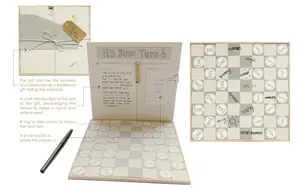
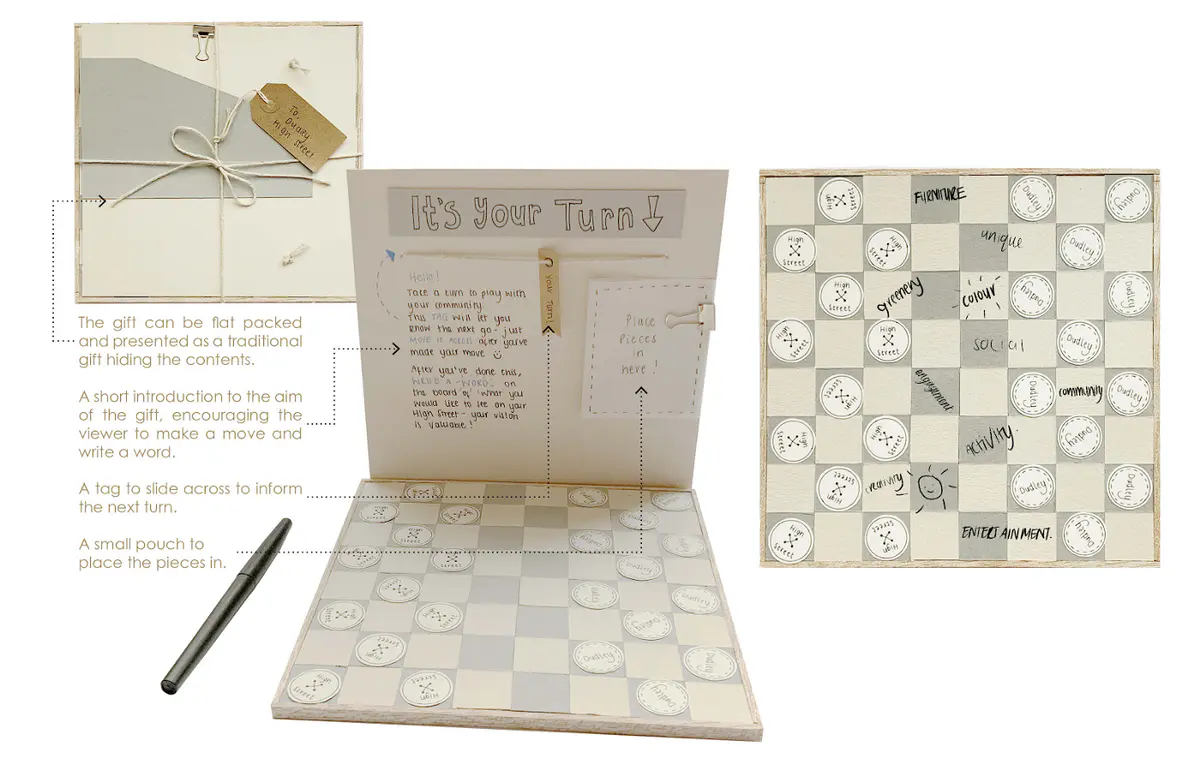
My purpose of my Gift to Dudley High Street is to encourage the users to become involved in the changes that occur in a place they use. The aim is to gain feedback from the users of the game to inform any progress made, this way, the focus of regeneration can come from the users themselves, becoming a collective collaboration. Through the users interacting with each other on the High Street using this game, the presence of users can be recognised, reminding the people of a sense of community to promote and celebrate going forward.
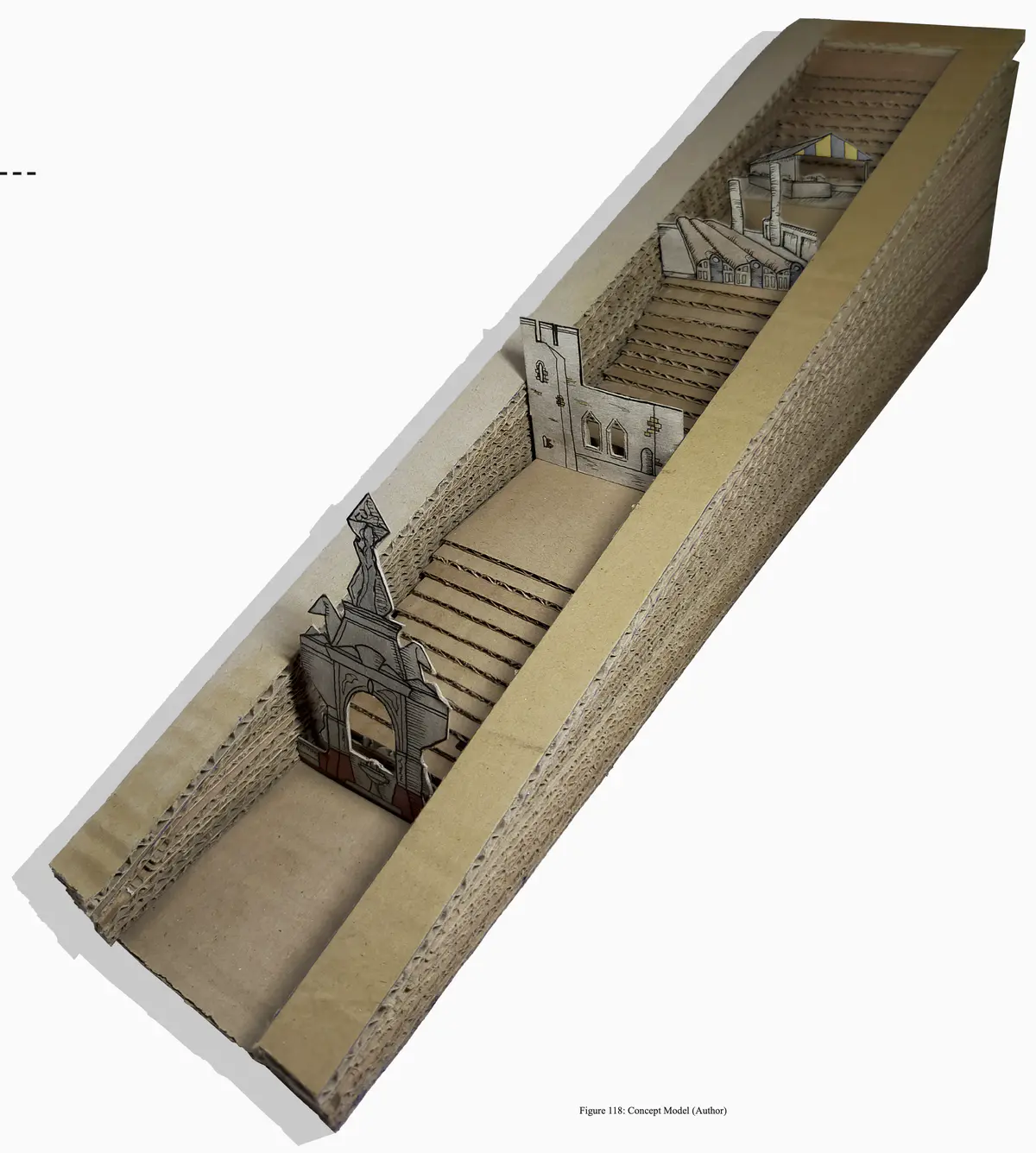
Concept Model - The model represents the idea of digging into the High Street itself. The idea was to drastically alter the form of the High Street to a point that it altered the ways that people in Dudley would live their day-to- day, changing the theatre of their lives, so that they could learn about their own history, their legacy, and about the endless possibilities of Dudley’s future. The idea was inspired by the word “Cut”, which in Black Country Dialect means “Canals”, as they were long cuts through the land.
Dudley’s fountain represents the Middle Ages, showing the growth of Dudley over time. While it was the Capital of the Black Country (and still is), the Middle Ages is when Dudley saw itself come into it’s own place, being recognised as a big market town, and slowly expanding it’s territories and influence.
The Castle represents the Dudley Castle, built in the 11th Century. Ruling over the land, the Castle is a key component of the Legacy of Dudley, sitting on the highest point for miles around, rich with history, from Being demolished twice, to the civil war, to now watching over the Zoo.
The factories represent the Industrial Revolution era of Dudley, a time when Dudley was the king of England, and basically ran the entire process. It was an important aspect of Dudley’s Legacy, and sits as probably its crowning glory - even if today we can recognise the disastrous affects it had on the world in the short period of time the era passed.
The Market represents the modern day. Dudley has seen better years, but it is with this project that I propose that even better ones are just around the corner. While people don’t look fondly at Dudley, those from there have a fierce dedication to the legacy of Dudley, which hopefully will burn to a brighter future.
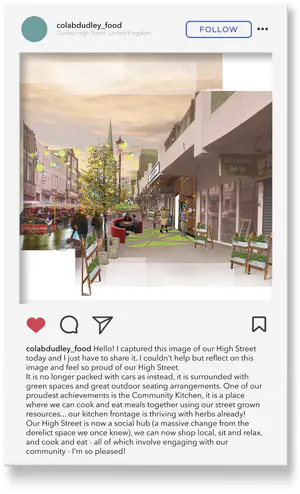
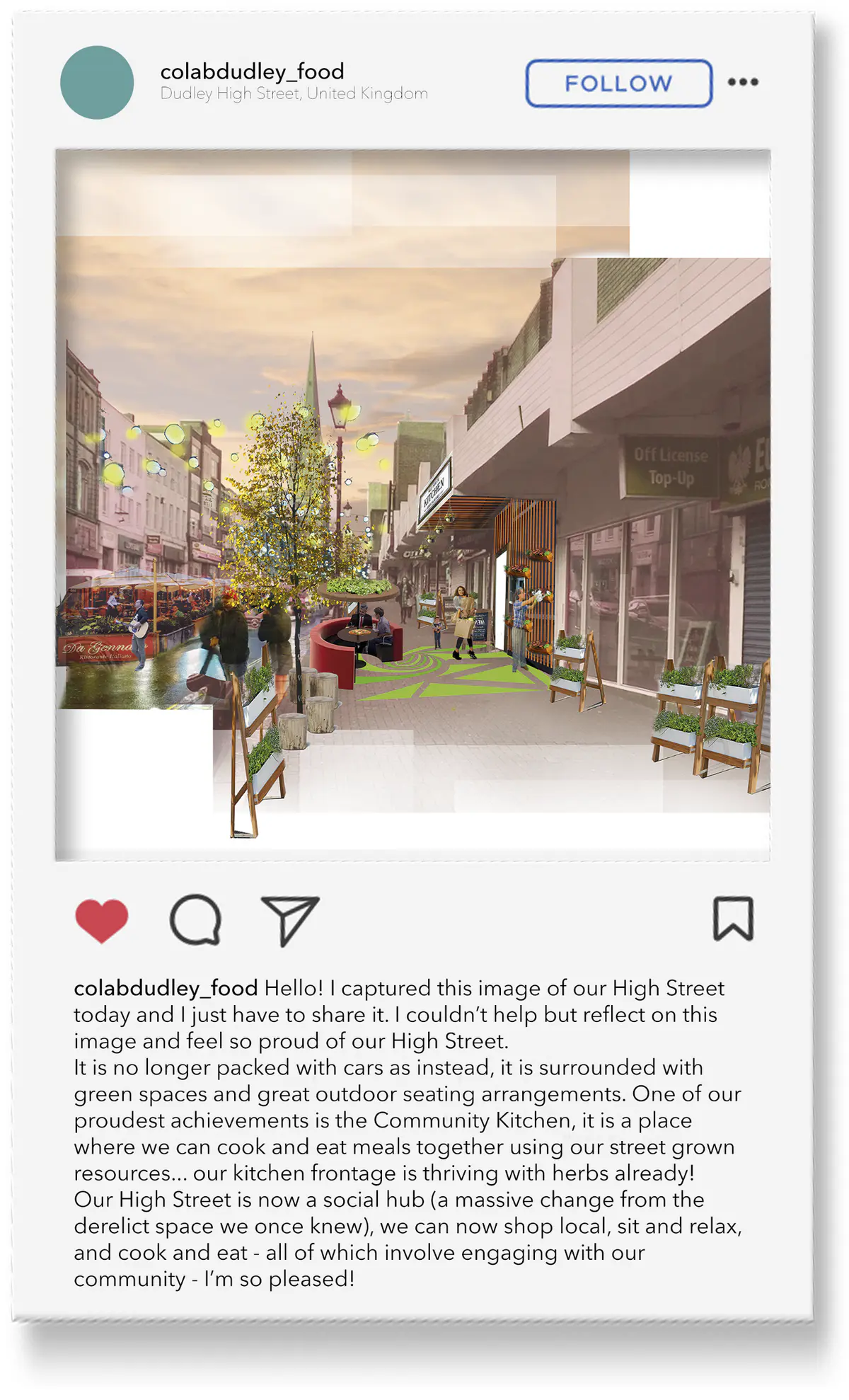
This post develops what the community kitchen has to offer with street grown resources and community engagement.
(We decided to present our narrative through social media and instagram posts as we wanted to showcase what individual experiences might be like when experiencing the future High Street. Each of our posts captures a different element of experience on the High Street to form a collective scenario.)
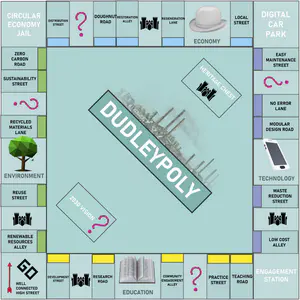
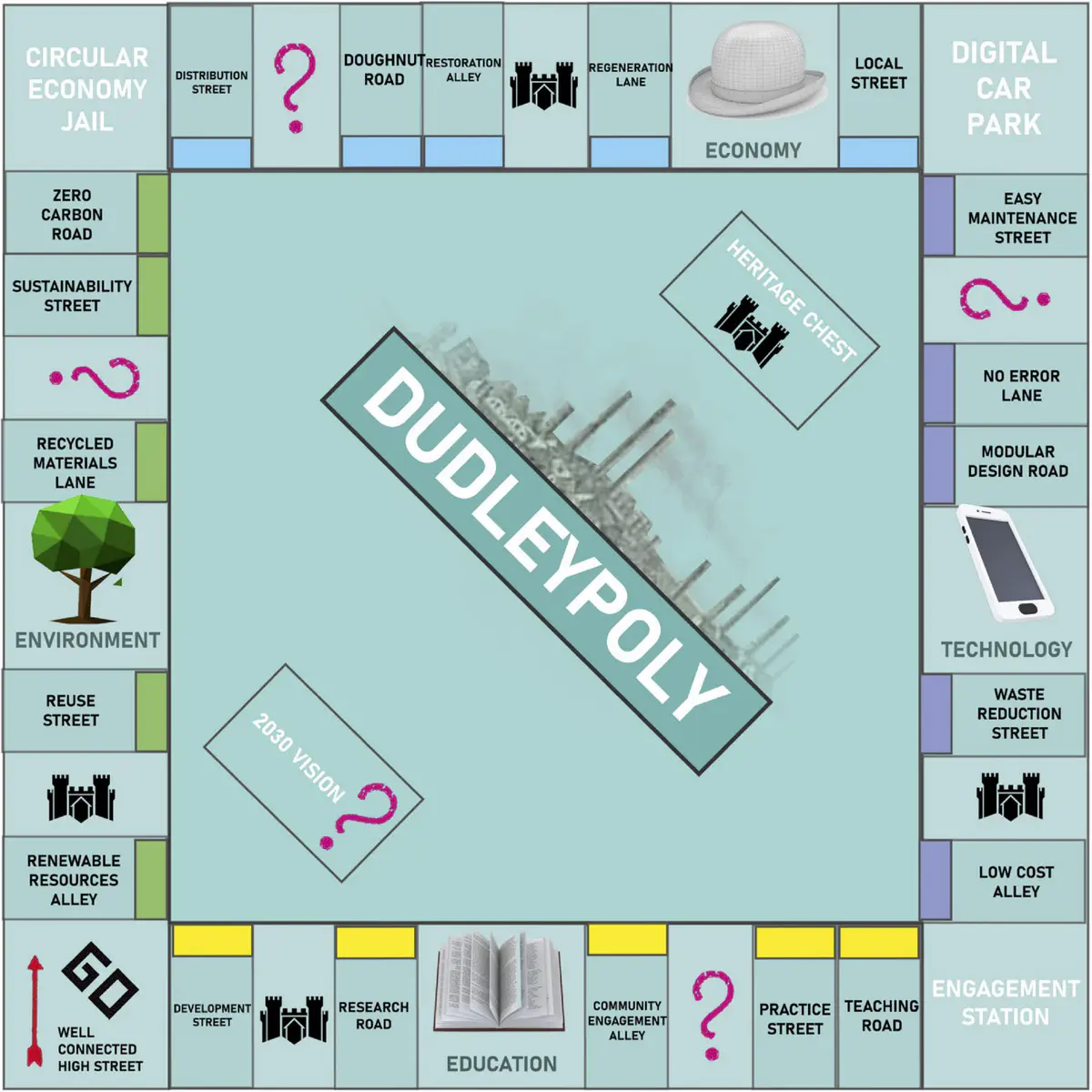
We created a visual representation of the main factors and sectors we came across in our research and explored individually: environment, economy, technology and education. It also summarises our goal of creating a connected High Street, and the steps we took to achieve this goal.
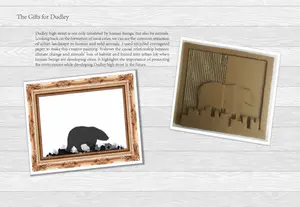
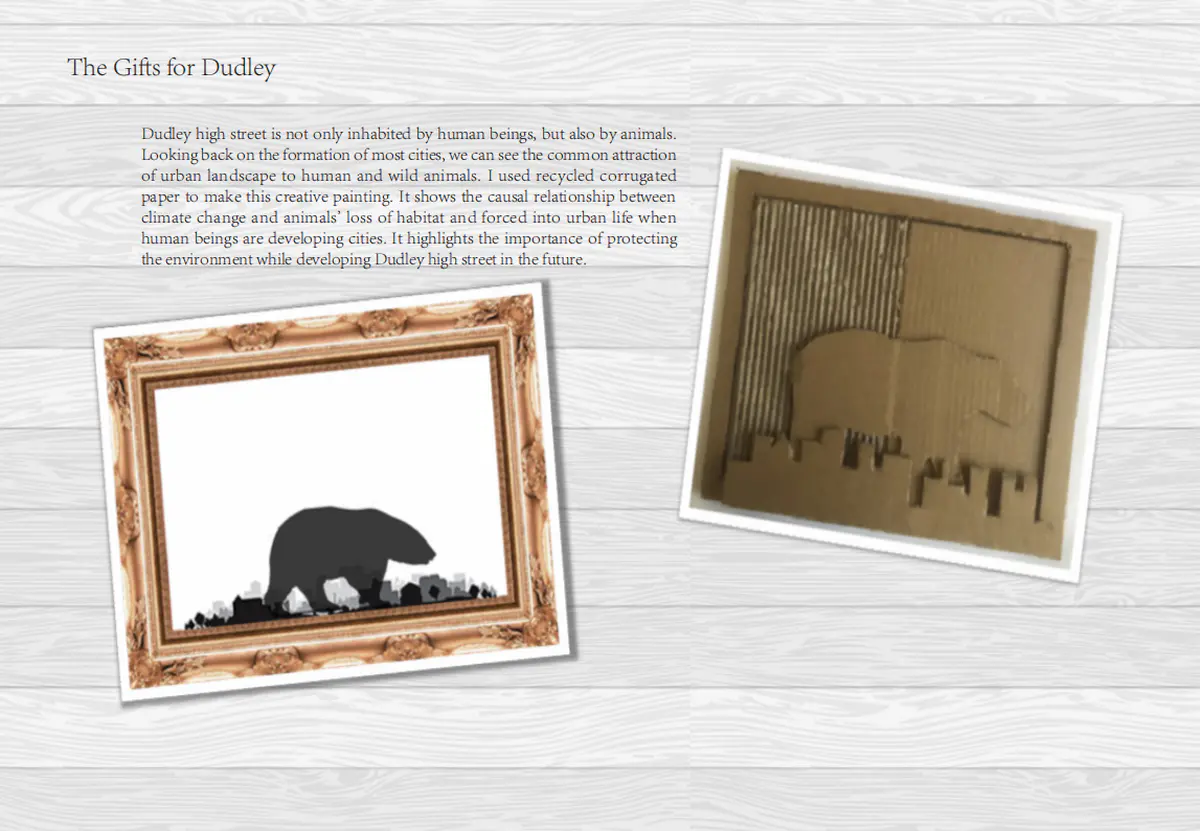
Dudley High Street is not only inhabited by human beings, but also by animals. Looking back on the formation of most cities, we can see the common attraction of urban landscapes to humans and and wild animals. I used recycled corrugated paper to make this creative painting. It shows the causal relationship between climate change and animals’ loss of habitat and forced into urban life when human beings are developing cities. It highlights the importance of protecting the environment while developing Dudley High Street in the future.
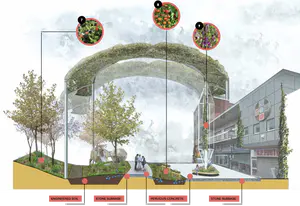
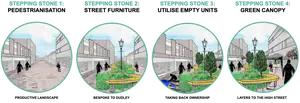
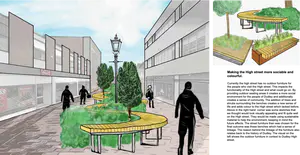
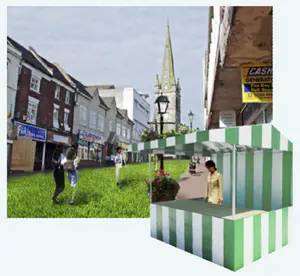
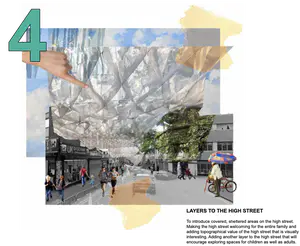
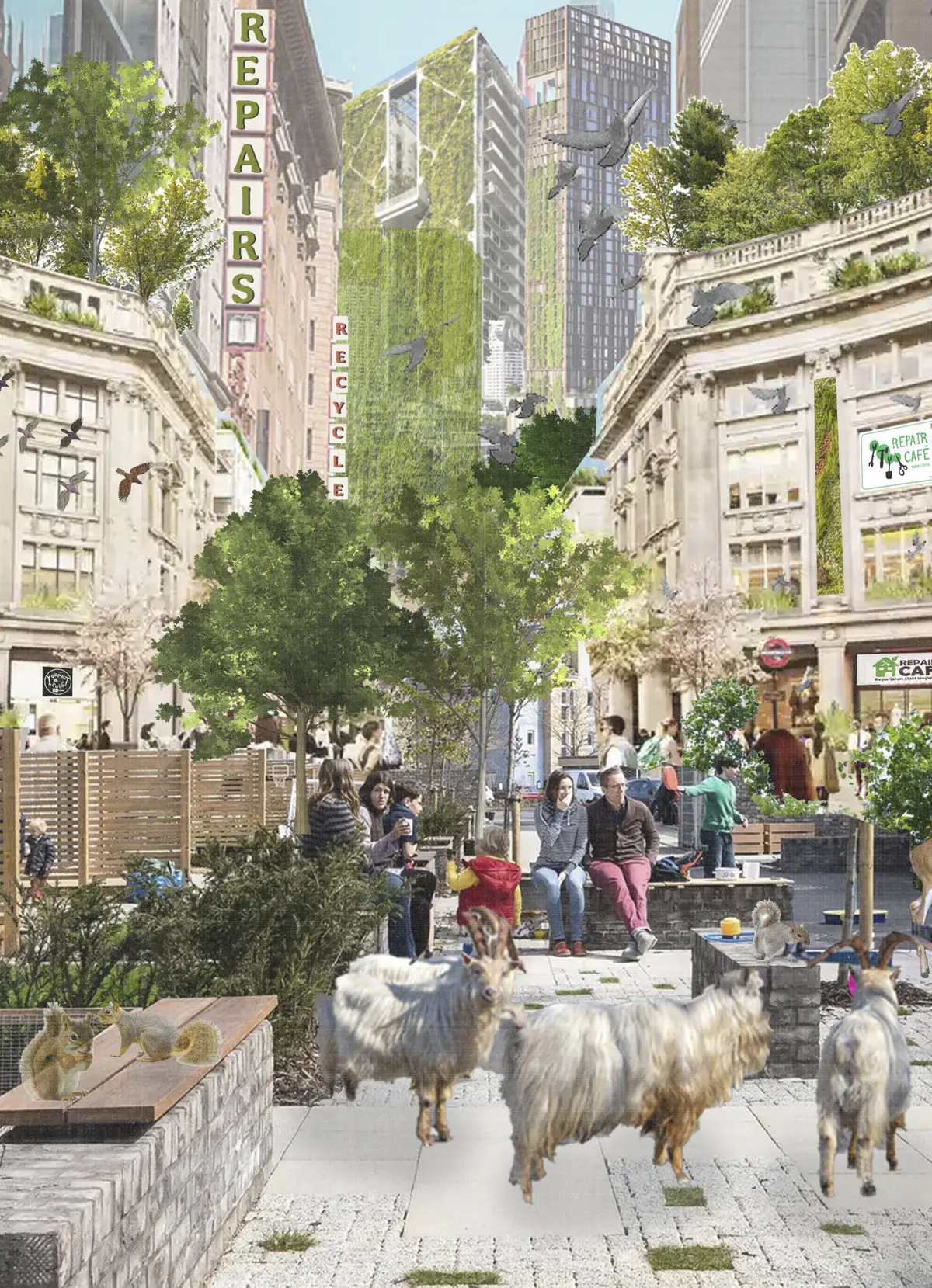
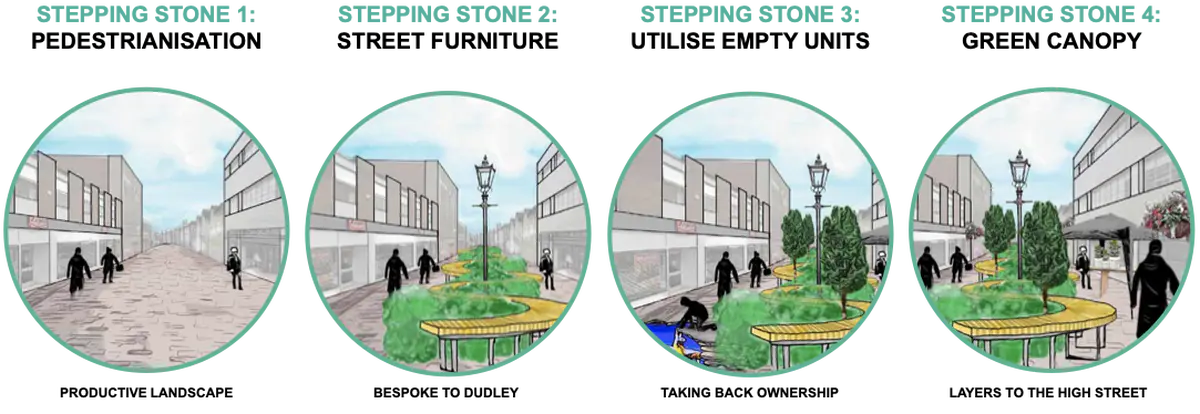
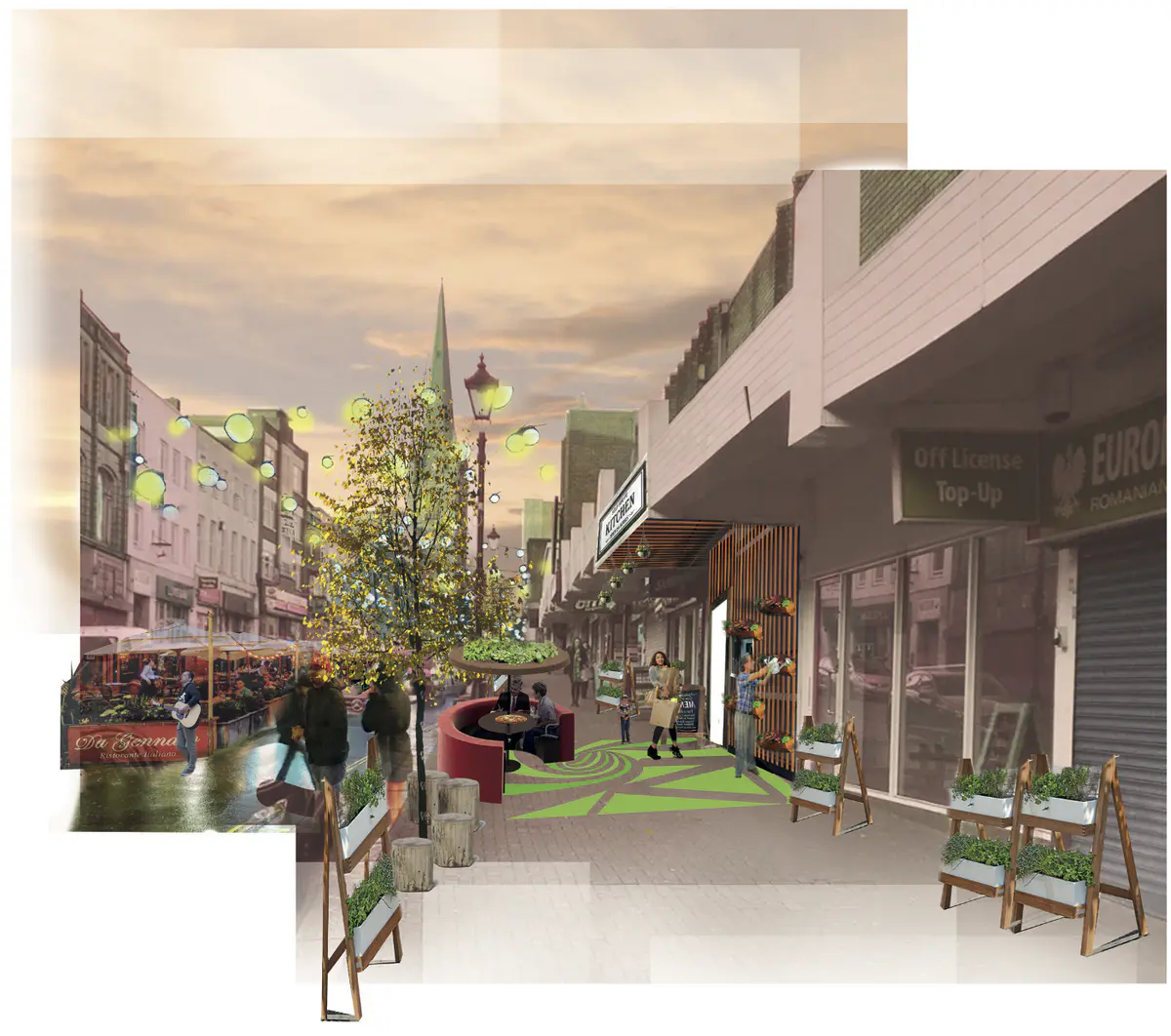
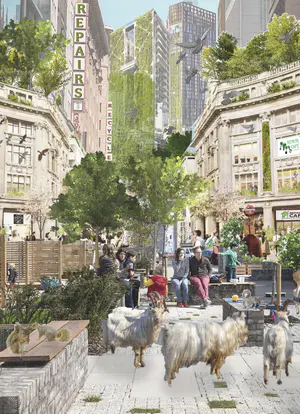
Stepping Stone 4 adds layers to the High Street. Like the other visions, we wanted to use CoLab Dudley’s principles ‘use nature as a guidebook’ and ‘create conditions for curiosity and experimentation’. The main way we proposed to do this was adding a green canopy to provide shelter, create a hybrid indoor outdoor space welcoming to families and a more communal open space, and support ecosystems.
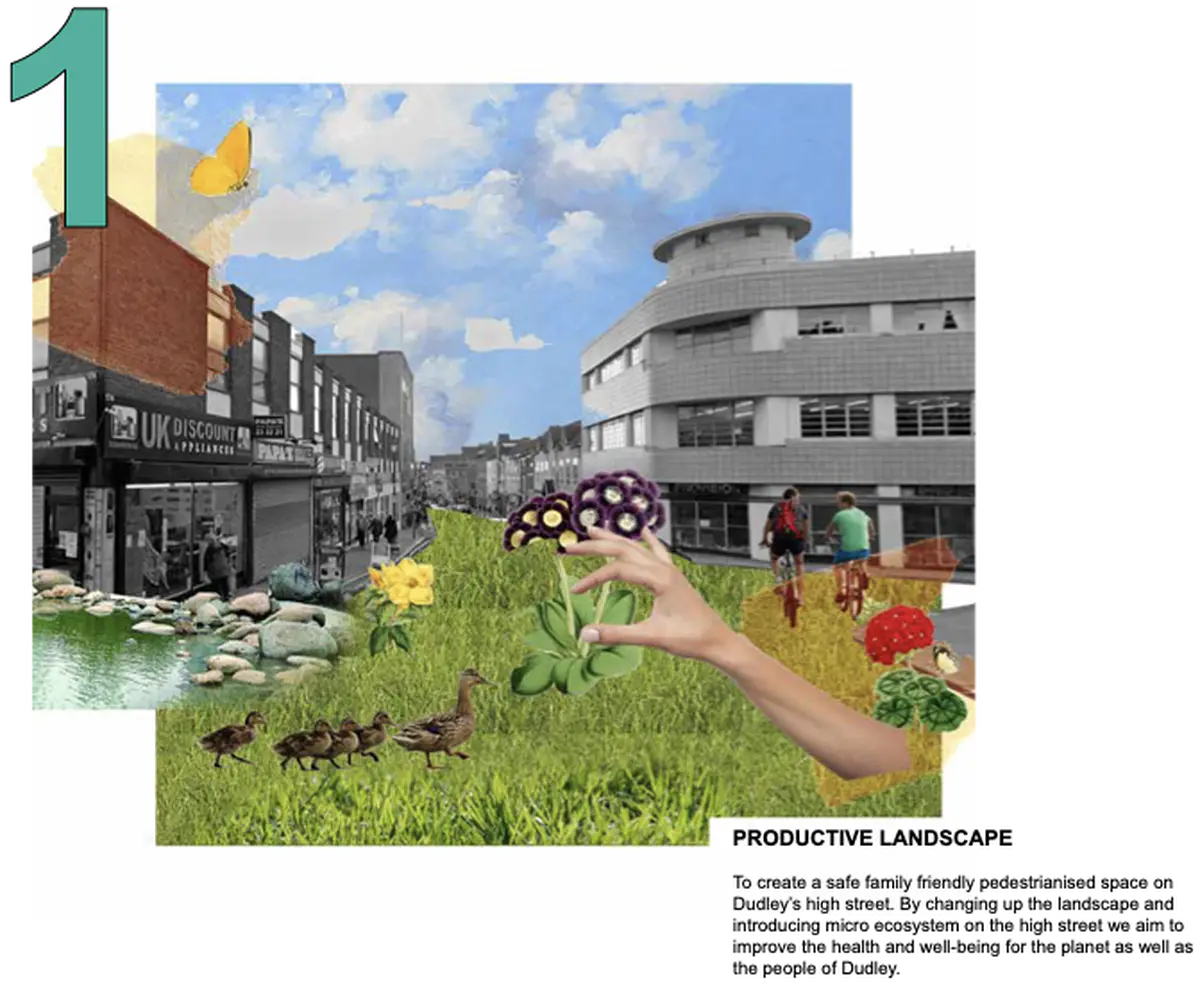
PRODUCTIVE LANDSCAPE
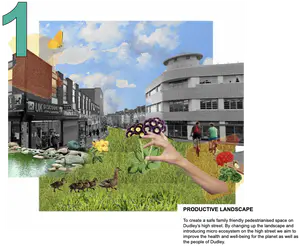
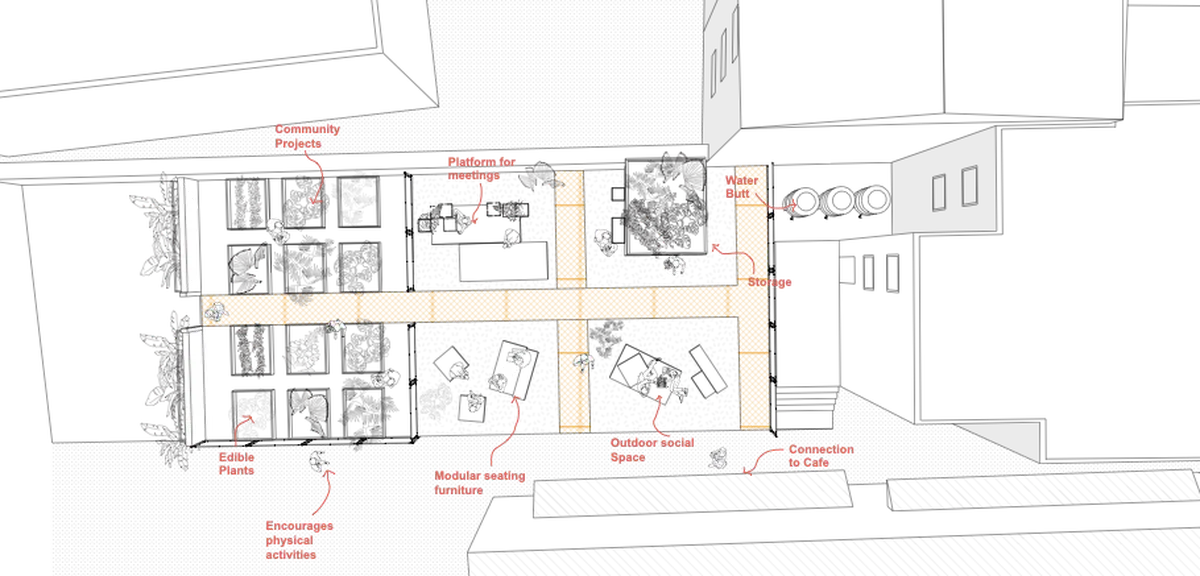
To create a safe family friendly pedestrianised space on Dudley's high street. By changing up the landscape and introducing micro ecosystem on the high street we aim to improve the health and well-being for the planet as well as the people of Dudley.
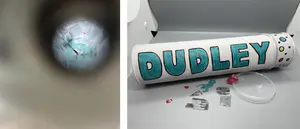
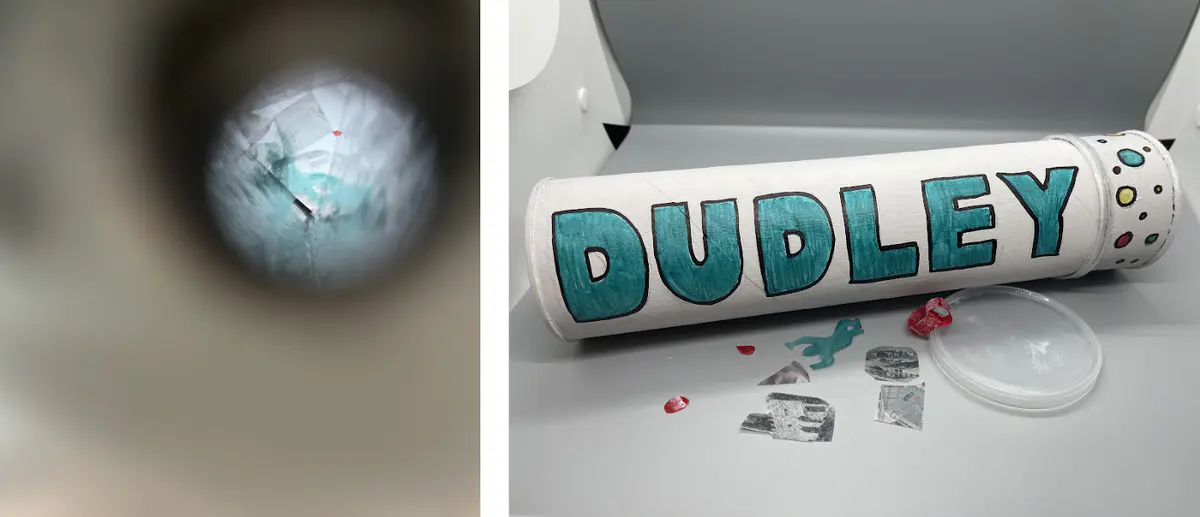
After investigating the history, heritage, culture and institutions of Dudley and its High street, I made a kaleidoscope gift based around the themes ‘overlooked’, ‘resilience’ and ‘layered’. Although sight is the most immediate sense in which many people engage with their surroundings, it’s not until you look beneath the surface and start to see things from a new perspective that you fully appreciate what is there and the potential beyond. I wanted people to engage with my gift, have fun and evoke a sense of nostalgia, whilst also using it as a way to look forward to what the High Street could be, all the while embodying the CoLab Dudley principle of allowing this object to be a co-op piece. The gift relates to the people and allows for each user to interpret and express their own thoughts.
By placing a community garden in this space space you can learn how to plant food and it will lead to more edible spaces on the High Street that will then lead to the re-wilding of Dudley.
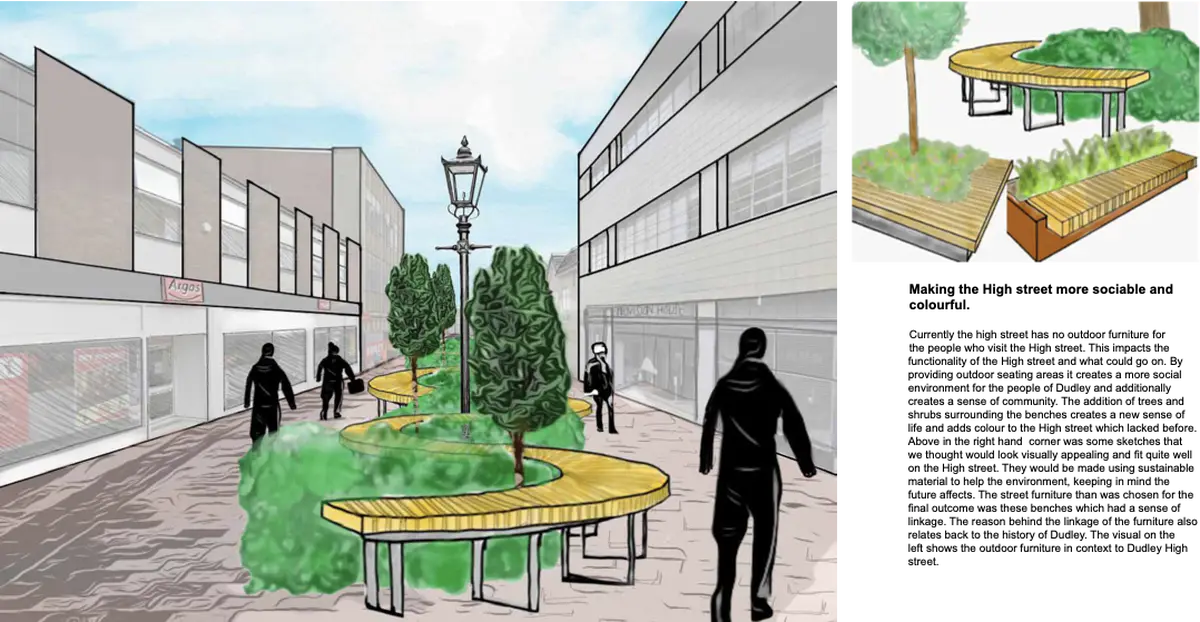
Stepping Stone 2 is about making the High Street bespoke to Dudley through street furniture. We wanted to make the High Street more sociable and colourful. By providing outdoor seating areas, people would be invited to speak to each other and bring back a sense of community.
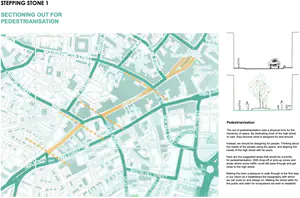
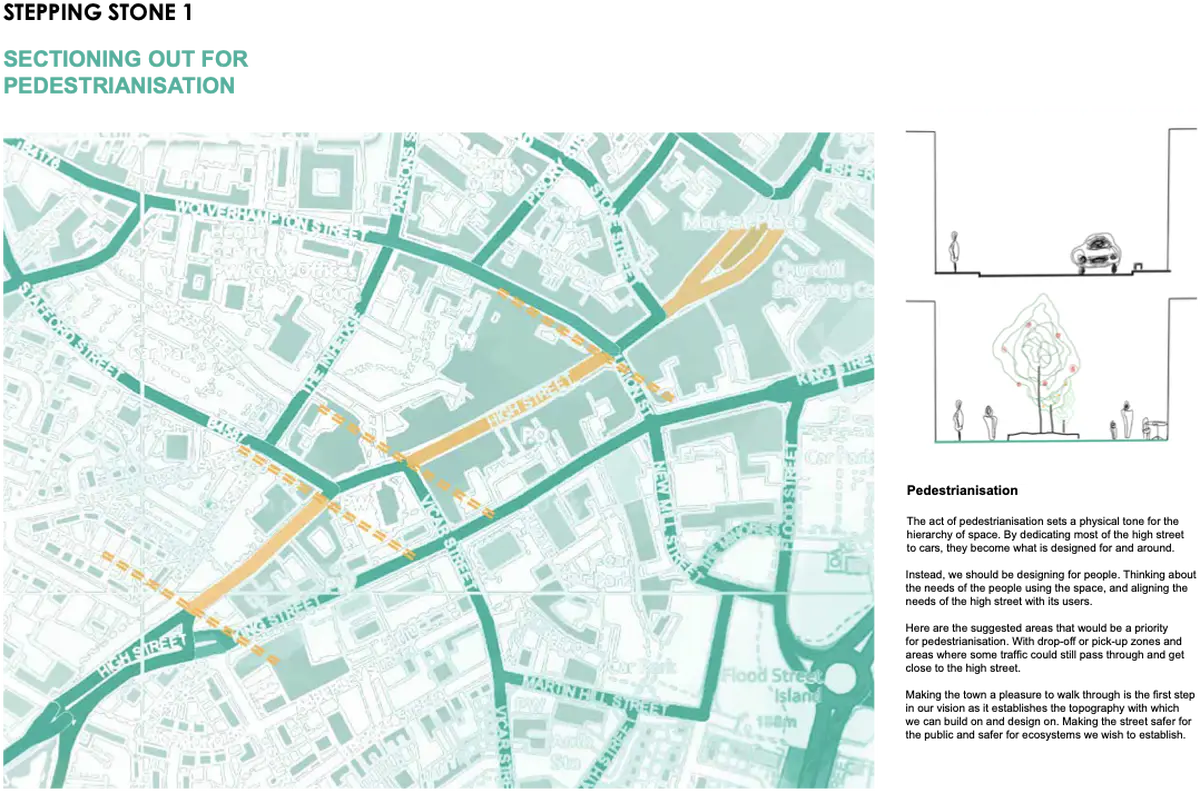
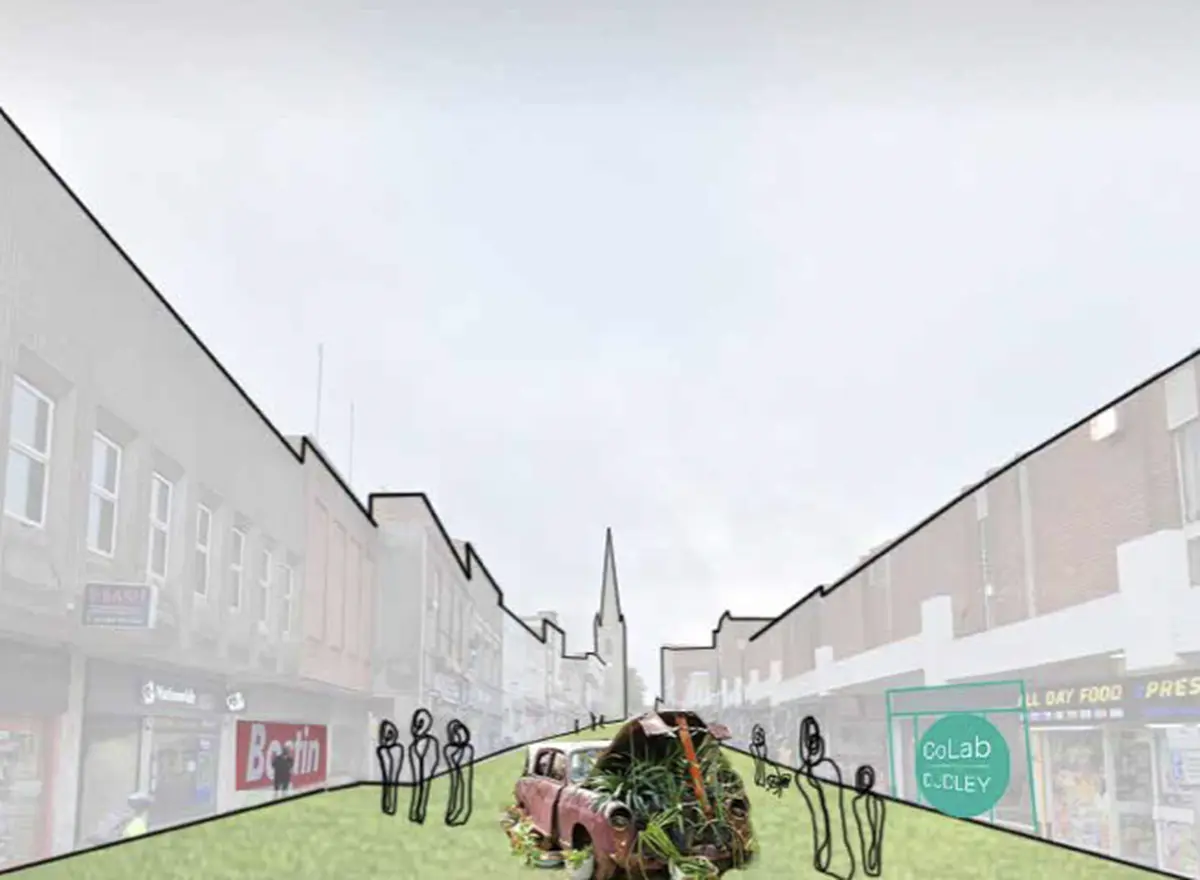
The first step is sectioning out for pedestrianisation. It was important that we did this so we can move down the intervention scale to the next stepping stone; laying the foundation for social and ecological benefits. The hierarchy of space is very much dedicated to cars right now. If you design for cars, you’re going to get more cars. If you design for people, you’re going to get more people. According to Just Economics, the footfall can increase by about 40% following pedestrianisation, and retail follows suit with about 30% increase in sales.
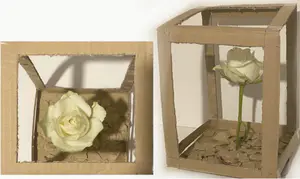
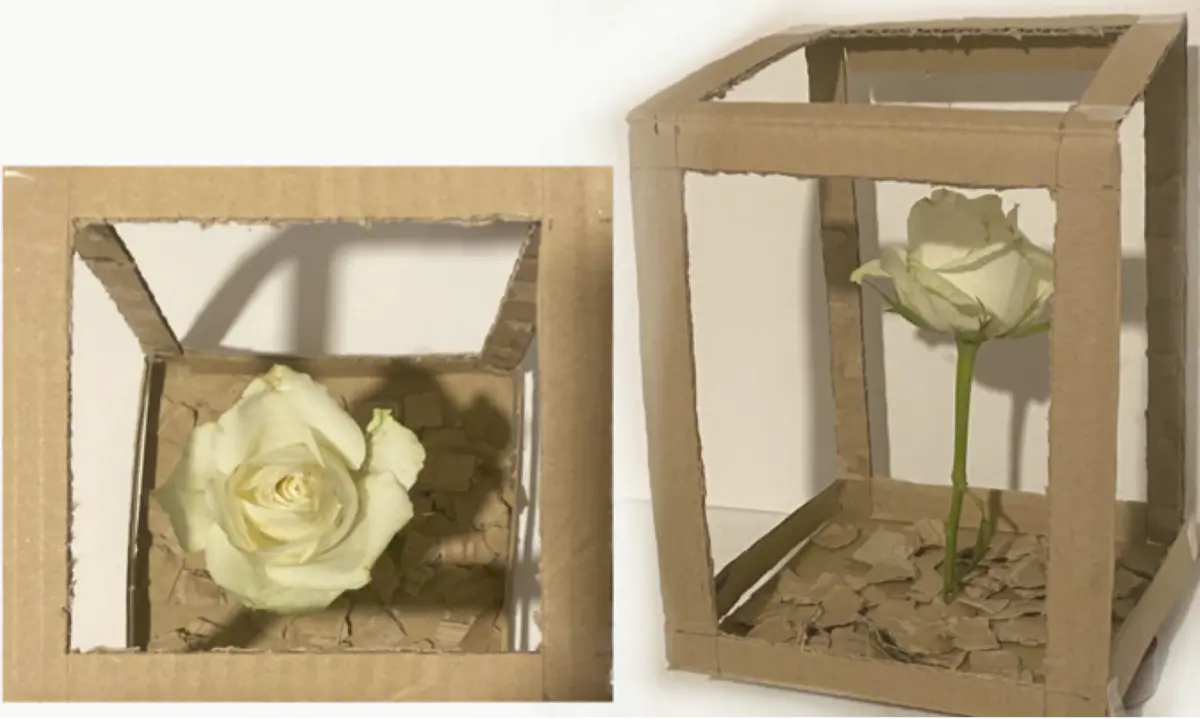
The meaning behind this gift is composed of three main foundations which are biodiversity, social and enclosure. The box represents the enclosed feeling of the surrounding buildings that you receive when walking down Dudley High Street. The ‘High Street’ gives the impression that the buildings are closing in on you, with very little open space around. The open element of the box is to create an airy space which is what Co-LAB Dudley is trying to achieve and make the atmosphere more sociable for the local people/ community. Therefore, attracting more people to the high street. Conducting research it is evident that the ‘High Street’ severely suffers from a lack of green space resulting in a lack of biodiversity across Dudley. Centrally, located within the box is a rose which resembles the biodiversity and the need for growth amongst the ‘High Street’. The white rose connotes the purity for the future of Dudley High Street and what it could become.
Bianca and her friends went clothes shopping. As they could smell the delicious food making in the community kitchen, they curiously went inside for the first time. Bianca and her friends were offered freshly made, delicious soup.
Ramsey’s
Wedged between G P Footwear and the Dental Surgery
Set back in the shadows under the circular cross
Behind the overspill of colour and dazzle
You will find Ramsey’s shop
Cornucopia of ladies fashion
Shoes
Handbags and
Accessories
Born out of West Brom clearance
Been six years grafting
Stretching a profit
Out of lycra and cotton
Cheaper than the exact same jeans
You will find in River Island or H&M
But people still like to haggle for
A pound off here
A fiver there
Ramsey is waiting
Waiting for the people to return
Waiting for Covid to subside
Waiting for the coats to fly
The joggers to shift gear
Blouses to find a new lease of life
So that the drive from Oldbury
Six days a week
Means more than just petrol in the tank
Wasted hours
Asking him about the future
Brings no sugar coating
Of what needs to change
More advertising please
Less traffic down the road
More foot-flow up this end
Where Ramsey offers
Cheap and cheerful
In all the colours of the rainbow
His rails rally already
Outside the shop
Where he would like to see
A revolution
People stop to pass the time though
To talk around it
Time for a change
One way or another
Time for a change
Sooner rather than later
While Ramsey soldiers on
Filling the street with colour
The sun glinting off
A nicely priced
Must have
Localising Material Accessibility
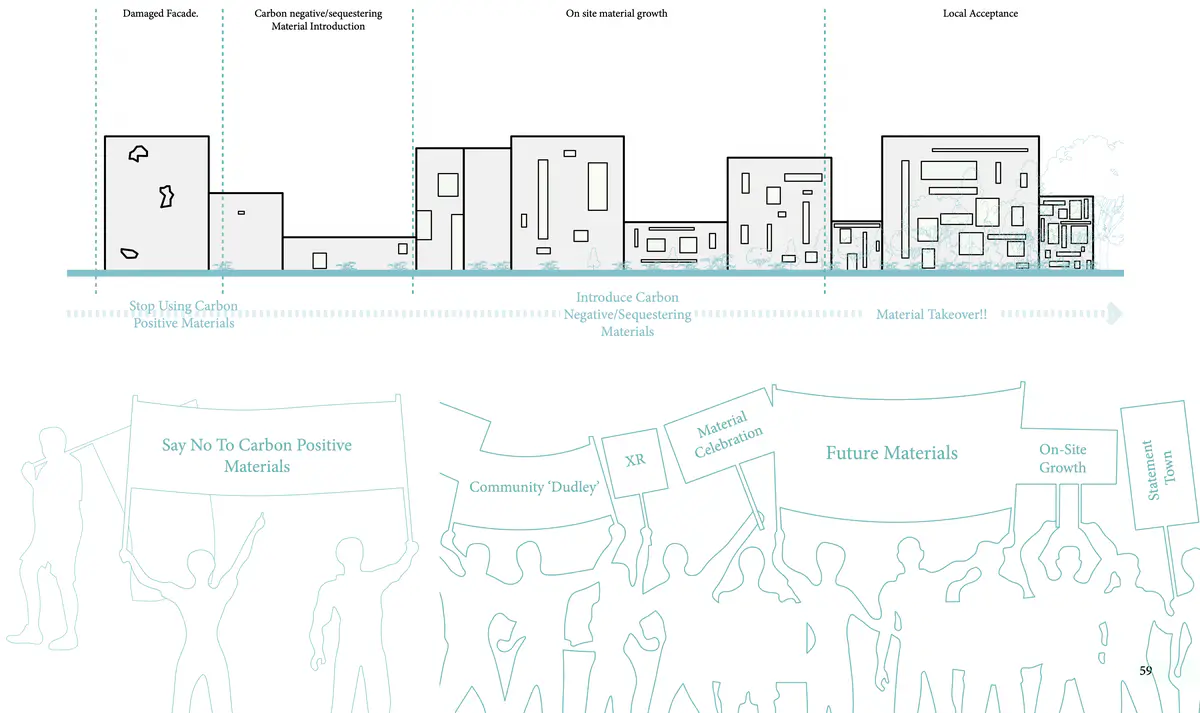
During my initial walk through the High Street of Dudley, I noticed an inevitable decline in the area. There were vacant shops, but those open had apparent facade damage. For the area to thrive, there needs to be an aesthetical uplift. Here I began to question how to make the repairs. On the one hand, one could complete a like for like repair with a deep clean to provide a new lease of life to achieve an aesthetical value. Alternatively, the repairs could be a status of where the street aims to be in the future. To achieve a statement, the implementation of repair work needs to stand out. It needs to be futuristic, a bold contrast to the existing.
At this point, I decided that after being informed of the damage the built environment has on the climate crisis, only carbon zero/ carbon sequestering materials would be present during repairs. This does not aim to destroy existing buildings but instead carefully implement repairs creating a patchwork effect across the street. This would then grow over time as more repair work is required.
Over time, the high street would transform into a zero-carbon environment. The manufacturing and growth of these materials need to be local, so consideration is vital. This provides an opportunity for the site to be a material producer itself.
Subway
Here, it’s all about the brand.
Green and yellow
Flashes of black
As staff move quickly to
Make subs
6 inch
Foot long
In the lunchtime rush
It’s all go, go, go.
Here, it’s all about the image.
New York subways
Map the walls
Alongside
Legends
Heroes
Iconics
Classics
Not names I would associate
With sandwiches
But to be fair I am not the target here
Too old by a country mile.
Here, it’s all about immediacy
Driven by technology
Attractive to young minds
Thumbs scroll over phones
To place orders
To make payments
To text their mate, who’s
Sat right next to them
Phones, phones, phones
As the Deliveroo driver
Double parks across the street
To pick up a meal deal
As ovens ping and
Cookies slide off trays and
A student picks and goes
No desire to sit in or
Wait a while.
Here, it’s all about speed and
It is busy.
A boy in a boiler suit
Made for a man
Jokes with his mate
He can’t decide what to order
There’s too much choice
He doesn’t know what he wants
He needs inspiration and
The counter guy offers him help
Bread style
Filling
Extra cheese
Drink and a cookie.
His mate ribs him
For getting double Jalapenos
But he doesn’t care.
Here, it’s all about the future
Contactless
A space in which a new generation move
Transactional
The model of a brave new world
Phone app ordering
Because this is what some people want
Safe
Easy
Quick
Convenient
Just because it’s not for me
Doesn’t make it wrong and
Judging by the queue at the door
They’re obviously doing something right.
I leave as another delivery
Heads out the door.
Boilersuit boy is making his way down the High Street
Back to college.
I’m sure he’ll be back tomorrow
Grateful for the help with his order.
Golden Touch
It’s my wedding anniversary
Ari is cutting my hair
“To make you look younger”
He says
We guess each other’s age
A trick he’s pretty good at
We talk about daughters
Sons
Families
How he goes back every year
When he can
To northern Iran
But really his family’s here now
Round the houses in Brum
From a young age
Now his home is Dudley
Four years in the shop
Cutting
Blending
Trimming
The heat from the hair dryer
Beats the sweepings to the floor and
I escape for twenty minutes
In the stories
In the swift hands
The mirrors
Posters from a bygone age
Product on the shelves
The smell of wax and leather
Scissors sweep over the comb and
I learn that the skills are hard taught
From the first time with the razor
To the years later
Efficient
Precise
Art in my eyes
Soon his brother will join him
From Manchester
Where he’s currently learning
To catch up
The future is all about the family and
I hope the shop is still here
For when his son
Picks up the scissors
For the first time
Thanks for the haircut Ari
It took years off me
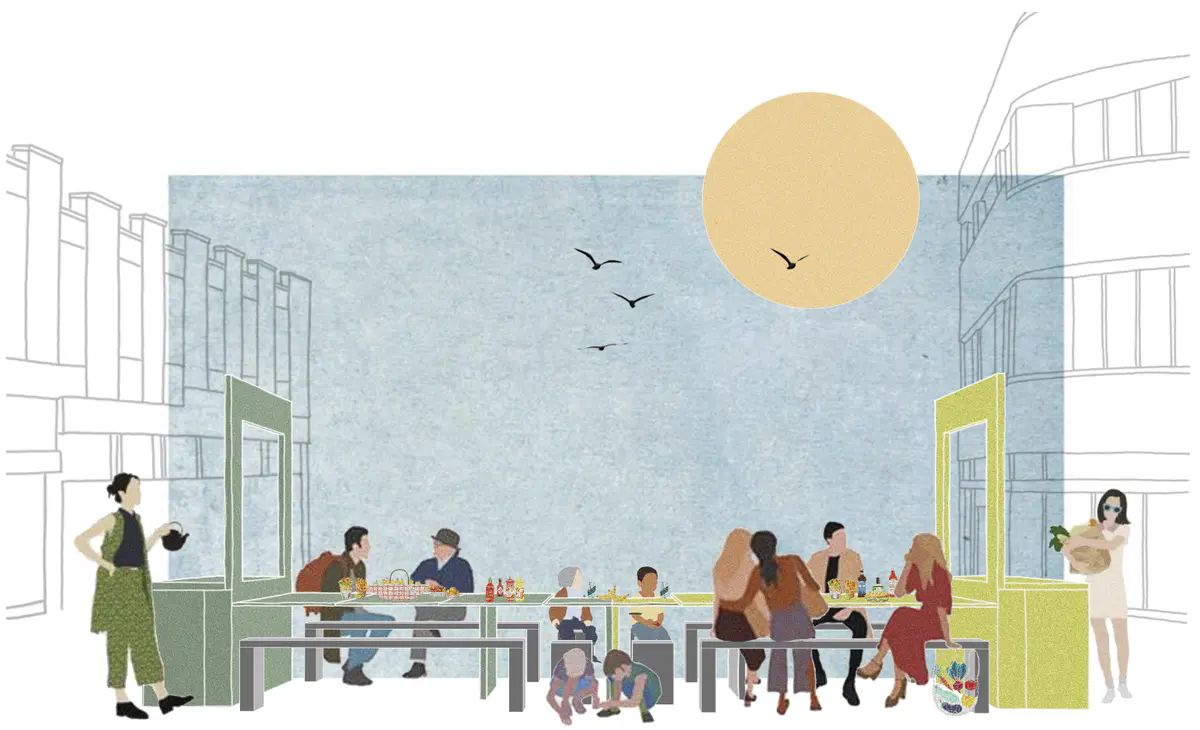
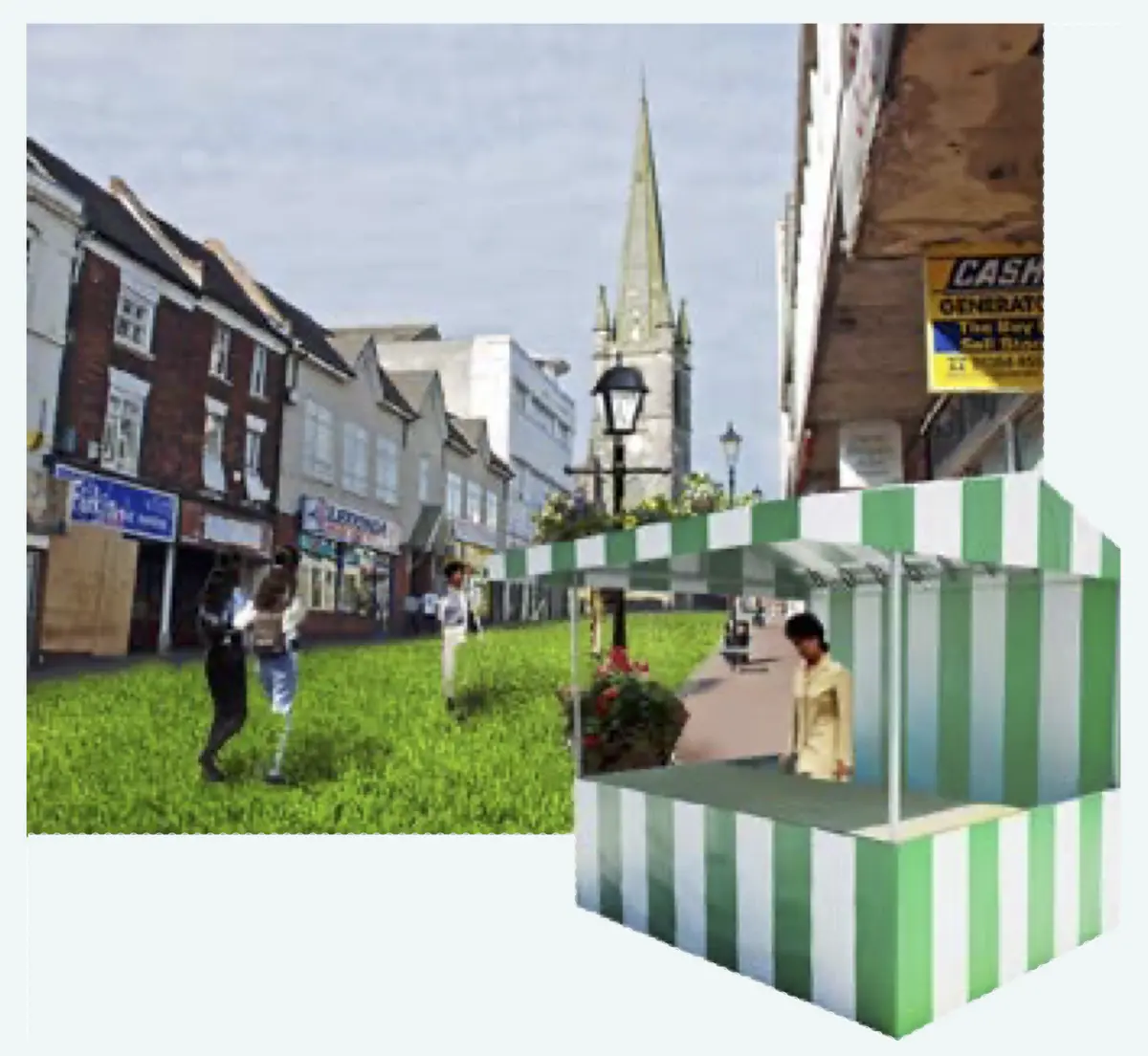
The first Stepping Stone project looks into designing multifunctional furniture for Dudley High Street to provide opportunities for a regenerative community, focusing on how the high street can be occupied with resilience. Initially, the stalls act as market stalls to provide opportunities for enterprises and small businesses to begin thriving and encouraging the High Street to become a place of inclusivity.
However, the stalls can extend out into outdoor seating arrangements, which can become an extension of the community kitchen and during events can become a part of the whole atmosphere.
By extending the furniture, they can connect together and become a large spread where people can sit together and enjoy company. It creates a lowered centre space so children can sit together, or paint on the surfaces. We decided to focus on furniture because we felt the importance of it can go unrecognised. We felt through the design of this market stall, many memories can be created and attached to these items, and become valuable assets within the community.
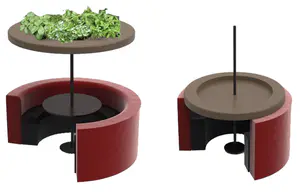
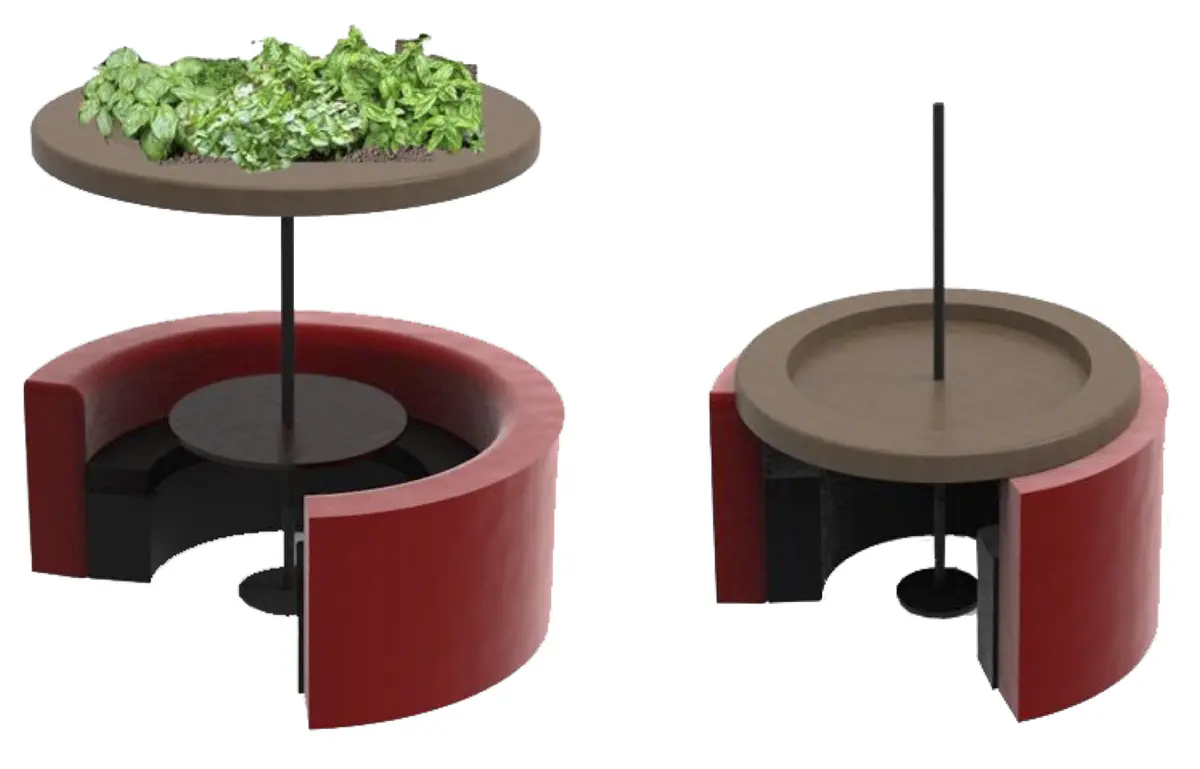
The fourth Stepping Stone project focused on the design of 2-in-1 flower pot seating for the exterior of the community kitchen. The design also integrates a canopy for growing herbs to also use in the kitchen. Through a collaboration with another Time Rebel collecting reusable waste, we thought about how this could be integrated into the materiality of this concept. The product analysis of this design is that it has a detachable seat to cater for a variety of arrangements. The flower pot can be raised to create a seating area, and lowered to be become a flower pot on the High Street.
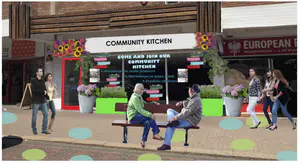
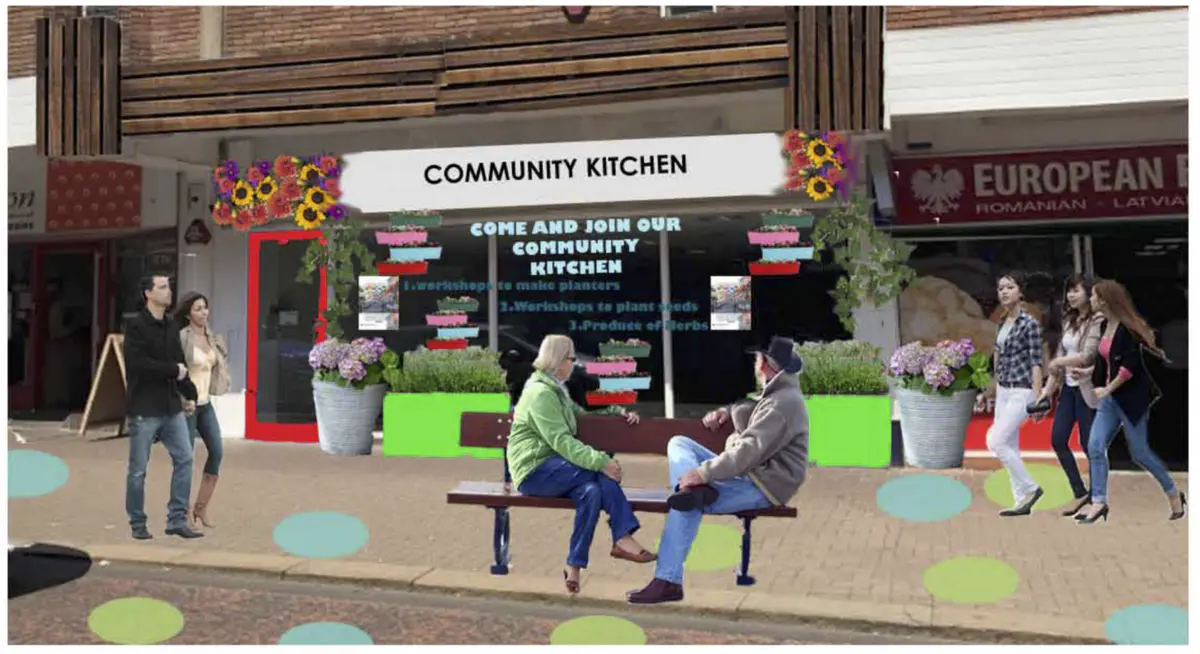
The second Stepping Stone project focused on the representation of colour and revitalising frontages. During our group discussions, we recognised the negligence of existing colour on Dudley High Street. Colour is a key element we believe can bring a sense of brightness into the High Street, and an element that should be of focus when revitalising the frontages.
In this example, we have approached the frontage for the community kitchen we envision. The visual showcases a Community Kitchen in which different herbs and spices can be grown. These can then be used to cook the many dishes respective to the different cultures existing on the High Street. Each frontage can respond to the different uses of the buildings to promote individuality across the street.
Our collective vision for Dudley is to support a creative community that is connected through our internet of things; creating spaces that allow for the collection and redistribution of materials that locals can use to construct products with. Community engagement is central to this design network with local businesses encouraged to get involved in manufacturing.
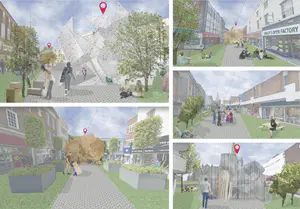
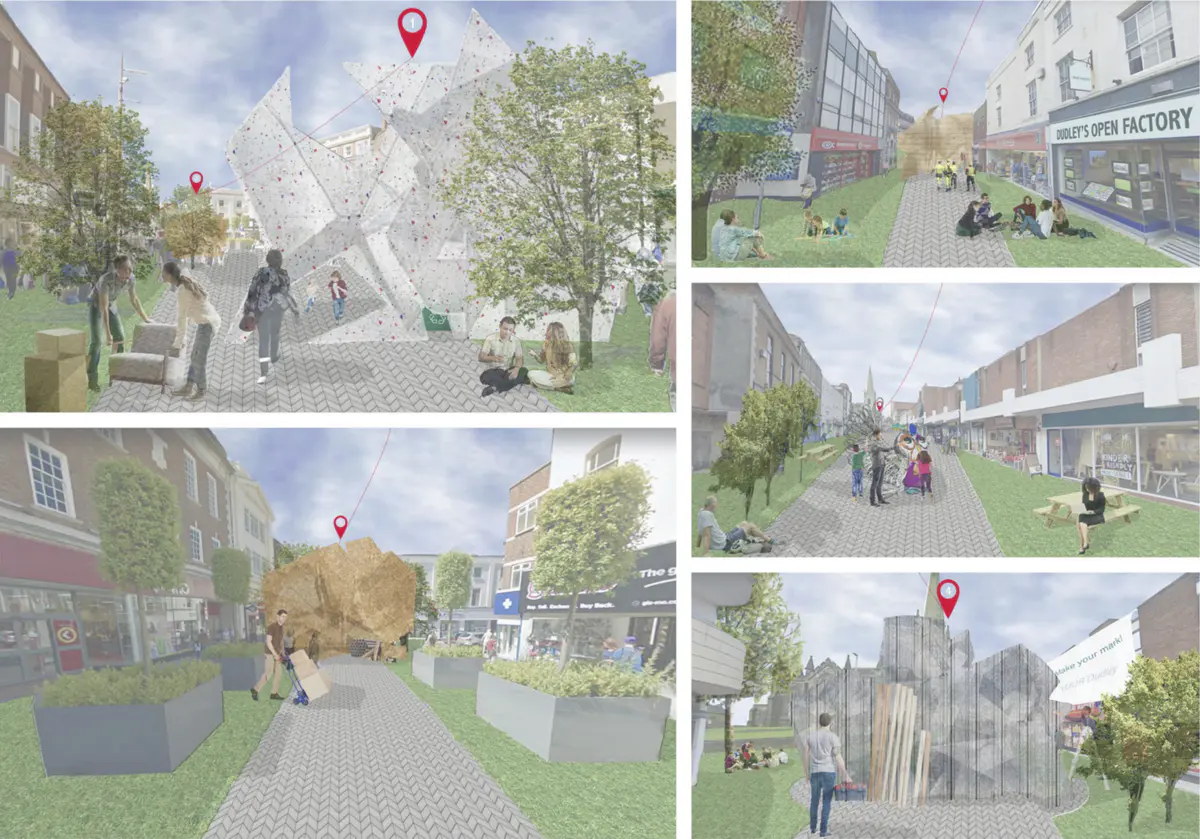
We decided to bring alive this vision through a series of pavilions positioned through the High Street, following a process through recycling, storing constructing and manufacturing. To take this idea further, we allocated several empty units along the High Street to become spaces involved in the open factory, from workshops, educational centres and co-working hubs. Since we wanted to show the journey people would be able to take, we decided to create a storyboard for our final visual.
These visuals show how the pavilions could sit in the High Street, starting at the market place, past CoLab Dudley’s base, and ending up at Top Church. We wanted to show how people would be able to interact with these different spaces and navigate between them.
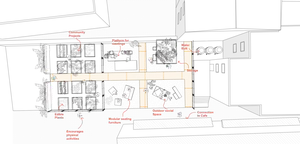
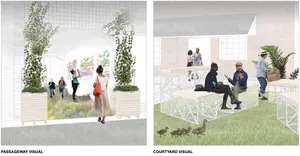
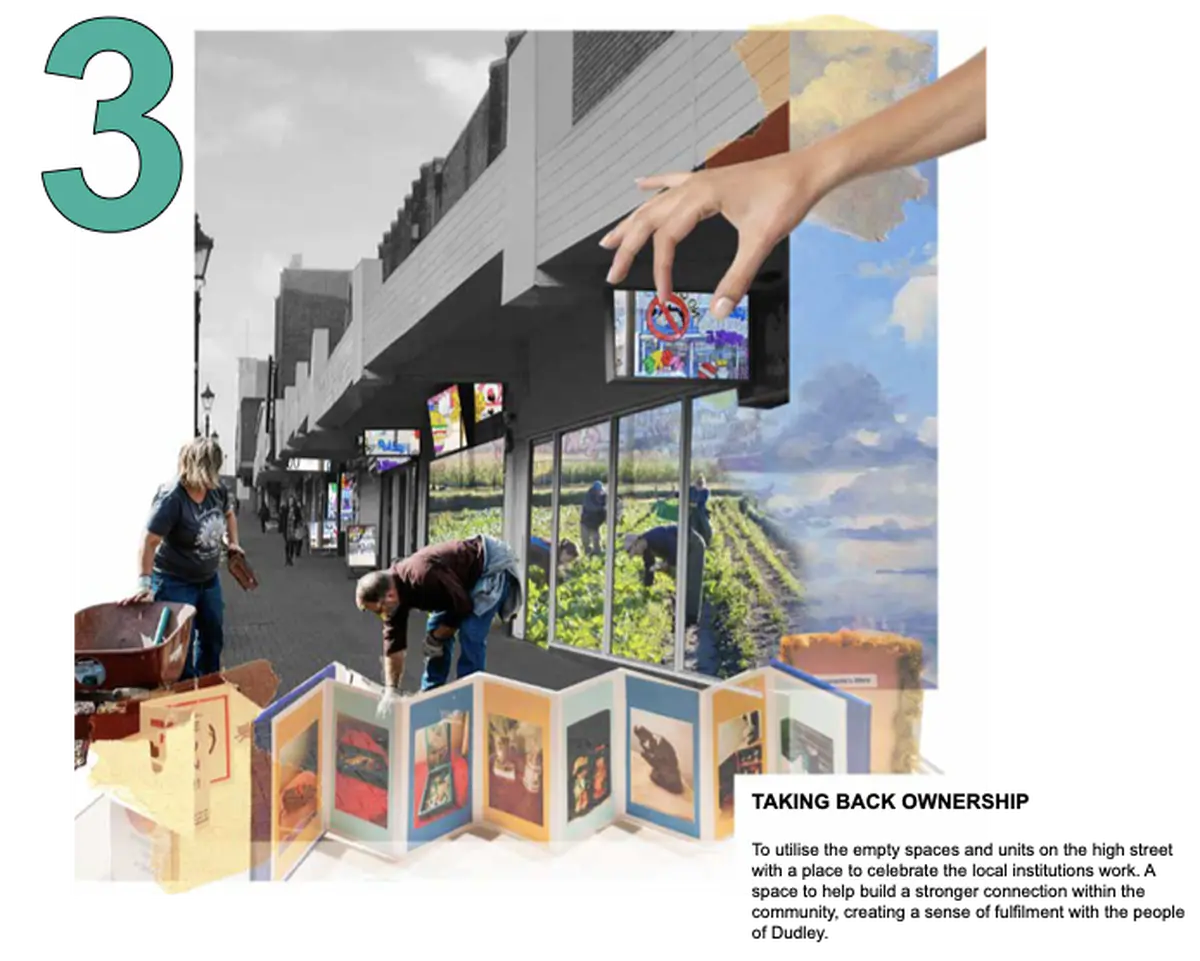
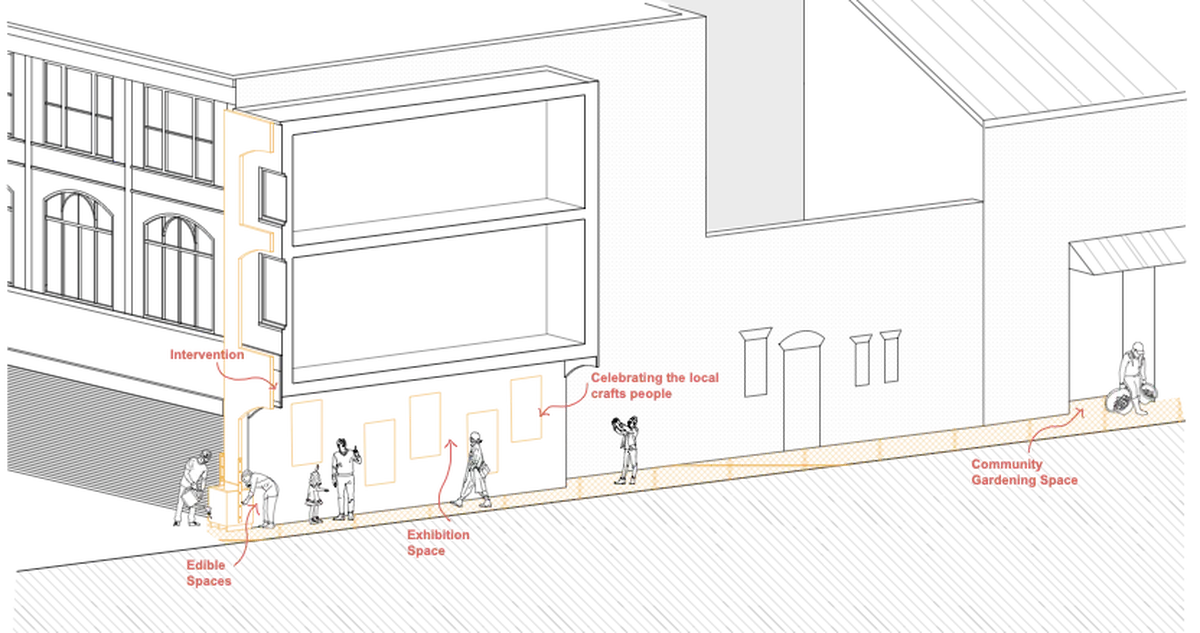
By utilising the passageway to display exhibition work from local institutions it would not only encourage them to create their crafts, it will celebrate their work and the range of crafts that Dudley has.
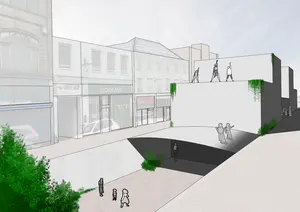
The main structure would have various spaces such as the Museum space, possibly a place that people can pin up local activities, and maybe rooms for either changing or for performance practice. As the street is 11m wide on average, there is plenty of space to have the building
fill the space. As the sunlight comes from mainly the south, the south side buildings often shadow the street entirely, which would mean that something being built (especially as it will be dug down a bit) would not shadow out the other buildings. The biggest hurdle to tackle is
that the space shouldn’t not feel overwhelming to the other shops or those who walk down the pavement. Because of this, most of the building’s structure would be in the underneath area, and only parts of it would pop out over the pavement. As the design would be flush
with the pavement, there are also opportunities to have crossing bridges that are both useful by the public, but also incorporated with the design of the new street.
The back of the street would create a unique space for social activities. The space is wide enough and long enough for a performance theatre space to be erected there, but it also has the possibility of having some kind of altered shape to the area, like a raised platform that could house
seating and other social activities. However, the space can also perfectly fit a fully regulated tennis court, badminton court, and volley ball court. People have mentioned that there is also a lack of sport engagement in the area, so this could be used to provide that kind of space.
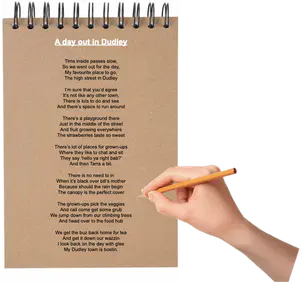
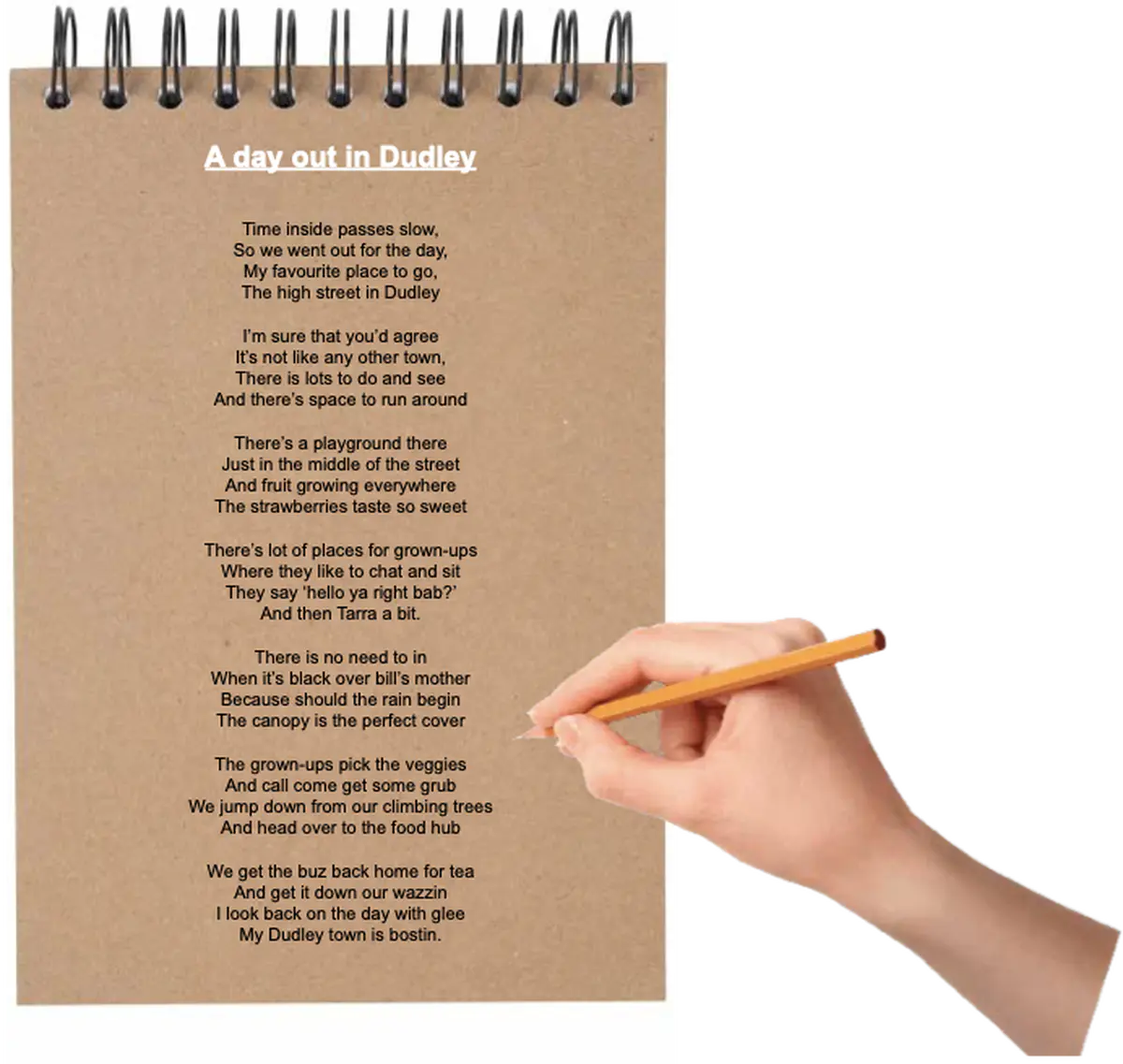
A day out in Dudley
Time inside passes slow,
So we went out for the day,
My favourite place to go,
The high street in Dudley
I'm sure that you'd agree
It's not like any other town,
There is lots to do and see
And there's space to run around
There's a playground there
Just in the middle of the street
And fruit growing everywhere
The strawberries taste so sweet
There's lots of places for grown-ups
Where they like to chat and sit
They say 'hello ya right bab?'
And then Tarra a bit.
There is no need to in
When it's black over bill's mother
Because should the rain begin
The canopy is the perfect cover
The grown-ups pick the veggies
And call come get some grub
We jump down from our climbing trees
And head over to the food hub
We get the buz back home for tea
And get it down our wazzin
I look back on the day with glee
My Dudley town is bostin.
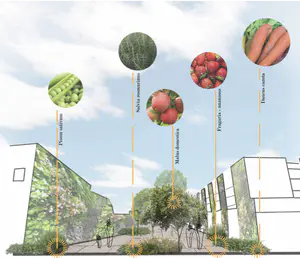
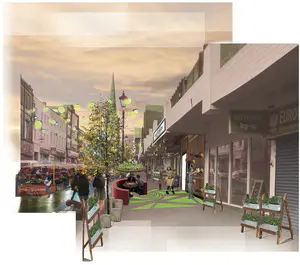
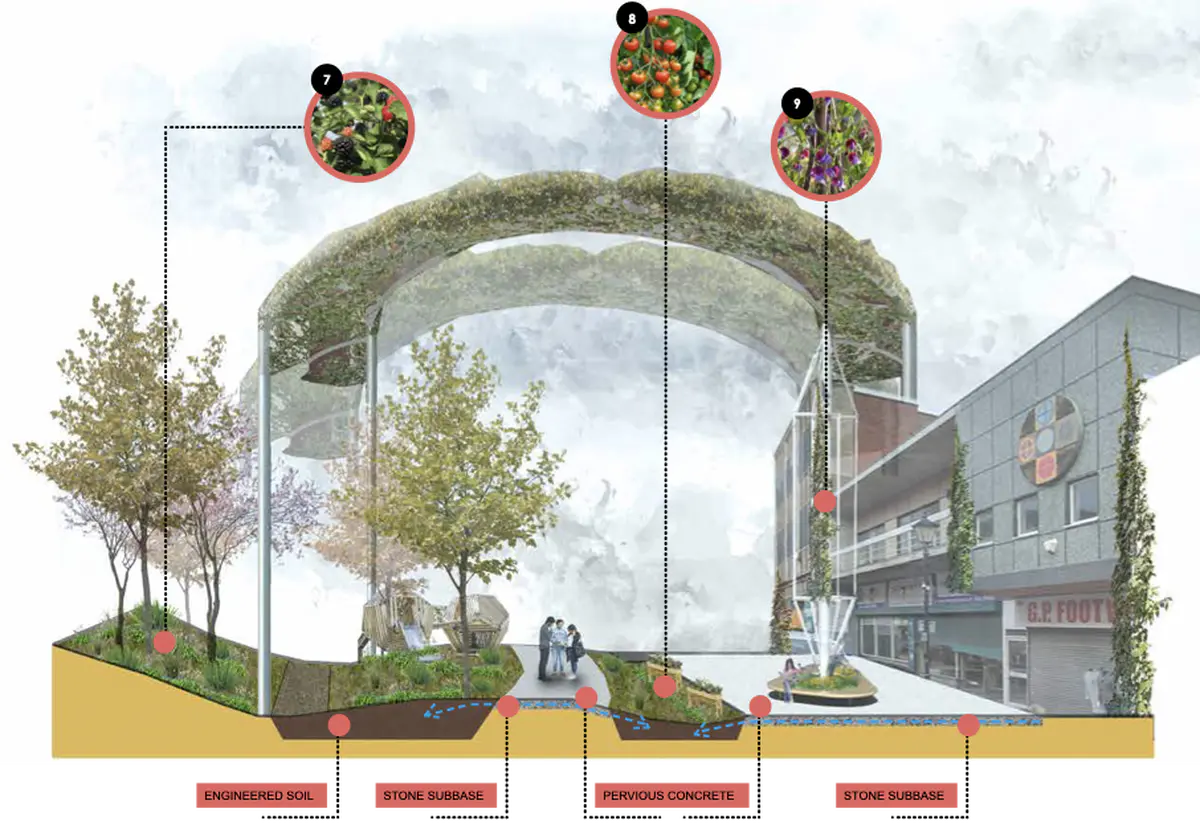
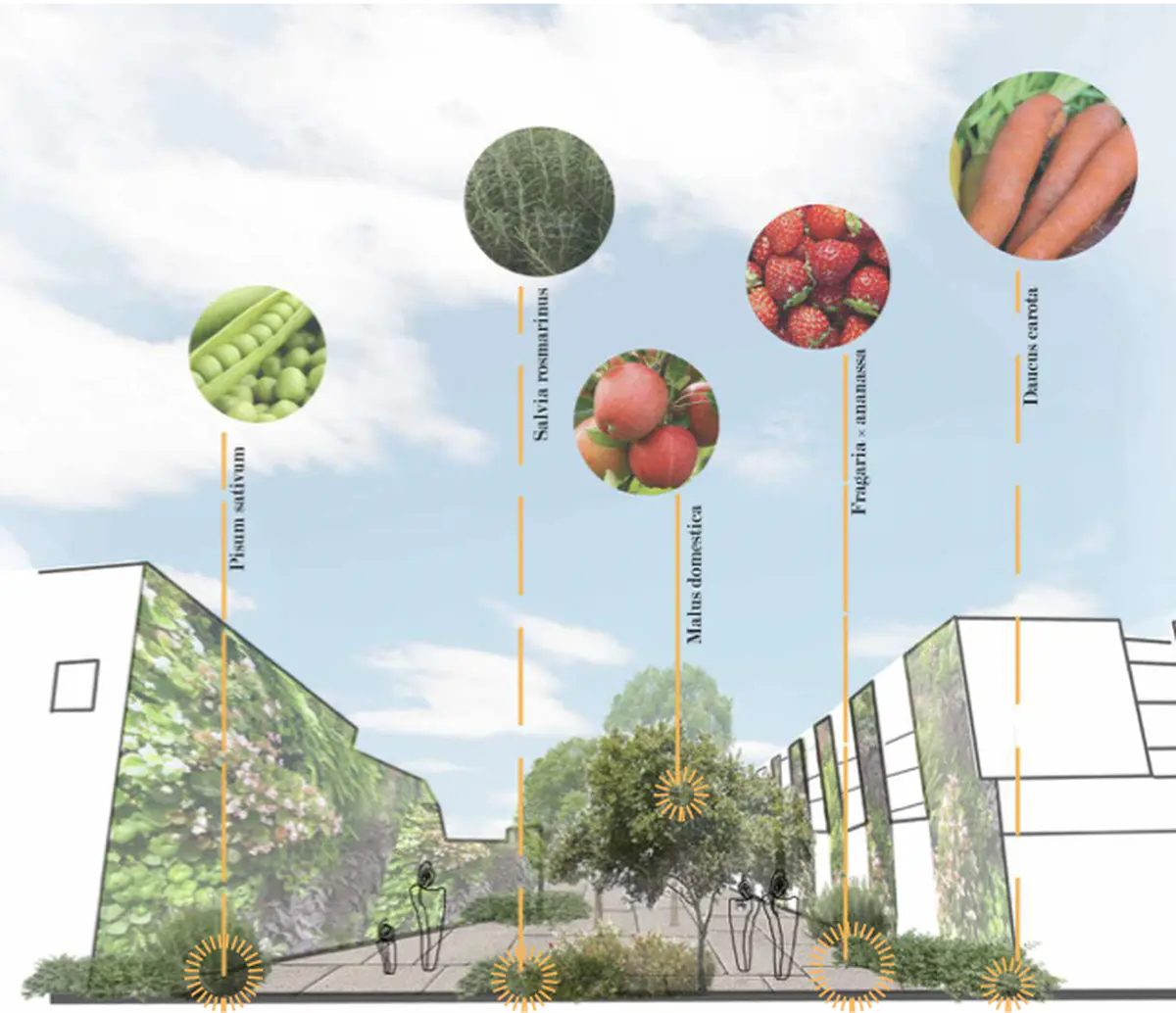
The image shows what this space could look like as a productive landscape. Where all the space is used. Vertical growing space can be utilised for pollinators for heights out of human range and for fruit and herbs in the lower regions that lie within our grasp. Trees can provide shelter, pollen and fruit, as can shrubs.
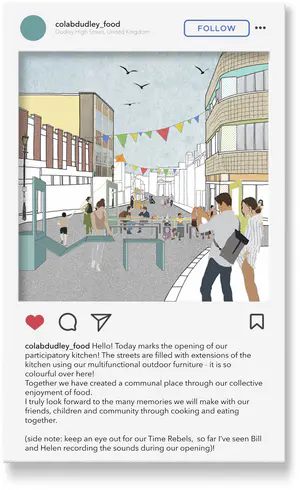
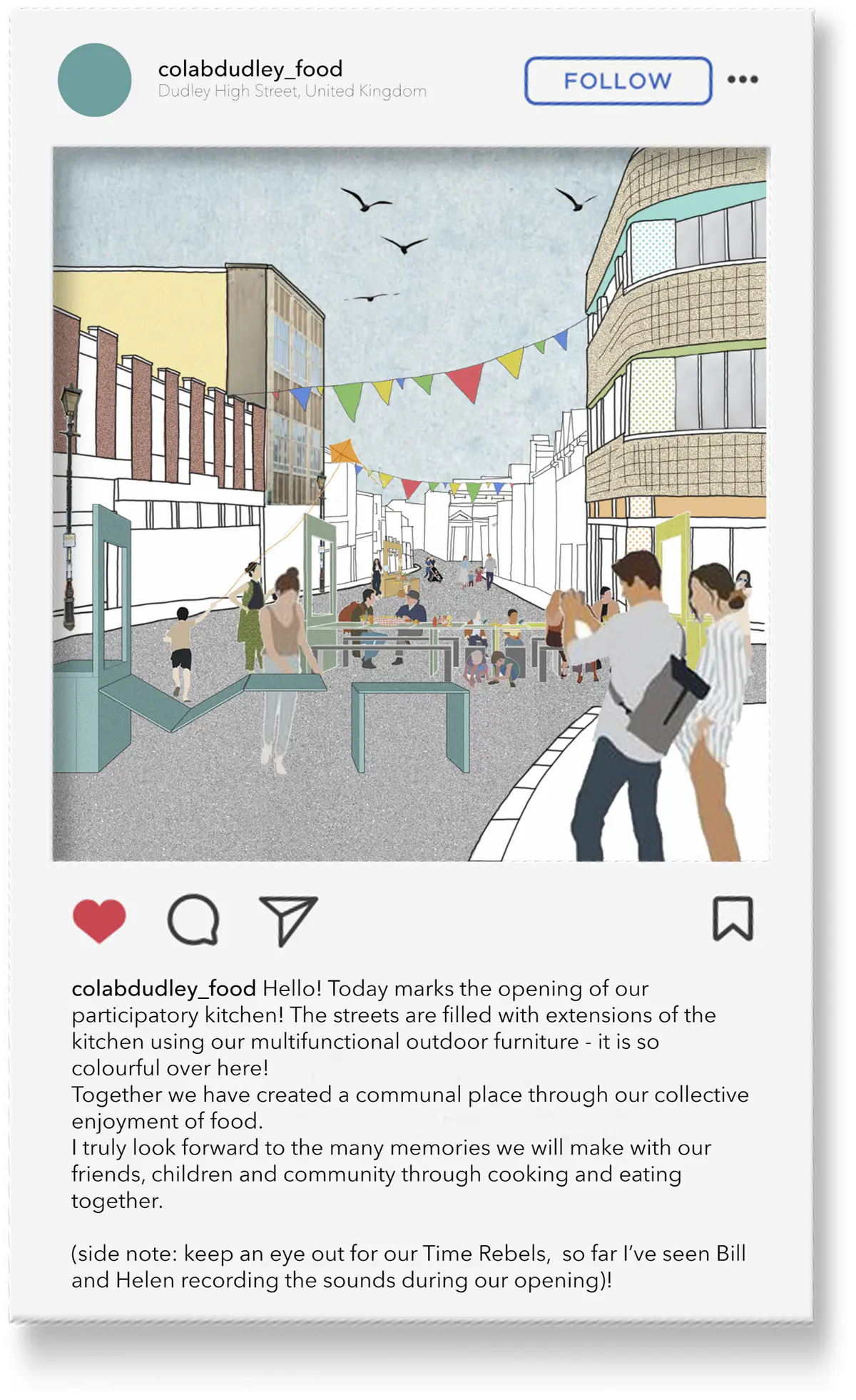
In this post, we captured the street’s atmosphere filled with colour, activity, and pedestrianised streets.
(We decided to present our narrative through social media and instagram posts as we wanted to showcase what individual experiences might be like when experiencing the future High Street. Each of our posts captures a different element of experience on the High Street to form a collective scenario.)
It is 5pm in the evening and the shops are still full with customers. David has had a long and busy working day at the shop and can now finally take a break, and so he ventured out onto the street to get fresh air. David randomly bumped into an old customer, they both instantly recognised each other, and decided to share some conversations on a nearby bench. The old customer could not stop pointing out many of positive changes on the High Street since he last visited. He noticed the fresh air from more vegetation and less pollution, outdoor seating and a thriving enjoyable space.
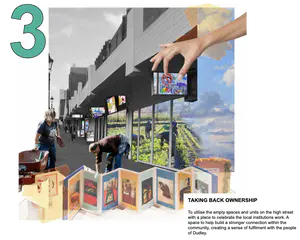
TAKING BACK OWNERSHIP - To utilise the empty spaces and units on the high street with a place to celebrate the local institutions work. A space to help build a stronger connection within the community, creating a sense of fulfilment with the people of Dudley.
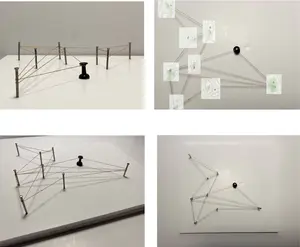
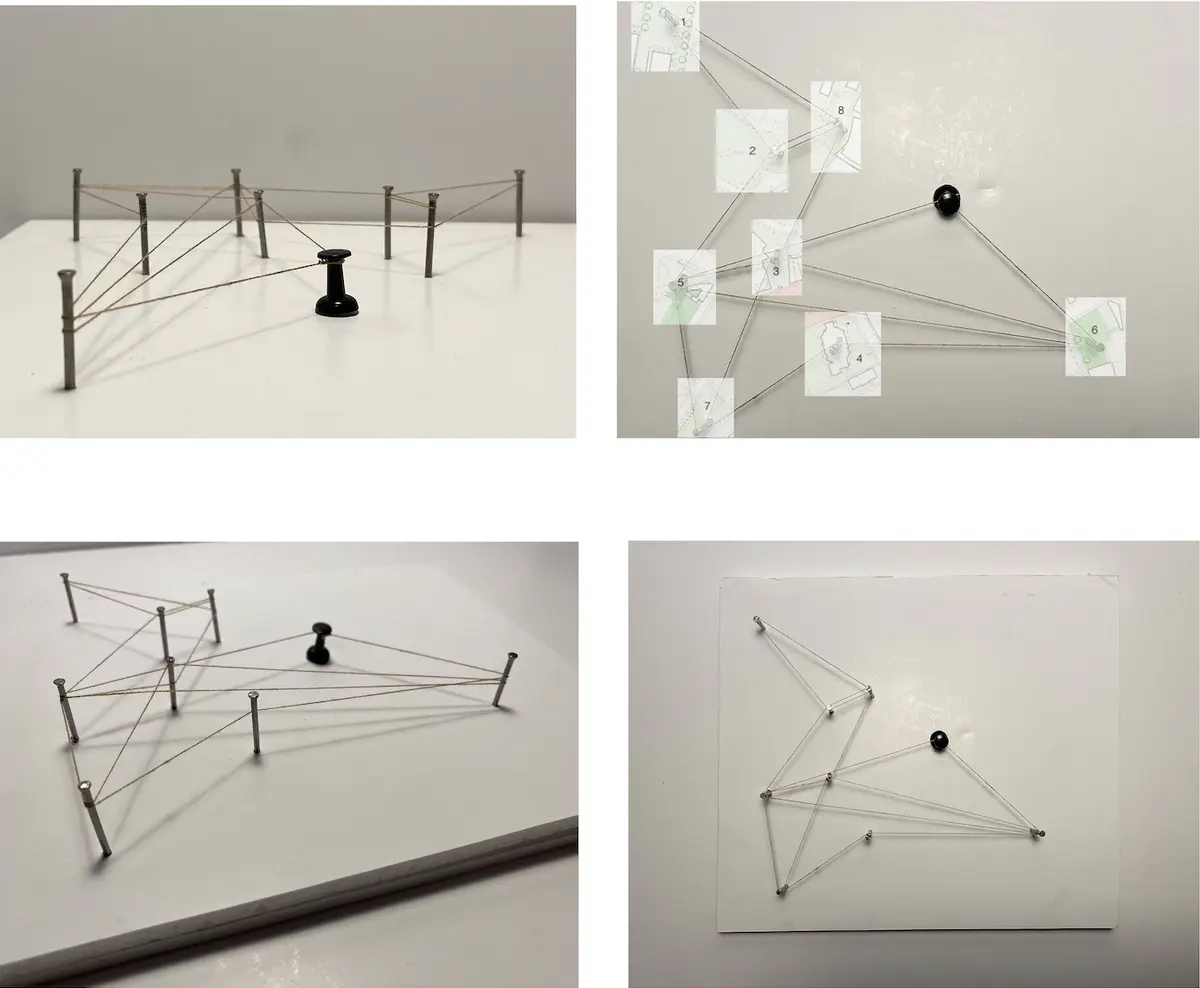
This gift represents the green spaces around CoLab Dudley and the connections they have to the high street. The black point marks the location of the High Street and the other pins mark each green space within the High Street’s immediate location. The lines act as a travel route that you may take in order to get from one green space to another. From this we can establish that there is a lack of greenery in some spaces. This then impacts the High Street as people do not need to use it as a travel route. By simply creating more of these green spaces like in the top right it will add more connections to the High Street which will draw more people to this particular location.
Atifa lives nearby. During her free time, Atifa takes part in social work and welcomes the visitors of the High Street. Her main responsibility involves managing the food produced on street garden. A group of out of town visitors seemed lost on the street as they were wondering about what to do after shopping. Atifa suggested to participate in a workshop in the community kitchen. They plucked some berries and veggies from street and made a quick salad with a locally developed recipe that they had never tried. They thanked Atifa for the new recipe.
We feel that our local High Streets should be the focal point for our local community. They should be seen as places of interest and a place where you can go for both essential items and leisure. Therefore, we feel making the High Street pedestrianised would mean that there is a larger space to work with on the High Street and that it will not only allow locals to shop but also congregate and relax with family and friends.
Caffe Min
Breakfast
Lunch
Meal deal
Everything you would expect
Fresh from the takeaway menu
Ham baguette
With a little bit of mayonnaise
Jacket potato
Hot cup of coffee
Bacon sarnie
Brown sauce
Not red
Tikka mint mayo panini
Something you might not expect
Sunglasses!
I sit on a long bench
Listening to Tainted Love
Over the radio
Reading one of the many signs
About coffee and good vibes
Jayne and Mustafa
Serve the steady flow of regulars
Some sit outside most of the day
Watching
Chatting
Taking it all in
There’s always a spot for them
As others come and go
Mustafa hopes that more regulars
Will return
From offices
When they can
The future seems uncertain
Until normality returns
Since West Brom
27 years ago
Jayne and Mustafa
Have been working together
She says she “has a thick skin to have put up with him for so long”
He says “she’s the second woman in his life”
Cheerful banter
From a lifetime of serving
Cooking
Cleaning
Managing
This is their third café in Dudley
23 years and still going
Opposite the Full Moon
Tables and chairs on the pavement
Watching the comings and goings
I end up chatting to Kath
Over a cup of tea
As she gets a sausage baguette
For the lady she volunteers with
Kath comes every Friday
For breakfast with her friends and
I see how this all takes shape
Regular
Reliable
Dependable
I say goodbye
Head back up the town
As Magic FM fades in the distance
I think I’ll probably pop in again
For a cup of tea
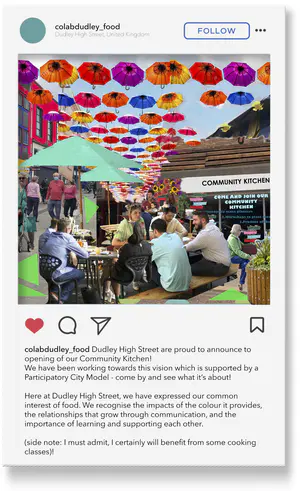
This post promotes the opening of a community kitchen, supported by the Participatory City model.
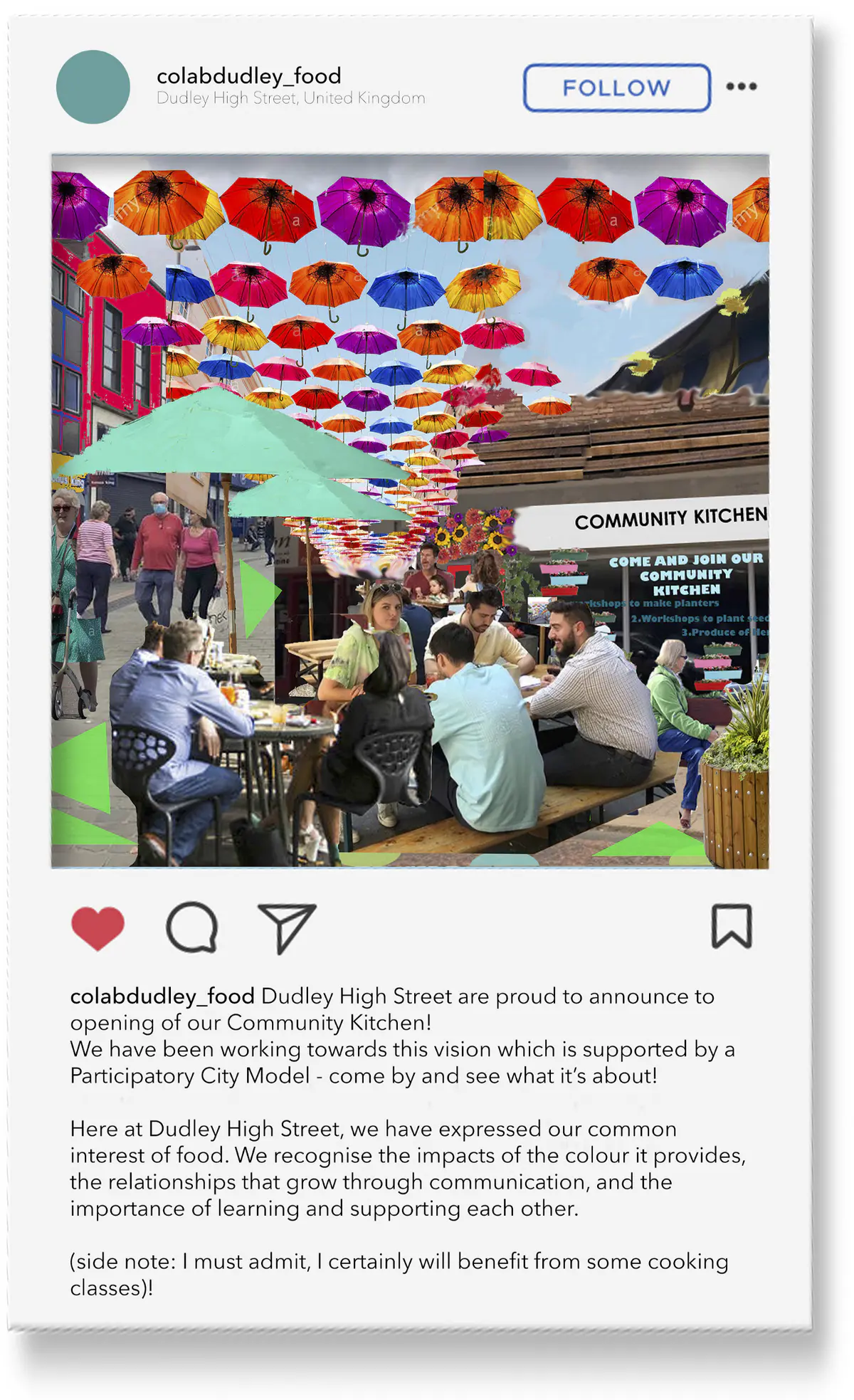
(We decided to present our narrative through social media and instagram posts as we wanted to showcase what individual experiences might be like when experiencing the future High Street. Each of our posts captures a different element of experience on the High Street to form a collective scenario.)
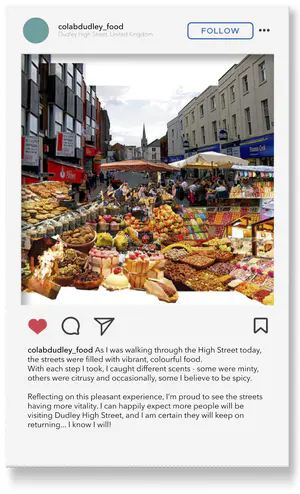
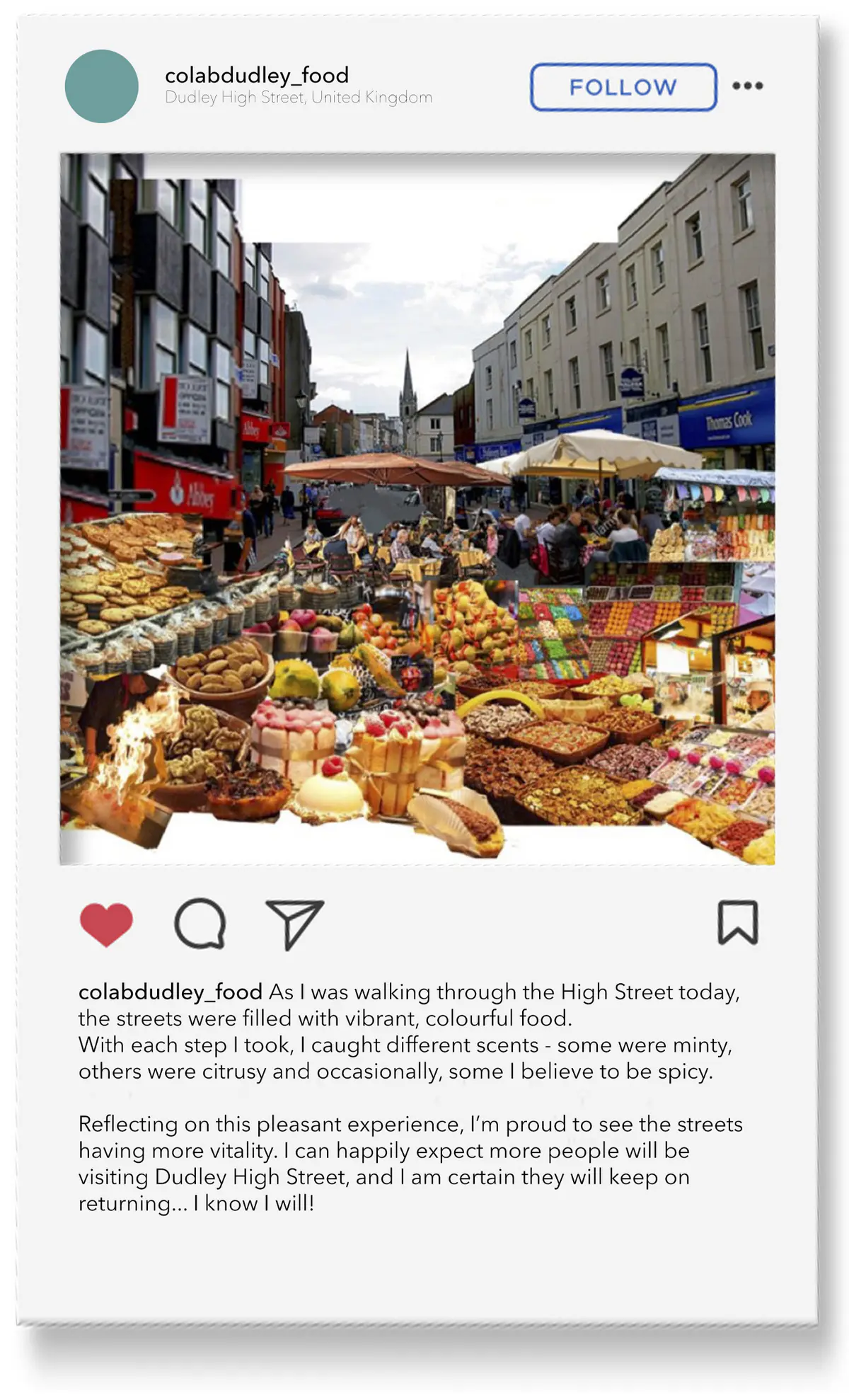
This post captures the street qualities where the visitors experience the colour and aromas of the food.
(We decided to present our narrative through social media and instagram posts as we wanted to showcase what individual experiences might be like when experiencing the future High Street. Each of our posts captures a different element of experience on the High Street to form a collective scenario.)
These are stepping stones that we wanted to achieve, with a scale of intervention, starting with small changes that could still have a big impact e.g. street furniture. At the other end of the scale is topography, where larger adaptations can be made for what we want to achieve.
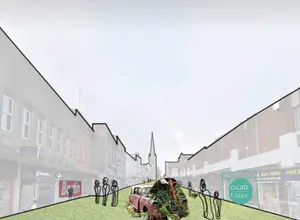
New use for cars — As part of pedestrianisation we would like to suggest a memorial of sorts to cars. The feature would sit in the middle of the High Street and would consist of an old out-of-use car, being used as a planter and being filled with plants. This gesture symbolises the movement of the High Street’s priorities shifting from the automobile to plants, people and food.
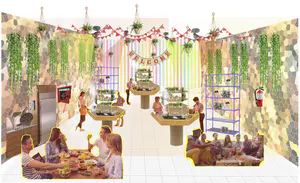
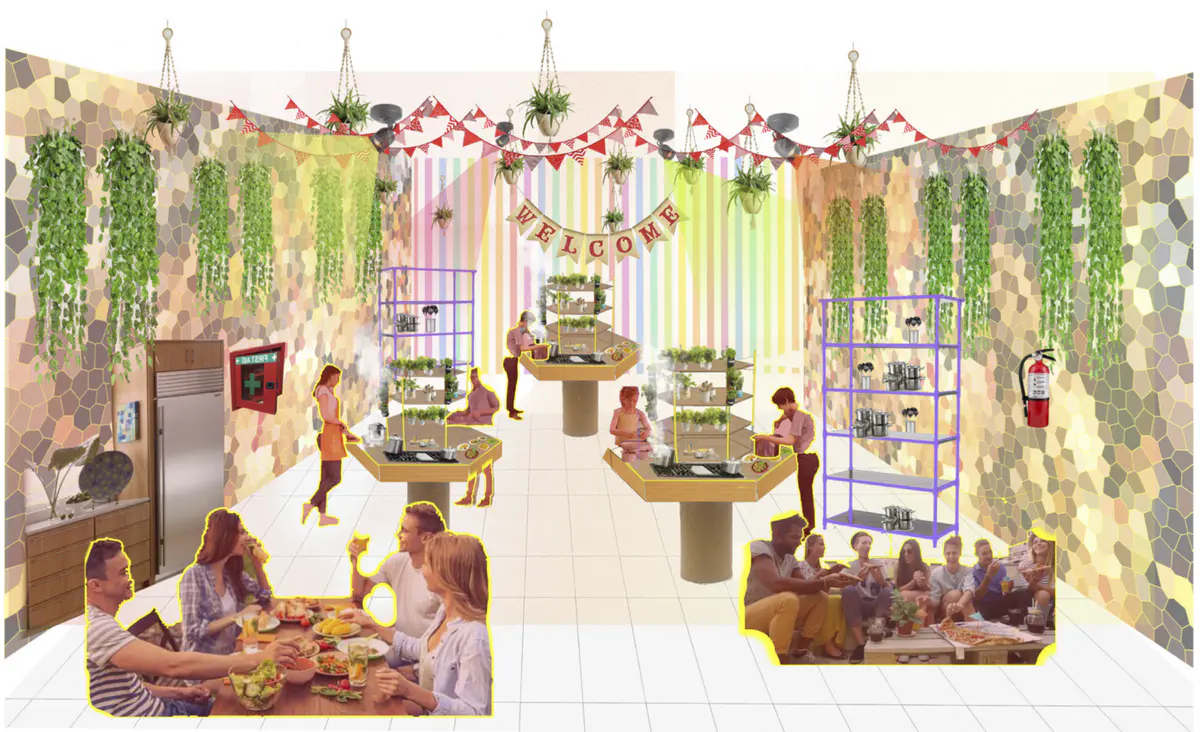
The interior of the community kitchen would be inviting and colourful to create a positive atmosphere. The colours were abstracted from one of our group collages of food. The kitchen counters are not considered as a back of house element; they have been combined with seating as we are trying to embrace the cooking process. The kitchen desk is designed in a way so multiple people can work together from all sides, with central storage for herbs.
The facade of the kitchen contains a small window so food can be sold outside. We have also created a vertical herb garden so it can be used in the community kitchen. We wanted to keep these below eye-line so people outdoors have a clear view into what’s going on inside.
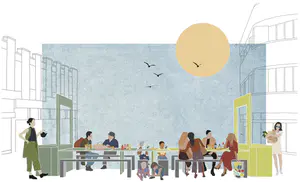
This street section shows activity from the back of the community kitchen to the other end of the street and how all these elements are working coherently. The street is filled more with people rather than cars. We believe that the outdoor seating, more trees, canopies and street lights can attract people to connect with the High Street.
Jack and his friends visited the High Street with their school teacher during a study trip. He learned a lot of things about sustainability, and how to grow food. He was so inspired. Atifa gave him some seeds from fruits on the street garden, and later he planted them in a small unused bucket. After a few months he came back to street to gift the kitchen some of the fruit from his tiny garden at home. Atifa felt so proud of the young generation of Dudley.
Social issues present ... between the two ends of the High Street, one recently improved in terms of materials, recreational areas and spaces for sitting, the other remains in disrepair and is heavily trafficked with completely transitional movement, lack of stopping and communication.
Lichen as bioindicators
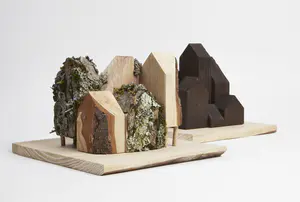
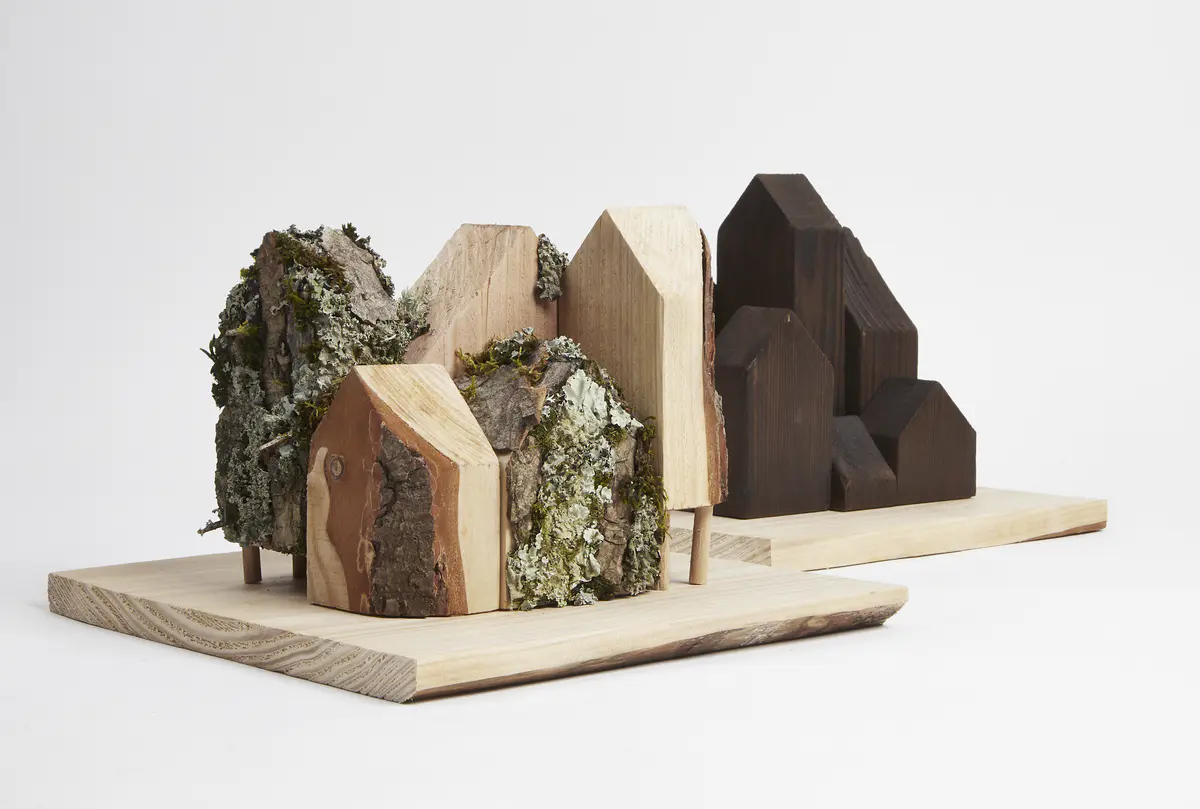
Lichen Vs Carbon. These concept models look to document both the current state of Dudley Highstreet and the vision looking towards the future within this thesis project.
The lichen covered model looks towards a future in Dudley that is rich in texture, colour, nature and oxygen. Natural materials promote natural growth, and textures such as rough sawn timber and stone are the prefect hosts for lichen. All new buildings in Dudley would benefit massively from following a fabric first approach and adopt the use of sustainable and recycled building materials along with systems that use minimal energy.
The lichen model represents a vision for this thesis, buildings that are covered in natural materials and lichens that help sequester carbon and promote a healthier Highstreet. Suggestions of raised buildings also proposes less disruption to the ground and natural landscape, giving plants and animals the opportunity to thrive in an otherwise hostile concrete environment. Raised buildings also look towards a future planet with rising sea levels, future factors that will drastically affect the way we carry out daily lives and futureproofing all buildings for generations to come.
This second model uses the Shou Sugi Ban method of charring timber to waterproof it. In this case however it represents the embodied carbon and pollution within the highstreet as it exists now. The simplicity and repetition is also used to symbolise the plain nature of the highstreet with only a few materials exhibited, mainly brick & concrete. Once burnt the timber forms were brushed with wire wool to reveal the natural grain of the wood, a visual representation of degradation of layers of buildings that are built poorly or not constructed to last longer than a generation.
The third Stepping Stone project attempted to design the community kitchen in one of the empty shops on Dudley High Street. We all know that food is an essential factor in our life and eating and cooking the food is not an abstract activity we do, it is part of our everyday routine. In our initial research, we found that many people live alone in compact housing on the High Street. We thought the kitchen connect the residents with society. We decided to make the process of preparing food more enjoyable. As our aim was to grow food on the street wherever possible, we can use these vegetables for the community kitchen. This will encourage residents to come down onto the street and engage with it. This could also be a new experience for the visitors of the High Street.
A collage response to a Co.LAB gift for the High St - “It was nice to be able to use the image for something else. It made me think about placing the cut-out roadmap onto a slightly brighter future version, with colour, vibrancy and plantlife, so that it reminds me what we are heading towards, but still with a hark back to the people and the industry that made Dudley the town it is...”
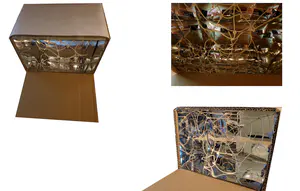
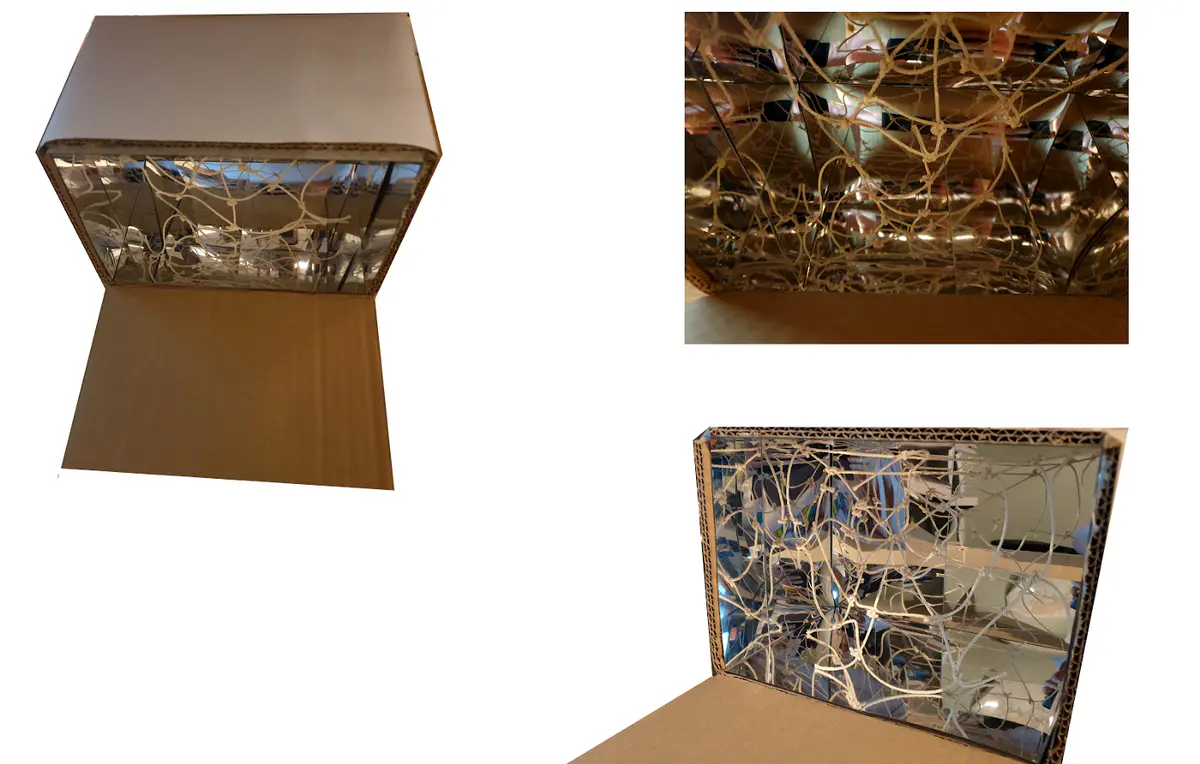
A cardboard box that when opened shows mirrors in all internal faces reflecting a web made with strings that represents Dudley as a complex system of interconnected elements. The Dudley High street has lack in colour, public spaces, and green areas, reflecting the local population that is experiencing deprivations and vice versa. Making a high street attractive can improve the local population in health, social and economic aspects.
This visual represents Dudley High Street re-imagined; a new vision of a re-wilded, food-centric town centre. The green canopy will begin as a frame that will encourage the growth of plants. Smaller scale units will be integrated at the start and build towards the final vision.