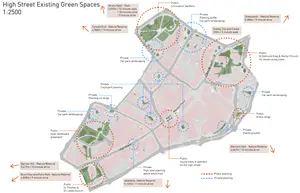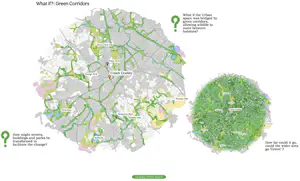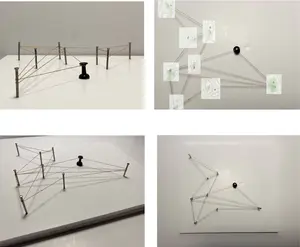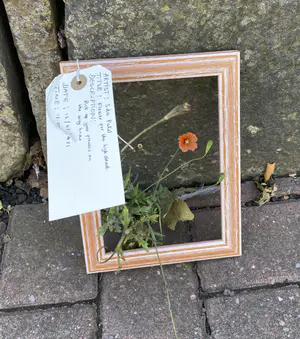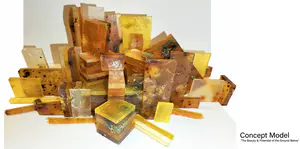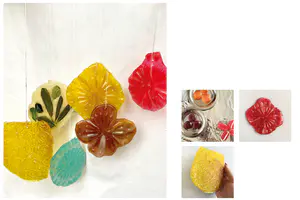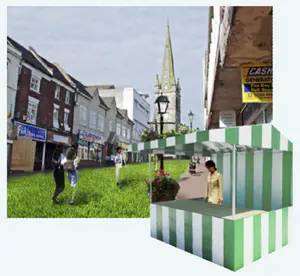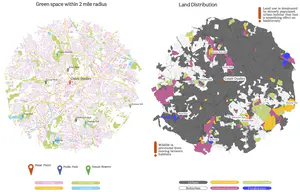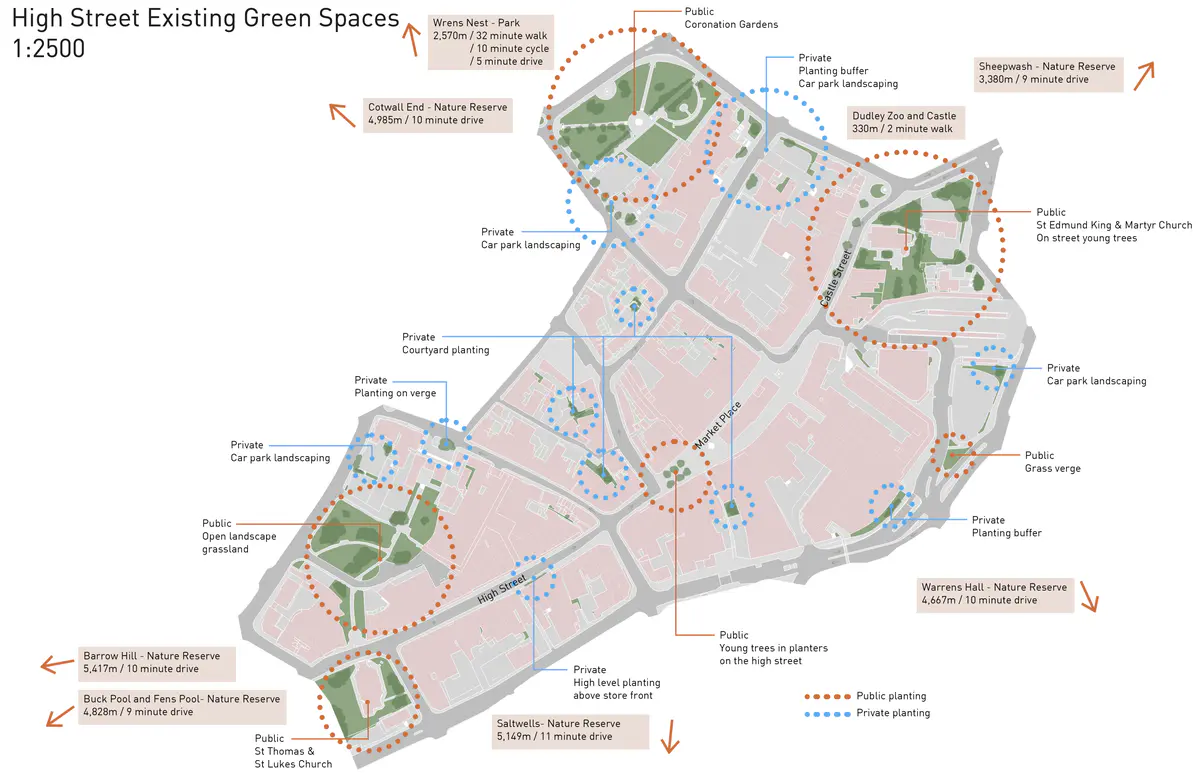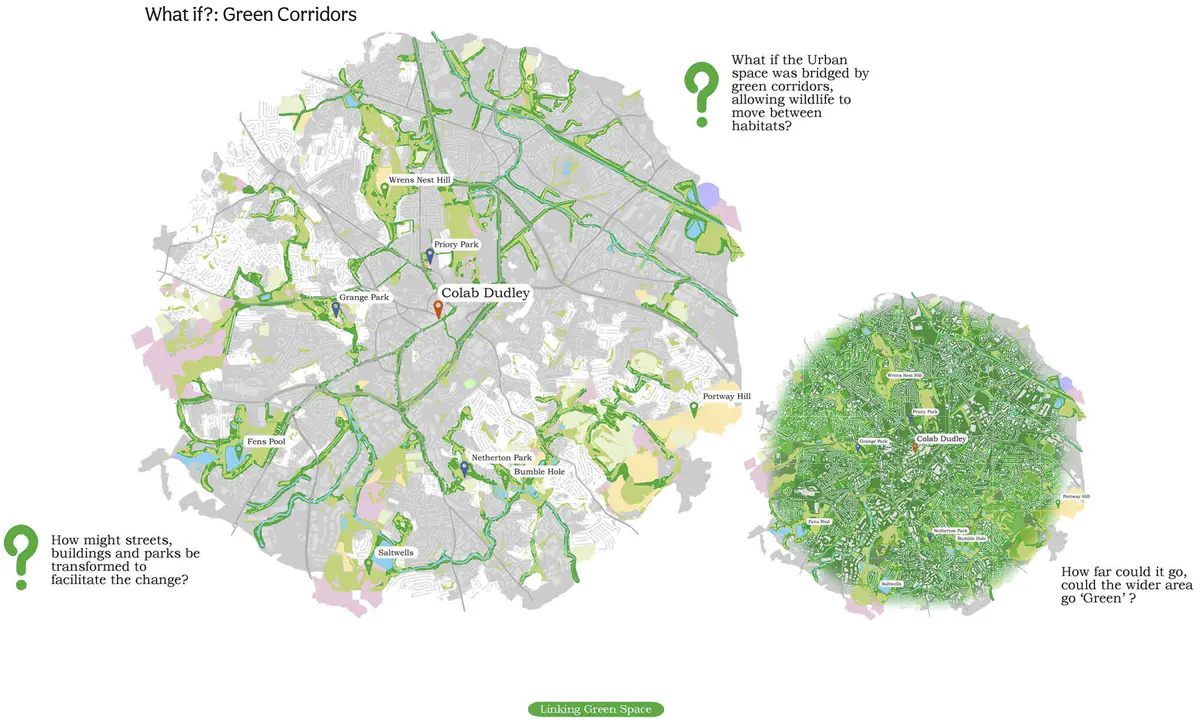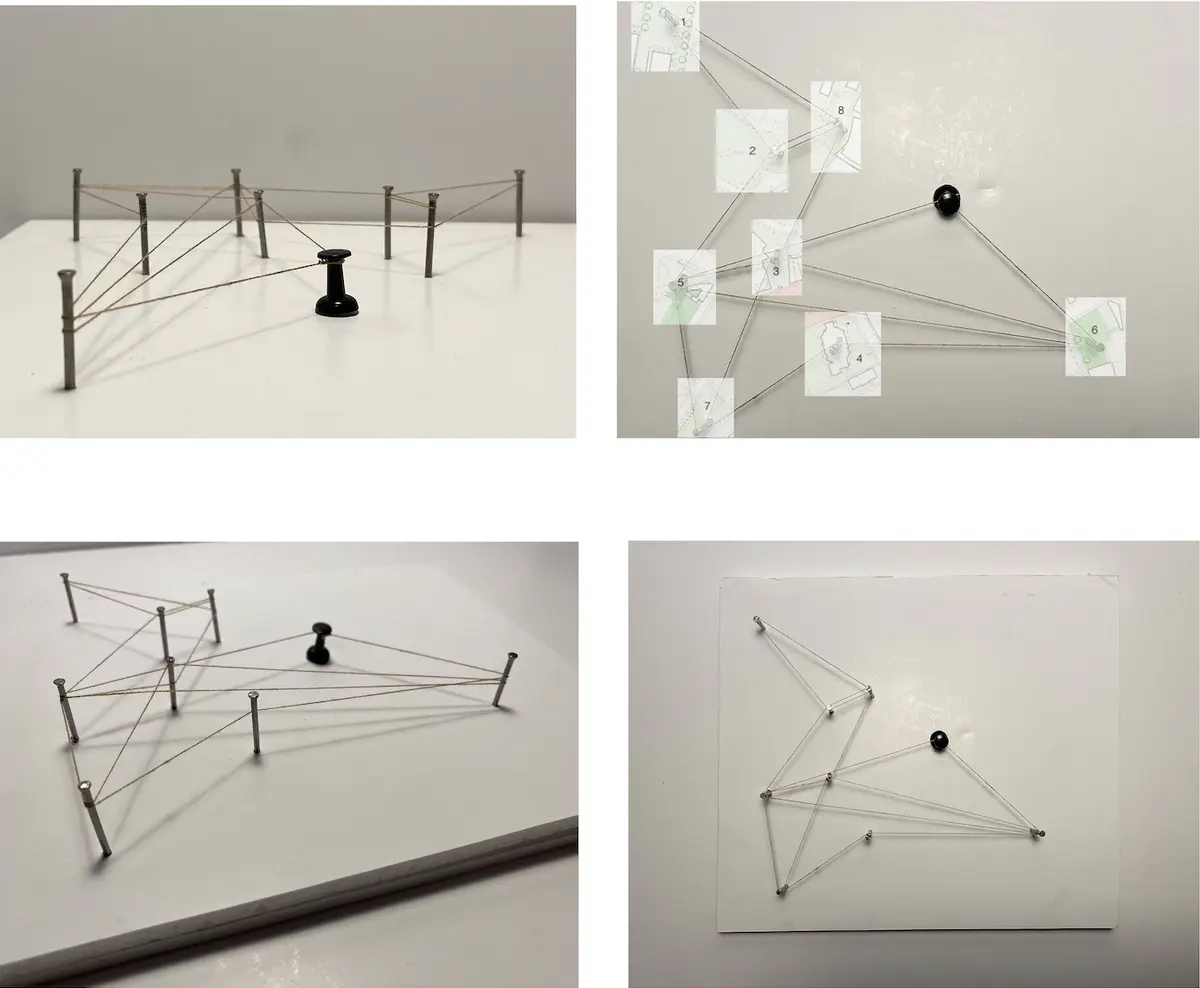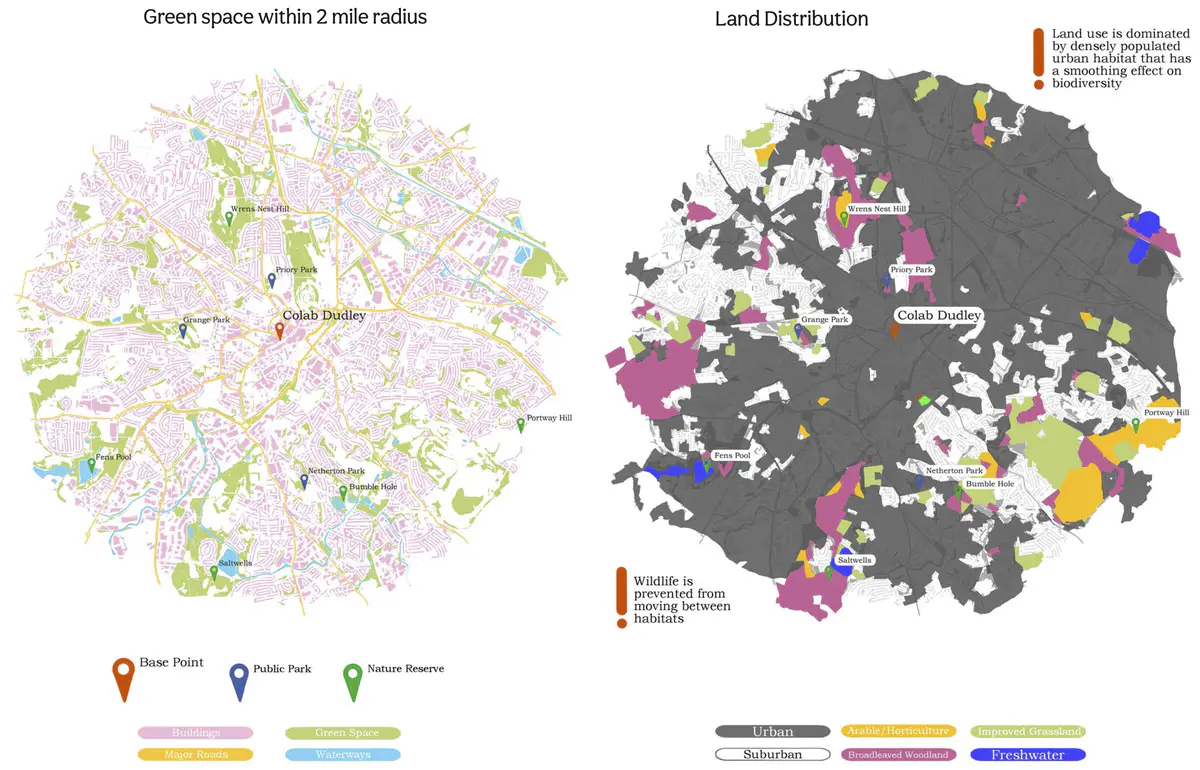
This gift represents the green spaces around CoLab Dudley and the connections they have to the high street. The black point marks the location of the High Street and the other pins mark each green space within the High Street’s immediate location. The lines act as a travel route that you may take in order to get from one green space to another. From this we can establish that there is a lack of greenery in some spaces. This then impacts the High Street as people do not need to use it as a travel route. By simply creating more of these green spaces like in the top right it will add more connections to the High Street which will draw more people to this particular location.
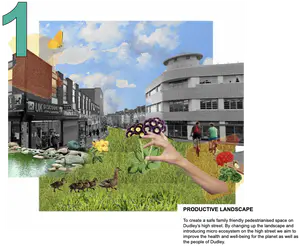
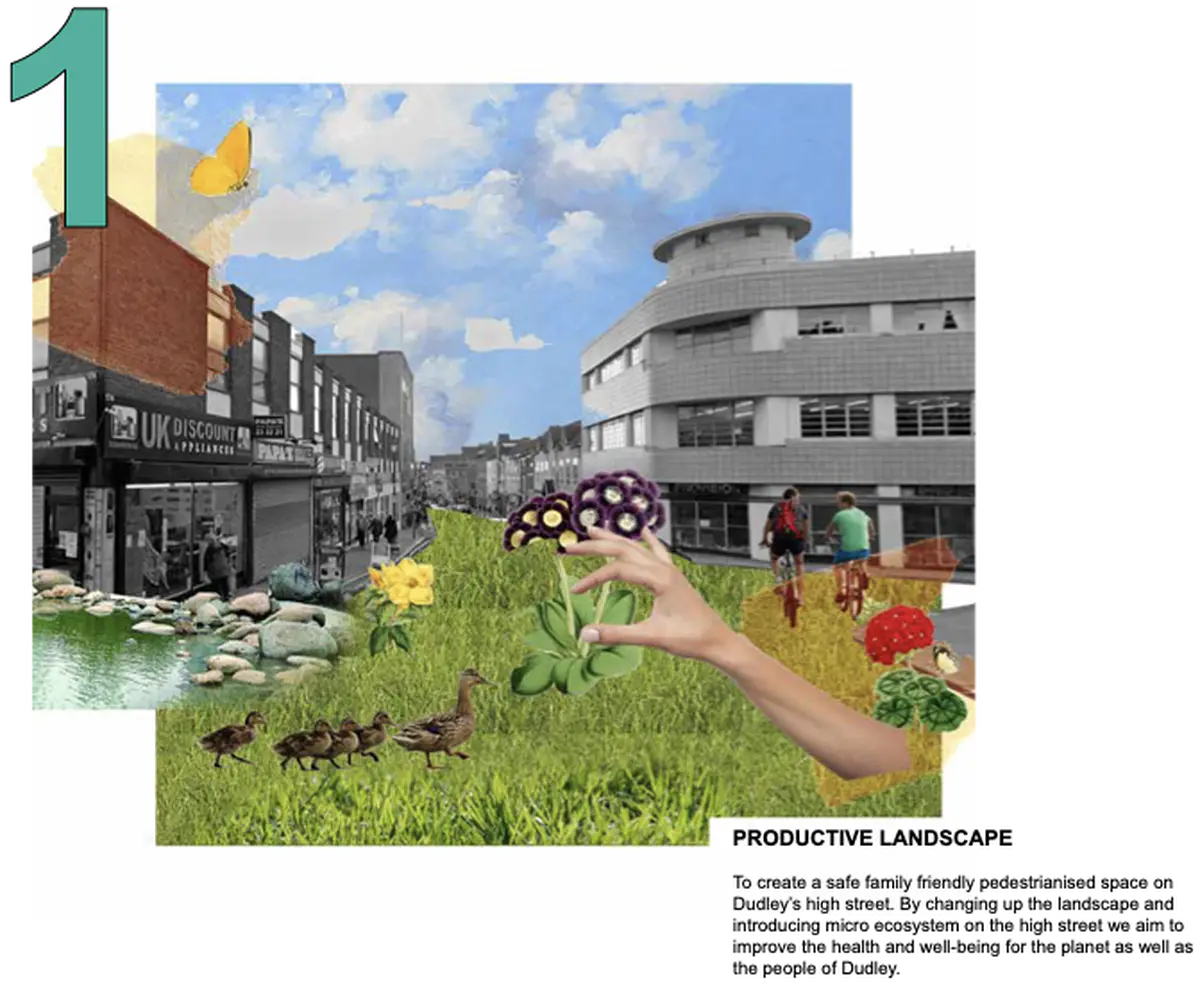
PRODUCTIVE LANDSCAPE
To create a safe family friendly pedestrianised space on Dudley's high street. By changing up the landscape and introducing micro ecosystem on the high street we aim to improve the health and well-being for the planet as well as the people of Dudley.
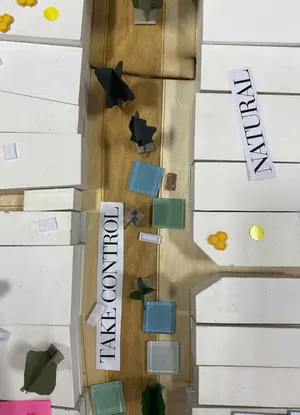
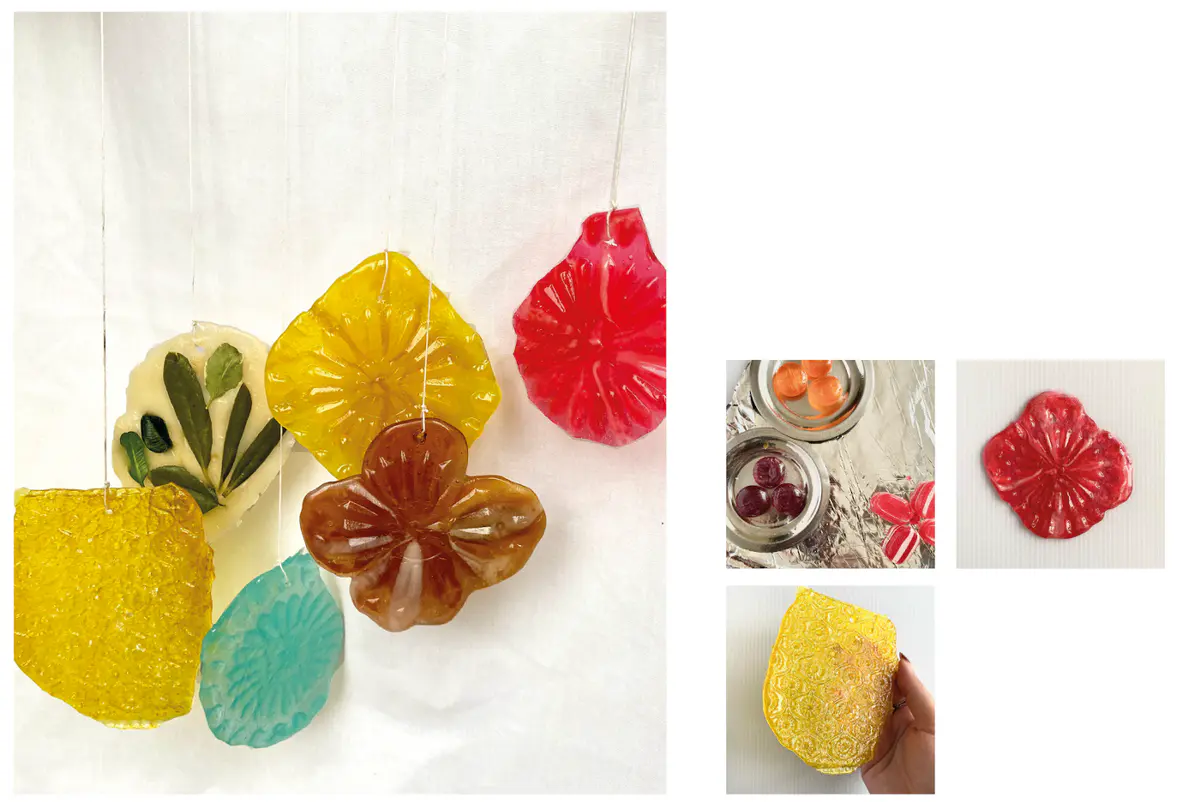
This gift was created to highlight different points in the social spaces on the high street. Aspects that we can improve on and celebrate. One point found was to incorporate more green spaces to improve health and wellbeing. The other to celebrate the textures and embossings in Dudley’s early ironworking. These ornaments were created by melting sweets and printing patterns onto them.
Creating a stronger connecting between the current food spaces by:
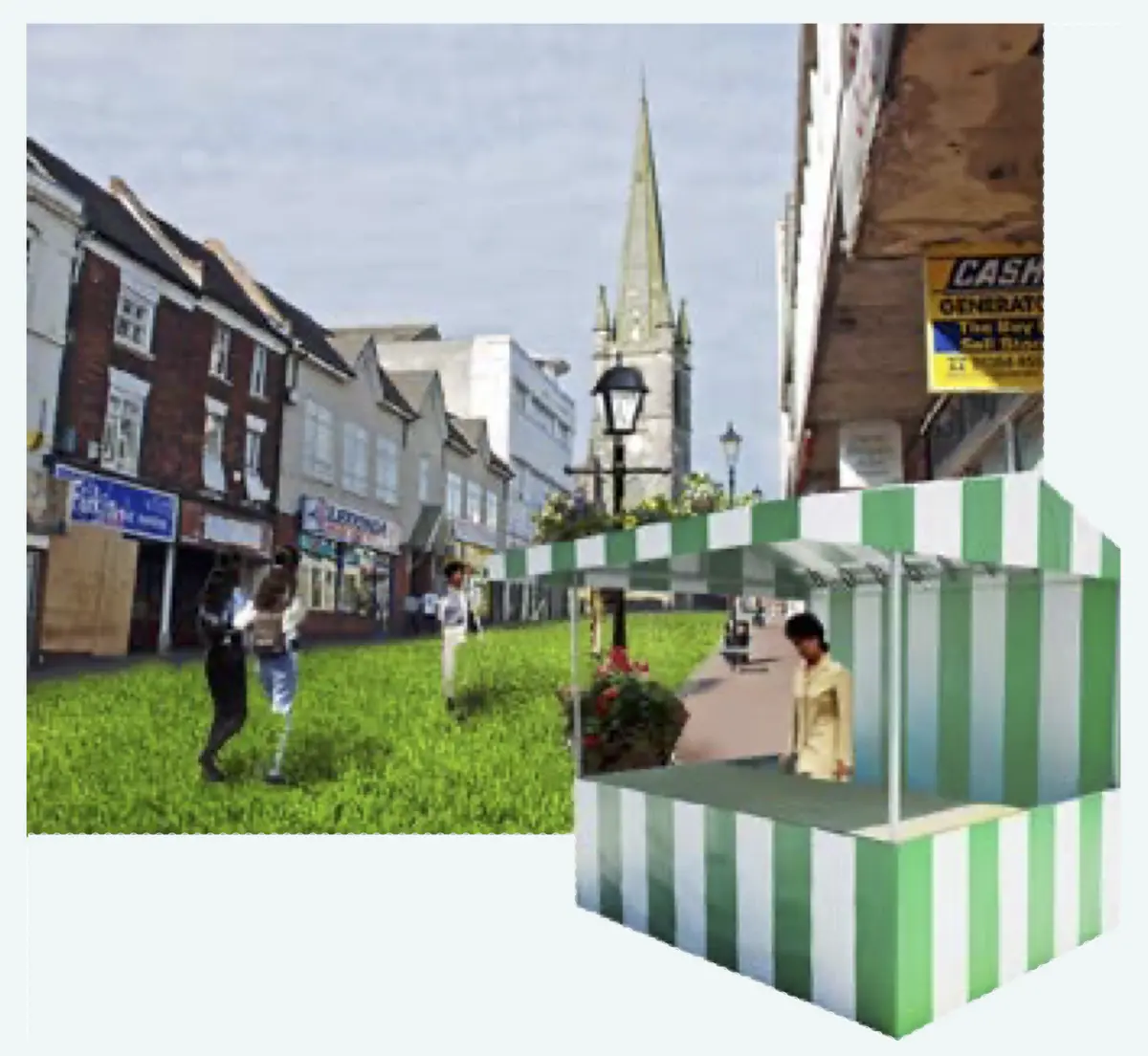
- Pedestrianising the road with a grassland
- Utilising abandoned building for education centres and community farming.
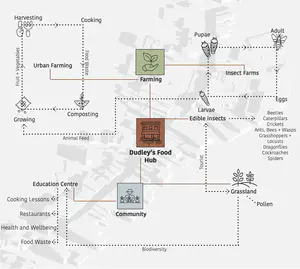
Linked to the Food Hub is an education centre sharing information on edible insects and Dudley’s biodiversity. Also offers insect cooking lessons to the local community and schools.
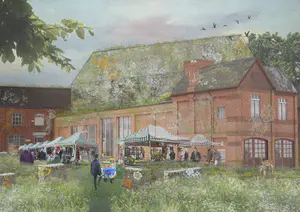
Immersed within the grassland is areas where existing buildings can extend out onto the street to create a stronger bond with new sustainable environment.
Redesigning the Market Place with more levels of outdoor seating to create a new experience and environment of eating food on the High Street.
Gardening and insect farming spaces integrated within the buildings. By bringing all the food production onto the High Street will help reduce food waste and also offer fresh produce to the locals.
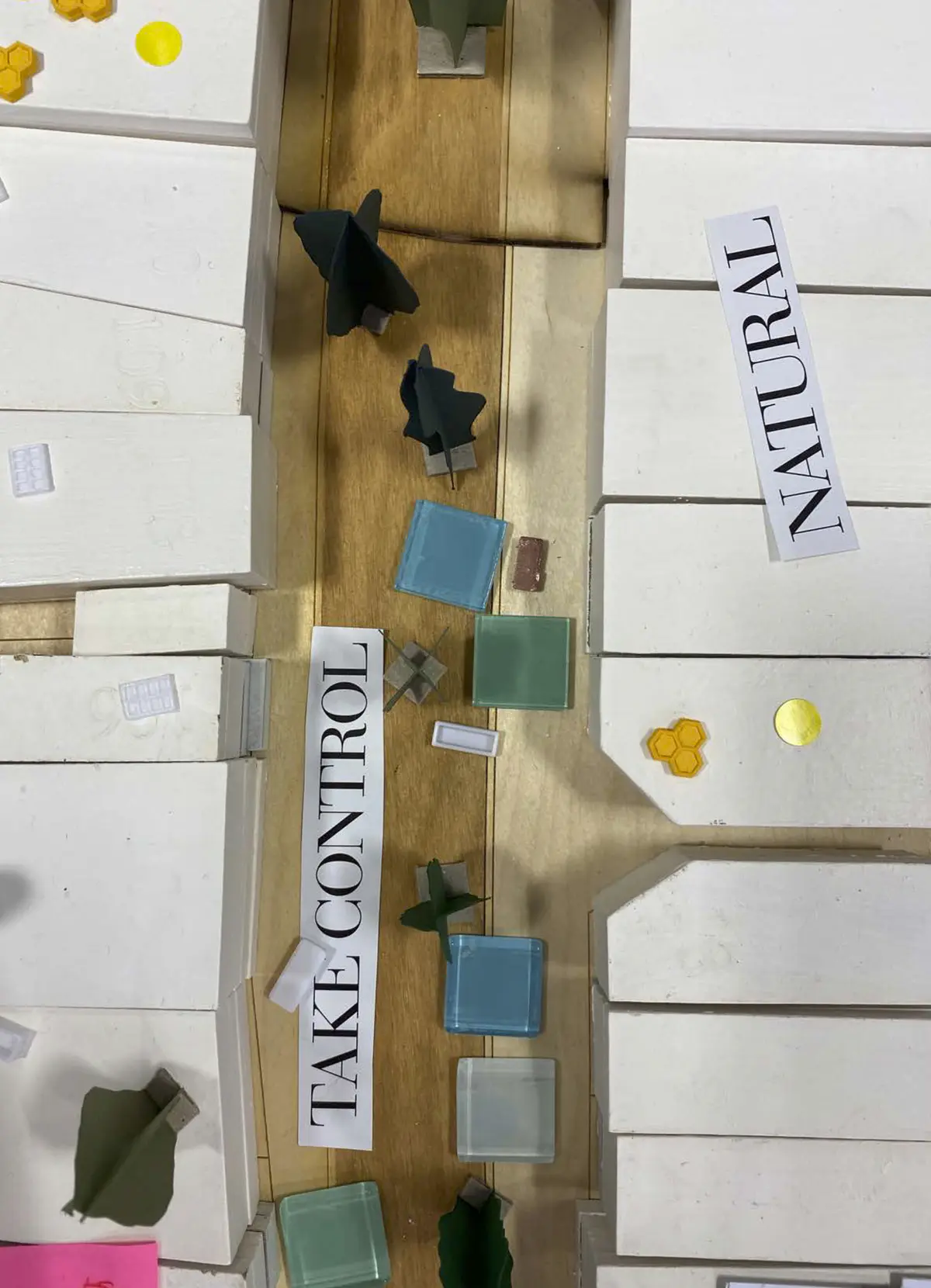
Looking to be the centrepiece of our exhibition, we proposed to create a site model of Dudley Highstreet at 1:200 scale with buildings modelled in a simple form. Local residents and visitors to the exhibition are then invited to decorate a chosen building to how they would envision it sat within the context of a greener Highstreet. We want to tie in our themes of biodiversity and materials by proposing that buildings can, and do, have the potential to be a lot healthier, sustainable, and interactive on the street. This site model also helps gain vital public opinions on the Highstreet and prompts discussion of areas most in need of attention.
To ensure that the model is utilising the MDF to the most efficient standard possible. First, the centres of the massing blocks have been hollowed out. This allows a reduction in materials used as other buildings can be cut in the centres of the model. Then the top is finished with a solid piece.
The waste material is placed into the recycling rack where other students can reuse it; otherwise, if the material left cannot be used for another project, it is recycled correctly by the university.
The model spanned just over 3.4m long and over 50cm wide. With the majority being cut from scrap woods that would fit the jigsaw of the shape, we were able to drastically cut down on waste. We also got some small benches and bee hives printed from recycled plastics, and used dried flowers as trees to represent the green spaces. Ultimately, the model seemed like a huge success, and really helped portray our ideas about Dudley High Street to those who came by. Everyone from Dudley who saw the model knew that it was the High Street, and interacted well with it. The size did make it difficult to move, especially to carry to the site, but it sat nicely in the centre of the the room and really drew people in to interact with it.
The model brought people in from outside to play with, write on, interact with. It became a spectacle for the public to come in and see what was happening and offer their ideas about what could be done.
The event was a success. Many people from the public (those who heard about the event, and those who just happened across it on the day) came in to interact with the model, which sat as the centre piece in the room. Kids liked to play with the pieces while the adults talked about things that could come from actions to help the High Street, not just leave it as is.
SOME OF THE KEY IDEAS WERE:
- The Shops need to be inviting for everyone. It’s no good having these places to go if people would rather take a bus to the next town.
- Just putting up boards across the windows is awful. Paint, Posters, Graffiti: Anything that actually makes the High Street look still alive is better than just wooden boards.
- More Green is needed. While it is obvious that there is a lack of Trees, many people wanted to push for these small bushes or planting spaces that could easily be implemented across the street.
- Spaces for public events or for people to at least gather at. While there is the Market and Fountain, it is not enough for the people of Dudley.
- Something needs to be done about the cars on the High Street. Some were Pro-Removal of all Cars, while some just wanted to limit when they could access the High Street.
Following the exhibition we created a series of drawings with our own interpretation of Sarah Wigglesworth ‘The Dining Table’ drawing. The drawings are a perfect representation of the our interactive model at the ERA Environmental Exhibition and Event. Showing the interaction the public had with the model, as well as the conversations that were held around the model.
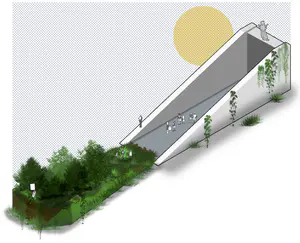
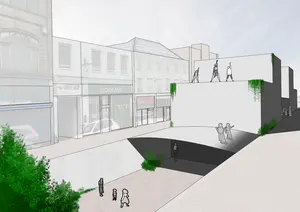
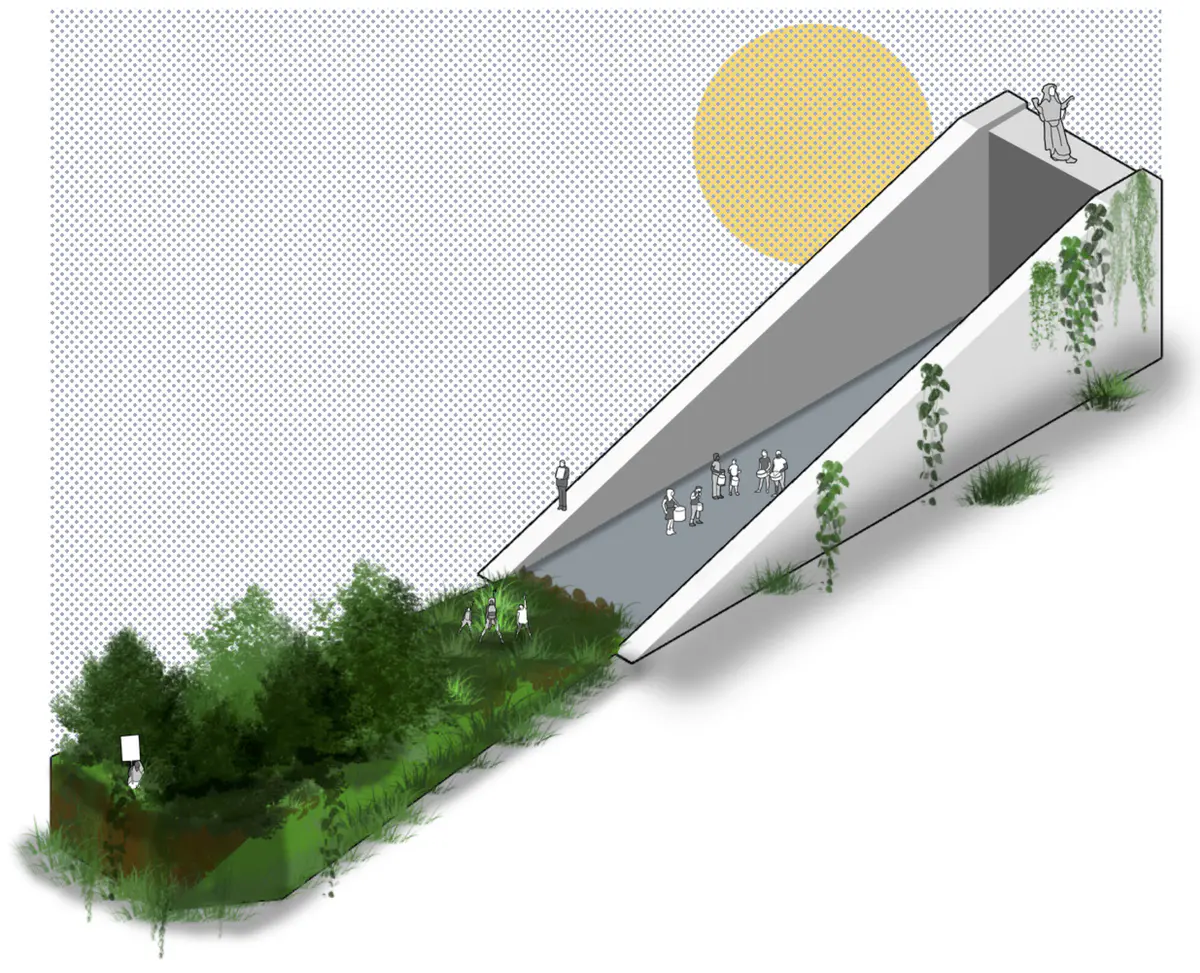
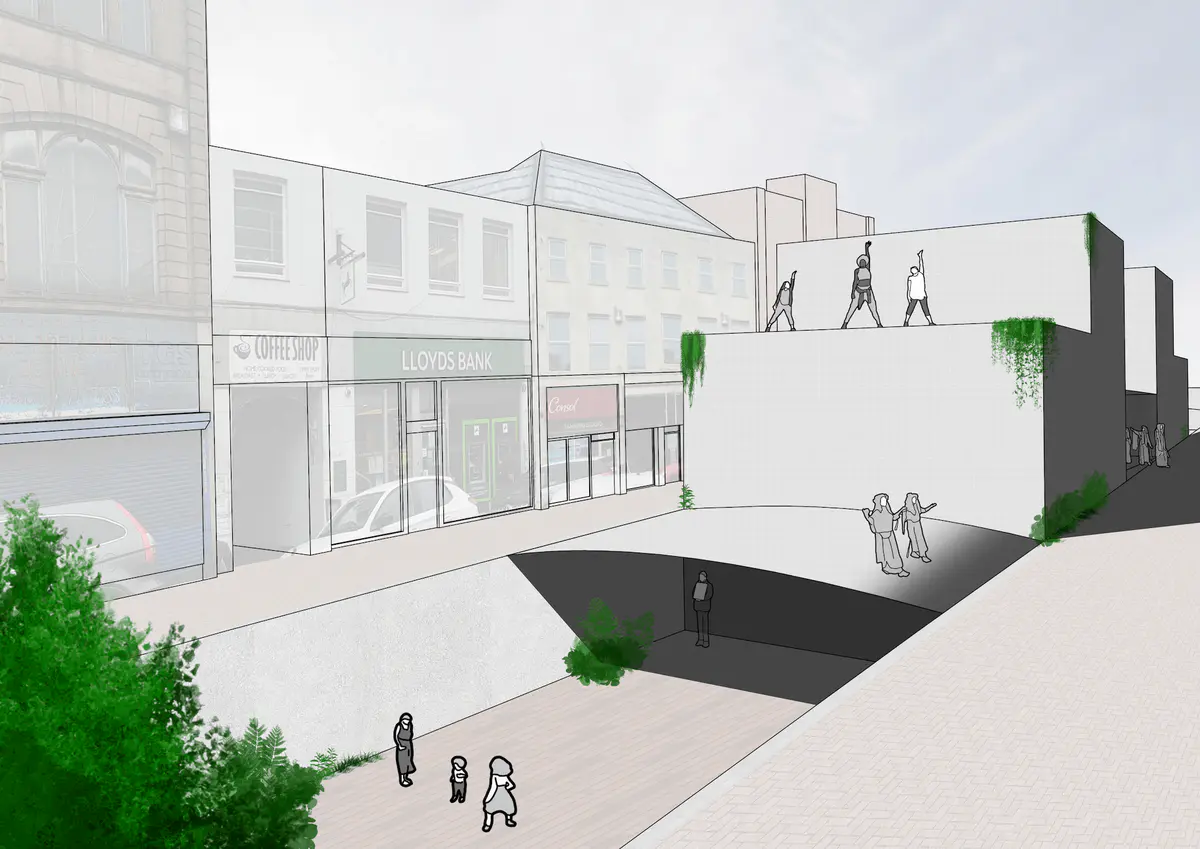
The whole High Street would be dug out to make way for this new kind of “street”. The idea, as stated, is to alter the way that people use this street, so that they can learn about the legacy of Dudley. This would mean that there would be a canopy that sits on top of the cut, that would also act as a means to shelter everything underneath, but would also be made in Dudley to promote local craftsmans. This canopy can then hold something like Theatre Curtains with the history of Dudley presented on them. As you walk through the cut, you go through all the different parts of Dudley’s Legacy - Saxon, Middle Ages, Industrial Revolution, Modern, and you would end the walk on the “Future”. You would start at one end, up by the top church, and as you walk through towards the market place, you would walk through the eras in chronological order. Then, once you exit the tunnel, you would leave the Modern era, and come out into the reclaimed green space, which would represent the future of Dudley’s Legacy. This would be a Miyawaki Forest that would be expanded out through the streets, taking over the spots where cars used to drive, to now benefit Dudley, it’s people, and the world as a whole.
Dudley’s High Street is about 240 metres long, about 9 metres wide, and rises about 8 metres. This would provided a very prominent feature for the High Street if it was dug out and recommissioned.
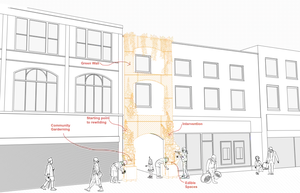
An added aspect to the dug out street would be that of the canopy that would reside above it. While thinking of the design, two ideas stood out - one that would stand raised, at about the same level as the end of the street, which would create this arcade styled archway that would reside high above the street. The second was having the canopy be flush with the pavement all the way up, except at the end that would then provide a small increase around the steps.
Both ideas serve the same purpose, but provide drastically different means of doing so.
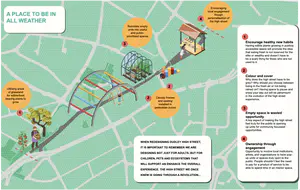
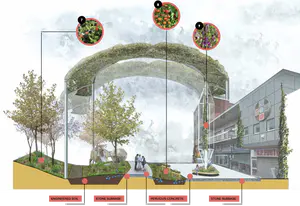
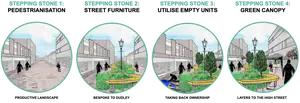
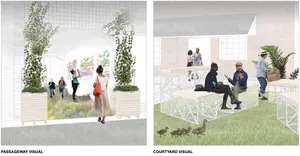
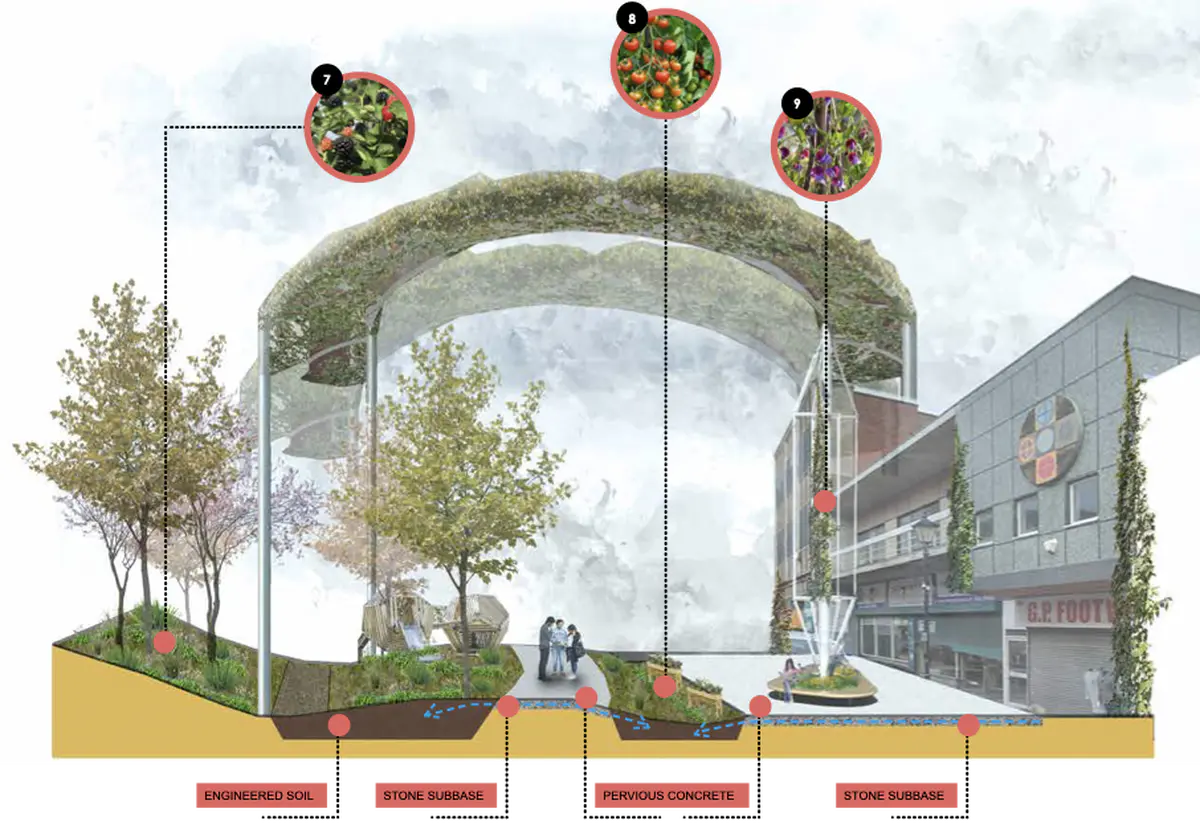
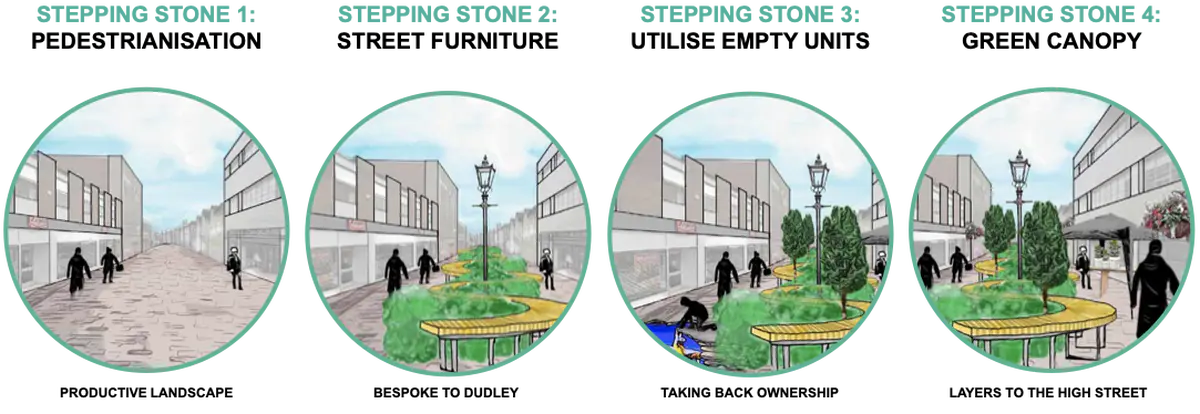
Stepping Stone 4 adds layers to the High Street. Like the other visions, we wanted to use CoLab Dudley’s principles ‘use nature as a guidebook’ and ‘create conditions for curiosity and experimentation’. The main way we proposed to do this was adding a green canopy to provide shelter, create a hybrid indoor outdoor space welcoming to families and a more communal open space, and support ecosystems.
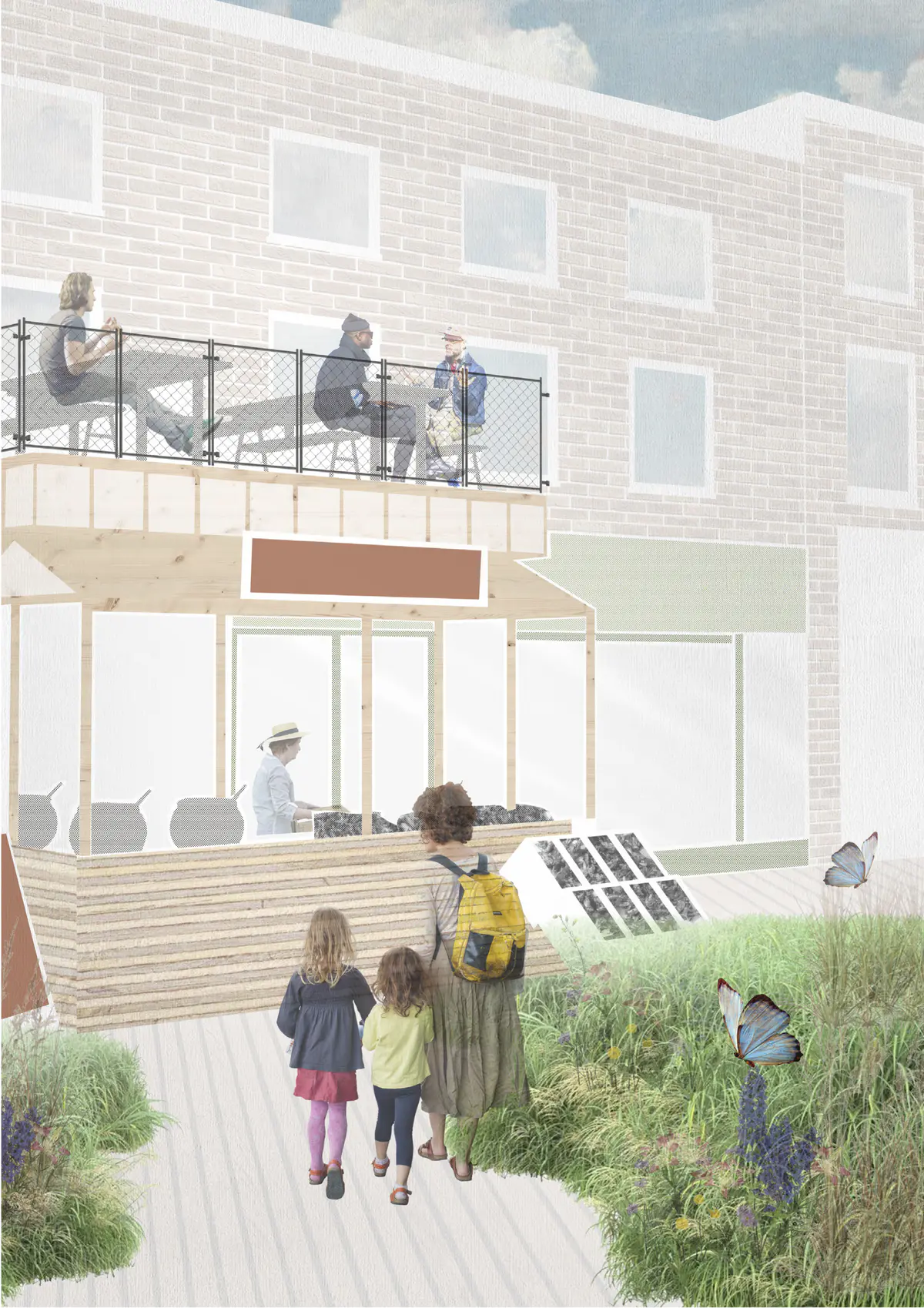
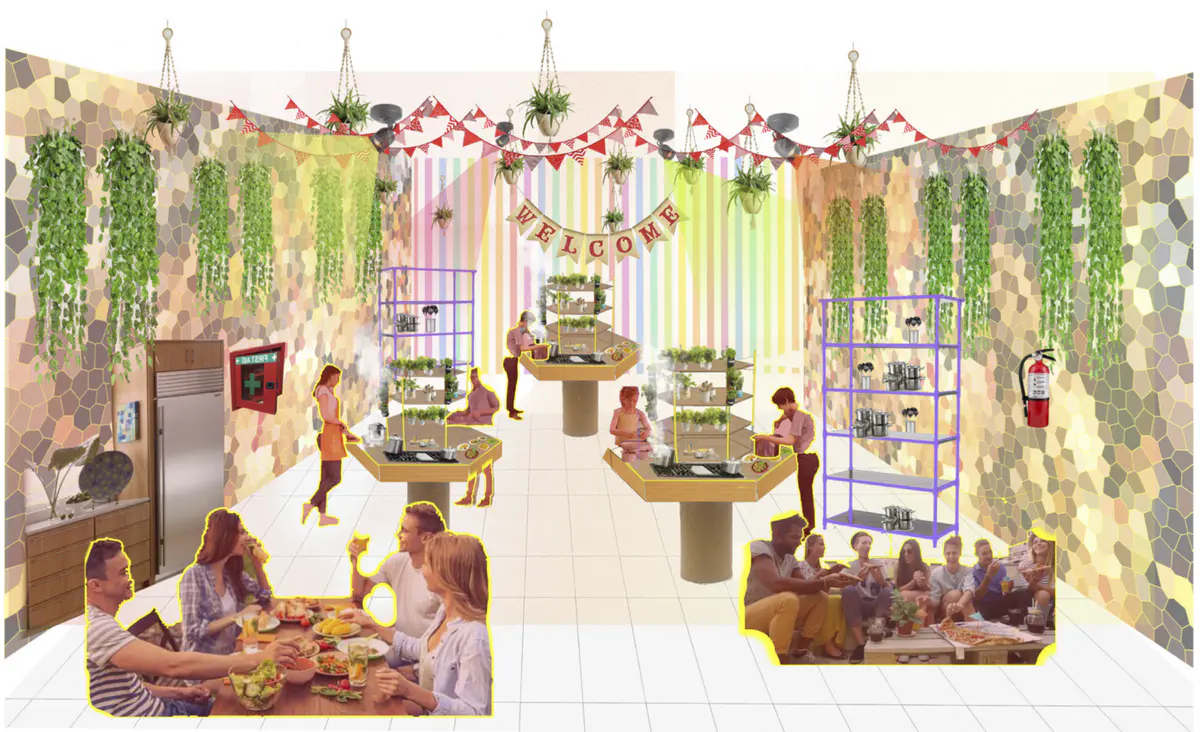
The third Stepping Stone project attempted to design the community kitchen in one of the empty shops on Dudley High Street. We all know that food is an essential factor in our life and eating and cooking the food is not an abstract activity we do, it is part of our everyday routine. In our initial research, we found that many people live alone in compact housing on the High Street. We thought the kitchen connect the residents with society. We decided to make the process of preparing food more enjoyable. As our aim was to grow food on the street wherever possible, we can use these vegetables for the community kitchen. This will encourage residents to come down onto the street and engage with it. This could also be a new experience for the visitors of the High Street.
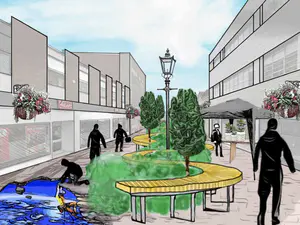
We feel that our local High Streets should be the focal point for our local community. They should be seen as places of interest and a place where you can go for both essential items and leisure. Therefore, we feel making the High Street pedestrianised would mean that there is a larger space to work with on the High Street and that it will not only allow locals to shop but also congregate and relax with family and friends.
Nurturing AgroEcology in Urban Life
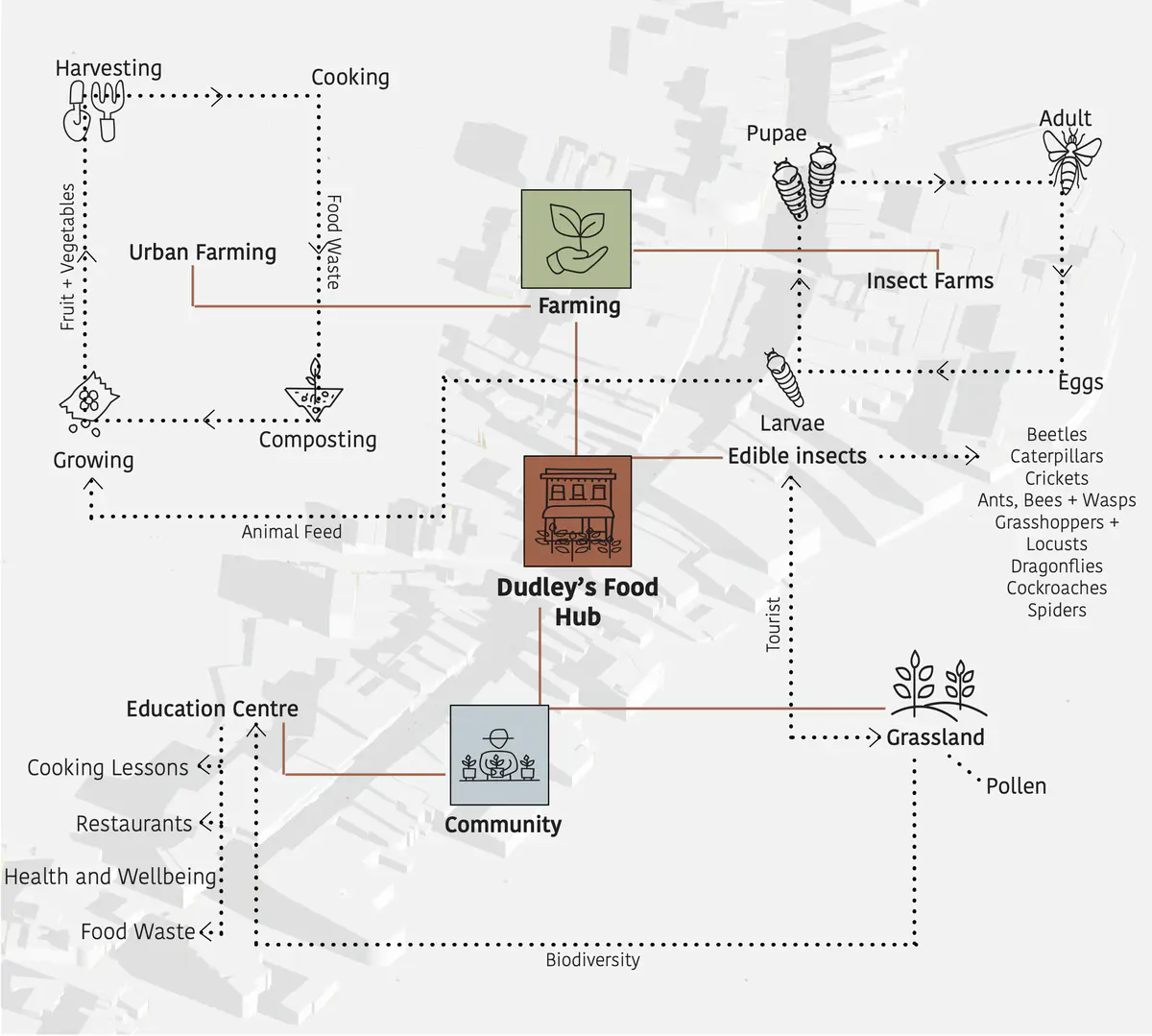
A strategy for living alongside food production
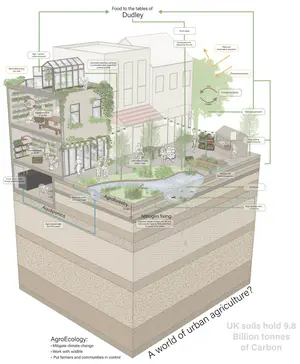
A critical part of the climate crisis is the degradation of soil, leading to scientists predicting the UK has approximately 100 harvests left of stable crop production. As an attempt to address the problem this project will explore the possibility of integrating sustainable agriculture into an urban setting, reducing the strain on agricultural land, reducing food miles and widening city biodiversity. Taking guidance from the farming movement, ‘Agroecology,’ a climate conscious, wildlife supporting and community engaged closed loop system will be developed, combining traditional growing with technology driven techniques that will support each other to produce a diverse plate.
Dudley High Street will be the focal point, reinvented as a destination not just for the purchase and consumption of food but also its creation, driven by the needs and engagement of local people. Connecting the community to the food they eat.
These are stepping stones that we wanted to achieve, with a scale of intervention, starting with small changes that could still have a big impact e.g. street furniture. At the other end of the scale is topography, where larger adaptations can be made for what we want to achieve.
A collage response to a Co.LAB gift for the High St - “It was nice to be able to use the image for something else. It made me think about placing the cut-out roadmap onto a slightly brighter future version, with colour, vibrancy and plantlife, so that it reminds me what we are heading towards, but still with a hark back to the people and the industry that made Dudley the town it is...”
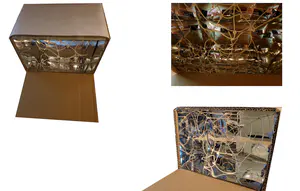
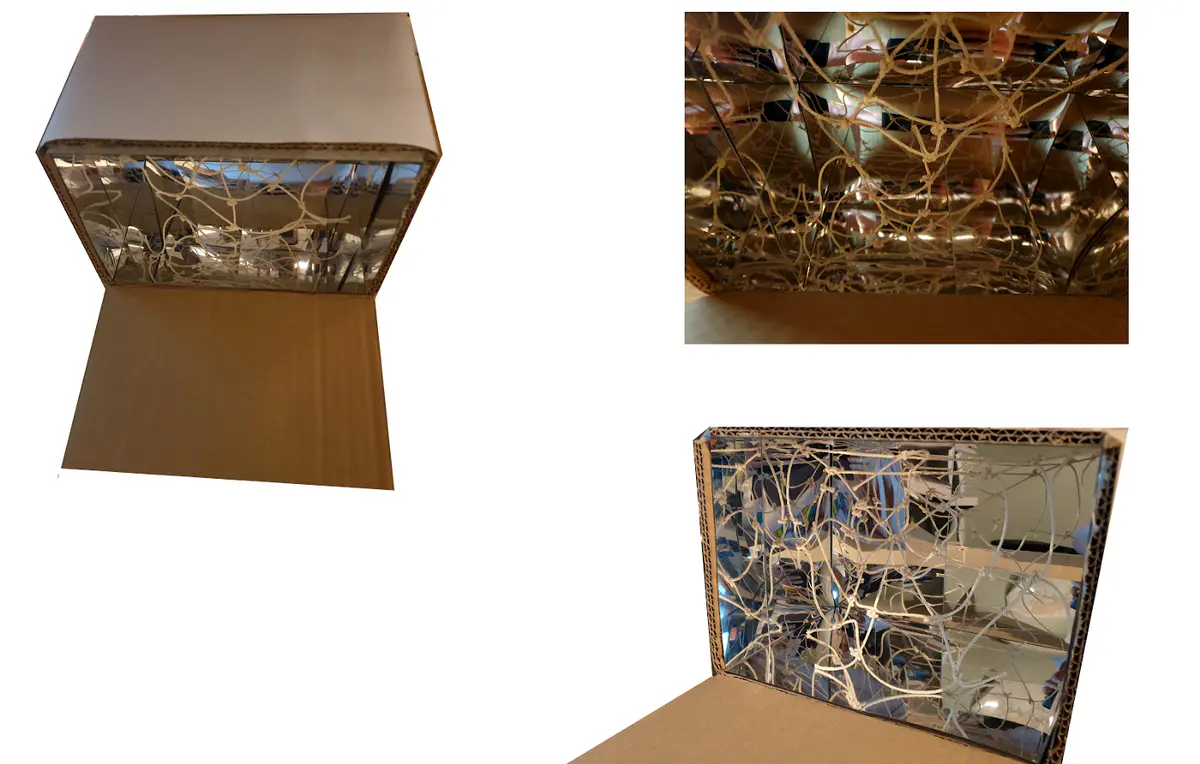
A cardboard box that when opened shows mirrors in all internal faces reflecting a web made with strings that represents Dudley as a complex system of interconnected elements. The Dudley High street has lack in colour, public spaces, and green areas, reflecting the local population that is experiencing deprivations and vice versa. Making a high street attractive can improve the local population in health, social and economic aspects.
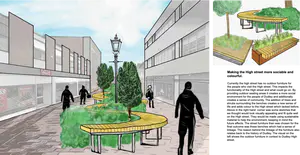
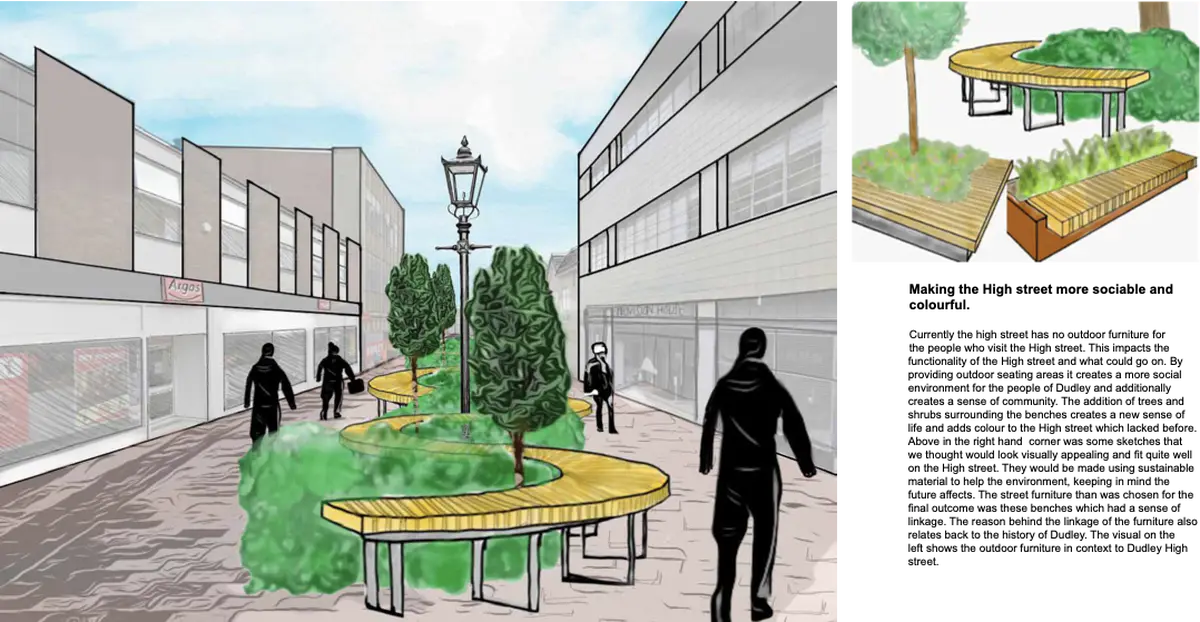
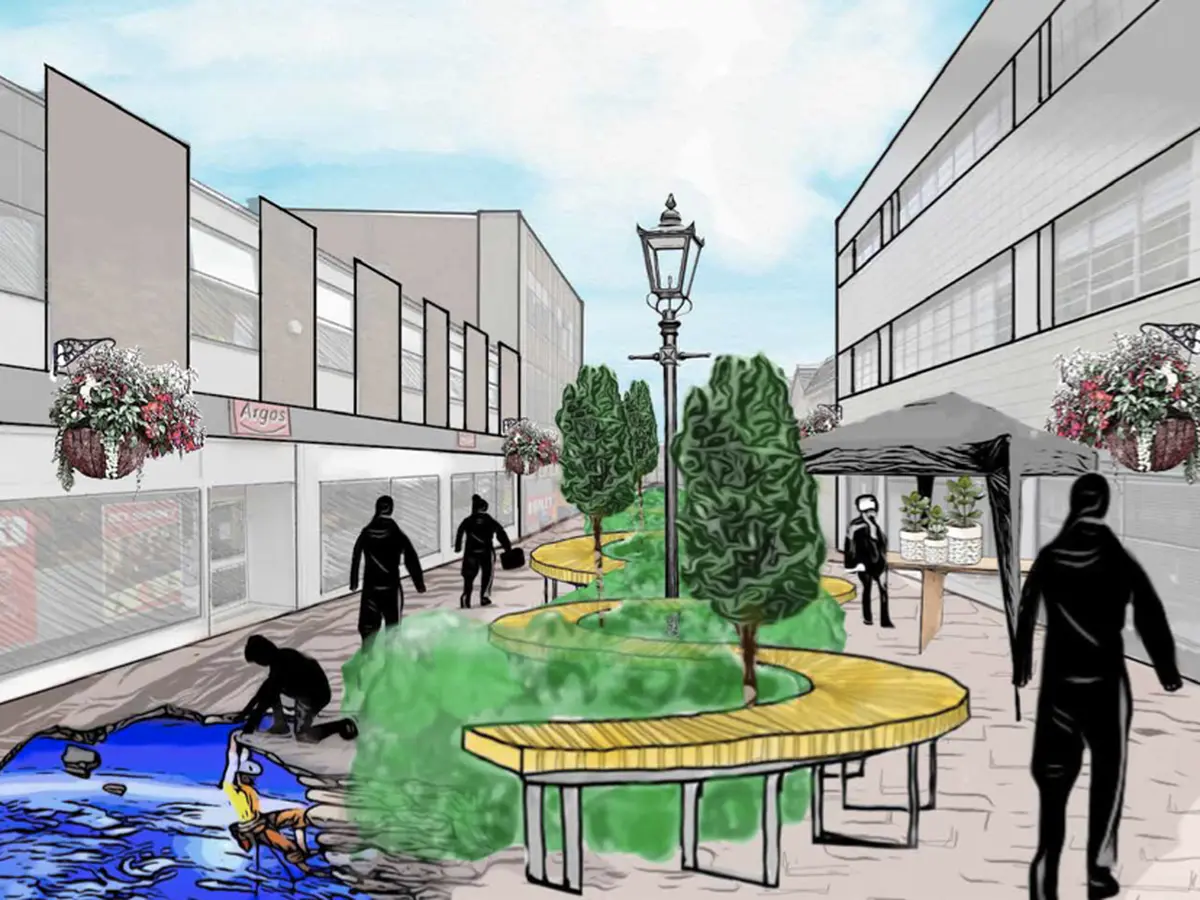
Stepping Stone 2 is about making the High Street bespoke to Dudley through street furniture. We wanted to make the High Street more sociable and colourful. By providing outdoor seating areas, people would be invited to speak to each other and bring back a sense of community.
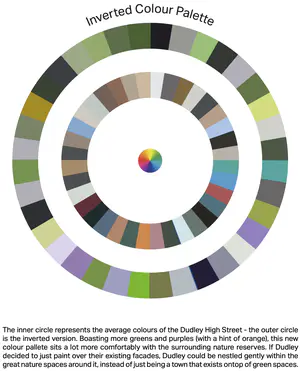
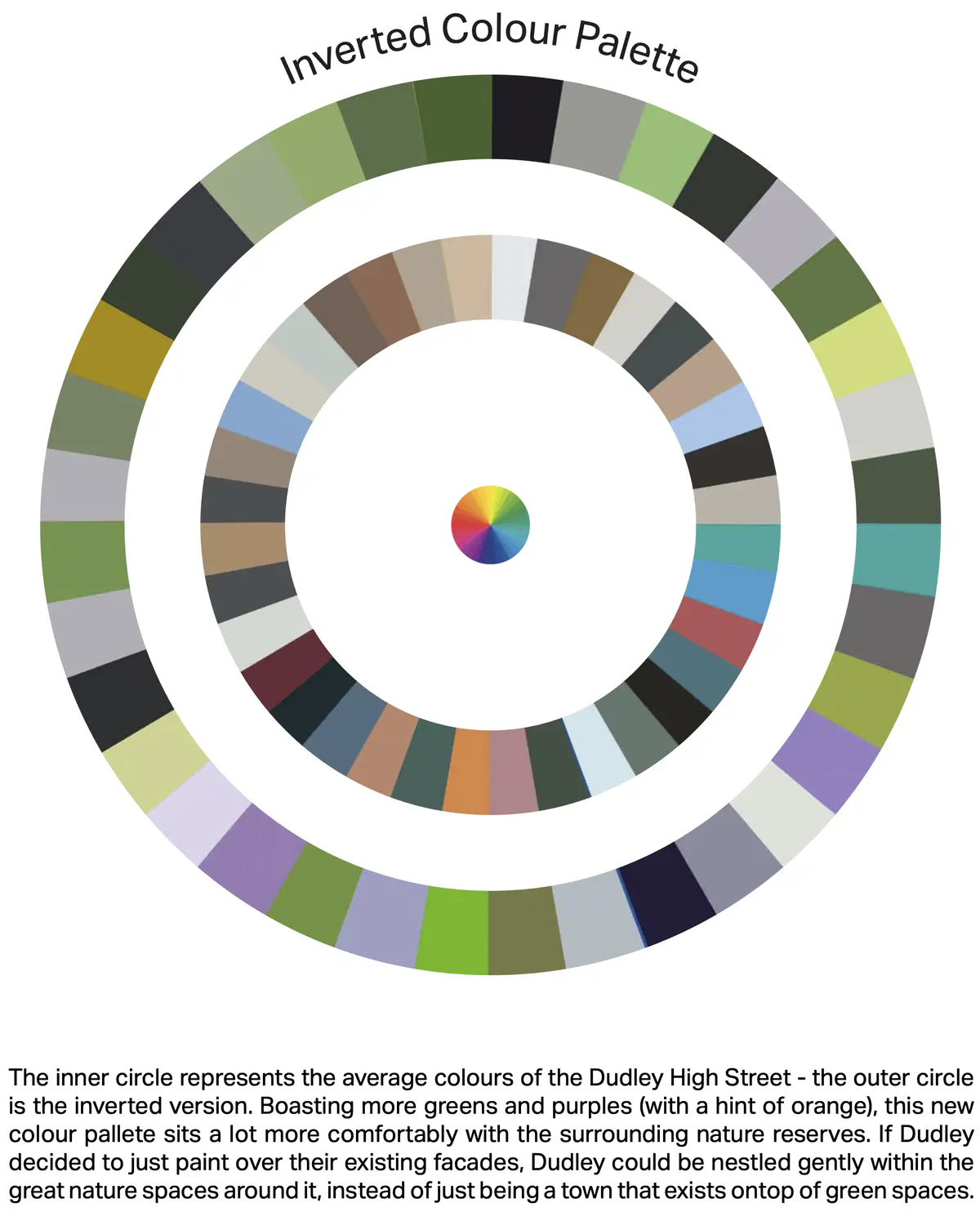
The inner circle represents the average colours of the Dudley High Street - the outer circle is the inverted version. Boasting more greens and purples (with a hint of orange), this new colour pallete sits a lot more comfortably with the surrounding nature reserves. If Dudley decided to just paint over their existing facades, Dudley could be nestled gently within the great nature spaces around it, instead of just being a town that exists ontop of green spaces.
It is 5pm in the evening and the shops are still full with customers. David has had a long and busy working day at the shop and can now finally take a break, and so he ventured out onto the street to get fresh air. David randomly bumped into an old customer, they both instantly recognised each other, and decided to share some conversations on a nearby bench. The old customer could not stop pointing out many of positive changes on the High Street since he last visited. He noticed the fresh air from more vegetation and less pollution, outdoor seating and a thriving enjoyable space.
Lichen as bioindicators
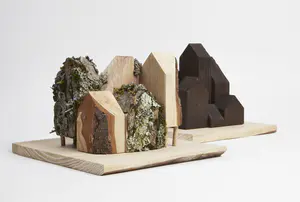
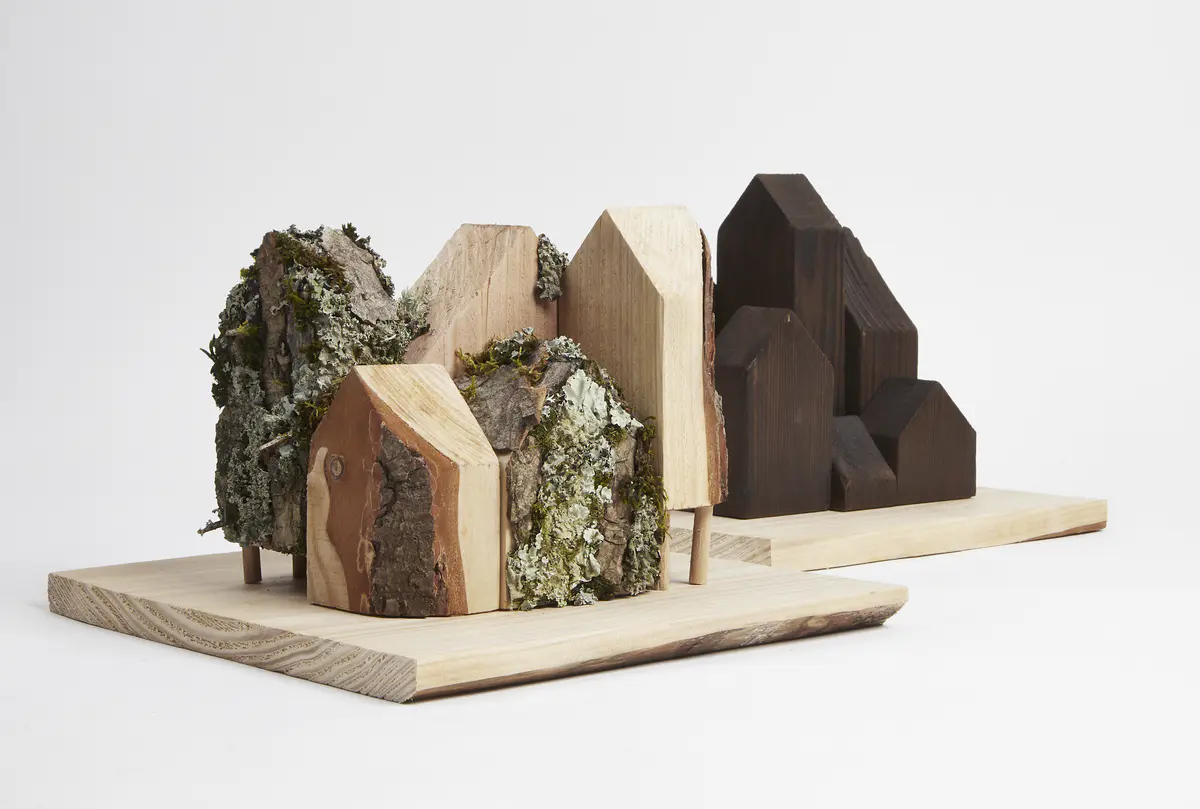
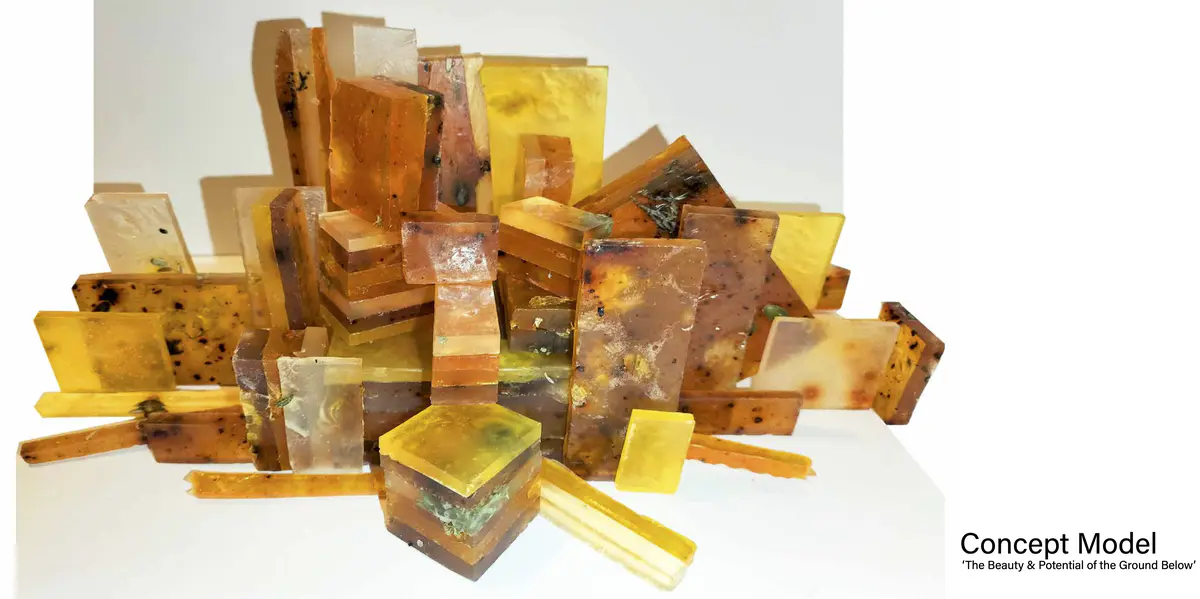
Lichen Vs Carbon. These concept models look to document both the current state of Dudley Highstreet and the vision looking towards the future within this thesis project.
The lichen covered model looks towards a future in Dudley that is rich in texture, colour, nature and oxygen. Natural materials promote natural growth, and textures such as rough sawn timber and stone are the prefect hosts for lichen. All new buildings in Dudley would benefit massively from following a fabric first approach and adopt the use of sustainable and recycled building materials along with systems that use minimal energy.
The lichen model represents a vision for this thesis, buildings that are covered in natural materials and lichens that help sequester carbon and promote a healthier Highstreet. Suggestions of raised buildings also proposes less disruption to the ground and natural landscape, giving plants and animals the opportunity to thrive in an otherwise hostile concrete environment. Raised buildings also look towards a future planet with rising sea levels, future factors that will drastically affect the way we carry out daily lives and futureproofing all buildings for generations to come.
This second model uses the Shou Sugi Ban method of charring timber to waterproof it. In this case however it represents the embodied carbon and pollution within the highstreet as it exists now. The simplicity and repetition is also used to symbolise the plain nature of the highstreet with only a few materials exhibited, mainly brick & concrete. Once burnt the timber forms were brushed with wire wool to reveal the natural grain of the wood, a visual representation of degradation of layers of buildings that are built poorly or not constructed to last longer than a generation.
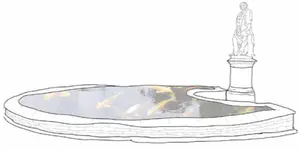
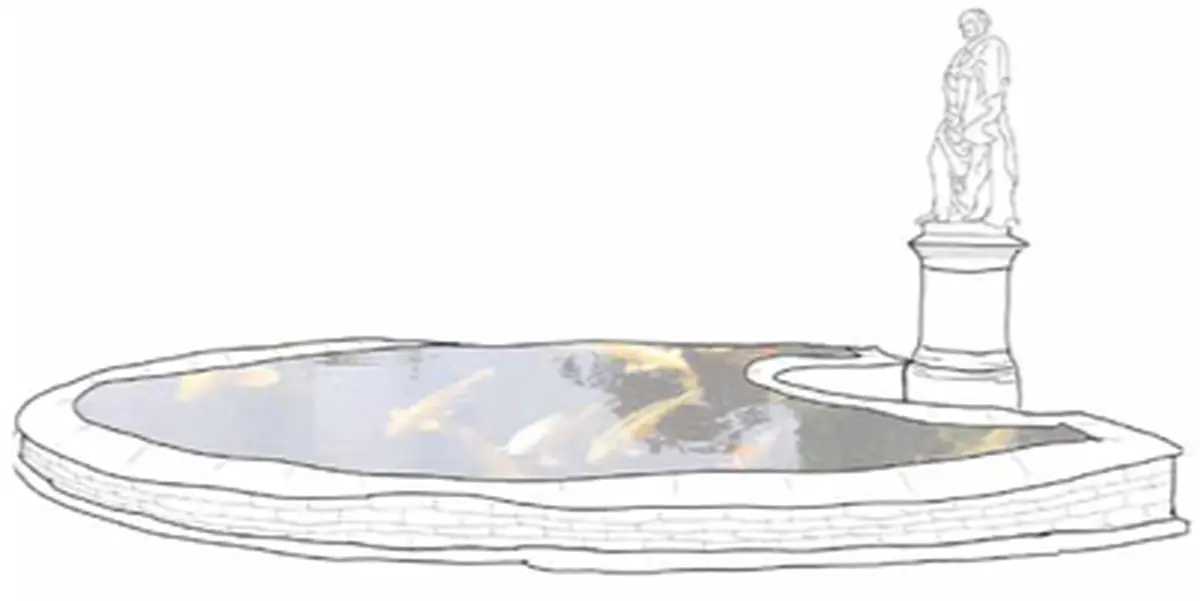
Pond — At the northern reaches of the High Street lies a raised bed with nothing but a sterile patch of grass. We suggest as a miniature stepping stone, we replace the grass with a pond. The sounds of water can soften the noise of the traffic and it will invite pedestrians onto the high street by having this point of interest. It also works with the plans for re-wilding and growing food along the High Street as it aids pollination.
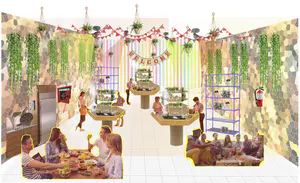
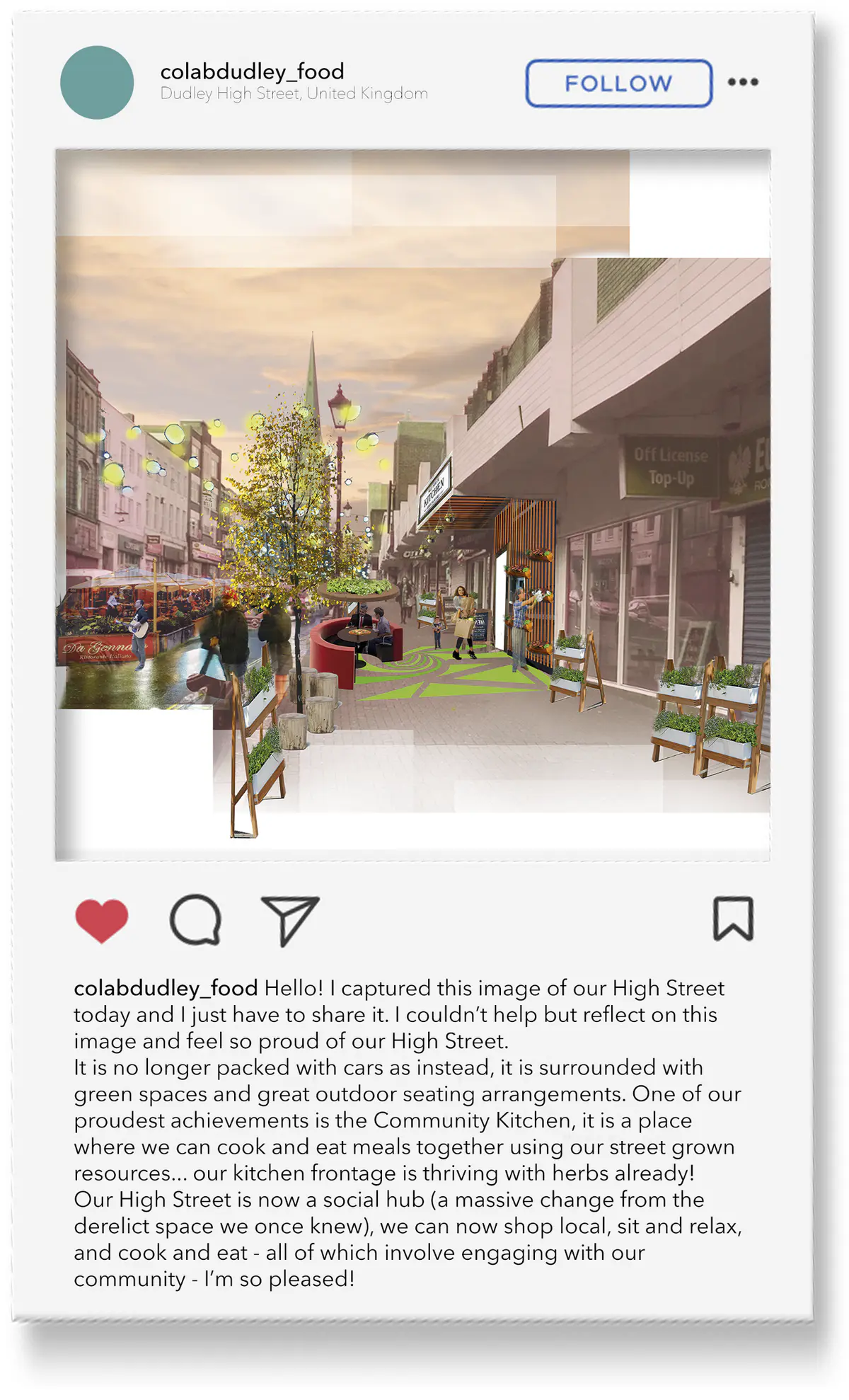
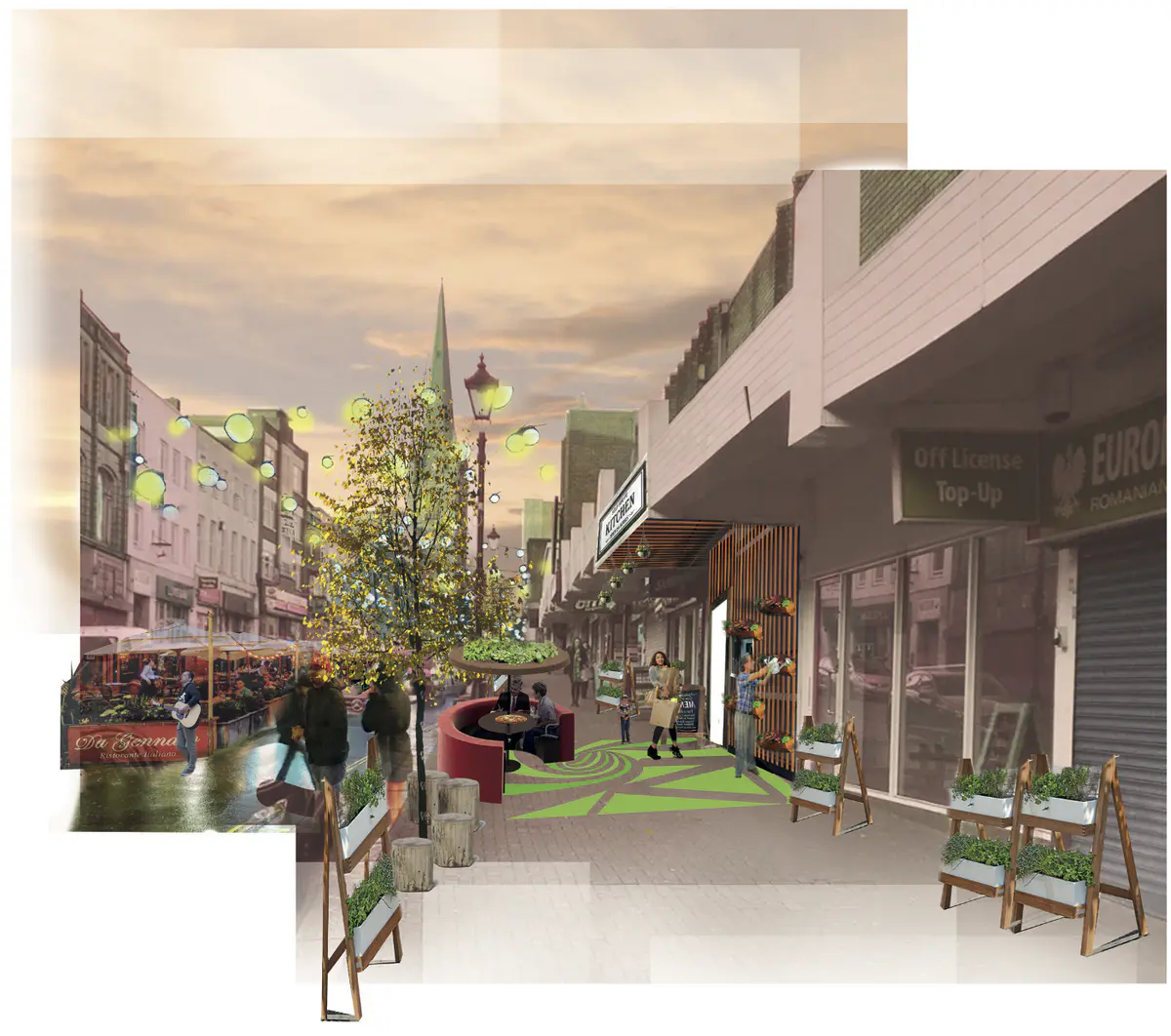
The interior of the community kitchen would be inviting and colourful to create a positive atmosphere. The colours were abstracted from one of our group collages of food. The kitchen counters are not considered as a back of house element; they have been combined with seating as we are trying to embrace the cooking process. The kitchen desk is designed in a way so multiple people can work together from all sides, with central storage for herbs.
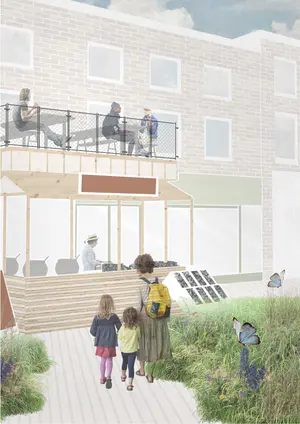
The facade of the kitchen contains a small window so food can be sold outside. We have also created a vertical herb garden so it can be used in the community kitchen. We wanted to keep these below eye-line so people outdoors have a clear view into what’s going on inside.
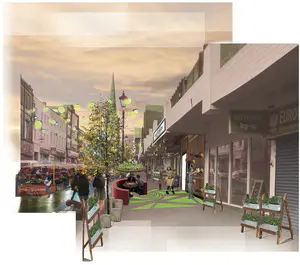
This street section shows activity from the back of the community kitchen to the other end of the street and how all these elements are working coherently. The street is filled more with people rather than cars. We believe that the outdoor seating, more trees, canopies and street lights can attract people to connect with the High Street.
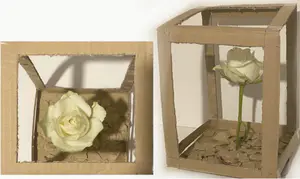
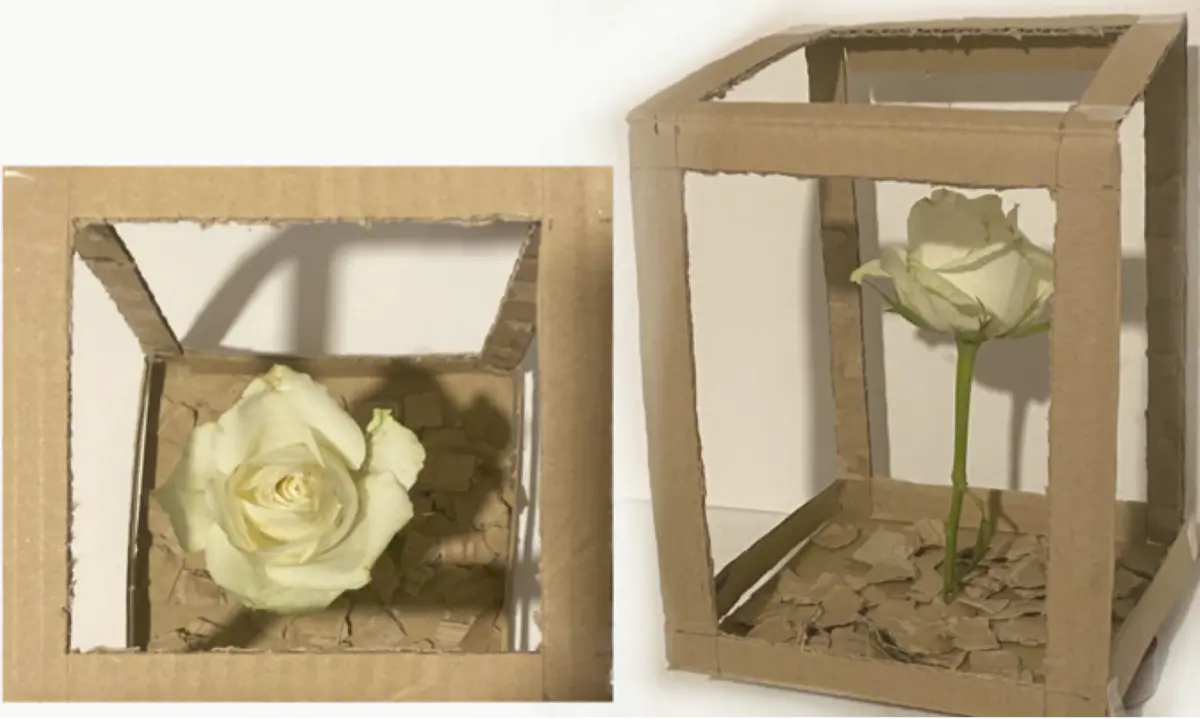
The meaning behind this gift is composed of three main foundations which are biodiversity, social and enclosure. The box represents the enclosed feeling of the surrounding buildings that you receive when walking down Dudley High Street. The ‘High Street’ gives the impression that the buildings are closing in on you, with very little open space around. The open element of the box is to create an airy space which is what Co-LAB Dudley is trying to achieve and make the atmosphere more sociable for the local people/ community. Therefore, attracting more people to the high street. Conducting research it is evident that the ‘High Street’ severely suffers from a lack of green space resulting in a lack of biodiversity across Dudley. Centrally, located within the box is a rose which resembles the biodiversity and the need for growth amongst the ‘High Street’. The white rose connotes the purity for the future of Dudley High Street and what it could become.
Jack and his friends visited the High Street with their school teacher during a study trip. He learned a lot of things about sustainability, and how to grow food. He was so inspired. Atifa gave him some seeds from fruits on the street garden, and later he planted them in a small unused bucket. After a few months he came back to street to gift the kitchen some of the fruit from his tiny garden at home. Atifa felt so proud of the young generation of Dudley.
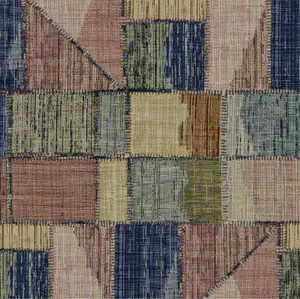
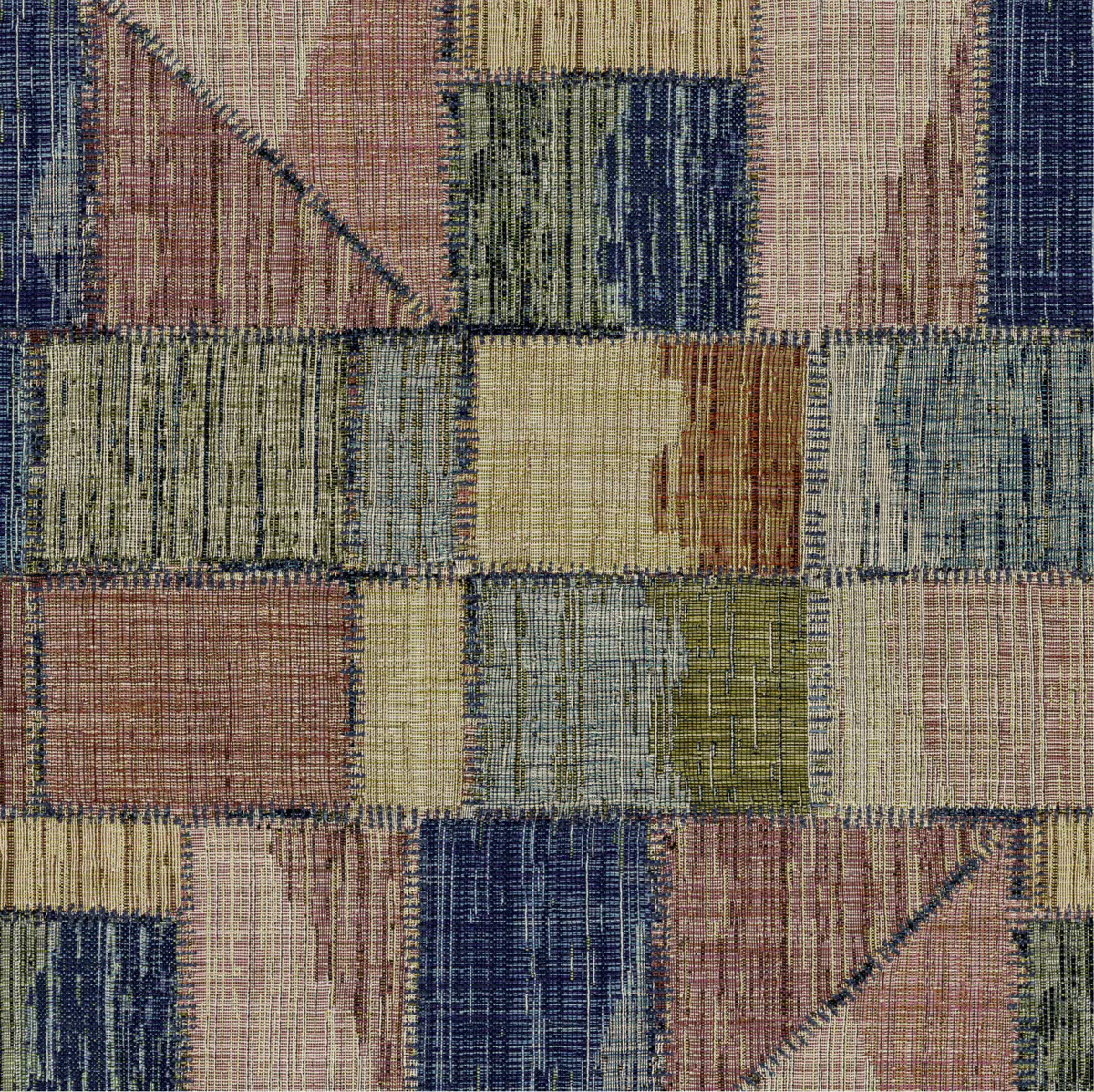
Street scale patchwork
Investigating Facade Damage will highlight where the repair needs to be undertaken.
It is creating an irregular pattern of repair that evolves.
Only intervene when necessary; this proposal will not ‘repair what does not need fixing’ as it appreciates there could be a negative effect on an already declining high street.
Repairs will be constructed with the materials grown on the street as part of the Macro-scale intervention.
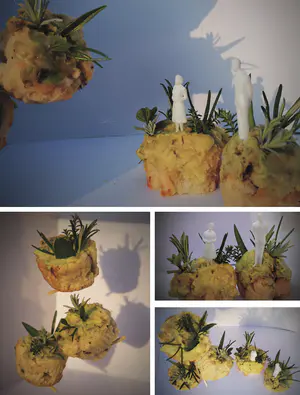
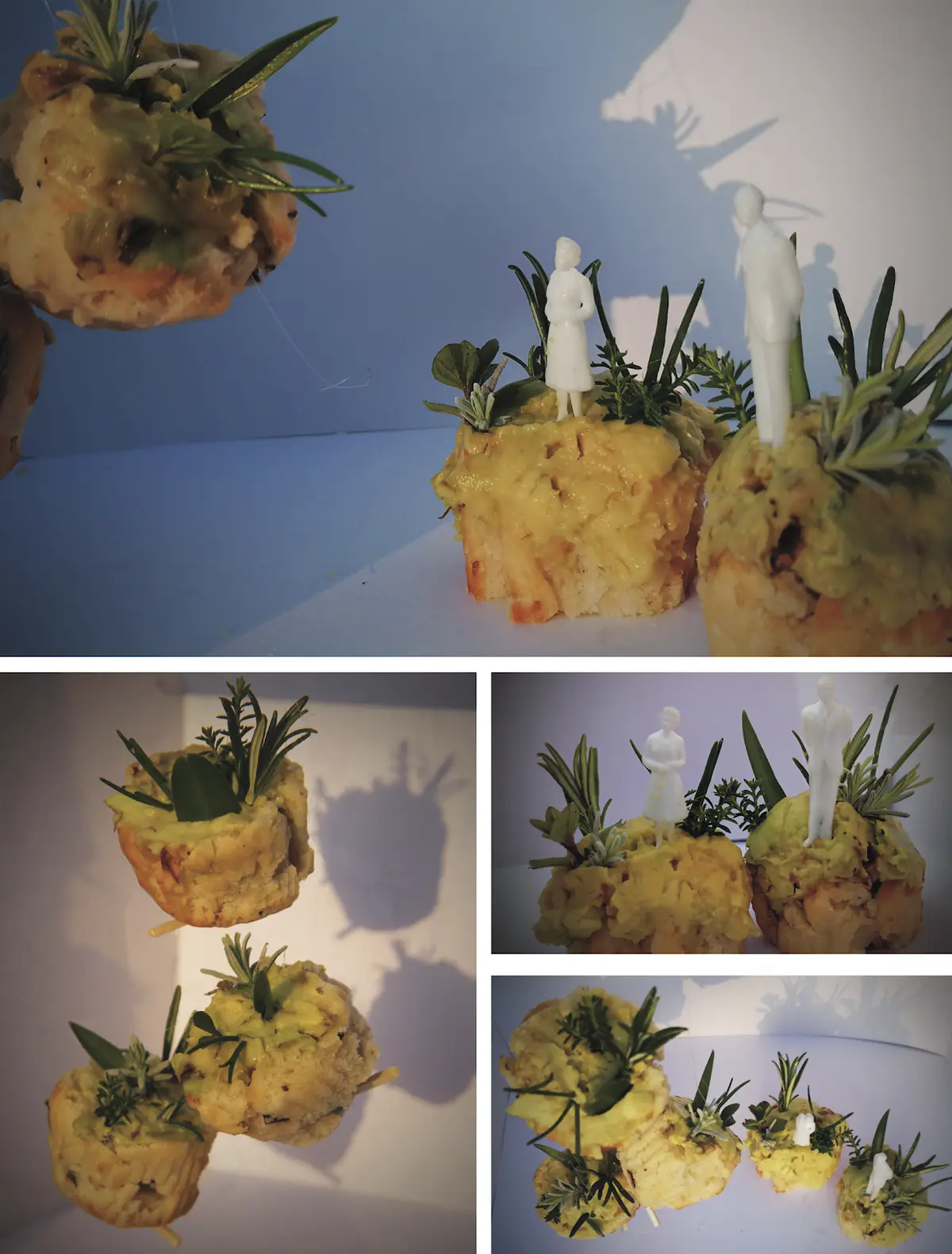
For Colab Dudley, I baked a model that ties into the final proposal. Food is a huge part of history and culture and part of Dudley’s history and culture is using what food there is available. Bread is cheap and easy to make, so is found in many traditional black country dishes. I foraged for edible plants in my garden and neighbourhood and built hanging baskets and islands to show in an abstract way how public space could be more productive and beautiful. They were a tasty treat and a sustainable model!
A sketch showing workshops utilising the empty spaces, street furniture, canopies on the side, and street art to brighten and liven the current High Street.
Water Collection
With this information I can begin to map out 1038m2 of miyawaki forests.
It is crucial that the forests do not use more water than stored as then the project isn’t zero carbon as it would require fresh water. It is important that the water collected is sufficient for this project to work. This data also provides the information to how much storage is required on the site.
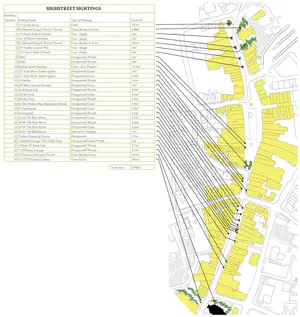
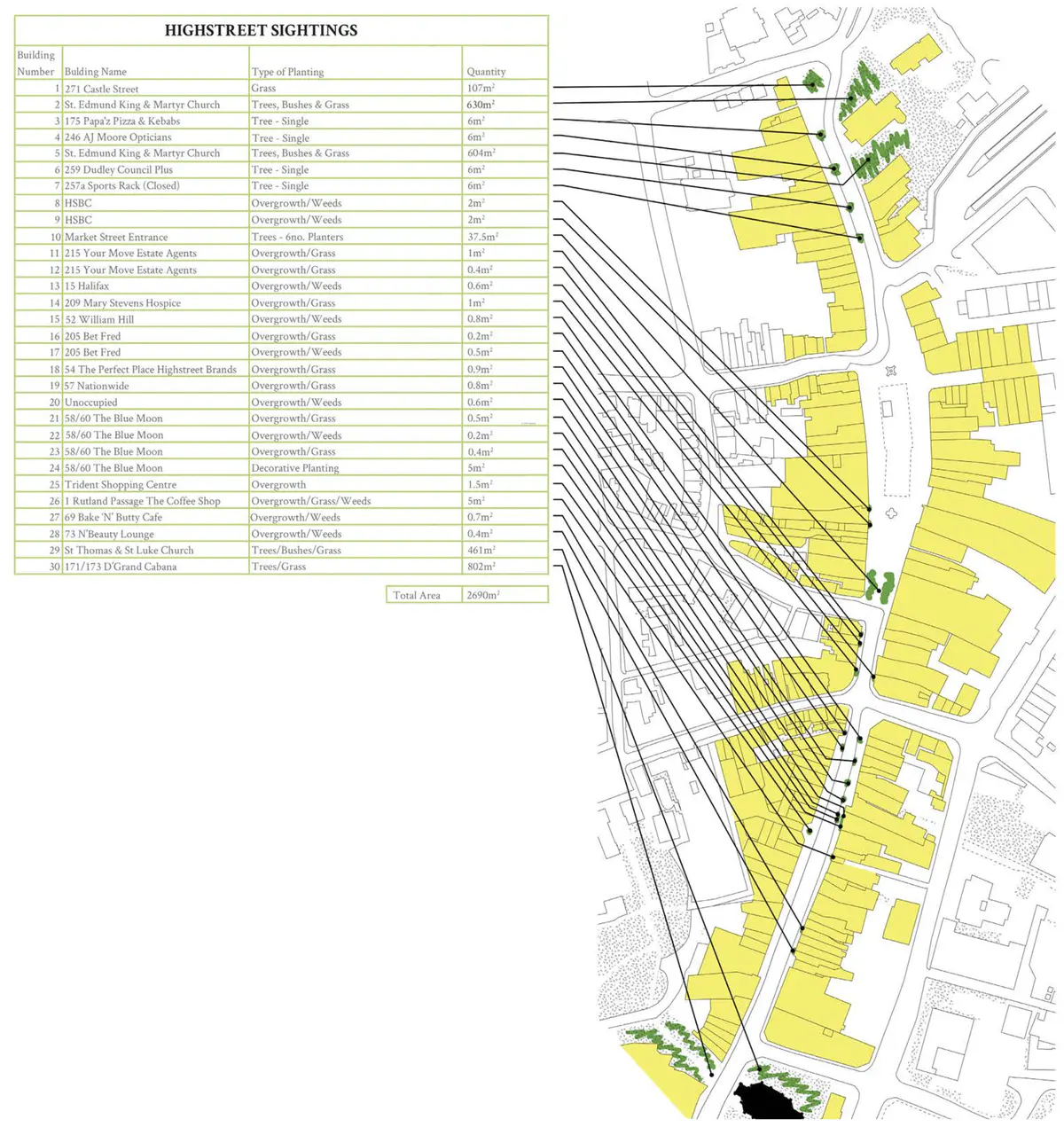
Street plant sightings
The charted planting is a selection of the current extent of the high street. As discovered, the area has little to no variance, with the exception of the more developed properties at either end of the high street. These properties generally have more trees and mature planting around them, making them more appreciative of the biodiversity.
Facing the high street, there is approximately 2690m2 of greenery, the majority of which is situated at either end, on the property of the two churches. Ignoring these numbers, the area of greenery drops significantly due to the limited overgrowth around lampposts, bins and along the store fronts.
For the wider biodiversity of the high street the select amount greenery provides very little benefit for nesting wildlife. Within the developed properties more thought and appreciation can be given to accommodate a more diverse spread of wildlife and planting. Along the high street there is little consideration for interactions with the wider biodiversity, a few trees (provided by the council) and strip of high level planting along a store front.
As for the rest of the ‘greenery’ along the high street, this could be seen more as neglect from the cleaning and maintenance of the street. The remaining biodiversity identified comes from areas that have retained water from lack of drainage and moisture retention. Seen around the street furniture, grass, weeds and moss can be seen growing along the gaps between paviers and along gutters. Despite being ‘greenery’ these areas provide no benefit to the biodiversity and are more of a sign that the council have no intention to improve the state of the area.
Within the developed quarters, the majority of the biodiversity is grassland, which too only has a limited positive environmental impact. The two churches provide an excellent coverage of their respective sights and can provide a good quality of air and absorption of CO2 due to the large number of trees and bushes . Whilst the grasslands are a welcoming sight, they play a very little roll in absorbing CO2 and to provide other positive environmental impacts that the larger greenery does.
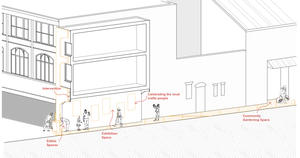
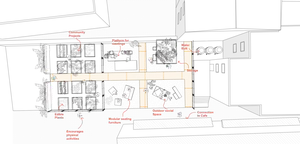
The main structure would have various spaces such as the Museum space, possibly a place that people can pin up local activities, and maybe rooms for either changing or for performance practice. As the street is 11m wide on average, there is plenty of space to have the building
fill the space. As the sunlight comes from mainly the south, the south side buildings often shadow the street entirely, which would mean that something being built (especially as it will be dug down a bit) would not shadow out the other buildings. The biggest hurdle to tackle is
that the space shouldn’t not feel overwhelming to the other shops or those who walk down the pavement. Because of this, most of the building’s structure would be in the underneath area, and only parts of it would pop out over the pavement. As the design would be flush
with the pavement, there are also opportunities to have crossing bridges that are both useful by the public, but also incorporated with the design of the new street.
The back of the street would create a unique space for social activities. The space is wide enough and long enough for a performance theatre space to be erected there, but it also has the possibility of having some kind of altered shape to the area, like a raised platform that could house
seating and other social activities. However, the space can also perfectly fit a fully regulated tennis court, badminton court, and volley ball court. People have mentioned that there is also a lack of sport engagement in the area, so this could be used to provide that kind of space.
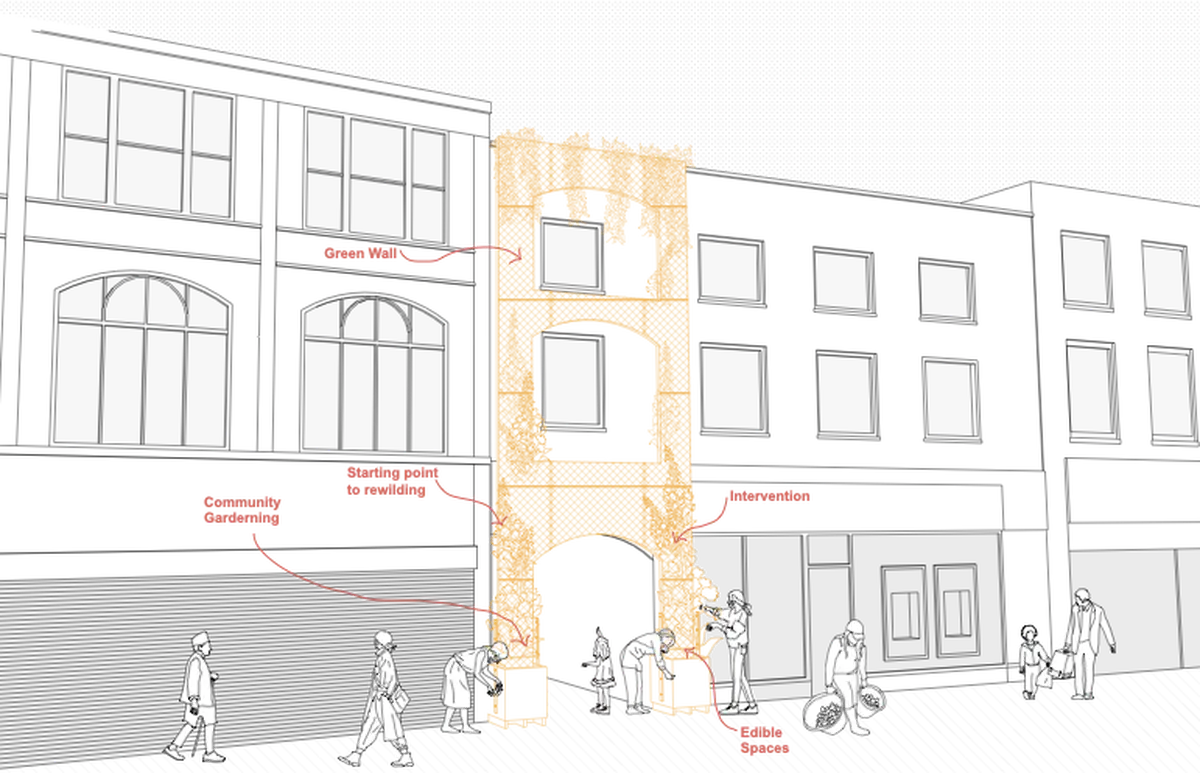
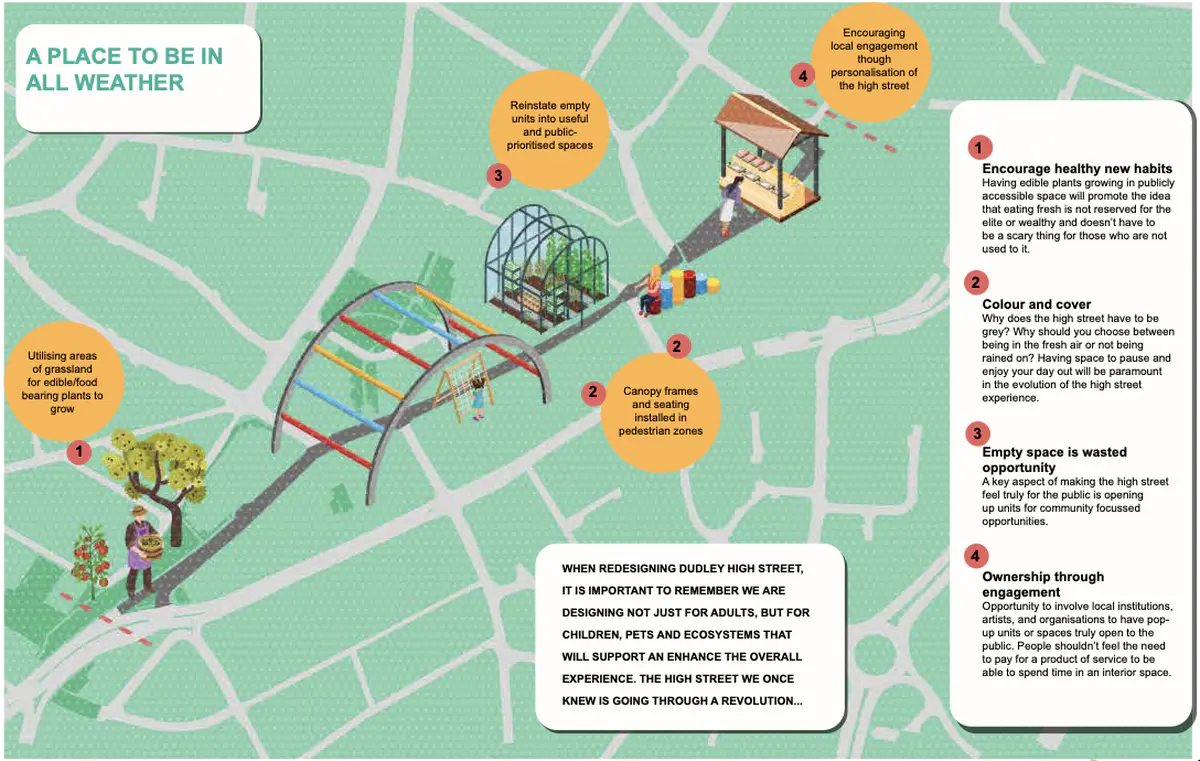
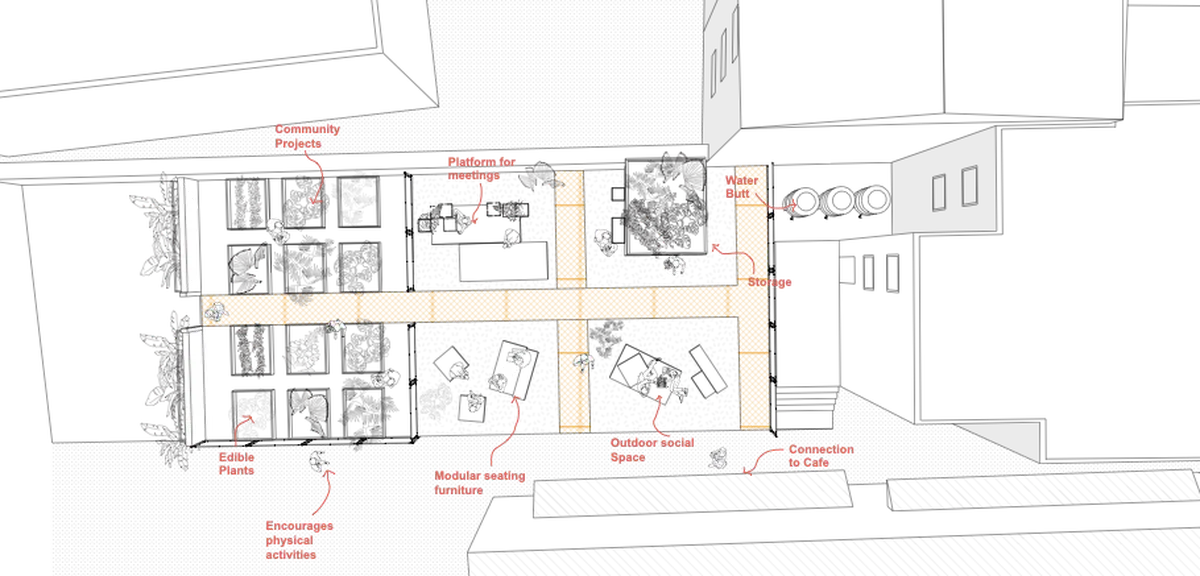
By placing a community garden in this space space you can learn how to plant food and it will lead to more edible spaces on the High Street that will then lead to the re-wilding of Dudley.
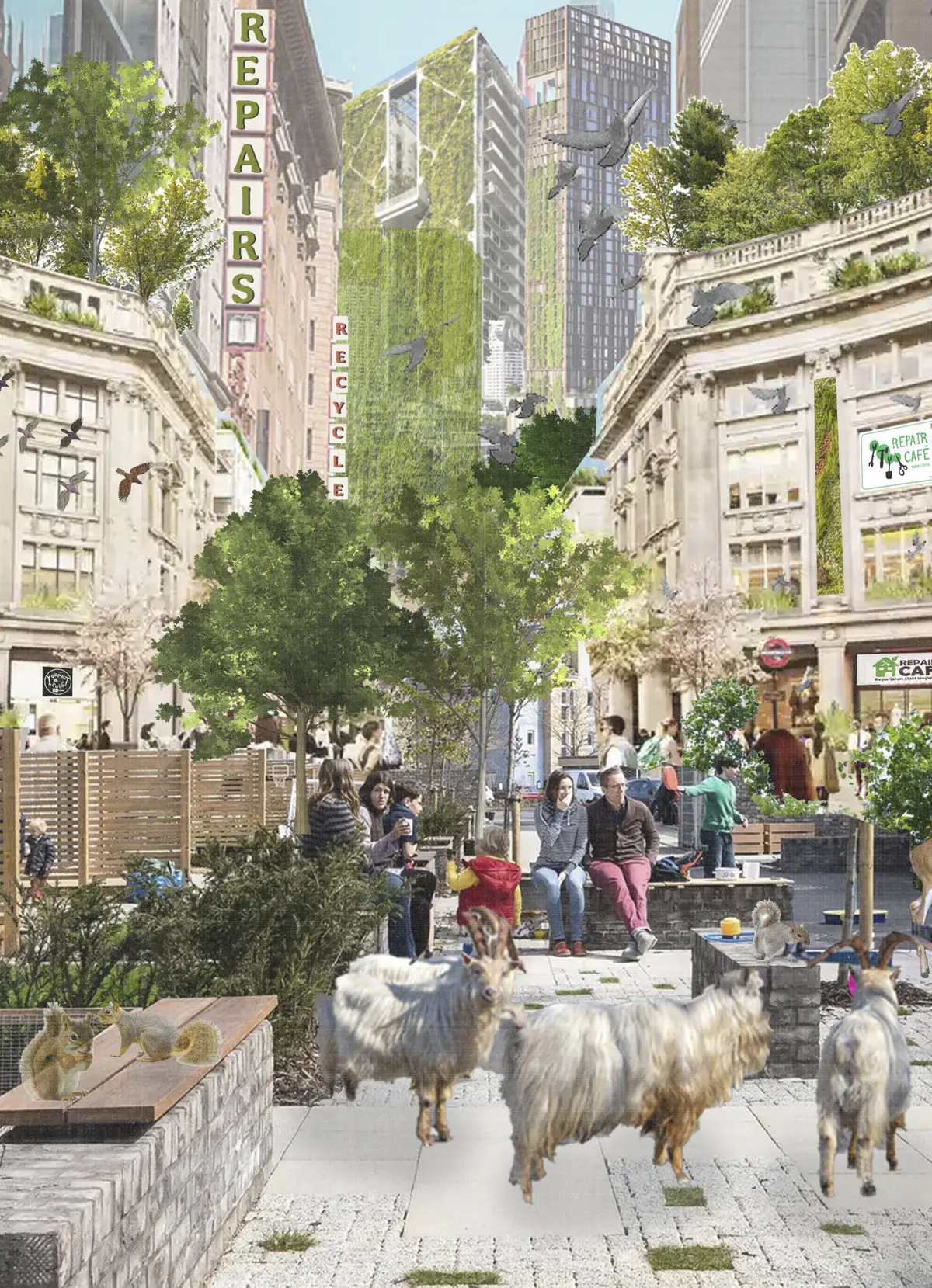
This visual represents Dudley High Street re-imagined; a new vision of a re-wilded, food-centric town centre. The green canopy will begin as a frame that will encourage the growth of plants. Smaller scale units will be integrated at the start and build towards the final vision.
Nurturing AgroEcology in Urban Life
A strategy for living alongside food production
A critical part of the climate crisis is the degradation of soil, leading to scientists predicting the UK has approximately 100 harvests left of stable crop production. As an attempt to address the problem this project will explore the possibility of integrating sustainable agriculture into an urban setting, reducing the strain on agricultural land, reducing food miles and widening city biodiversity. Taking guidance from the farming movement, ‘Agroecology,’ a climate conscious, wildlife supporting and community engaged closed loop system will be developed, combining traditional growing with technology driven techniques that will support each other to produce a diverse plate.
Dudley High Street will be the focal point, reinvented as a destination not just for the purchase and consumption of food but also its creation, driven by the needs and engagement of local people. Connecting the community to the food they eat.
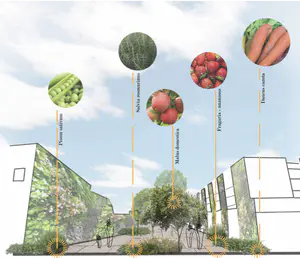
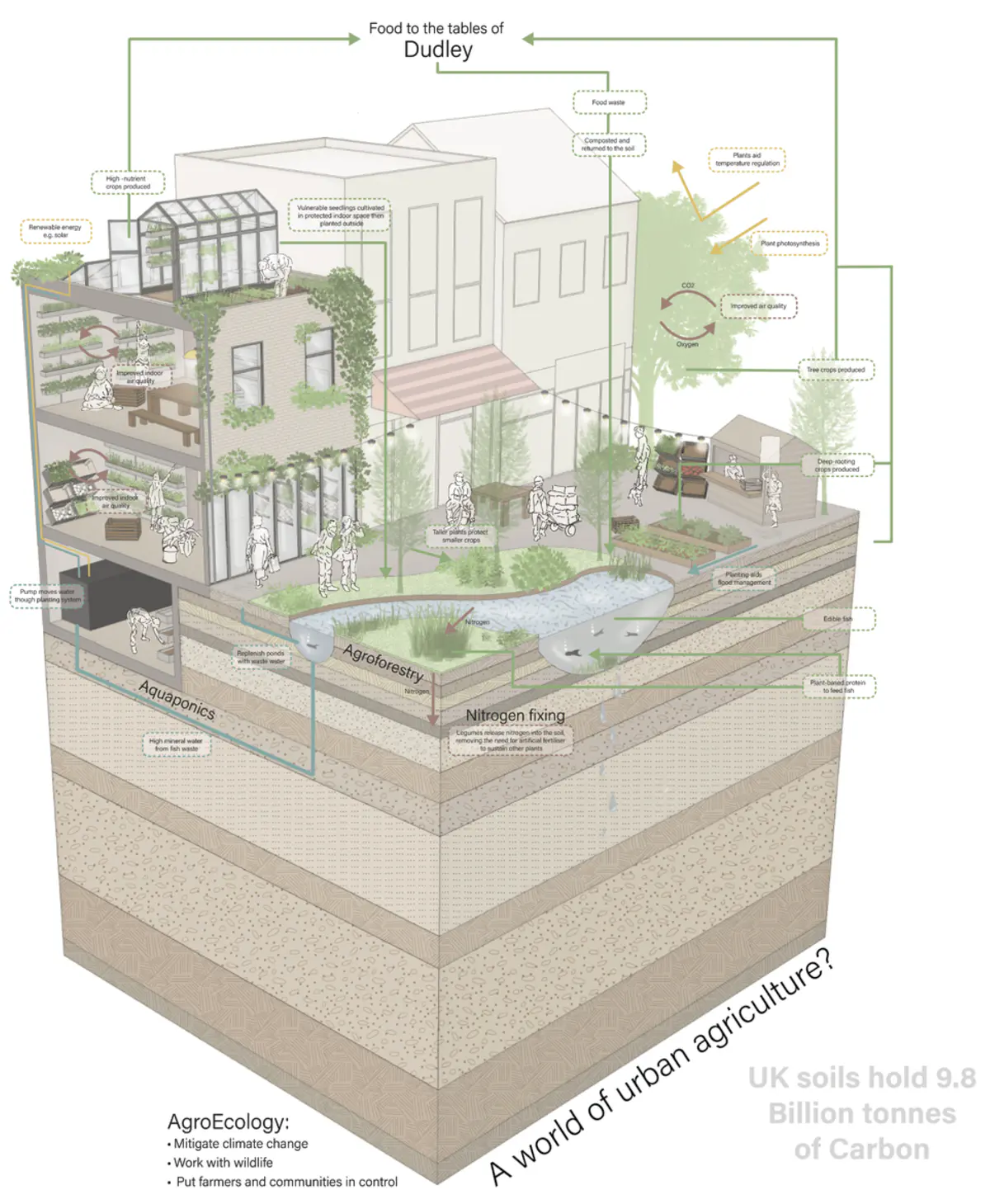
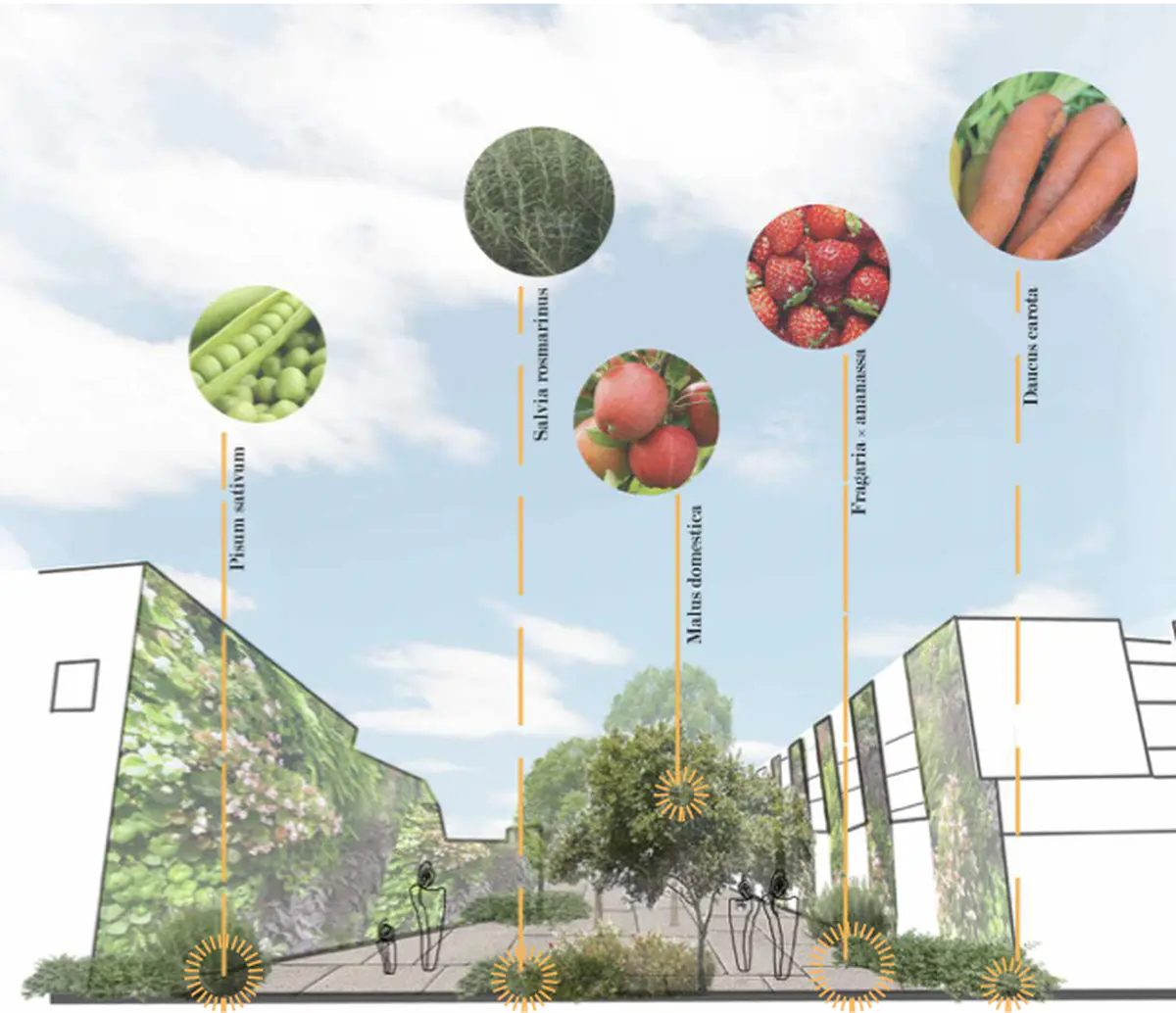
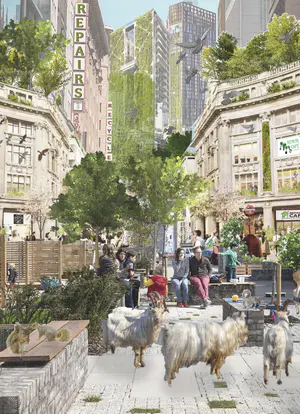
The image shows what this space could look like as a productive landscape. Where all the space is used. Vertical growing space can be utilised for pollinators for heights out of human range and for fruit and herbs in the lower regions that lie within our grasp. Trees can provide shelter, pollen and fruit, as can shrubs.
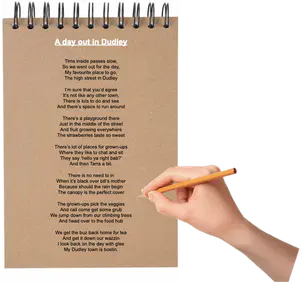
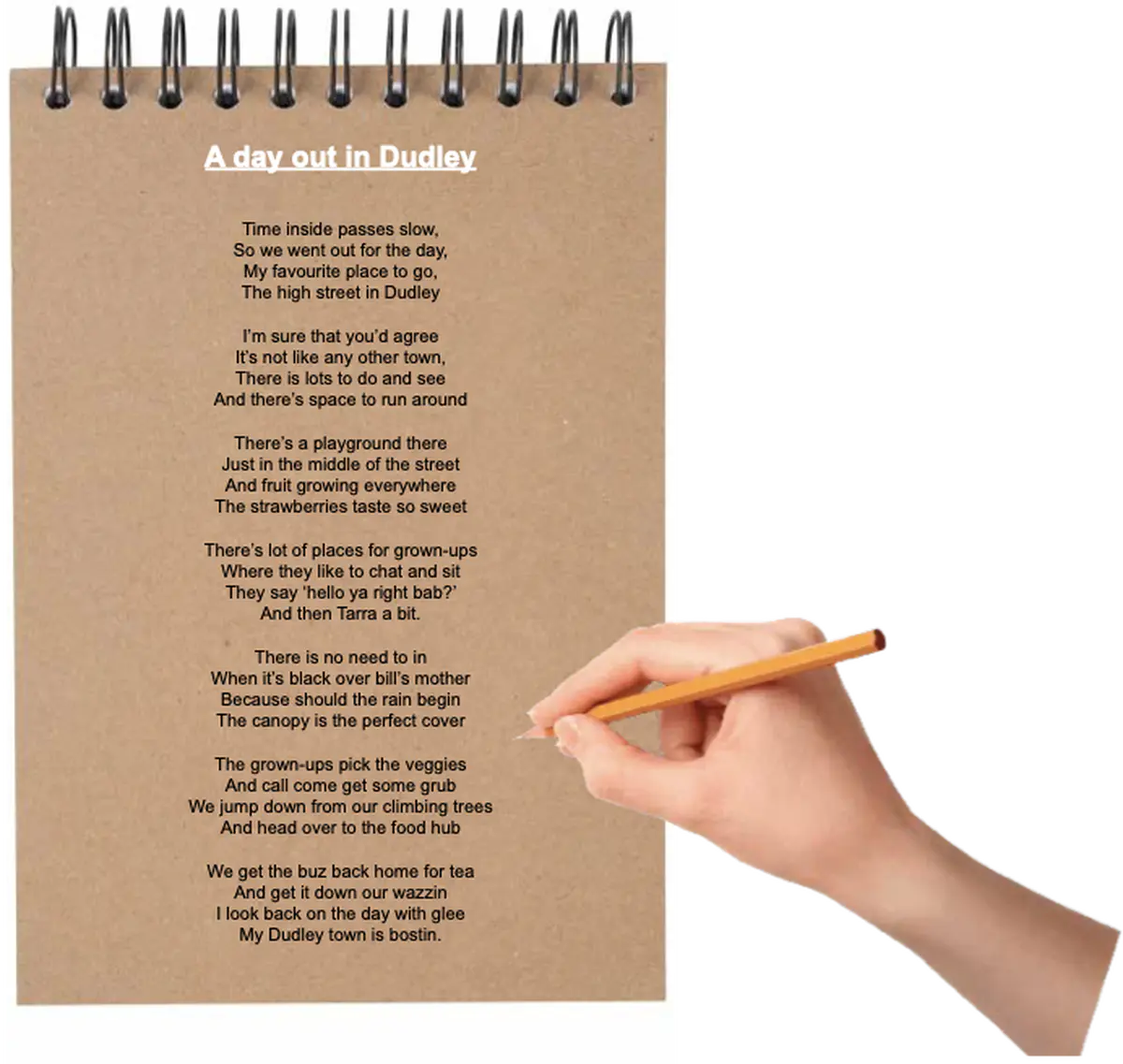
A day out in Dudley
Time inside passes slow,
So we went out for the day,
My favourite place to go,
The high street in Dudley
I'm sure that you'd agree
It's not like any other town,
There is lots to do and see
And there's space to run around
There's a playground there
Just in the middle of the street
And fruit growing everywhere
The strawberries taste so sweet
There's lots of places for grown-ups
Where they like to chat and sit
They say 'hello ya right bab?'
And then Tarra a bit.
There is no need to in
When it's black over bill's mother
Because should the rain begin
The canopy is the perfect cover
The grown-ups pick the veggies
And call come get some grub
We jump down from our climbing trees
And head over to the food hub
We get the buz back home for tea
And get it down our wazzin
I look back on the day with glee
My Dudley town is bostin.
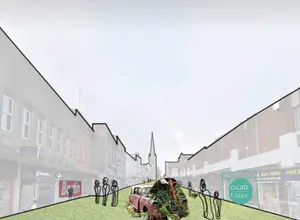
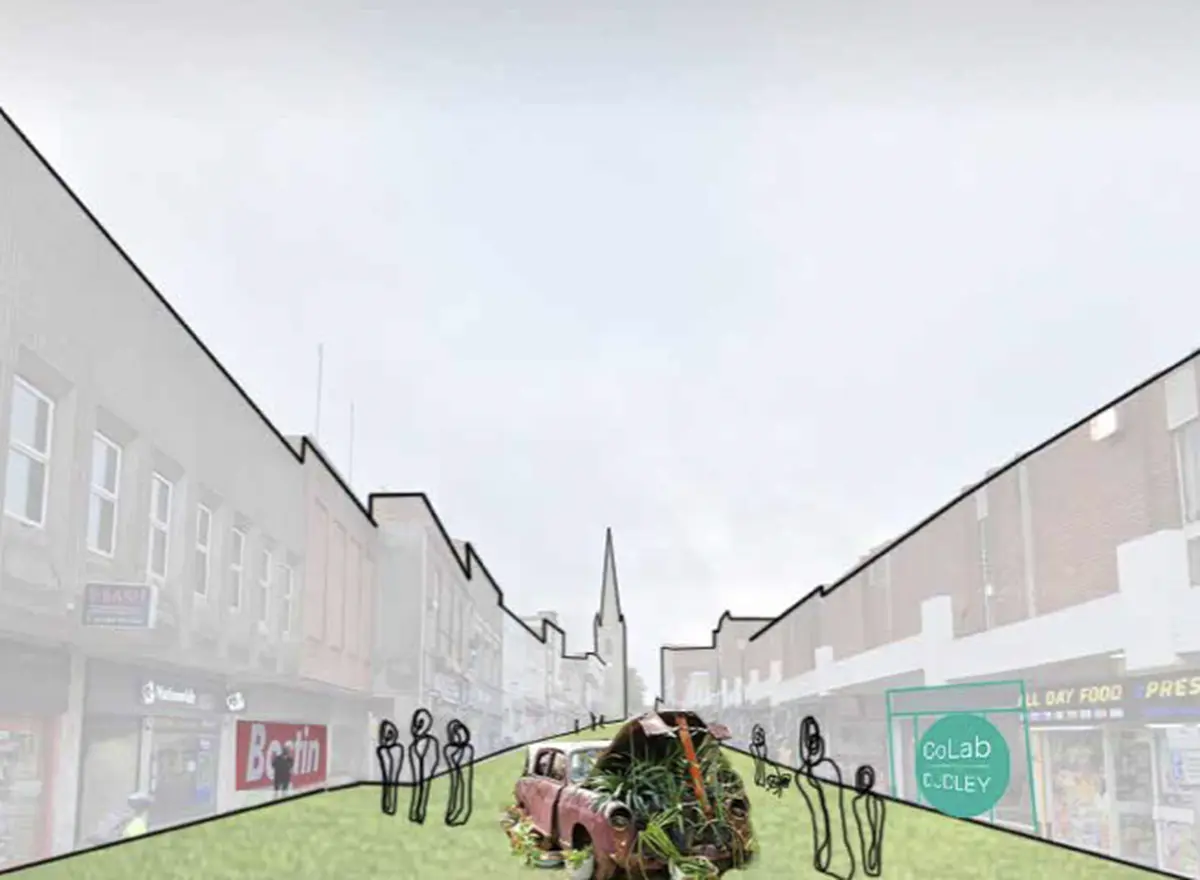
New use for cars — As part of pedestrianisation we would like to suggest a memorial of sorts to cars. The feature would sit in the middle of the High Street and would consist of an old out-of-use car, being used as a planter and being filled with plants. This gesture symbolises the movement of the High Street’s priorities shifting from the automobile to plants, people and food.
Localised Green Spaces
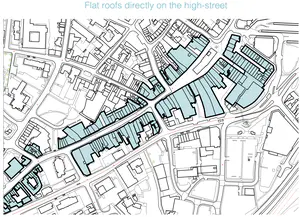
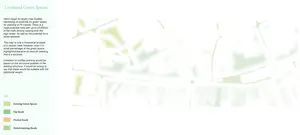
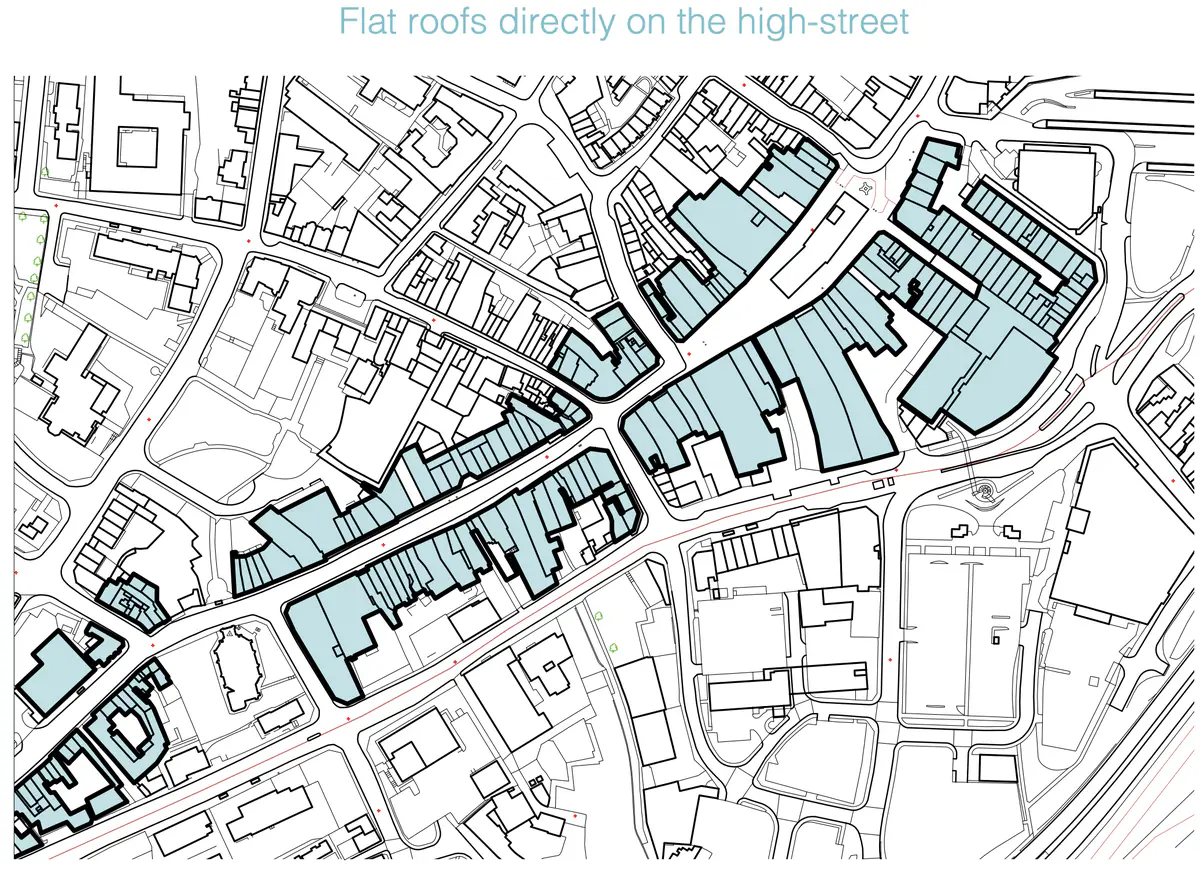
Here I begin to locally map Dudley, identifying its potential for green space for planting or PV panels. There is a huge potential here with up to 22,855m2 of flat roofs directly looking onto the high street. As well as the potential for a street takeover.
This map is only a theoretical analysis of a utopian idea; however, even if a small percentage of the green space highlighted became an area for planting, that is a success.
Limitation to rooftop planting would be based on the structural qualities of the existing structure. It would be wrong to say that these would be suitable with the additional weight.
Explore The History Of Site Voids - This will provide an opportunity to reimplement these to allow vertical green corridors to occur.
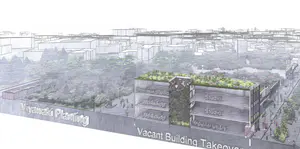
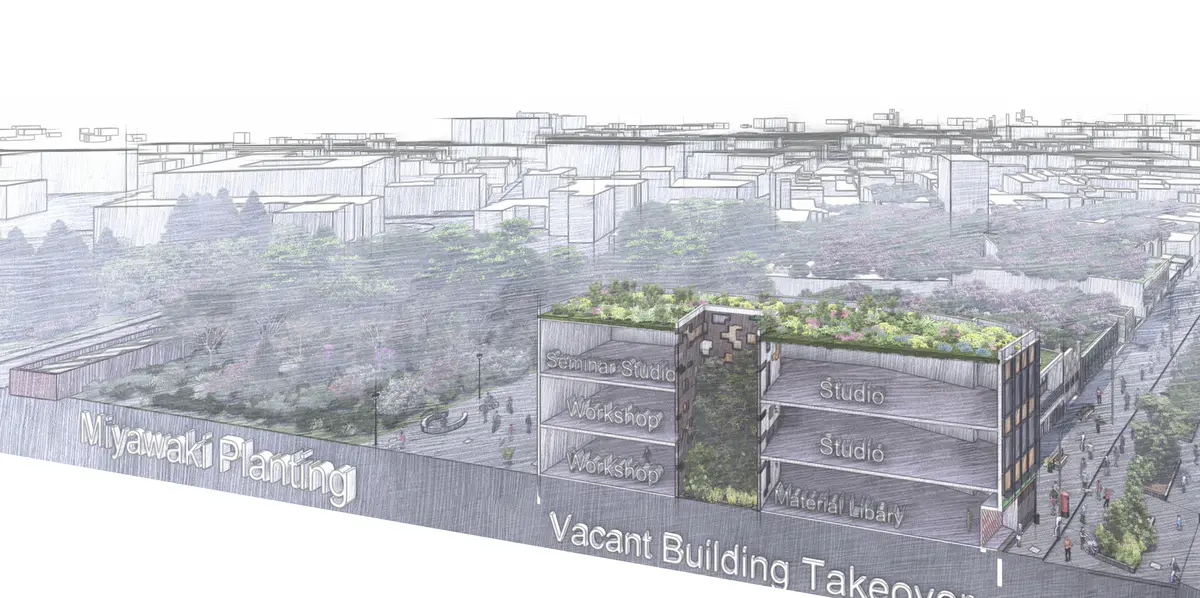
Explore Vacant Buildings - To avoid damaging an already deteriorating high street, I aim only to take over vacant plots.
Investigate the opportunity for Miyawaki planting - understand the conditions required to grow a sustainable material source on-site, including ground, water, and space conditions.
It takes over a building that leads directly to an open space where a community hub is the centre of the thesis, offering education, community engagement and material celebration.
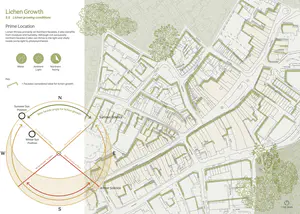
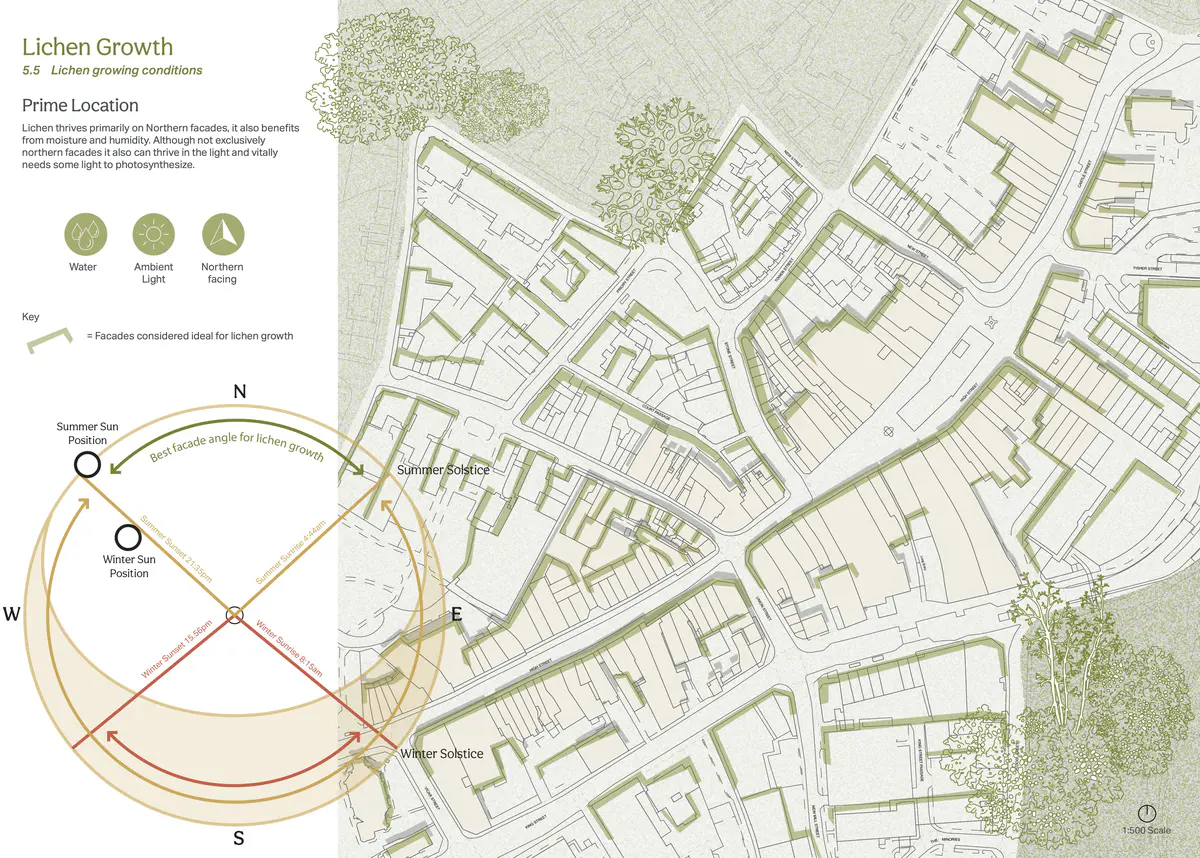
Lichen Growth
Lichen thrives primarily on Northern facades, it also benefits from moisture and humidity. Although not exclusively northern facades it also can thrive in the light and vitally needs some light to photosynthesize.
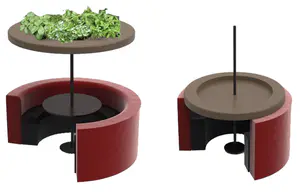
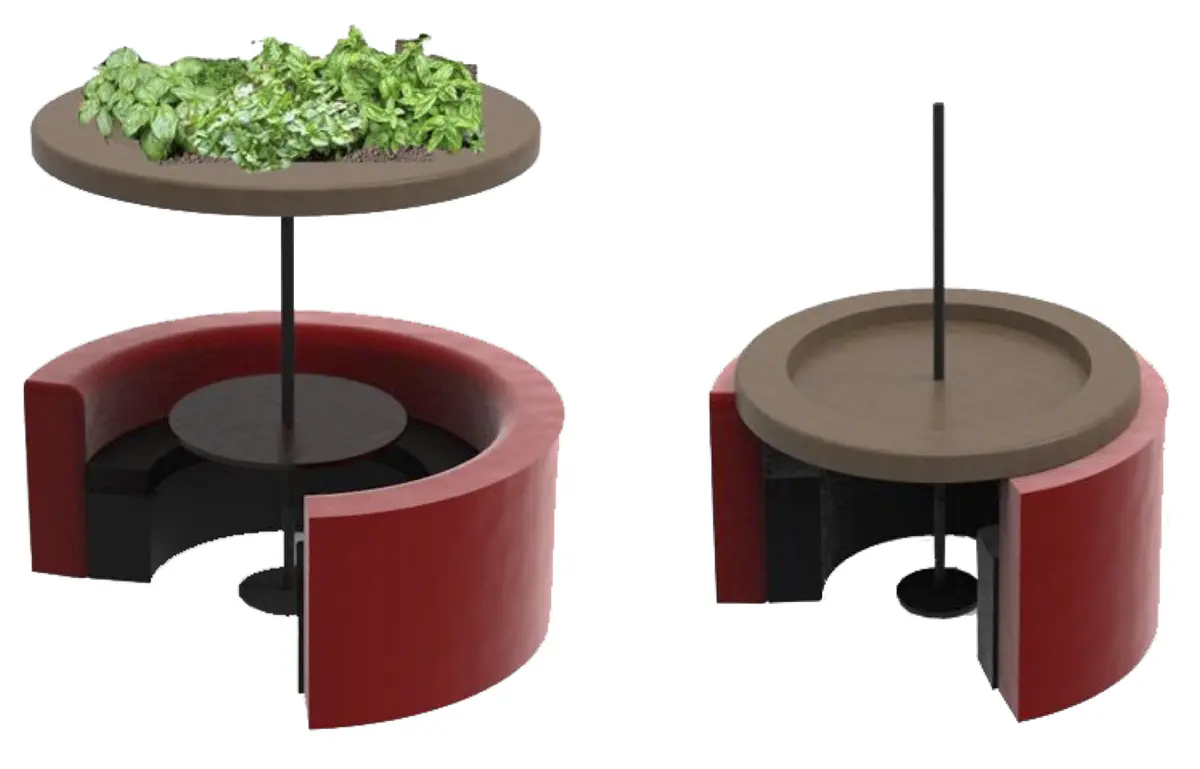
The fourth Stepping Stone project focused on the design of 2-in-1 flower pot seating for the exterior of the community kitchen. The design also integrates a canopy for growing herbs to also use in the kitchen. Through a collaboration with another Time Rebel collecting reusable waste, we thought about how this could be integrated into the materiality of this concept. The product analysis of this design is that it has a detachable seat to cater for a variety of arrangements. The flower pot can be raised to create a seating area, and lowered to be become a flower pot on the High Street.
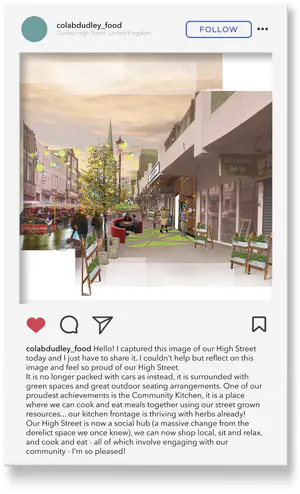
This post develops what the community kitchen has to offer with street grown resources and community engagement.
(We decided to present our narrative through social media and instagram posts as we wanted to showcase what individual experiences might be like when experiencing the future High Street. Each of our posts captures a different element of experience on the High Street to form a collective scenario.)
A More-Than-Human Story of Dudley High Street
This story is a collective outcome after utilising completed Street Detectorism maps, and More-Than-Human findings to create of 'A More-Than-Human Story of Dudley High Street'.
As part of a dissertation study, this workshop invited participants to share their imagination and develop stories from the previous findings on Dudley High Street. This story creatively archives nature on Dudley High Street, with emphasis for the value of storytelling and nature at the forefront of this task.
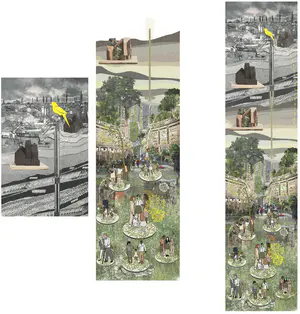
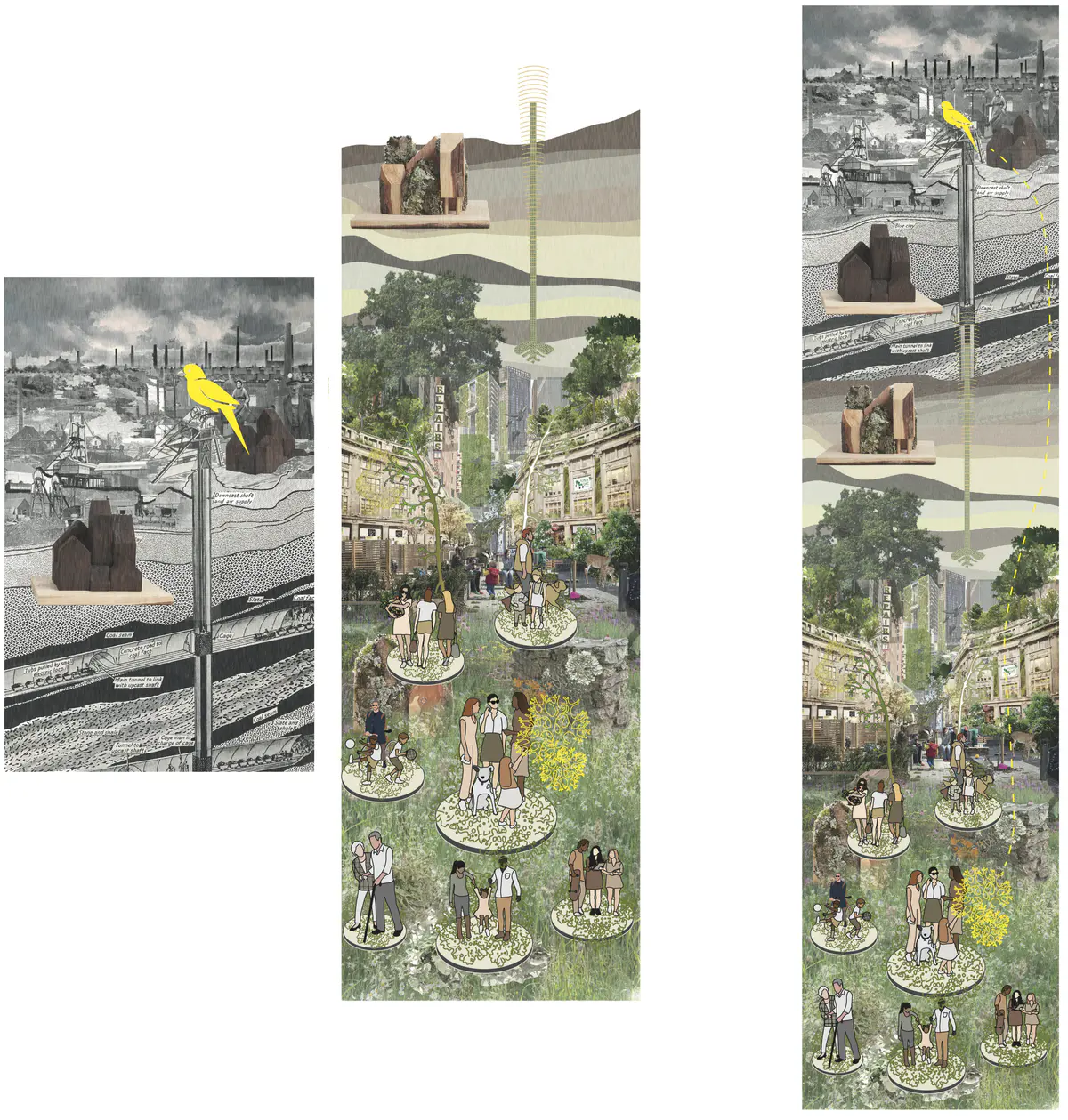
The yellow canary of the mines, a symbol of protection for miners spending time in highly polluted areas. The yellow lichen becomes the new symbol for Dudley, protecting inhabitants through carbon sequestration & clean air.
High Street Development
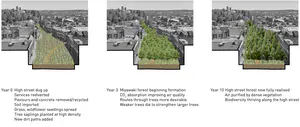
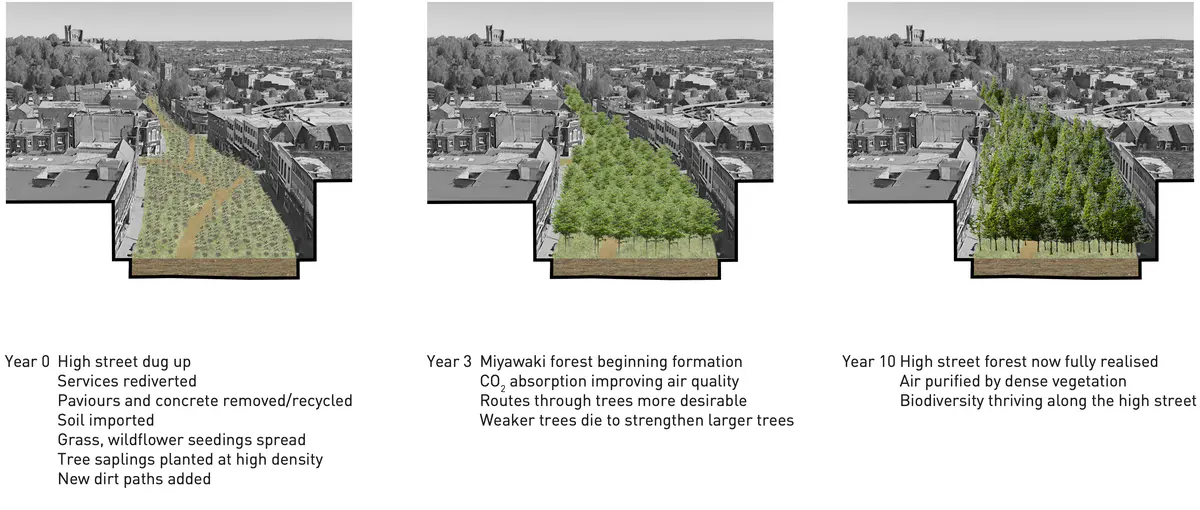
The following images represent the high street development over the next 10 years.
Green Corridor
The hard standing throughout the high street is quickly converting a field of seeding of wild grasses and wildflowers, in the mix is also a high density of tree saplings. These will then grow to become the high streets Miyawaki forest and the centre point of Dudley’s green corridor.
Vertical Farming
Initially one vertical farm would appear on the high street and as the idea of urban farming becomes more widely accepted more and more buildings will either be converted, extended or built as new farms.
Apartment Conversion
As the population increases and more people are predicted to live in built up towns and cities, apartment blocks will pop up in new environments. As for the high street this will become a desired place to live as there are already most common amenities ready to use. As more blocks are created they themselves will become semi self sustaining.
Atifa lives nearby. During her free time, Atifa takes part in social work and welcomes the visitors of the High Street. Her main responsibility involves managing the food produced on street garden. A group of out of town visitors seemed lost on the street as they were wondering about what to do after shopping. Atifa suggested to participate in a workshop in the community kitchen. They plucked some berries and veggies from street and made a quick salad with a locally developed recipe that they had never tried. They thanked Atifa for the new recipe.
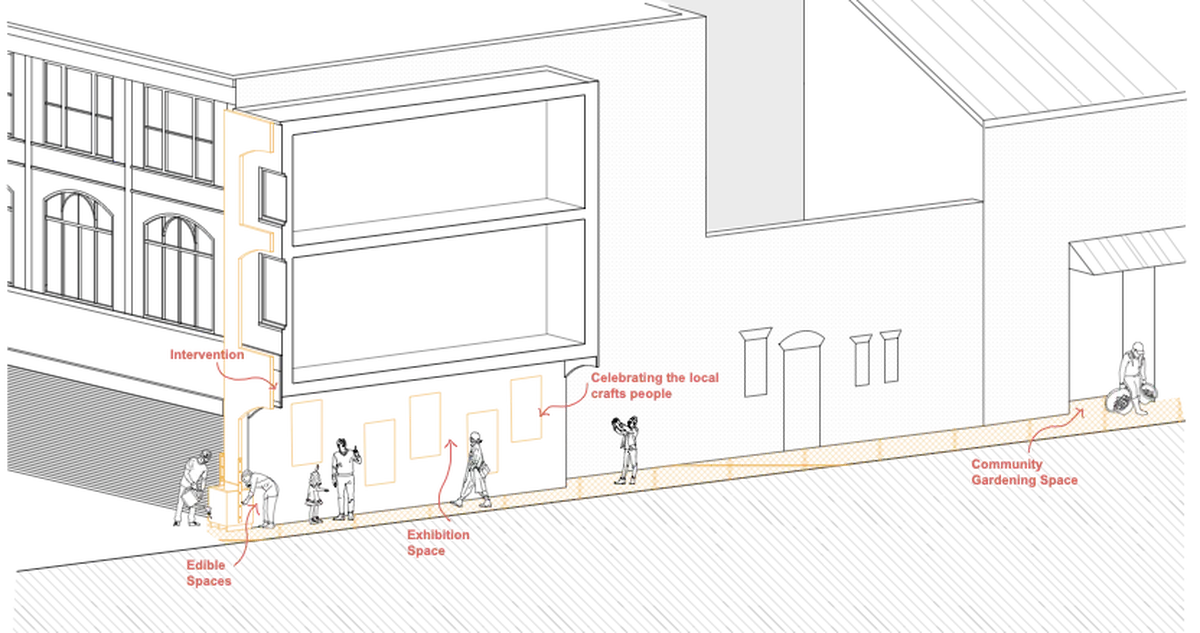
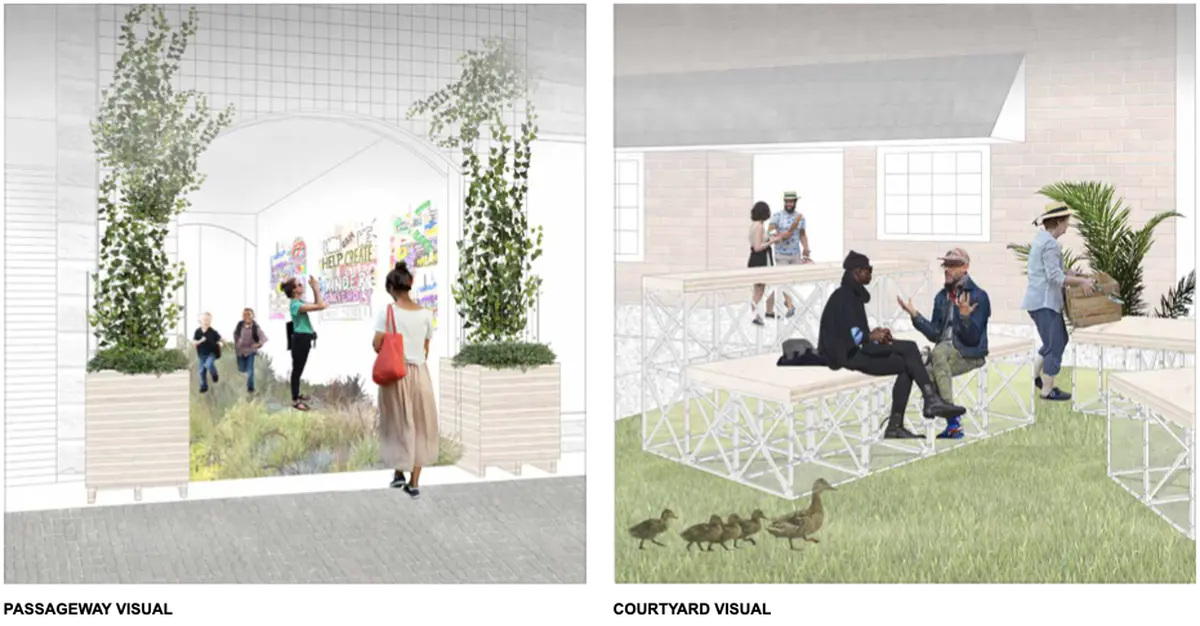
By utilising the passageway to display exhibition work from local institutions it would not only encourage them to create their crafts, it will celebrate their work and the range of crafts that Dudley has.
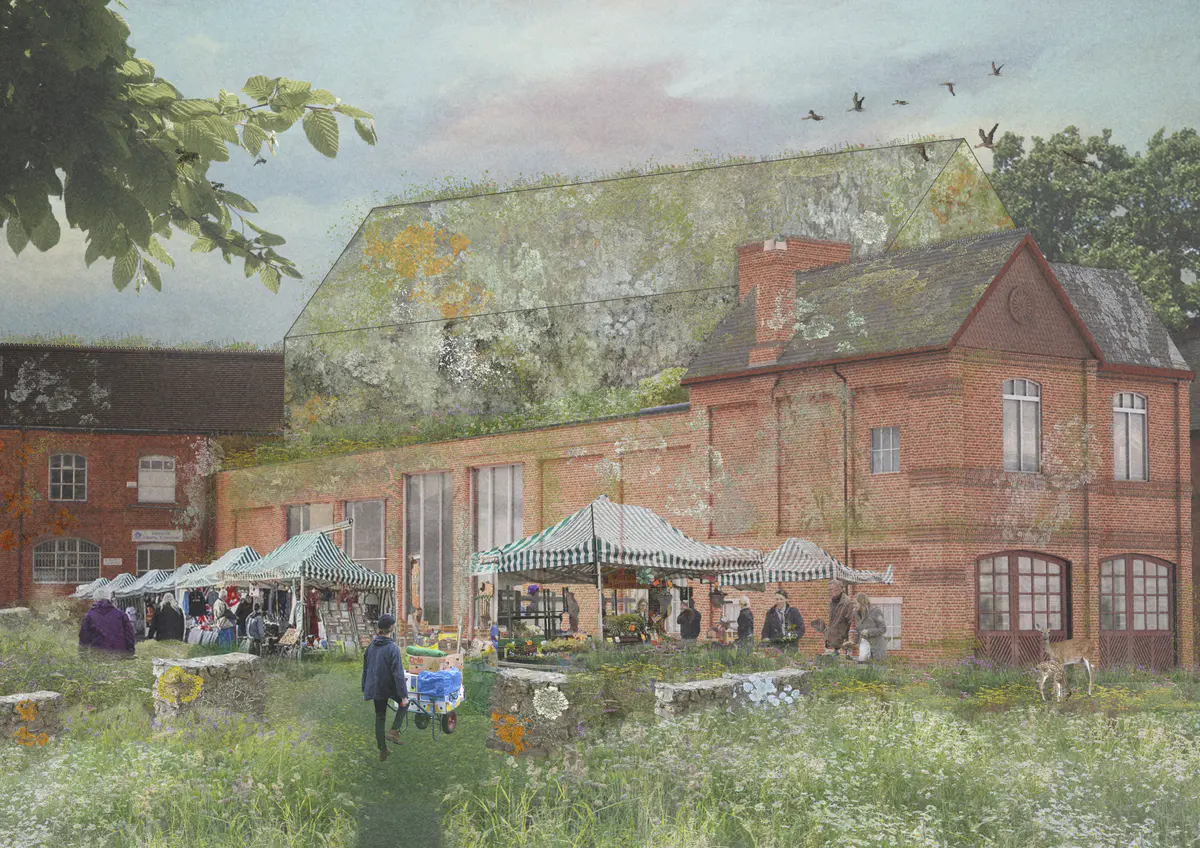
This visual represents the vision for the thesis, buildings covered in lichens, air purifying plants and community activities held on the Highstreet. This visual focuses in on the proposed site for the building and shows expression of a raised new build component on site as well as a full and wild landscaping plan.
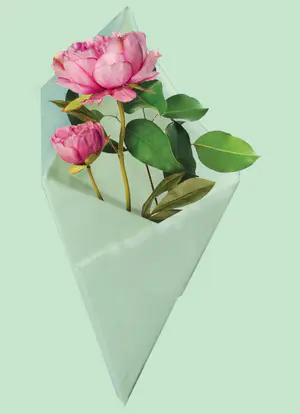
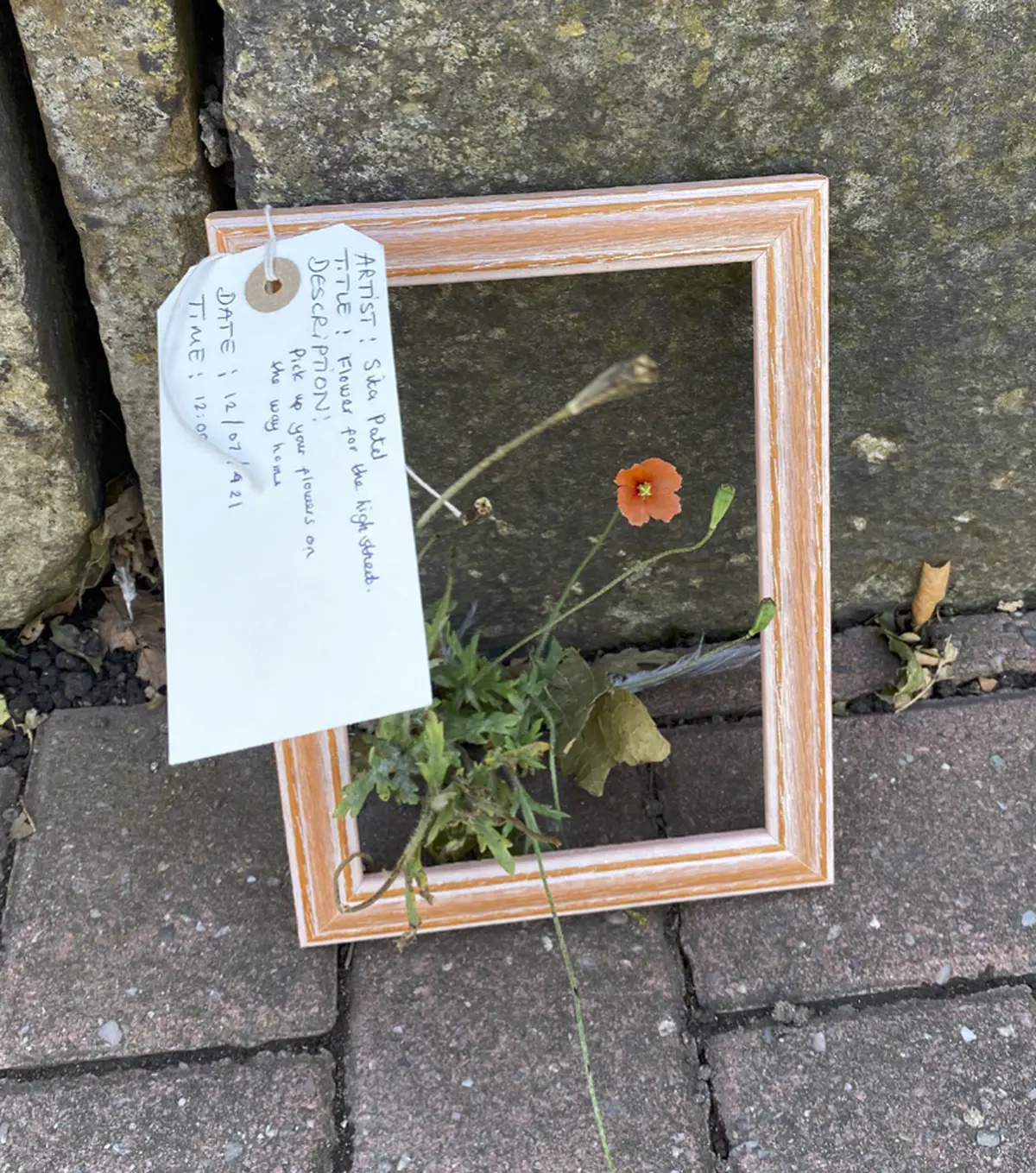
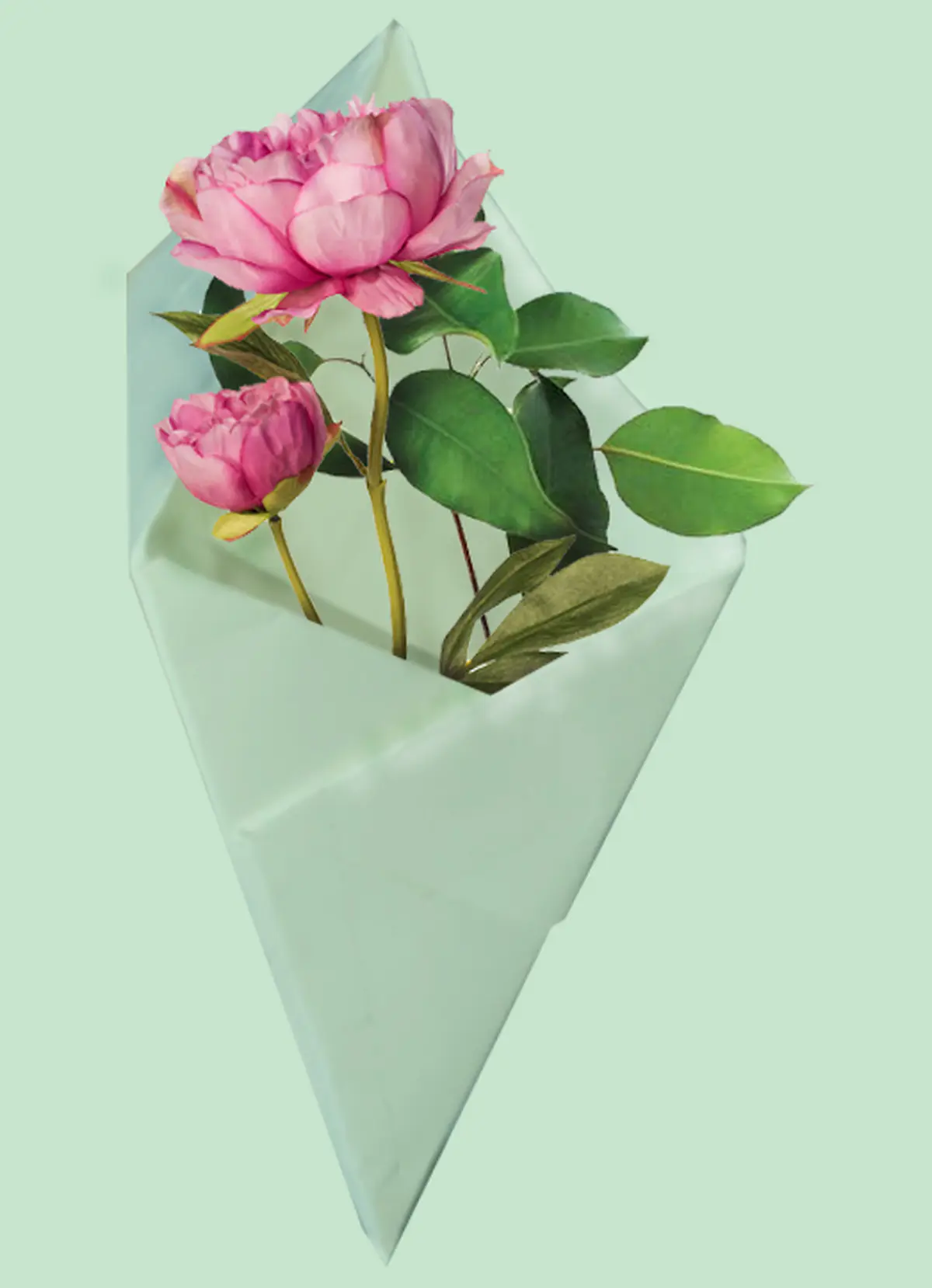
From the research that I collated, I found that the High Street was a very under-valued place that lacked both colour and nature. Therefore, the origami plant holder was a gift designed to bring natural elements such as flowers to the High Street, which could be taken home by the public.